🎉NEWCapSolver for AI agents-MCP, agent tools, and SDK integrations

Nikolai Smirnov
Software Development Lead
Published Jun 26, 2026
Updated Jun 24, 2026 · min read
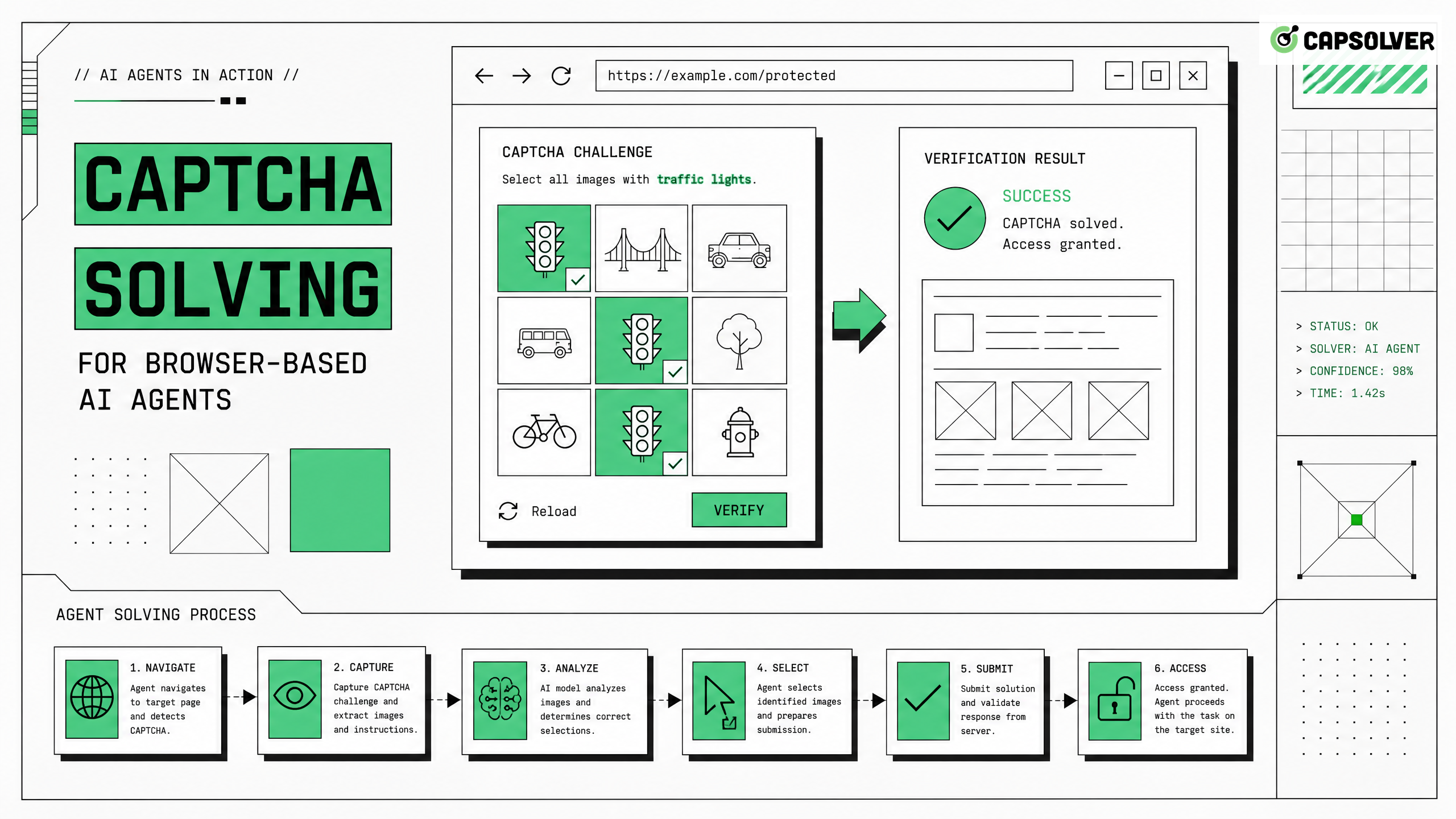
The rapid advancement of automated systems has made CAPTCHA solving for browser-based AI agents a critical component of modern web operations. As these agents navigate complex digital environments, they frequently encounter sophisticated traffic validation mechanisms designed to distinguish human users from automated scripts. Addressing these challenges requires a comprehensive understanding of both the underlying technology and the ethical considerations involved. By implementing robust infrastructure, organizations can ensure their automated workflows remain efficient and compliant. For those seeking a reliable solution, CapSolver offers advanced capabilities tailored for modern AI agents.
Browser-based AI agents are transforming how organizations approach web automation. These systems are capable of executing complex tasks, from data extraction to routine testing, with remarkable precision. However, their effectiveness is often hindered by security measures such as CAPTCHAs. Understanding what is an AI agent and how does it work is the first step in developing strategies to manage these obstacles. By using advanced machine learning models, these agents can simulate human-like interactions, making them invaluable for modern digital operations.
When deploying these agents, it is crucial to establish a solid web automation infrastructure stack for AI agents. This stack typically includes headless browsers, proxy management, and CAPTCHA solving capabilities. Ensuring that each component functions harmoniously is essential for maintaining high success rates and minimizing downtime. Furthermore, organizations must prioritize responsible use, ensuring that their automated activities comply with relevant terms of service and legal requirements.
One of the primary hurdles for browser-based AI agents is navigating traffic validation challenges. Websites employ various techniques to detect and block automated traffic, ranging from simple image recognition tasks to complex behavioral analysis. According to Cloudflare's bot management documentation, modern bot detection systems analyze over 150 signals per request, including mouse movement patterns, keystroke dynamics, and JavaScript execution fingerprints.
To effectively manage these challenges, developers must integrate a reliable CAPTCHA solving API for autonomous agents. This integration allows agents to programmatically resolve CAPTCHAs, ensuring uninterrupted operation. The most common CAPTCHA types encountered by browser-based AI agents include reCAPTCHA v2 and v3, hCaptcha, Cloudflare Turnstile, and AWS WAF challenges. Each type requires a different solving approach, and a well-designed CAPTCHA solving infrastructure must support all of them simultaneously.
The latency of CAPTCHA solving directly impacts agent throughput. A browser-based AI agent that encounters a 10-second solving delay on every page load will complete only a fraction of its intended tasks. Production-grade systems require solving times under 5 seconds for image-based challenges and under 2 seconds for token-based challenges. This performance requirement makes dedicated CAPTCHA solving for browser-based AI agents a non-negotiable component of any serious automation stack.
Redeem Your CapSolver Bonus Code
Boost your automation budget instantly!
Use bonus code CAP26 when topping up your CapSolver account to get an extra 5% bonus on every recharge — with no limits.
Redeem it now in your CapSolver Dashboard
Understanding what is headless browser detection and how to avoid it is also critical. Many security systems specifically target headless browsers, identifying them through subtle differences in execution environments. By employing techniques such as fingerprint spoofing and behavioral mimicry, developers can reduce the likelihood of detection. Additionally, utilizing a headless browser configured to mimic human behavior can significantly improve the success rate of automated tasks.
Developing a robust bot protection infrastructure for AI agents is essential for organizations relying on automated web interactions. This infrastructure must be capable of adapting to evolving security measures while maintaining high performance. Key components include dynamic proxy rotation, intelligent request throttling, and advanced CAPTCHA solving capabilities. By implementing these features, organizations can ensure their agents operate efficiently and securely.
A well-architected infrastructure for CAPTCHA solving for browser-based AI agents typically follows a three-layer design. The first layer handles browser orchestration, managing multiple headless browser instances with proper fingerprinting. The second layer manages network routing through residential and datacenter proxies. The third layer provides CAPTCHA solving as a service, accepting challenge parameters and returning valid tokens. This separation of concerns allows each layer to scale independently based on demand.
Session management is another critical factor. Browser-based AI agents must maintain cookies, local storage, and session state across multiple page navigations. When a CAPTCHA challenge appears mid-session, the solving process must preserve the existing session context. Failure to do so results in infinite redirect loops or repeated challenges. According to MDN Web Docs on HTTP cookies, proper cookie handling requires attention to domain scope, path restrictions, and SameSite attributes.
When evaluating solutions, it is important to consider the best CAPTCHA API for AI agents in 2026. The ideal API should offer high accuracy, low latency, and support for a wide range of CAPTCHA types. Furthermore, it should provide comprehensive documentation and robust support to facilitate integration. Organizations must also consider the ethical implications of their automated activities, ensuring they adhere to responsible use guidelines and respect the privacy of individuals.
Choosing the right CAPTCHA solver is a critical decision for any organization deploying browser-based AI agents. The evaluation process should consider factors such as accuracy, speed, and integration capabilities. A comprehensive guide on choosing a CAPTCHA solver for agent infrastructure 2026 can provide valuable insights into the selection process. By carefully assessing these factors, organizations can identify a solution that meets their specific needs.
For those seeking a reliable and efficient solution, a CapSolver agent ready CAPTCHA solver offers advanced capabilities tailored for modern AI agents. This solution provides high accuracy and low latency, ensuring that automated workflows remain uninterrupted. Additionally, it supports a wide range of CAPTCHA types, making it a versatile choice for various applications. By integrating a robust CAPTCHA solver, organizations can significantly improve the performance and reliability of their automated systems.
The field of agentic browser automation is rapidly evolving, driven by advancements in machine learning and artificial intelligence. As these technologies continue to mature, we can expect to see even more sophisticated AI agents capable of executing complex tasks with unprecedented precision. Exploring inside the agentic browser automation layer reveals the intricate mechanisms that power these systems. From advanced behavioral mimicry to intelligent decision-making, these agents are poised to revolutionize how organizations approach web automation.
As the capabilities of AI agents expand, so too will the challenges associated with traffic validation. Organizations must remain vigilant, continuously updating their infrastructure to address emerging threats. By staying informed about the latest developments in CAPTCHA solving infrastructure for AI agents, organizations can ensure their automated systems remain effective and secure. Furthermore, fostering a culture of responsible use will be essential for maintaining trust and compliance in an increasingly automated world.
The following table compares different approaches to CAPTCHA solving for browser-based AI agents across key performance dimensions.
| Feature | Traditional Solvers | Advanced AI Solvers | Hybrid Approach |
|---|---|---|---|
| Accuracy | 70-85% | 95-99% | 90-97% |
| Average Latency | 15-30s | 2-8s | 5-12s |
| Integration Complexity | High (custom code) | Low (REST API) | Medium |
| Support for New CAPTCHAs | Limited, manual updates | Comprehensive, auto-adapting | Partial |
| Behavioral Mimicry | None | Advanced fingerprinting | Basic |
| Scalability | Poor (human workers) | Excellent (cloud-native) | Moderate |
| Cost per 1000 Solves | $2-5 | $0.5-2 | $1-3 |
As shown in the table, advanced AI-powered solvers provide the best combination of accuracy, speed, and cost-effectiveness for CAPTCHA solving for browser-based AI agents. Organizations running high-volume automation workflows should prioritize solutions that offer sub-5-second latency and support for emerging challenge types such as Cloudflare Turnstile and AWS WAF CAPTCHA.
The integration of robust CAPTCHA solving capabilities is essential for the success of browser-based AI agents. By understanding the challenges associated with traffic validation and implementing effective solutions, organizations can ensure their automated workflows remain efficient and secure. As the field of agentic browser automation continues to evolve, staying informed about the latest developments and best practices will be crucial. For organizations seeking a reliable and advanced solution, CapSolver provides the tools necessary to navigate the complexities of modern web automation.
Browser-based AI agents frequently encounter traffic validation mechanisms designed to distinguish human users from automated scripts. These challenges include complex image recognition tasks and behavioral analysis, which can hinder the execution of automated workflows.
Organizations can improve the success rate of their automated tasks by implementing robust infrastructure, including dynamic proxy rotation, intelligent request throttling, and advanced CAPTCHA solving capabilities. Additionally, employing techniques such as fingerprint spoofing and behavioral mimicry can reduce the likelihood of detection.
Responsible use is important in web automation to ensure compliance with relevant terms of service and legal requirements. Organizations must respect the privacy of individuals and avoid accessing private, restricted, sensitive, or unauthorized data without permission.
When evaluating a CAPTCHA solver, organizations should consider factors such as accuracy, speed, integration capabilities, and support for a wide range of CAPTCHA types. Additionally, comprehensive documentation and robust support are essential for facilitating integration.
Advanced behavioral mimicry benefits AI agents by allowing them to simulate human-like interactions, making it more difficult for security systems to detect them as automated scripts. This capability significantly improves the success rate of automated tasks and ensures continuous operation.
Nikolai Smirnov
Software Development Lead
Building dependable software for complex automation.
ABOUT THE AUTHOR
Estimate CAPTCHA solving costs in Browser Use by separating agent runs, challenge types, billable solves, retries, and verified outcomes from browser costs.

Set up CapSolver MCP in Claude Code, check the available CAPTCHA tools, and choose token or page solving for a supported, authorized browser task.