🎉NEWCapSolver for AI agents-MCP, agent tools, and SDK integrations

Emma Foster
Machine Learning Engineer
Published Jun 26, 2026
Updated Jun 24, 2026 · min read
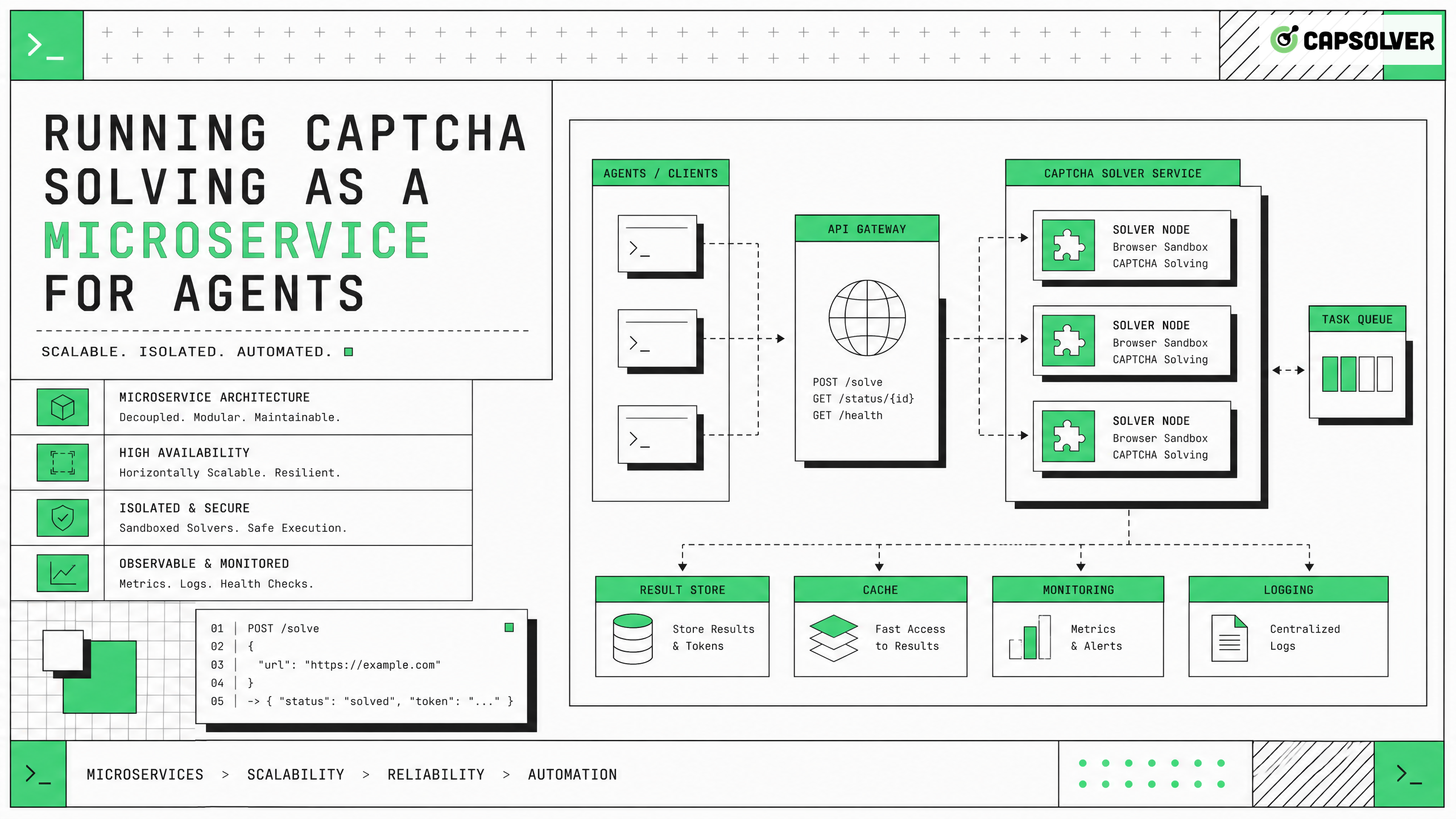
Building robust AI agents requires a structured approach to handling traffic validation and risk control mechanisms. Integrating a CAPTCHA solving microservice directly into your agent infrastructure provides a scalable, centralized solution for managing these challenges. Instead of embedding solving logic within individual agent scripts, a microservice architecture isolates this function, allowing your core automation to remain lightweight and focused on its primary objectives.
Organizations developing autonomous systems need reliable infrastructure to handle complex web interactions. By adopting a microservice model, development teams can standardize how agents interact with external validation systems. This approach ensures consistent performance, simplifies updates, and optimizes resource usage across distributed environments. Implementing CapSolver within this architecture provides a dependable foundation for managing traffic validation efficiently.
AI agents operate in dynamic environments where they frequently encounter traffic validation checkpoints. A CAPTCHA solving microservice acts as a dedicated intermediary, processing these challenges on behalf of the agents. This separation of concerns is a fundamental principle in modern software design, ensuring that the agent's primary logic is not obstructed by the intricacies of solving mechanisms. By isolating this functionality, developers can maintain cleaner codebases and reduce the cognitive load required to manage complex automation tasks.
When an agent encounters a validation request, it delegates the task to the microservice. The microservice handles the communication with the solving provider, manages timeouts, and returns the necessary tokens. This centralized approach means that any updates to the solving logic or provider configurations only need to be applied in one place. It significantly reduces the maintenance burden on the development team and ensures that all agents benefit from the latest improvements simultaneously. This architectural pattern is especially beneficial for large-scale deployments where hundreds or thousands of agents operate concurrently.
Implementing a CAPTCHA solving microservice also facilitates better monitoring and analytics. By routing all validation requests through a single service, organizations can track success rates, latency, and resource consumption. This data is crucial for optimizing the infrastructure and identifying potential bottlenecks in the automation workflow. Detailed logging allows operations teams to pinpoint exactly when and where validation failures occur, enabling rapid troubleshooting. For teams building extensive systems, understanding the bot protection infrastructure for AI agents is essential for maintaining operational stability and ensuring consistent performance across all automated tasks.
Decoupling traffic validation from the core agent logic offers substantial architectural advantages. A standalone CAPTCHA solving microservice allows for independent scaling. If the volume of validation requests increases, the microservice can be scaled horizontally without requiring additional resources for the agents themselves. This elasticity is vital for handling fluctuating workloads efficiently, ensuring that the system remains responsive even during peak traffic periods. Independent scaling also optimizes cloud infrastructure costs by allocating resources precisely where they are needed.
Furthermore, a microservice architecture promotes language and framework agnosticism. Agents written in Python, Node.js, or Go can all communicate with the same CAPTCHA solving microservice via standard HTTP or gRPC APIs. This interoperability simplifies the development process and allows teams to choose the best tools for their specific agent implementations. It also makes it easier to integrate new agents into the existing ecosystem without rewriting the validation logic for each new language or framework introduced to the project.
Security and compliance are also enhanced through decoupling. The microservice can enforce strict rate limiting, authentication, and logging policies, ensuring that the solving capabilities are used responsibly. Centralizing these controls helps organizations adhere to ethical automation practices and maintain compliance with target platform guidelines. By isolating the credentials and API keys required for solving providers within the microservice, the overall security posture of the application is strengthened. When designing these systems, reviewing the OAuth 2.0 Threat Model and Security Considerations provides valuable insights into securing microservice communications and protecting sensitive data.
The design of the API is a critical factor in the effectiveness of a CAPTCHA solving microservice. The API must be intuitive, resilient, and capable of handling asynchronous operations. Since solving tasks can take varying amounts of time, the microservice should implement a polling or webhook mechanism to notify the agent when the token is ready. This asynchronous design prevents the agent from blocking its execution thread while waiting for a response, thereby improving the overall throughput of the automation system.
A well-designed API abstracts the complexity of different validation types. The agent simply sends the necessary parameters, such as the site key and URL, and the microservice determines the appropriate solving strategy. This abstraction allows the underlying solving provider to be changed or upgraded without modifying the agent code. It also enables the microservice to implement intelligent routing, selecting the most efficient solving method based on the specific characteristics of the challenge. For developers evaluating options, selecting the best CAPTCHA API for AI agents in 2026 is a key step in building a reliable microservice that can handle diverse validation requirements.
Error handling is another crucial aspect of the API design. The microservice must provide clear and actionable error messages when a solving task fails. This allows the agent to implement appropriate fallback strategies, such as retrying the request with different parameters or alerting a human operator for manual intervention. Robust error handling ensures that the automation workflow remains resilient even when encountering unexpected validation challenges. Standardized HTTP status codes and detailed JSON error payloads are essential components of a developer-friendly API.
Redeem Your CapSolver Bonus Code
Boost your automation budget instantly!
Use bonus code CAP26 when topping up your CapSolver account to get an extra 5% bonus on every recharge — with no limits.
Redeem it now in your CapSolver Dashboard
Running a CAPTCHA solving microservice at scale requires careful infrastructure planning. Containerization technologies like Docker and orchestration platforms like Kubernetes are ideal for deploying and managing the microservice. These tools provide the necessary features for automated deployment, scaling, and self-healing. By packaging the microservice and its dependencies into a standardized container, development teams can ensure consistent behavior across different environments, from local testing to production deployment.
Load balancing is essential to distribute incoming requests evenly across multiple instances of the microservice. This prevents any single instance from becoming a bottleneck and ensures high availability. Advanced load balancing strategies, such as least-connections or round-robin, can be configured to optimize resource utilization. Additionally, implementing a caching layer using technologies like Redis or Memcached can improve performance by storing recently solved tokens that are still valid, significantly reducing the number of requests sent to the external provider.
Monitoring and alerting are critical components of a scalable infrastructure. Organizations must track key metrics such as request volume, error rates, and solving latency. Setting up automated alerts for anomalous behavior allows operations teams to respond quickly to potential issues before they impact the broader automation system. Comprehensive dashboards that visualize these metrics provide valuable insights into the health and performance of the microservice. Understanding the broader web automation infrastructure stack for AI agents helps in integrating the microservice effectively within the overall system architecture, ensuring smooth communication between all components.
Modern traffic validation systems employ sophisticated techniques to differentiate between human users and automated scripts. A robust CAPTCHA solving microservice must be equipped to handle these complex scenarios. This includes managing dynamic challenges that require interaction, such as clicking specific elements, solving puzzles, or analyzing image content. The microservice must be capable of parsing these complex challenges and formatting the requests correctly for the solving provider.
The microservice must also handle the contextual data required by advanced validation systems. This may involve passing specific headers, cookies, or browser fingerprints to the solving provider. Ensuring that this data is transmitted securely and accurately is vital for achieving high success rates. The microservice should provide mechanisms for agents to securely inject this contextual data into the validation request without exposing sensitive information. For a deeper understanding of these mechanisms, exploring what is headless browser detection and how to avoid it provides essential context for configuring the microservice to handle sophisticated risk control systems.
Furthermore, the microservice should support multiple solving providers to ensure redundancy. If one provider experiences downtime or degraded performance, the microservice can automatically route requests to an alternative provider. This multi-provider strategy is a cornerstone of building a highly available CAPTCHA solving microservice that can withstand external disruptions. Implementing intelligent routing logic that selects the best provider based on historical success rates and current latency can further optimize the solving process.
Deploying a CAPTCHA solving microservice carries the responsibility of ensuring ethical and compliant automation practices. Organizations must adhere to the terms of service of the platforms they interact with and respect rate limits and access guidelines. The microservice should be configured to enforce these constraints automatically, preventing agents from overwhelming target servers with excessive requests. Implementing token bucket or leaky bucket algorithms within the microservice can effectively manage request rates and ensure compliance.
Implementing robust logging and auditing capabilities within the microservice is essential for accountability. Organizations should maintain records of all validation requests, including the target URL, the agent initiating the request, the timestamp, and the outcome. This data is valuable for internal audits, troubleshooting, and demonstrating compliance with data protection regulations. Secure storage and regular rotation of these logs are necessary to maintain data privacy and system integrity. The W3C WebDriver Standard offers guidelines on automated browser interaction that can inform responsible implementation strategies and ensure that automation tools interact with web content in a standardized and predictable manner.
Responsible use also involves minimizing the impact on target systems. The microservice should employ caching and optimization techniques to reduce the volume of validation requests. By prioritizing efficiency and compliance, organizations can build sustainable automation workflows that respect the integrity of the web ecosystem. Establishing clear internal policies regarding the use of automated agents and regularly reviewing these practices ensures that the organization remains aligned with ethical standards.
When integrating traffic validation capabilities, development teams must choose between different architectural approaches. The following table compares embedding the logic directly within the agent versus deploying a dedicated CAPTCHA solving microservice.
| Feature | Embedded Logic | CAPTCHA Solving Microservice |
|---|---|---|
| Scalability | Tied to agent scaling, potentially inefficient | Independent scaling based on validation volume |
| Maintenance | Requires updating every agent script individually | Centralized updates applied once for all agents |
| Language Support | Limited to the agent's specific programming language | Language-agnostic via standard HTTP/gRPC APIs |
| Resource Usage | Agents consume resources while waiting for tokens | Agents remain lightweight, offloading wait times |
| Monitoring | Fragmented and difficult to aggregate across agents | Centralized analytics and comprehensive performance tracking |
| Redundancy | Difficult to implement multi-provider failover logic | Easy to route requests to backup providers automatically |
| Security | API keys distributed across multiple agent instances | Credentials secured centrally within the microservice |
This comparison highlights the operational advantages of centralizing validation tasks. For teams managing multiple autonomous systems, a dedicated microservice provides the necessary control, flexibility, and security. Reviewing the CAPTCHA solving infrastructure for AI agents can further clarify these architectural decisions and provide practical guidance on implementing a centralized solution.
Performance optimization is a continuous process when managing a CAPTCHA solving microservice. Latency is a critical metric, as delays in obtaining validation tokens can slow down the entire automation workflow. To minimize latency, the microservice should be deployed in geographic proximity to the agents and the target platforms whenever possible. Utilizing content delivery networks (CDNs) or edge computing platforms can further reduce network latency and improve response times.
Efficient connection pooling and keep-alive mechanisms can reduce the overhead of establishing new connections for every request. By reusing existing connections, the microservice can significantly decrease the time required to communicate with external solving providers. Additionally, optimizing the internal processing logic of the microservice ensures that requests are handled swiftly. Profiling the microservice code, identifying performance bottlenecks, and optimizing database queries are essential maintenance tasks that contribute to overall system efficiency.
Caching strategies play a significant role in performance optimization. If a validation token is valid for a certain period and can be reused across multiple requests, the microservice should cache it. This significantly reduces the reliance on external solving providers and decreases overall latency. Implementing a distributed cache ensures that cached tokens are available across all instances of the microservice. For developers looking to refine their setup, understanding how can AI agents automate web scraping tasks efficiently provides practical insights into performance tuning and resource management.
The landscape of AI agent infrastructure is rapidly evolving, and the role of the CAPTCHA solving microservice will continue to adapt. As validation mechanisms become more sophisticated, microservices will need to incorporate advanced machine learning models to analyze and respond to dynamic challenges. This evolution will require continuous updates and integration with cutting-edge solving technologies. The ability to quickly adapt to new risk control measures will be a key differentiator for successful automation platforms.
The shift towards more autonomous and decentralized agent networks will also impact microservice architecture. Microservices will need to support distributed consensus and secure peer-to-peer communication to function effectively in these environments. Service mesh technologies, such as Istio or Linkerd, may become standard components for managing the complex network interactions between distributed agents and the validation microservice. Staying informed about these trends is crucial for organizations that want to maintain a competitive edge in automation.
Furthermore, the integration of specialized hardware, such as TPUs and advanced GPUs, may become necessary to process complex validation tasks efficiently. Organizations must be prepared to adapt their infrastructure to accommodate these technological advancements. Exploring the NIST Zero Trust Architecture principles can guide the secure design of these future-proof systems, ensuring that the microservice remains resilient against emerging threats while providing reliable validation services.
Implementing a CAPTCHA solving microservice is a strategic decision that significantly enhances the reliability and scalability of AI agent infrastructure. By decoupling traffic validation from core agent logic, organizations can achieve better performance, simplified maintenance, and improved resource utilization. This architectural approach provides a robust foundation for managing complex web interactions and ensuring consistent automation workflows across diverse environments.
As autonomous systems become more prevalent, the need for centralized, efficient validation mechanisms will only grow. A well-designed microservice architecture allows development teams to adapt to evolving challenges, maintain operational stability, and enforce responsible automation practices. For organizations seeking a dependable solution to integrate into their infrastructure, exploring CapSolver offers a professional approach to managing traffic validation effectively and supporting the next generation of AI agents.
A CAPTCHA solving microservice is a dedicated, centralized application that handles traffic validation challenges on behalf of AI agents. It decouples the solving logic from the core agent code, allowing for independent scaling, easier maintenance, and standardized API communication across different automation workflows.
Embedding the logic directly in the agent makes maintenance difficult, as updates must be applied to every script individually. A microservice centralizes the process, allowing you to update the solving mechanism once. It also enables independent scaling and allows agents written in different programming languages to use the same validation infrastructure.
A well-designed microservice uses asynchronous APIs, such as polling or webhooks, to manage latency. The agent submits a request and can continue other tasks or wait efficiently until the microservice notifies it that the validation token is ready, preventing the agent from blocking resources unnecessarily.
Yes, a microservice can improve success rates by centralizing the management of contextual data, such as headers and cookies, ensuring they are formatted correctly. It also facilitates the implementation of multi-provider redundancy, automatically routing requests to a backup provider if the primary one fails.
Centralizing validation in a microservice can enhance security by providing a single point for enforcing rate limits, authentication, and logging. This allows organizations to monitor usage closely, ensure compliance with target platform guidelines, and implement robust access controls to protect the infrastructure.
Emma Foster
Machine Learning Engineer
Where machine learning meets practical AI tooling.
ABOUT THE AUTHOR
Fix CAPTCHA handling that works locally but fails in a cloud AI agent. Compare browser setup, dependencies, credentials, network access, and page state.
Estimate CAPTCHA solving costs in Browser Use by separating agent runs, challenge types, billable solves, retries, and verified outcomes from browser costs.