🎉NEWCapSolver for AI agents-MCP, agent tools, and SDK integrations

Emma Foster
Machine Learning Engineer
Published Jun 25, 2026
Updated Jun 24, 2026 · min read
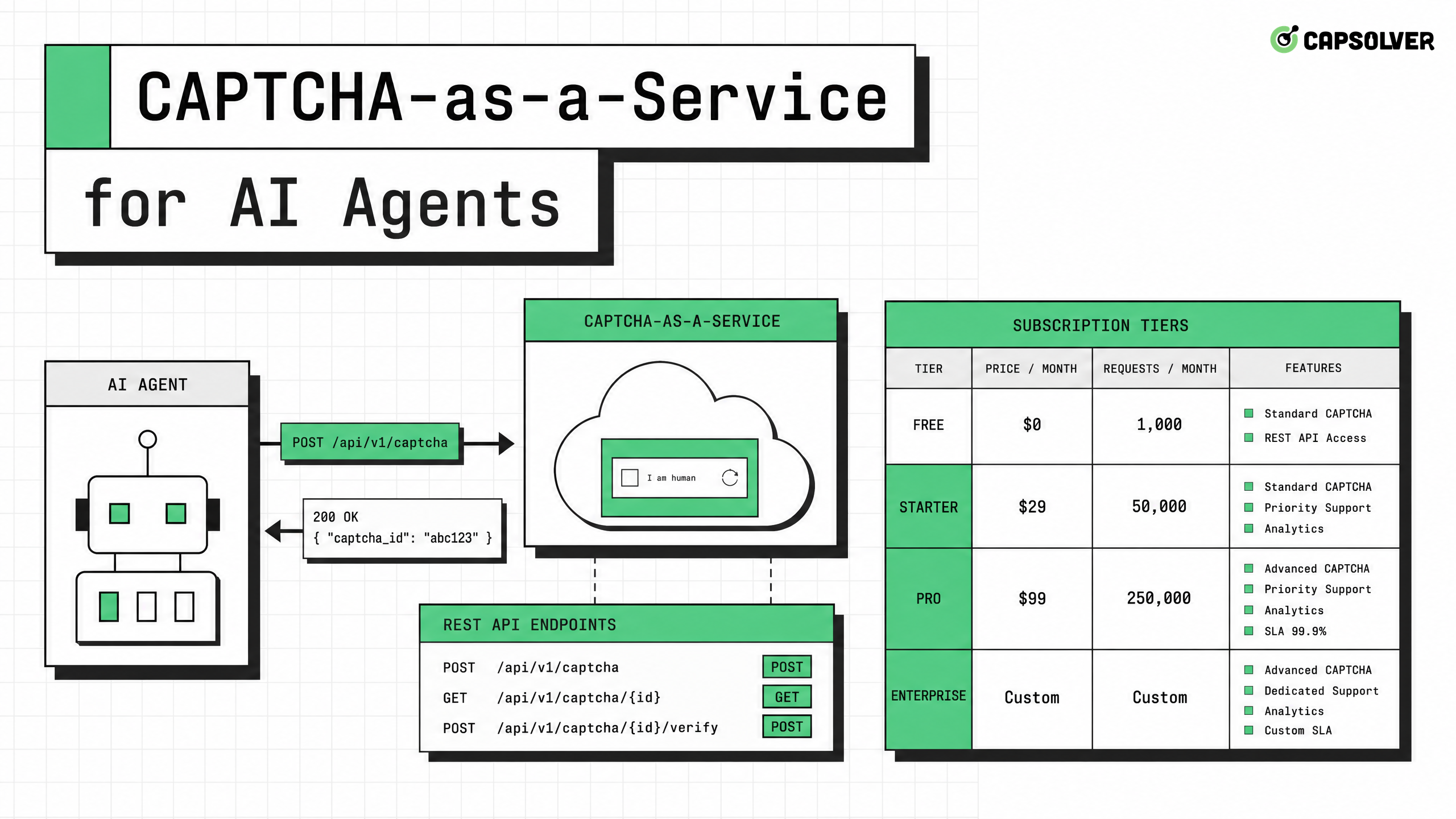
In the rapidly evolving landscape of artificial intelligence, AI agents are becoming indispensable tools for automating complex online tasks, from data aggregation to interactive web operations. However, their efficiency is often compromised by the pervasive presence of CAPTCHA challenges, designed to differentiate human users from automated bots. The solution lies in adopting a robust CAPTCHA-as-a-Service model, which provides AI agents with the capability to programmatically navigate these digital gatekeepers. This approach ensures uninterrupted workflows and maximizes the potential of AI-driven automation. CapSolver stands at the forefront, offering a specialized infrastructure that enables AI agents to resolve these hurdles effectively, ensuring that critical tasks are completed without manual intervention.
AI agents are transforming how businesses operate, performing tasks that range from market research to customer service. These agents often interact with websites and applications designed primarily for human users. As a result, they frequently encounter CAPTCHA (Completely Automated Public Turing test to tell Computers and Humans Apart) systems. These security measures, while essential for preventing spam and abuse, pose a significant obstacle to automated processes. Without an effective solution, AI agents can get stuck, leading to delays, incomplete data, and increased operational costs. The challenge for developers is to build resilient AI agents that can overcome these barriers without violating ethical guidelines or terms of service.
CAPTCHA-as-a-Service refers to a specialized platform that provides an API or SDK for automated CAPTCHA solving. Instead of an AI agent attempting to solve a CAPTCHA directly, it sends the challenge to the service, which then returns the solution. This externalization of the CAPTCHA-solving process allows AI agents to focus on their primary tasks, offloading the complex and often resource-intensive challenge resolution to a dedicated system. Services like CapSolver are designed to handle various CAPTCHA types, including reCAPTCHA v2/v3, Cloudflare Turnstile and more, with high accuracy and speed. For a deeper dive into how these systems work, consider exploring the concept of CAPTCHA solving infrastructure for AI agents.
The architectural model of a CaaS platform is typically asynchronous. An AI agent submits a task to the service endpoint, receives a task ID, and then polls for the result once the challenge has been processed. This non-blocking design is critical for production-grade agent systems, as it prevents the agent thread from stalling while waiting for a resolution. More advanced integrations use webhook callbacks, where the CaaS platform pushes the solved token directly back to the agent's endpoint the moment it becomes available, further reducing latency and simplifying the polling logic. Understanding these architectural nuances is essential when evaluating the best CAPTCHA API for AI agents in 2026 for your specific use case.
Integrating a CAPTCHA-as-a-Service solution offers numerous advantages for AI agents and their operators:
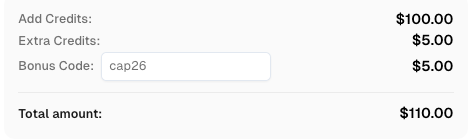
Redeem Your CapSolver Bonus Code
Boost your automation budget instantly!
Use bonus code CAP26 when topping up your CapSolver account to get an extra 5% bonus on every recharge — with no limits.
Redeem it now in your CapSolver Dashboard
When selecting a CAPTCHA-as-a-Service provider for your AI agents, several factors are crucial for optimal performance and integration:
Integrating CAPTCHA-as-a-Service into an AI agent's workflow typically involves a few steps. First, the agent detects a CAPTCHA challenge. Next, it captures the necessary data (e.g., image, site key) and sends it to the CAPTCHA service via its API. The service then processes the CAPTCHA and returns the solution, which the AI agent uses to proceed. This process can be implemented as a middleware layer, as discussed in adding CAPTCHA handling middleware to your agent. For agents utilizing headless browsers, special considerations might be needed to ensure the CAPTCHA context is correctly passed.
Consider an AI agent designed for large-scale web scraping. Without CAPTCHA-as-a-Service, the agent would frequently encounter CAPTCHAs, leading to failed requests and incomplete datasets. By integrating a service like CapSolver, the agent can automatically resolve these challenges, ensuring a continuous and efficient data flow. This significantly improves the agent's ability to gather information from various sources, as highlighted by research from Pew Research Center on the impact of bots and AI on the internet. The result is more comprehensive data, faster project completion, and a higher return on investment for data-driven initiatives.
When a production AI agent integrates a CaaS provider, the measurable improvements are significant. Teams that have moved from ad-hoc, in-house CAPTCHA handling to a dedicated service typically report a reduction in task failure rates from double-digit percentages down to below 1%. Average CAPTCHA resolution time drops from tens of seconds (or indefinite blocking) to under three seconds for most challenge types. For operations running hundreds of concurrent agent threads, this translates directly into a proportional increase in throughput and a corresponding reduction in infrastructure costs, since fewer compute resources are wasted on idle, blocked agents.
The cost model also shifts favorably. In-house solutions require dedicated engineering time for initial development, ongoing maintenance as CAPTCHA providers update their algorithms, and monitoring infrastructure to detect when the solver starts failing. A CaaS model consolidates all of these costs into a single, predictable per-solve fee, making budget forecasting straightforward. According to data from Gartner's automation research, organizations that adopt managed services for non-core technical functions consistently achieve better total cost of ownership compared to those maintaining equivalent capabilities in-house.
| Feature | In-house CAPTCHA Solving | CAPTCHA-as-a-Service |
|---|---|---|
| Development | High initial effort, ongoing maintenance | Minimal integration effort |
| Accuracy | Varies, requires constant updates | High, continuously optimized |
| Scalability | Limited by internal resources | Highly scalable, on-demand |
| Cost | High fixed costs, unpredictable variable | Variable, pay-per-use |
| Maintenance | Significant, dedicated team required | Handled by service provider |
| Focus | Diverts resources from core tasks | Allows focus on core AI agent logic |
CAPTCHA-as-a-Service is no longer a luxury but a necessity for AI agents operating in today's web environment. It provides a robust, scalable, and efficient solution to overcome digital barriers, ensuring that automated tasks run smoothly and effectively. By offloading the complexities of CAPTCHA resolution, businesses can empower their AI agents to achieve their full potential, driving innovation and efficiency across various domains. To equip your AI agents with unparalleled CAPTCHA-solving capabilities and enable reliable automation, explore the advanced solutions offered by CapSolver today.
Q1: What types of CAPTCHAs can CAPTCHA-as-a-Service solve?
A1: CAPTCHA-as-a-Service platforms typically support a wide range of CAPTCHA types, including reCAPTCHA v2/v3, Cloudflare Turnstile, Image CAPTCHAs, and more. Providers continuously update their systems to handle new and evolving challenges.
Q2: Is CAPTCHA-as-a-Service legal and ethical?
A2: Yes, when used responsibly and in compliance with website terms of service, CAPTCHA-as-a-Service is legal. It's primarily used for legitimate automation tasks like data collection for research or business intelligence, not for malicious activities. Always ensure your use aligns with ethical guidelines and legal frameworks.
Q3: How difficult is it to integrate CAPTCHA-as-a-Service with an existing AI agent?
A3: Integration difficulty varies by provider and your agent's architecture. Most services offer well-documented APIs and SDKs designed for straightforward integration. Many also provide client libraries for popular programming languages, simplifying the process significantly. For example, choosing a CAPTCHA solving service for agent automation often involves evaluating ease of integration.
Q4: Can CAPTCHA-as-a-Service help with bot protection?
A4: While CAPTCHA-as-a-Service helps AI agents resolve CAPTCHAs, it's not a bot protection solution itself. Instead, it enables legitimate bots (AI agents) to function. For comprehensive bot protection, websites employ various strategies, including advanced analytics and behavioral analysis, as discussed in bot protection infrastructure for AI agents.
Q5: What is the typical response time for a CAPTCHA-as-a-Service?
A5: Response times can vary depending on the CAPTCHA type, service provider, and current load. However, reputable services aim for very fast resolution, often within a few seconds, to minimize delays for AI agents. Consistent speed is a key factor when evaluating a scalable CAPTCHA solving for production agents.
Emma Foster
Machine Learning Engineer
Where machine learning meets practical AI tooling.
ABOUT THE AUTHOR
Fix CAPTCHA handling that works locally but fails in a cloud AI agent. Compare browser setup, dependencies, credentials, network access, and page state.
Estimate CAPTCHA solving costs in Browser Use by separating agent runs, challenge types, billable solves, retries, and verified outcomes from browser costs.