CAPSOLVER
Blog
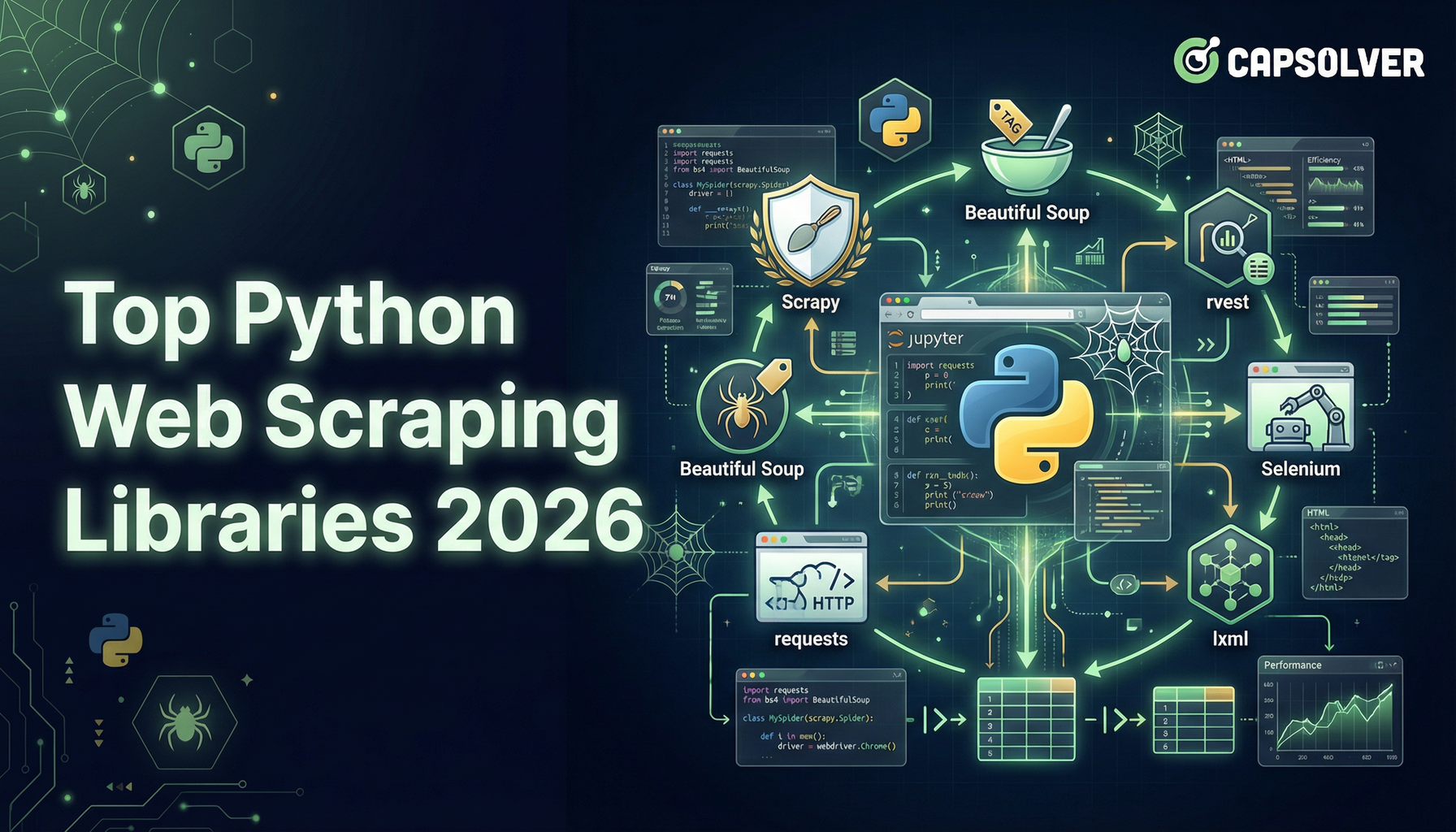
Top Python Web Scraping Libraries 2026

Top Python Web Scraping Libraries 2026

Logo of CapSolver

Emma Foster

Machine Learning Engineer

09-Jan-2026

Key Takeaways

  • Python is the leading language for web scraping due to its ease of use, extensive libraries, and strong community support.
  • Beautiful Soup is excellent for static HTML parsing and beginners.
  • Scrapy is a powerful framework for large-scale, complex scraping projects.
  • Selenium and Playwright are essential for scraping dynamic, JavaScript-heavy websites by controlling actual browsers.
  • Requests-HTML offers a convenient blend of fetching, parsing, and JavaScript rendering.
  • Advanced techniques like CAPTCHA solving (using services like CapSolver) and proxy management are crucial for robust scraping.
  • Ethical considerations, including respecting robots.txt and website terms of service, are paramount.

Introduction

Did you know that the global data analytics market is projected to reach $655.8 billion by 2029, growing at a CAGR of 12.9%? (Source: Grand View Research). This explosive growth underscores the increasing importance of data extraction, and Python web scraping remains a cornerstone for accessing and analyzing vast amounts of online information. As we look ahead to 2026, the landscape of Python web scraping libraries continues to evolve, offering developers increasingly powerful, efficient, and user-friendly tools.

Choosing the right library can significantly impact the success of your scraping projects, affecting everything from development time to the robustness of your scrapers. This guide will delve into the leading Python web scraping libraries you should consider in 2026, examining their strengths, weaknesses, and ideal use cases. We'll cover everything from beginner-friendly options to advanced frameworks, ensuring you have the knowledge to select the perfect tool for your data extraction needs.

Why Python for Web Scraping?

Python's dominance in web scraping isn't accidental. Several key factors contribute to its popularity:

  • Simplicity and Readability: Python's clear syntax makes it relatively easy to learn and write, even for those new to programming. This translates to faster development cycles for scraping projects.
  • Extensive Libraries and Frameworks: The Python ecosystem is rich with libraries specifically designed for web scraping, data manipulation, and analysis (e.g., NumPy, Pandas). This means you often don't have to build complex functionalities from scratch.
  • Large and Active Community: A vast community means abundant resources, tutorials, and support. If you encounter a problem, chances are someone else has already solved it and shared the solution.
  • Versatility: Python can be used for a wide range of tasks beyond scraping, such as data analysis, machine learning, and web development, making it a valuable skill for data professionals.

Key Considerations When Choosing a Web Scraping Library

Before diving into specific libraries, it's crucial to understand the factors that differentiate them:

1. Ease of Use

How quickly can you get started? Libraries with simpler APIs and clear documentation are ideal for beginners or projects with tight deadlines. For complex projects requiring intricate logic, a more feature-rich but potentially steeper learning curve might be acceptable.

2. Features and Functionality

Does the library handle dynamic content (JavaScript-rendered pages)? Does it support handling CAPTCHAs or proxies? Does it offer asynchronous capabilities for faster scraping? The features you need will depend heavily on the websites you intend to scrape.

3. Performance and Scalability

For large-scale scraping operations, performance is paramount. Libraries that can handle many requests concurrently or efficiently process large amounts of data will be more suitable. Asynchronous programming and efficient memory management are key here.

4. Community Support and Documentation

Good documentation and an active community are invaluable. They provide help when you're stuck and ensure the library is maintained and updated.

5. Handling Anti-Scraping Measures

Many websites employ measures to block scrapers. Your chosen library should ideally offer features or integrate well with tools that can help bypass these restrictions, such as proxy rotation, user-agent spoofing, and CAPTCHA solving services.

The Top Python Web Scraping Libraries for 2026

Let's explore the leading contenders that are set to dominate the web scraping scene in 2026.

1. Beautiful Soup

Beautiful Soup is arguably the most popular and widely used Python library for parsing HTML and XML documents. It creates a parsing tree from page source code that can be used to extract data in a hierarchical and readable way.

  • Strengths:
    • Extremely easy to learn and use: Its API is intuitive, making it perfect for beginners.
    • Handles malformed HTML gracefully: It can often parse messy or invalid HTML that other parsers might struggle with.
    • Excellent for static content: If the data you need is present in the initial HTML source, Beautiful Soup is a fantastic choice.
    • Integrates well with other libraries: Often used in conjunction with requests for fetching web pages.
  • Weaknesses:
    • Doesn't execute JavaScript: It cannot render pages that heavily rely on JavaScript to load content. For dynamic websites, you'll need to combine it with other tools.
    • Can be slower for very large datasets: Compared to more specialized or lower-level libraries, it might not be the fastest option for massive scraping tasks.
  • Ideal Use Cases: Scraping static websites, extracting specific data from HTML documents, learning the basics of web scraping.

Example (using requests):

python Copy
import requests
from bs4 import BeautifulSoup

url = 'http://example.com'
response = requests.get(url)
soup = BeautifulSoup(response.text, 'html.parser')

# Find all paragraph tags
paragraphs = soup.find_all('p')
for p in paragraphs:
    print(p.text)

2. Scrapy

Scrapy is a powerful, open-source web crawling framework. It's designed for large-scale scraping projects, offering a comprehensive suite of tools for fetching, processing, and storing data. Scrapy operates on a component-based architecture, allowing for flexibility and extensibility.

  • Strengths:
    • Asynchronous and fast: Built with Twisted, Scrapy is highly efficient and can handle thousands of concurrent requests.
    • Robust framework: Provides built-in support for crawling, data extraction, item pipelines, middleware, and more.
    • Scalable: Excellent for large-scale data extraction projects.
    • Extensible: You can customize almost every aspect of the crawling process.
    • Handles complex crawling logic: Great for navigating websites with intricate structures and following links.
  • Weaknesses:
    • Steeper learning curve: More complex than Beautiful Soup, requiring a better understanding of Python and web crawling concepts.
    • Overkill for simple tasks: For basic scraping of static pages, Scrapy might be too much.
  • Ideal Use Cases: Large-scale data extraction, complex crawling operations, building robust and scalable web scrapers, projects requiring efficient handling of many pages.

Official Scrapy Documentation: Scrapy Project

3. Selenium

Selenium is primarily known as a tool for automating web browsers for testing purposes. However, its ability to control a real browser instance makes it incredibly powerful for web scraping, especially when dealing with JavaScript-heavy websites.

  • Strengths:
    • Handles dynamic content perfectly: Because it controls a browser, it can execute JavaScript and interact with elements as a human user would.
    • Simulates user interaction: Can click buttons, fill forms, scroll pages, and more.
    • Cross-browser compatibility: Supports major browsers like Chrome, Firefox, Edge, and Safari.
    • Good for complex scenarios: Useful for scraping data that only appears after user interaction or AJAX calls.
  • Weaknesses:
    • Slow: Running a full browser is resource-intensive and significantly slower than direct HTTP requests.
    • Resource intensive: Requires more memory and CPU power.
    • Can be brittle: Changes in website structure or browser updates can break scripts.
  • Ideal Use Cases: Scraping websites that heavily rely on JavaScript, automating user interactions to extract data, testing web applications.

4. Requests-HTML

Requests-HTML is a library that aims to provide a more user-friendly experience for web scraping, combining the ease of requests with some of the parsing capabilities of Beautiful Soup and the ability to render JavaScript.

  • Strengths:
    • Combines fetching and parsing: Simplifies the workflow by handling both HTTP requests and HTML parsing.
    • JavaScript rendering: Can render JavaScript using a headless Chrome instance, making it suitable for dynamic content.
    • CSS Selectors: Supports CSS selectors for easier element selection, similar to Beautiful Soup.
    • Built-in JSON parsing: Convenient for APIs.
  • Weaknesses:
    • Less mature than Beautiful Soup or Scrapy: While powerful, it's not as widely adopted or battle-tested.
    • JavaScript rendering can be slow: Similar to Selenium, rendering JavaScript adds overhead.
  • Ideal Use Cases: Scraping dynamic websites without the full complexity of Scrapy, projects where both static and dynamic content need to be handled, developers who prefer CSS selectors.

5. Playwright

Developed by Microsoft, Playwright is a newer but rapidly growing automation library that enables reliable end-to-end testing and web scraping. It offers a robust API for controlling Chromium, Firefox, and WebKit browsers.

  • Strengths:
    • Fast and reliable: Known for its speed and stability compared to other browser automation tools.
    • Cross-browser support: Works with Chromium, Firefox, and WebKit.
    • Auto-waits: Intelligently waits for elements to be ready, reducing flakiness.
    • Handles modern web applications: Excellent for complex SPAs and dynamic content.
    • Network interception: Allows for advanced control over network requests.
  • Weaknesses:
    • Newer than Selenium: The community is growing but still smaller than Selenium's.
    • Can be resource-intensive: Like other browser automation tools.
  • Ideal Use Cases: Scraping complex, modern web applications; projects requiring high reliability and speed in browser automation; developers looking for a modern alternative to Selenium.

Playwright Documentation: Playwright

6. Puppeteer (via pyppeteer)

Puppeteer is a Node.js library developed by Google for controlling Chrome or Chromium. The pyppeteer library is a Python port that allows you to use Puppeteer's capabilities within Python.

  • Strengths:
    • Excellent for JavaScript rendering: Designed to control headless Chrome, it excels at rendering dynamic content.
    • Powerful API: Offers fine-grained control over browser actions.
    • Good for automation tasks: Can be used for more than just scraping, like generating PDFs or screenshots.
  • Weaknesses:
    • Python port quality: pyppeteer is a third-party port and might not always be as up-to-date or stable as the original Node.js library.
    • Resource intensive: Requires a browser instance.
    • Less direct Python integration: Compared to libraries built natively for Python.
  • Ideal Use Cases: Scraping heavily JavaScript-dependent websites, generating automated reports or screenshots, when a Node.js-like control flow is desired within Python.

Advanced Techniques and Tools for Web Scraping

Beyond the core libraries, several advanced techniques and tools can enhance your scraping capabilities:

1. Handling CAPTCHAs

CAPTCHAs are designed to prevent automated access. For legitimate scraping needs (e.g., market research), you might need to solve them. Services like CapSolver offer APIs that can solve various types of CAPTCHAs programmatically. Integrating these services with your scrapers can significantly improve success rates on sites that employ such measures.

  • CapSolver: A popular choice known for its efficiency and support for various CAPTCHA types, including reCAPTCHA, hCaptcha, and image CAPTCHAs. Integrating CapSolver can automate the process of bypassing these security challenges, allowing your scraper to proceed without manual intervention. Learn more at CapSolver.

2. Proxy Management

To avoid IP bans and distribute your requests, using proxies is essential for large-scale scraping. Libraries like requests and Scrapy support proxy usage. You can use rotating proxy services to manage a pool of IP addresses.

3. User-Agent Rotation

Websites often check the User-Agent header to identify bots. Rotating through a list of common browser user agents can help your scraper appear more like a legitimate user.

4. Rate Limiting and Delays

Respecting website terms of service and avoiding overwhelming servers is crucial. Implementing delays (time.sleep() in Python) between requests or using Scrapy's built-in rate limiting features is good practice.

5. Headless Browsers

As discussed with Selenium, Playwright, and Puppeteer, headless browsers (browsers running without a graphical interface) are essential for scraping dynamic content. They execute JavaScript and render pages just like a regular browser.

Choosing the Right Library for Your Project

Here’s a quick decision tree to help you select the best library:

  • Are you a beginner and scraping static websites? Start with Beautiful Soup + requests.
  • Do you need to scrape dynamic content (JavaScript-rendered)? Consider Selenium, Playwright, or Requests-HTML.
  • Are you building a large-scale, complex scraping project? Scrapy is likely your best bet.
  • Do you need the most reliable and fastest browser automation for modern web apps? Playwright is a strong contender.
  • Do you need to automate interactions within a browser for testing or scraping? Selenium or Playwright are excellent choices.

Ethical Considerations in Web Scraping

While powerful, web scraping comes with ethical responsibilities. Always:

  • Check robots.txt: This file on a website indicates which parts of the site bots are allowed or disallowed to access.
  • Respect Terms of Service: Many websites explicitly prohibit scraping in their terms of service.
  • Avoid Overloading Servers: Scrape responsibly by implementing delays and limiting your request rate.
  • Don't Scrape Private Data: Avoid collecting personal or sensitive information without consent.
  • Identify Yourself: Use a descriptive User-Agent string so website administrators know who is accessing their site (though this can sometimes be a double-edged sword).

According to a study by the University of Washington, responsible scraping practices are crucial for maintaining access to public data and avoiding legal repercussions. (Source: University of Washington, Computer Science & Engineering).

Conclusion

As we move into 2026, the Python web scraping ecosystem continues to offer a diverse range of powerful tools. Whether you're a beginner looking to extract data from simple static pages or an experienced developer tackling complex, dynamic websites, there's a Python library suited for your needs. Beautiful Soup remains the go-to for simplicity, Scrapy for large-scale projects, and Selenium, Playwright, and Requests-HTML are indispensable for handling dynamic content. By understanding the strengths and weaknesses of each, and by scraping responsibly, you can effectively harness the power of web scraping to gather valuable data.

Frequently Asked Questions (FAQs)

Q1: What is the easiest Python library for web scraping?

A1: For beginners, Beautiful Soup combined with the requests library is generally considered the easiest to learn and use. It has a straightforward API for parsing HTML and XML documents.

Q2: Which Python library is best for scraping websites with a lot of JavaScript?

A2: Libraries that can control a web browser are best for JavaScript-heavy sites. Selenium, Playwright, and Requests-HTML (with its JavaScript rendering capabilities) are excellent choices. Playwright is often praised for its speed and reliability.

Q3: Can I use Python web scraping libraries to scrape data from any website?

A3: While Python libraries are very powerful, you must always check a website's robots.txt file and its Terms of Service. Some websites prohibit scraping, and attempting to scrape them can lead to legal issues or IP bans. Furthermore, some sites use advanced anti-scraping techniques that can be difficult to overcome.

Q4: How do I handle CAPTCHAs when web scraping with Python?

A4: CAPTCHAs are designed to stop automated scripts. For legitimate scraping needs, you can integrate with third-party CAPTCHA solving services like CapSolver. These services provide APIs that can solve various CAPTCHA types programmatically, allowing your scraper to proceed.

Q5: Is Scrapy suitable for small, simple scraping tasks?

A5: While Scrapy is incredibly powerful and scalable, it might be overkill for very simple scraping tasks. For basic extraction from a few static pages, Beautiful Soup and requests would be more efficient to set up and run.

Q6: What are the ethical guidelines for web scraping?

A6: Key ethical guidelines include: always check and respect robots.txt, adhere to website Terms of Service, avoid overwhelming the website's servers with too many requests (implement delays), and never scrape private or sensitive user data without explicit consent. Responsible scraping ensures the continued availability of online data.

Compliance Disclaimer: The information provided on this blog is for informational purposes only. CapSolver is committed to compliance with all applicable laws and regulations. The use of the CapSolver network for illegal, fraudulent, or abusive activities is strictly prohibited and will be investigated. Our captcha-solving solutions enhance user experience while ensuring 100% compliance in helping solve captcha difficulties during public data crawling. We encourage responsible use of our services. For more information, please visit our Terms of Service and Privacy Policy.

More

How to Solve Captcha with Katana Using CapSolver
Integrating Katana with CapSolver: Automated CAPTCHA Solving for Web Crawling

Learn how to integrate Katana with Capsolver to automatically solve reCAPTCHA v2 and Cloudflare Turnstile in headless crawling.

web scraping
Logo of CapSolver

Lucas Mitchell

09-Jan-2026

How to Solve Captcha with Crawlab Using CapSolver
Integrating Crawlab with CapSolver: Automated CAPTCHA Solving for Distributed Crawling

Learn how to integrate CapSolver with Crawlab to solve reCAPTCHA and Cloudflare Turnstile at scale.

web scraping
Logo of CapSolver

Ethan Collins

09-Jan-2026

Top Python Web Scraping Libraries 2026

Explore the best Python web scraping libraries for 2026. Compare features, ease of use, and performance for your data extraction needs. Includes expert insights and FAQs.

web scraping
Logo of CapSolver

Emma Foster

09-Jan-2026

6 Best Web Unblockers Compared
6 Best Web Unblockers Compared: Best Options in 2026

Compare the 6 best web unblockers in 2026. Discover top-rated web unblocker APIs like Decodo, Oxylabs, and Bright Data for bypassing anti-bot systems, residential proxies, and automated scraping tools.

web scraping
Logo of CapSolver

Ethan Collins

07-Jan-2026

The Best AI Scraping Tools You Must Know in 2026

Discover the Best AI Scraping tool options for 2026. We compare top AI web scraping tools, including Bright Data, Crawl4AI, and Browse AI, with specific pricing to help you master automated data extraction and security challenge resolution.

web scraping
Logo of CapSolver

Emma Foster

07-Jan-2026

Best Alternative Data Providers
Best Alternative Data Providers in 2026 (Top Platforms Compared)

Discover the best Alternative Data Providers in 2026. Our guide compares top platforms (YipitData, FactSet, Preqin) with pros, cons, and pricing insights for compliance and alpha generation.

web scraping
Logo of CapSolver

Lucas Mitchell

05-Jan-2026