🎉NEWCapSolver for AI agents-MCP, agent tools, and SDK integrations

Ethan Collins
AI Agent Workflow Engineer
Published Jan 20, 2026
Updated Jan 20, 2026 · min read
Web automation in 2026 has shifted from simple scripts to autonomous AI agents that can navigate the internet like humans. These tools handle complex tasks such as research, data extraction, and transaction execution without constant supervision. This guide ranks the top seven AI agent tools based on their reliability, scalability, and ease of integration for production environments. Whether you are a developer building custom workflows or a business looking to automate routine operations, these platforms provide the infrastructure needed to scale your digital presence.
Web automation has historically relied on brittle, code-heavy scripts. These scripts frequently break when minor changes occur on a target website. The emergence of AI agent tools fundamentally changes this paradigm. Agents use large language models (AI LLM) to understand goals and execute actions autonomously. They can interpret visual cues, adapt to dynamic web structures, and even recover from errors without human intervention. This shift is essential for scaling operations in the modern digital economy.
The demand for production AI agents is driven by the need for resilience. Businesses require automation that can navigate complex, human-centric workflows like data scraping, lead generation, and competitive intelligence. The most effective agents in 2026 are those that excel at this kind of adaptive, goal-oriented execution. They represent a significant leap beyond simple robotic process automation (RPA). The future of web automation is not just about speed, but about intelligent, persistent task completion.
To provide a valuable and actionable ranking, we evaluated each tool against four core criteria. These factors determine an agent's true capability in a demanding, real-world setting. We moved past marketing claims to assess genuine utility for complex browser automation tasks.
| Ranking Criterion | Description | Why It Matters for Web Automation |
|---|---|---|
| Real-Web Performance | The agent's ability to handle anti-bot measures, CAPTCHAs, and dynamic content. | Ensures continuous operation and prevents workflow interruptions on protected sites. |
| Ease of Integration | How easily the tool connects with existing tech stacks, APIs, and other services. | Reduces development time and allows for seamless incorporation into enterprise workflows. |
| Multi-Agent Support | The capacity to orchestrate teams of specialized agents for complex, distributed tasks. | Essential for tackling large-scale projects that require parallel processing and role specialization. |
| Adaptability & Resilience | The agent's ability to recover from unexpected UI changes or errors during execution. | Minimizes maintenance overhead and increases the overall reliability of the automation. |
The following tools represent the cutting edge of autonomous web interaction. They range from powerful open-source frameworks to sophisticated commercial platforms. Each offers a unique approach to solving the challenges of browser automation in 2026.
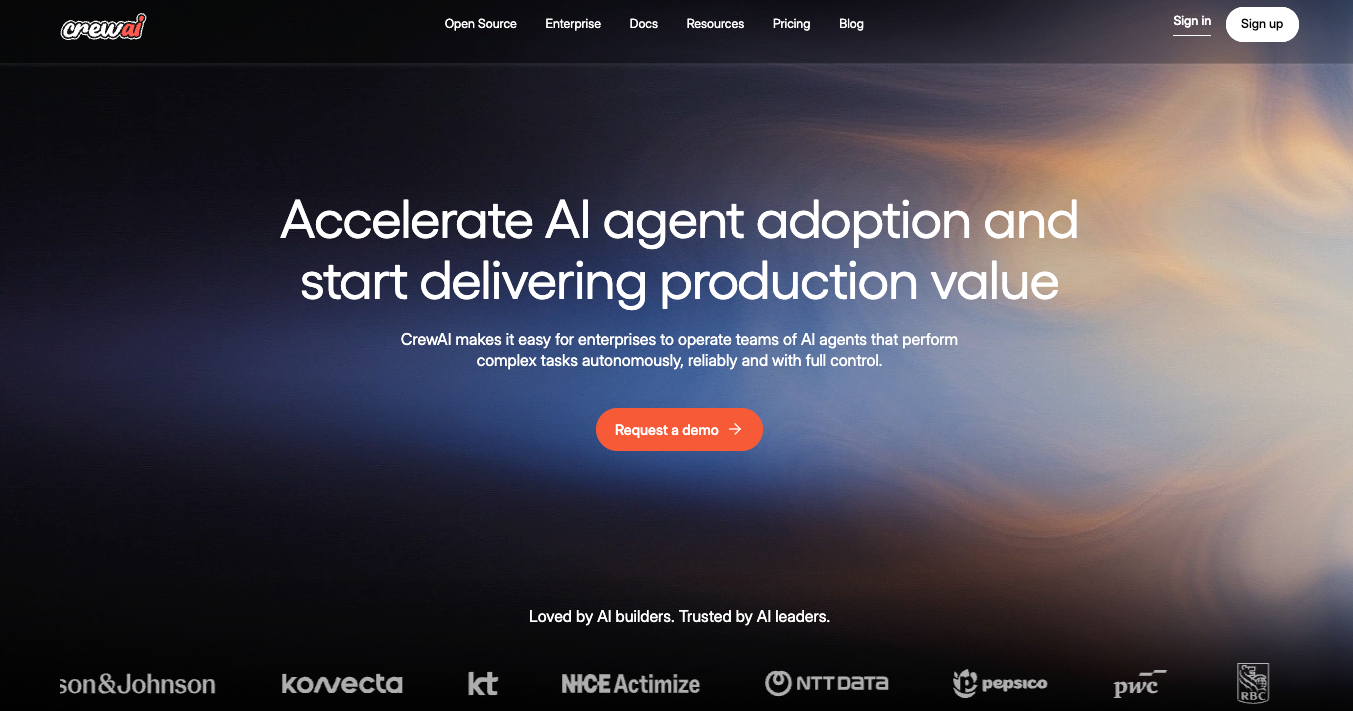
CrewAI is not a browser automation tool itself, but a powerful framework for orchestrating teams of collaborative AI agent tools It allows developers to define agents with specific roles, goals, and tools, enabling them to work together to solve complex problems. This multi-agent approach is highly effective for research and data synthesis tasks that involve web interaction.
Key Features:
Best For: Developers building sophisticated, multi-step data collection and analysis pipelines. It is ideal for projects where the problem requires a division of labor among specialized agents.
Pricing/Access: Open-source framework. Paid tiers are available for cloud deployment and enhanced features.
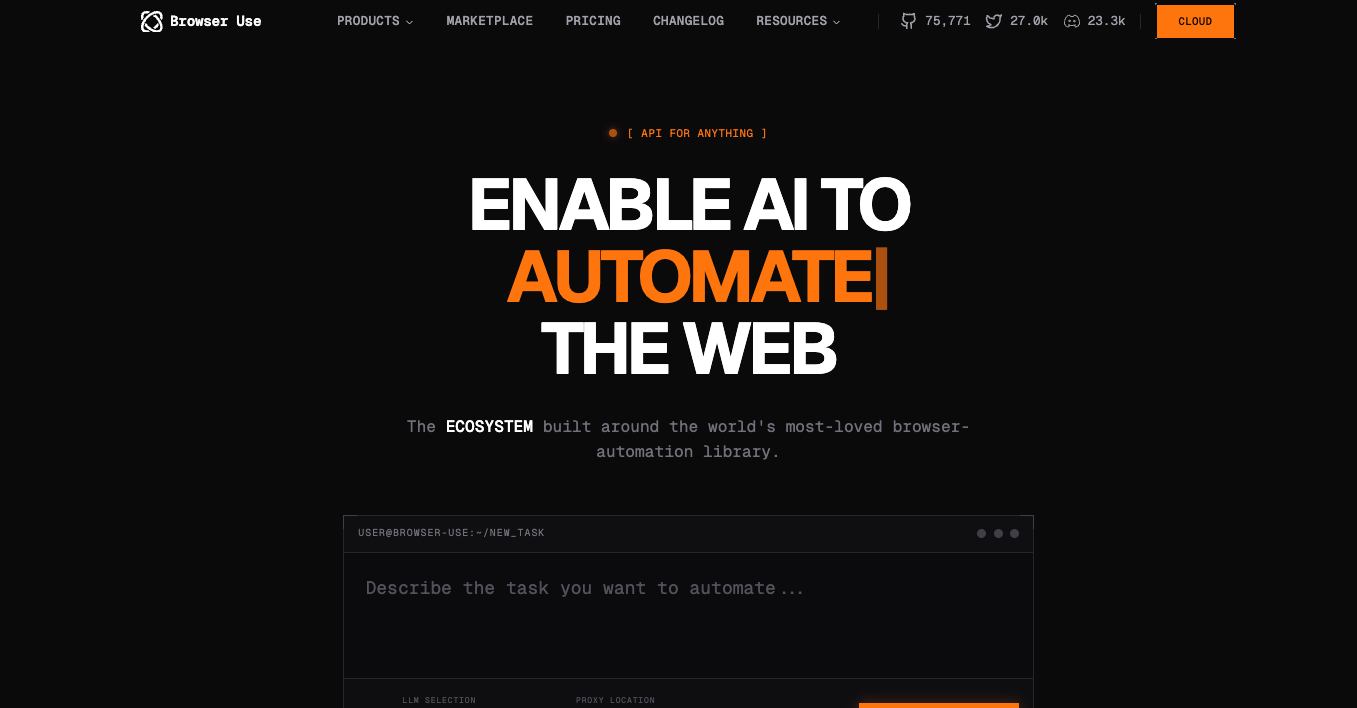
Browser Use is a specialized, open-source library designed for running AI agents directly alongside a browser instance. This architecture minimizes latency and maximizes the agent's ability to interact with the web in real-time. It focuses on providing a robust, persistent, and authenticated browsing environment.
Key Features:
Best For: Technical teams needing a highly reliable, low-level foundation for their browser automation agents. It is particularly strong when combined with infrastructure designed to handle web defenses, as detailed in the article on Browser Use and CapSolver.
Pricing/Access: Open-source and free to use.
MultiOn positions itself as the "Motor Cortex layer for AI," providing autonomous agents capable of executing complex, multi-step tasks on the web. It excels at transactional tasks like booking flights, making purchases, and filling out forms across various websites.
Key Features:
Best For: Businesses requiring high-volume, transactional web automation, such as e-commerce monitoring or travel booking. Its focus on anti-bot measures makes it a strong choice for production AI agents.
Pricing/Access: Tiered API-based pricing, typically based on the number of requests or steps executed.
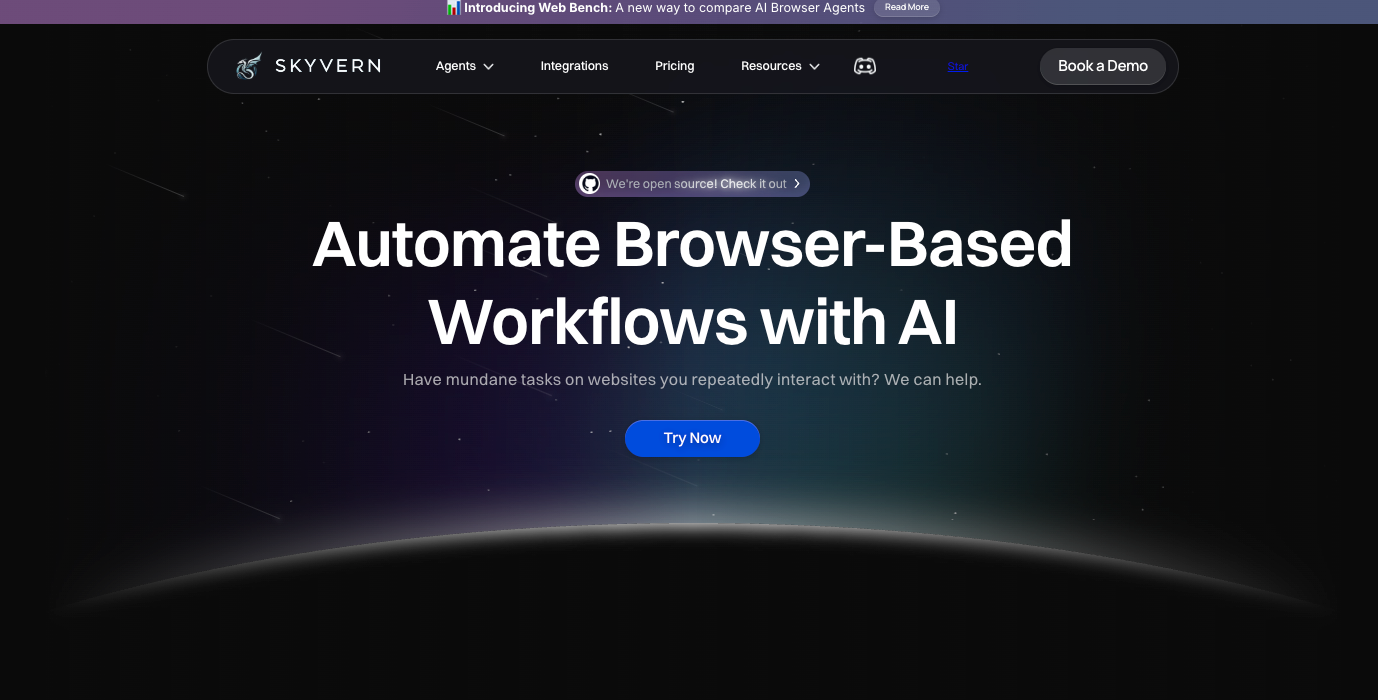
Skyvern use computer vision and LLMs to automate browser-based workflows. Its core strength lies in its ability to adapt to any webpage structure, even when the underlying HTML changes. This makes it highly resilient to the UI updates that frequently break traditional selectors-based automation.
Key Features:
Best For: Operations teams automating internal tools or third-party platforms with frequently changing UIs. Its vision-based approach offers a high degree of resilience.
Pricing/Access: Open-source version available. Cloud service with usage-based pricing (e.g., $0.05 per step).
OpenAI Operator, a research preview available to Pro users, represents a significant move by OpenAI into the autonomous agent space. It is a browser-based executor that can take control of a browser to perform tasks like scheduling, shopping, and data entry. Its primary advantage is its deep integration with the powerful OpenAI ecosystem.
Key Features:
Best For: Users already heavily invested in the ChatGPT and OpenAI ecosystem who prioritize cutting-edge reasoning capabilities for their automation tasks.
Pricing/Access: Available to ChatGPT Pro-tier subscribers.
Microsoft AutoGen is an open-source framework that simplifies the creation of multi-agent conversation systems. While not exclusively focused on web automation, its flexibility makes it a powerful tool for developers. Agents in AutoGen can converse with each other to solve tasks, making it excellent for complex research and development workflows.
Key Features:
Best For: Developers and researchers who need a highly customizable, multi-agent framework for experimental or highly specific automation tasks. It provides a strong, open-source alternative to commercial orchestration platforms.
Pricing/Access: Open-source and free to use.
Manus AI is designed as a general-purpose action engine that goes beyond simple Q&A to execute tasks across various domains, including web automation. Its "Browser Operator" feature allows it to interact with authenticated services and complex web applications, making it a versatile tool for both research and operational tasks.
Key Features:
Best For: Individuals and small teams looking for a single, versatile AI agent that can handle a wide range of tasks, from web data extraction to content creation.
Pricing/Access: Commercial platform with various subscription tiers.
To simplify the selection process, the table below summarizes the key differentiators for each of the top AI agent tools in 2026.
| Tool | Primary Focus | Multi-Agent Support | Web Resilience Approach | Best Use Case |
|---|---|---|---|---|
| CrewAI | Agent Orchestration | High (Core Feature) | Tool-dependent (Integrates with robust tools) | Complex research and data synthesis |
| Browser Use | Low-Latency Web Execution | Low (Single-agent focus) | Low-level persistence and anti-detection features | Building highly reliable, custom scrapers |
| MultiOn | Autonomous Web Navigation | High (Parallel Agents) | Native proxy and anti-bot support | High-volume transactional tasks (e.g., booking) |
| Skyvern | UI Adaptability | Low | Computer Vision and UI-change resilience | Automating workflows on frequently updated UIs |
| OpenAI Operator | Ecosystem Integration | Low | Ecosystem-driven (Browser-based executor) | Users prioritizing cutting-edge LLM reasoning |
| Microsoft AutoGen | Conversational Framework | High (Conversational) | Tool-dependent (Framework for custom tools) | Experimental and highly customized agent systems |
| Manus AI | General-Purpose Action | Low | Persistent login and authenticated service interaction | Versatile research and operational tasks |
The most sophisticated AI agents 2026 can plan and reason with remarkable intelligence. However, their execution often falters at the final hurdle: interacting with the real web. Modern websites employ advanced defenses to block automated traffic, including sophisticated CAPTCHAs and anti-bot systems. An agent's intelligence is useless if it cannot reliably complete its action.
This is where specialized infrastructure becomes essential. To ensure production AI agents can operate reliably on the real web, they need a robust, external service to handle these defenses. Services like CapSolver provide the necessary infrastructure. By integrating CapSolver, AI agents can overcome challenges like reCAPTCHA, AWS WAF and Cloudflare protection. This integration allows the agent to focus on its core task—reasoning and execution—while offloading the complex, adversarial challenge of web defense bypass.
For instance, integrating CapSolver with a framework like CrewAI ensures that the data collection phase of a multi-agent task is never blocked by a CAPTCHA. Similarly, a tool like Browser Use gains significant real-world utility when paired with CapSolver for handling anti-bot measures. This combination creates a truly resilient and reliable automation pipeline. You can learn more about integrating this infrastructure in our detailed guides, such as AI Agent CAPTCHA
The year 2026 marks a pivotal moment in web automation The shift from brittle scripts to intelligent, autonomous agents is complete. Tools like CrewAI and Browser Use offer powerful new ways to build resilient and adaptive workflows. The best choice depends on your specific needs: a flexible framework for developers, a transactional powerhouse for operations, or a vision-based tool for UI resilience.
Ultimately, the success of any autonomous web agent relies on its ability to execute reliably. By adopting one of these top-tier tools and pairing it with essential infrastructure like CapSolver, you can build automation that not only reasons intelligently but also performs consistently on the real web. The future of productivity is autonomous, and the time to upgrade your automation stack is now.
AI Agents are replacing traditional scripts due to their superior adaptability and resilience to web changes.
Real-Web Performance is the most critical factor, requiring solutions for CAPTCHAs and anti-bot measures.
Infrastructure like CapSolver is necessary to ensure production AI agents can operate reliably on protected websites.
Microsoft AutoGen and Skyvern offer strong open-source and vision-based alternatives, respectively.
A: Traditional Robotic Process Automation (RPA) uses pre-programmed scripts based on fixed selectors and rules. It is brittle and breaks easily when a website's UI changes. An AI agent uses an LLM to understand a high-level goal, reason about the steps needed, and adapt its actions dynamically to changes on the webpage. This makes it far more resilient and capable of handling complex, human-like workflows.
A: While the agent's core intelligence handles task planning, specialized infrastructure is required for anti-bot measures. The most effective production AI agents integrate with services like CapSolver. This offloads the challenge of solving CAPTCHAs and bypassing anti-bot systems, allowing the agent to maintain continuous, reliable operation on protected websites.
A: The choice depends on your team's technical expertise and project scope. Open-source frameworks like CrewAI and Microsoft AutoGen offer maximum customization and control, ideal for developers building highly specific solutions. Commercial platforms like MultiOn provide a ready-to-use, high-resilience service with built-in infrastructure, which is often better for operations teams prioritizing speed and reliability over deep customization.
A: The key trends include a greater focus on multi-agent systems (like CrewAI) for distributed problem-solving, increased reliance on computer vision (like Skyvern) for UI resilience, and the necessity of robust real-web performance infrastructure to handle increasingly sophisticated anti-bot defenses. The trend is moving toward agents that are not just intelligent, but also persistently effective in adversarial online environments.
A: The primary advantage of Browser Use is its low-latency, persistent execution environment. By running the agent logic directly next to the browser, it ensures faster, more reliable interaction. It is designed to handle session persistence, cookies, and authentication, making it an excellent foundation for building custom, high-performance browser automation tools.
Ethan Collins
AI Agent Workflow Engineer
Building clearer handoffs between AI agents and tools.
ABOUT THE AUTHOR
Build a reliable GLM-5.3 web scraping pipeline with response classification, bounded CAPTCHA handling, structured extraction, and validation.

Understand CAPTCHA MCP proxy support across the client connection, browser, and solver task, including the limits of current CapSolver MCP tools.