🎉NEWCapSolver for AI agents-MCP, agent tools, and SDK integrations

Aloísio Vítor
Image Processing Expert
Published Feb 04, 2026
Updated Feb 05, 2026 · min read
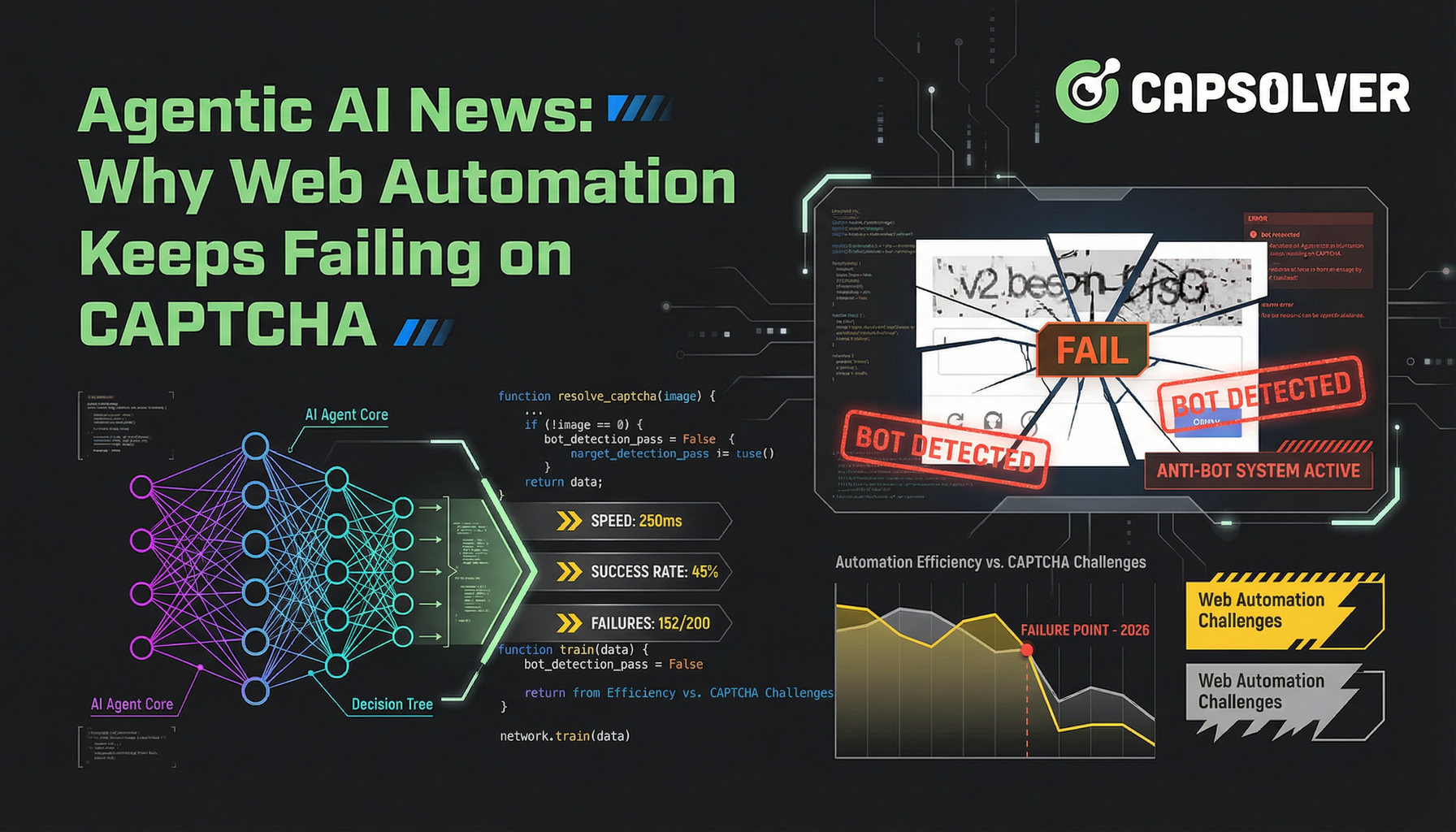
The rapid evolution of autonomous systems has sparked a new era of digital productivity, yet a persistent barrier remains. Agentic AI News frequently highlights the impressive reasoning capabilities of large language models, but real-world application often stumbles at the first sign of a security challenge. Web automation is no longer a simple matter of scripts and selectors; it now requires navigating complex, human-centric puzzles designed to thwart non-human interaction. For developers and enterprises building autonomous agents, understanding why these systems fail on CAPTCHA is crucial for deploying reliable solutions. This article explores the technical gaps in current AI architectures and provides actionable insights into bridging the divide between cognitive intelligence and practical execution. As the digital landscape becomes increasingly fortified, the ability to maintain fluid automation will define the success of agentic deployments.
One of the primary reasons web automation fails is the fundamental difference in how humans and machines process information. Humans possess an innate intuition that allows them to compress complex visual tasks into single, fluid actions. When a person sees a grid of images, they don't consciously analyze every pixel; they recognize patterns instantly. In contrast, even the most advanced AI agents tend to over-segment tasks into literal sub-steps. This brittle approach increases the number of potential failure points, as each segment offers a new opportunity for error. Research from MBZUAI Research indicates that while humans achieve over 93% accuracy on modern puzzles, AI agents often hover around 40% due to this reasoning depth mismatch.
When an agent encounters a challenge, it must maintain a stable plan while interacting with a dynamic interface. Most best AI agents excel at text-based reasoning but struggle when visual cues become ambiguous. For instance, a puzzle might require identifying objects with specific textures or orientations. An agent might correctly identify the goal but fail because it lacks the "common sense" to ignore irrelevant background noise or metadata. This lack of situational awareness means that even a minor change in the UI can cause the entire automation sequence to collapse. The inability to adapt to these subtle variations is a core reason why general-purpose models often fail in production environments.
Precision is the second major hurdle for autonomous systems. Web automation often relies on coordinate-based interactions, which are notoriously difficult for multimodal models to execute with pixel-perfect accuracy. A Correct plan can still result in failure if the agent mis-clicks by a few dozen pixels. This is particularly evident in slider-based challenges or jigsaw puzzles that require fine-grained spatial control. Humans have spent years developing hand-eye coordination, a trait that is difficult to replicate in a virtual environment without specialized training.
| Challenge Type | Human Success Rate | AI Agent Success Rate | Primary Failure Cause |
|---|---|---|---|
| Image Selection | 95% | 55% | Visual Ambiguity |
| Slider Alignment | 92% | 30% | Precision Errors |
| Sequence Clicking | 94% | 45% | Memory Drift |
| Arithmetic Puzzles | 98% | 70% | Logic Errors |
| Dynamic Interaction | 91% | 25% | Latency & State Sync |
The table above summarizes the performance gap across various security challenges. As shown, the precision required for slider alignment is a significant pain point for current web automation frameworks. This is why many developers are turning to specialized top 9 AI agent frameworks in 2026 that allow for better integration with external tools. Without these specialized frameworks, agents are often left guessing where to click, leading to repeated failures and eventual IP blocking. The "trial and error" loop common in many AI agents is not only inefficient but also highly detectable by modern security measures.
Modern security systems do not just look at the final answer; they analyze the behavior leading up to it. Web automation tools often exhibit "strategy drift," where the agent begins to focus on irrelevant cues like image filenames or page text instead of the actual visual challenge. For example, an agent might try to find a "submit" button by searching for the word in the HTML code, rather than visually identifying the button's location and state. This robotic behavior is a clear signal to advanced detection algorithms that the user is not human.
Furthermore, the cost of running high-compute models for simple browser tasks is becoming a barrier to entry. According to HackerNoon Analysis, there is a steep cost-accuracy frontier where the most capable models are too expensive for bulk automation, and cheaper models lack the necessary reliability. This economic reality is pushing the industry toward more efficient, hybrid approaches. High-end models like OpenAI's o3 might be able to reason through a puzzle, but using them for every single interaction is financially unsustainable for most enterprises. This creates a gap where web automation is either too expensive to be viable or too unreliable to be useful.
Web automation is further complicated by stateful interfaces. A security challenge is rarely a static image; it is an interactive element that changes based on user input. If an agent clicks a checkbox, the page might reload or present a secondary challenge. Managing this state requires a level of working memory that many current agents lack. They often treat each interaction as a fresh start, losing the context of previous actions. This "memory drift" leads to circular logic where the agent repeatedly attempts the same failed action, eventually triggering more aggressive security measures.
Digital friction is intentionally built into these interfaces to slow down automation. Things like hover effects, delayed loading, and dynamic element positioning are all designed to confuse scripts. For an AI agent, these small obstacles can be insurmountable. The complexity of navigating a modern, JavaScript-heavy website requires more than just a vision model; it requires a robust execution engine that can handle asynchronous events and varying network conditions. This is where most standard web automation libraries fall short, as they are not built with the nuances of agentic reasoning in mind.
Use code
CAP26when signing up at CapSolver to receive bonus credits!
To overcome these persistent failures, developers must move beyond general-purpose models and implement specialized solving services. CapSolver provides the necessary infrastructure to handle the complexities of modern web automation. By offloading the visual and behavioral challenges to a dedicated system, AI agents can focus on their core reasoning tasks without getting stuck at the gatekeeper. CapSolver’s technology is specifically designed to mimic human-like interaction patterns, reducing the likelihood of detection while maintaining high success rates across all major puzzle types.
Integrating browser-use with CapSolver allows for a more robust workflow. Instead of the agent attempting to guess coordinates or struggle with spatial precision, it can leverage CapSolver’s API to receive the correct solution instantly. This not only improves the success rate but also significantly reduces the operational cost of the automation. For those looking for the best CAPTCHA solver, the combination of agentic intelligence and specialized solving is the gold standard. By using CapSolver, enterprises can ensure their agents remain productive, even when faced with the most sophisticated security challenges on the web.
Scalability is a major concern for any web automation project. When deploying dozens or hundreds of agents, the failure rate of a single puzzle can have a cascading effect on the entire system. A reliable solver must be able to handle high volumes of requests with low latency. CapSolver’s infrastructure is built for this exact purpose, providing a stable and scalable API that integrates seamlessly into any tech stack. Whether you are using Python, Node.js, or a dedicated agent framework, the implementation is straightforward and well-documented.
The technical advantage of using a specialized service lies in its ability to adapt. As security measures evolve, so does the solving technology. A standalone AI agent would require constant retraining or prompting updates to keep up with new puzzle types. In contrast, a service like CapSolver handles these updates behind the scenes, ensuring that your automation remains functional without manual intervention. This allows development teams to focus on building better agentic logic rather than constantly fighting with security barriers.
As we look toward the future, the integration of agentic AI and specialized tools will become even more seamless. The current trend in Agentic AI News suggests that the "agentic web" will require systems that are not only smart but also highly adaptable. AWS has already begun exploring ways to reduce digital friction for AI agents, but the need for reliable, third-party solvers remains paramount. The move toward "bot-friendly" authentication is a positive step, but it will take years to be universally adopted. In the meantime, the burden of navigation remains on the agents themselves.
Developers should prioritize frameworks that support modular integrations. Comparing browser-use vs Browserbase reveals that the ability to handle security challenges is often the deciding factor in which platform to choose. By building with a "solve-first" mentality, enterprises can ensure their autonomous systems remain productive in an increasingly protected digital landscape. The goal is to create a system where the AI agent acts as the brain, and specialized services like CapSolver act as the hands, providing the precision and reliability needed for real-world execution.
When looking at the top-ranking articles for web automation and AI agents, a clear gap emerges. Most content focuses either on the high-level capabilities of LLMs or the low-level details of scraping scripts. There is very little discussion on the "middle ground"—the actual interaction layer where reasoning meets execution. This article fills that gap by highlighting the importance of motor control, spatial precision, and behavioral consistency. By addressing these specific technical challenges, we provide a more comprehensive guide for developers who are actually building these systems.
Furthermore, many competitors ignore the economic reality of agentic deployment. They assume that using the most powerful model is always the best choice, without considering the cost per successful interaction. By introducing the concept of the cost-accuracy frontier, we offer a more pragmatic view of the industry. This level of detail is what separates a generic blog post from a truly valuable resource for the agentic community.
Web automation is at a crossroads. While the reasoning power of AI agents is at an all-time high, the practical execution of navigating security barriers remains a significant challenge. The lack of precision, the tendency for strategy drift, and the high cost of compute are all factors that contribute to the frequent failures seen in the industry today. However, by leveraging specialized services like CapSolver, developers can bridge these gaps and create truly autonomous, reliable systems. The key to success in 2026 lies in the synergy between general intelligence and specialized execution. As we continue to move toward an agent-driven web, those who master the art of navigating digital friction will be the ones who lead the market.
Aloísio Vítor
Image Processing Expert
Interpreting the visual signals behind web workflows.
ABOUT THE AUTHOR
Discover how AI agents transform web scraping and competitive intelligence. Learn about automated data collection, anti-bot challenges, and CAPTCHA solutions for scalable workflows.

Discover the key differences between AI agent vs chatbot. Learn how agentic AI outperforms traditional AI in automation, decision-making, and complex workflows.