🎉NEWCapSolver for AI agents-MCP, agent tools, and SDK integrations

Ethan Collins
AI Agent Workflow Engineer
Published Mar 13, 2026
Updated Mar 13, 2026 · min read
CAPTCHA technology is being redefined by AI visual recognition capabilities. Many still view CAPTCHA as a simple "component," but in real-world automated processing environments, it has evolved into a continuous advancement between AI visual technology and verification mechanisms.
Technical Background
The core problems faced by the early internet were spam and automated program abuse. reCAPTCHA emerged as a pioneering system, with a simple design philosophy: leverage human advantages in visual recognition to create barriers difficult for machines to overcome.
Typical Implementations
Evolution of Automated Recognition Technology
| Phase | Technical Method | Recognition Efficiency |
|---|---|---|
| 2003-2005 | Traditional OCR (Tesseract) + Rule Correction | 30-50% |
| 2005-2008 | Image Preprocessing (denoising, binarization, segmentation) + SVM | 60-80% |
| 2008-2010 | Convolutional Neural Networks (LeNet-5 improved version) | 90%+ |
Milestone Event
In 2008, research published in Science demonstrated that machine recognition rates for text-based CAPTCHAs were rapidly improving. This directly spurred the birth of the second generation of CAPTCHAs.
Core Insight: Fixed character sets + limited distortion rules = collectible datasets = easily recognized by automated systems.
Paradigm Shift
CAPTCHA designers realized that simply increasing recognition difficulty would also negatively impact real user experience. It became necessary to introduce "human-exclusive capabilities"—semantic understanding and behavioral patterns.
Analysis of Three Major Commercial Systems
reCAPTCHA (Google)
GCaptcha (Intuition Machines)
GeeTest
Development of Automated Processing Technology
| Automation Type | Technical Method | Verifier's Response |
|---|---|---|
| Automated Image Recognition | Object Detection (YOLO/Faster R-CNN) + Semantic Segmentation | Dynamic image generation, adversarial samples |
| Slider Trajectory Simulation | Physics engine simulation (Bezier curves, noise injection) | Time-series analysis, biometric recognition |
| Crowdsourced Platform Processing | Crowdsourcing platforms (cost $0.5-2/thousand) | Rate limiting, correlation analysis, reputation systems |
| Browser Automation | Selenium, Puppeteer, Playwright | Browser fingerprint detection, automated feature recognition |
Core Challenges
The core assumption of second-generation systems was that automated programs could not simulate human behavior at scale. However, with the development of deep learning, this assumption is being challenged:
Core Insight: Any fixed challenge, no matter how cleverly designed, is essentially an "exam with standard answers." As long as there are standard answers, they can be collected, learned, and ultimately processed by automated programs.
Modern CAPTCHA automated recognition has formed a complete industrialized system with highly specialized technology stacks:
Data Layer
Model Layer
| Task Type | Model Architecture | Open-source Implementation Reference |
|---|---|---|
| Character Recognition | CRNN + CTC | PaddleOCR, EasyOCR |
| Object Detection | YOLOv8, RT-DETR | Ultralytics |
| Image Classification | ViT, ConvNeXt | Hugging Face Transformers |
| Slider Trajectory | Seq2Seq, Diffusion Model | Community open-source solutions |
| Multimodal Understanding | CLIP, LLaVA | OpenAI CLIP, Alibaba Qwen-VL |
Engineering Layer
Analysis of the OpenClaw Phenomenon
The recent highly popular OpenClaw project represents the trend of "democratization of AI visual recognition tools":
Impact on Enterprises: What previously required specialized security teams to implement automated recognition can now be quickly adopted by ordinary developers. This significantly raises the technical requirements for CAPTCHA verification mechanisms.
Paradigm Shift: Rise of Behavioral Modeling
The core transformation of enterprise-grade CAPTCHA systems is from "verifying answer correctness" to "assessing behavioral authenticity." This is analogous to the evolution of financial risk control from "rule engines" to "machine learning scorecards."
Multi-dimensional Behavioral Fingerprint System
| Data Collection Dimension | Technical Indicators | AI Analysis Method |
|---|---|---|
| Mouse Dynamics | Trajectory point density, velocity curves, acceleration distribution, angle changes | LSTM/Transformer time-series modeling, comparison with real user baseline distribution |
| Keyboard Interaction | Key press intervals (Keydown-Keyup), key combination patterns, correction behaviors (Backspace frequency) | Rhythm analysis, detection of uniform interval characteristics of automated tools |
| Touch Events (Mobile) | Pressure value, contact area, sliding inertia, multi-touch patterns | Biometric recognition, distinguishing human fingers from robotic arms/simulators |
| Visual Attention | Eye tracking (if permitted), page scrolling patterns, element focus timing | Attention heatmap analysis, detection of non-human browsing patterns |
| Cognitive Reaction Time | Delay from challenge presentation to first interaction, decision time distribution | Statistical testing, automated tools are often too fast or too slow |
| Environmental Context | Device posture (gyroscope), battery status, network latency fluctuations | Anomaly detection, identification of virtual machines/simulators/cloud phones |
Key Role of Large Models
Traditional rule engines struggle to handle high-dimensional, non-linear behavioral sequences. Large models (especially Transformer architecture) bring breakthroughs:
Data Flywheel: In the Era of Data Dominance, Enterprises' Unique Competitive Advantage
Comparison of Automated Recognizer vs. Verifier Data
| Data Type | Available to Automated Recognizer | Actually Owned by Enterprise Verifier | Strategic Value |
|---|---|---|---|
| Successful Recognition Cases | ✅ Limited samples (requires costly collection) | ✅ Massive failed cases (automated recognition logs) | Training "automated pattern recognition" models |
| Real User Behavior | ❌ Difficult to obtain at scale | ✅ Full business traffic | Building "human behavior baselines" |
| Automated Tool Fingerprints | ❌ Passively discovered | ✅ Proactive detection + honeypot collection | Identifying automated framework characteristics |
| Time-series Correlated Data | ❌ Single-point perspective | ✅ Global view across business lines | Correlation analysis, identifying organized automated behavior |
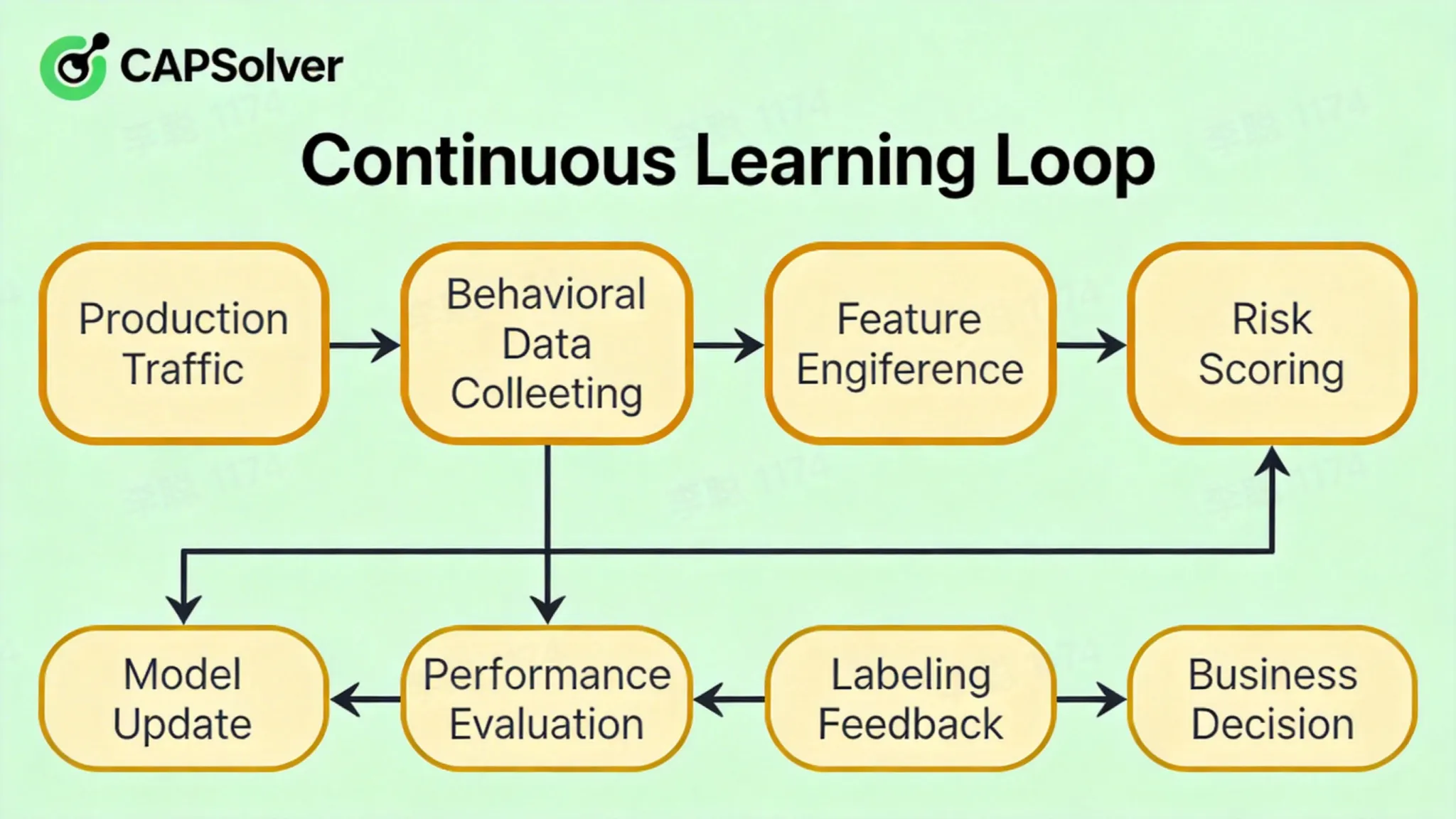
Continuous Learning Loop
[Production Traffic] → [Behavioral Data Collection] → [Feature Engineering] → [Model Inference] → [Risk Scoring]
↑ ↓
[Model Update] ← [Performance Evaluation] ← [Labeling Feedback] ← [Business Decision]
Deep Integration with Business Risk Control
| Integration Scenario | Technical Implementation | Business Value |
|---|---|---|
| Login Protection | CAPTCHA score + device fingerprint + IP reputation → unified risk score | Precisely intercept automated logins, reduce false positives |
| Registration Anti-fraud | Abnormal verification behavior → trigger phone/email secondary verification | Identify batch registrations, protect user pool quality |
| Marketing Activities | Flash sales scenarios, real-time human-machine recognition → dynamic rate limiting | Prevent automated snatching, protect real user rights |
| Payment Security | Mandatory verification before high-risk operations + behavioral review | Block automated fraudulent transactions, reduce asset loss |
For more insights on modern automation, see our guide on why web automation keeps failing on CAPTCHA
Typical Journey from Experiment to Production
Phase One: Proof of Concept (PoC, 1-2 months)
Phase Two: Pilot Deployment (Pilot, 3-6 months)
Phase Three: Production at Scale (Production, 6-12 months)
Phase Four: Platform Operation (Platform, 1-2 years)
| Comparison Dimension | Non-Enterprise Solutions (OpenClaw / Traditional OCR) | Enterprise CAPTCHA AI Visual Recognition |
|---|---|---|
| Deployment Complexity | ✅ Simple, Docker one-click startup | ❌ Complex, requires MLOps platform support |
| Initial Cost | ✅ Low, single GPU sufficient | ❌ High, requires cluster + labeling team |
| Model Updates | ❌ Fixed weights, easily targeted by automated recognition | ✅ Online learning, continuous evolution |
| Behavioral Analysis | ❌ Pure image recognition, no behavioral dimension | ✅ Multimodal fusion, precise human-machine differentiation |
| Risk Control Linkage | ❌ Isolated system, no contextual awareness | ✅ Deep integration with WAF, device fingerprints |
| High Availability | ❌ Single point of deployment, no SLA guarantee | ✅ Multi-active architecture, elastic scaling |
| Compliance Support | ❌ Weak audit logs, privacy compliance | ✅ GDPR/CCPA adaptation, complete audit |
| Applicable Scenarios | Small and medium businesses, internal testing, short-term projects | Large-scale production, finance, e-commerce, government affairs |
Technology Evolution Trends
| Evolution Direction | Current State | Next 3-5 Years |
|---|---|---|
| Verification Method | Passive challenges (user required to perform actions) | Invisible CAPTCHA, based on background behavioral analysis |
| Model Architecture | Specialized small models (CNN/LSTM) | Multimodal large models (GPT-4V-like architecture fine-tuning) |
| Challenge Generation | Fixed question bank + limited variations | Generative AI real-time synthesis (one question per person, every question different) |
| Decision Logic | Binary classification (human/machine) | Continuous risk scoring + dynamic strategy orchestration |
| Verification Mode | Single-point verification | Federated learning collaboration, industry-level automated recognition intelligence sharing |
Imagination Space for Generative CAPTCHA
Using Diffusion Models or GANs to generate verification content in real-time:
| Time Dimension | Action Item | Key Milestone | Goal |
|---|---|---|---|
| Short-term (1-3 months) | Automated Recognition Surface Assessment | Complete OpenClaw simulated automated recognition, quantify current CAPTCHA MTBF | Establish risk awareness, secure resource investment |
| Monitoring System Construction | Deploy automated recognition detection rules, identify automated traffic characteristics | From "passive response" to "visible recognition" | |
| Mid-term (3-12 months) | Data Infrastructure | Build behavioral data collection pipelines, accumulate 10 million+ labeled samples | Possess the data foundation for training production-grade models |
| Model Iteration and Launch | First deep learning model A/B testing, verify recognition defense effectiveness | Prove technical feasibility, build team confidence | |
| Long-term (1-2 years) | Platformization | CAPTCHA service SLA reaches 99.99%, supports 100,000 QPS | Become a core security infrastructure for the company |
| AI Security Strategy | Integrate into a unified risk control platform, link with anti-fraud | Form a multi-dimensional AI verification system |
As a technology provider focused on delivering efficient and stable AI visual recognition services, CapSolver possesses significant advantages in image CAPTCHA recognition and custom solver training:
Use code
CAP26when signing up at CapSolver to receive bonus credits!
| Resource Type | Recommended Content | Value |
|---|---|---|
| Open Source Projects | OpenClaw & CapSolver | Understanding automated recognition technology stacks |
| Industry Reports | Gartner Market Guide for Fraud Detection | Reference for commercial solution selection |
With the rapid advancement of AI technology, CAPTCHA recognition is no longer a simple technical challenge but a critical capability for enterprises to acquire public data and ensure business continuity in the digital age. AI visual large models, with their excellent complex scene understanding, powerful generalization capabilities, and efficient model scalability, provide unprecedented solutions for enterprise-level automated recognition. CapSolver, with its deep accumulation in AI visual recognition and enterprise-grade service capabilities, is committed to being your trusted partner, helping enterprises efficiently and compliantly address various CAPTCHA challenges, and focus on creating core business value.
Q1: How do Large Visual Models (LVMs) differ from traditional CNNs in CAPTCHA recognition?
A1: Unlike traditional CNNs that rely on local feature extraction, LVMs utilize architectures like Vision Transformers (ViT) to capture global context and semantic meaning. This allows them to understand complex scenes and generalize to new, unseen CAPTCHA styles with much higher accuracy and minimal additional training.
Q2: What is "Few-shot Learning" in the context of AI-based CAPTCHA solvers?
A2: Few-shot learning refers to the ability of a pre-trained AI model to adapt to a new task (like a new type of CAPTCHA) using only a very small number of labeled examples. This is a core advantage of large models, enabling rapid deployment against evolving verification mechanisms.
Q3: What types of image CAPTCHAs does CapSolver support?
A3: CapSolver has deeply optimized its recognition algorithms for mainstream and complex image CAPTCHAs, supporting types including but not limited to image classification and object detection.
Check the image Solution : Imagetotext & VisionEngine
Q4: How does CapSolver ensure the accuracy and stability of recognition?
A4: CapSolver is based on advanced large visual model technology, continuously optimizing model performance through a continuous learning loop and online learning mechanisms. Additionally, we provide enterprise-grade APIs and a high-concurrency architecture, ensuring millisecond-level responses and 99.9% availability.
Q5: Does CapSolver's service support private deployment?
A5: CapSolver offers flexible deployment options, including cloud services and private deployment, to meet the security and compliance needs of different enterprises. Private deployment solutions can be customized based on the enterprise's specific architecture and resources.
Ethan Collins
AI Agent Workflow Engineer
Building clearer handoffs between AI agents and tools.
ABOUT THE AUTHOR
Discover how AI agents transform web scraping and competitive intelligence. Learn about automated data collection, anti-bot challenges, and CAPTCHA solutions for scalable workflows.

Discover the key differences between AI agent vs chatbot. Learn how agentic AI outperforms traditional AI in automation, decision-making, and complex workflows.