Agentic AI vs AI Agents: Key Differences for Automation Engineers

Nikolai Smirnov
Software Development Lead
TL;Dr
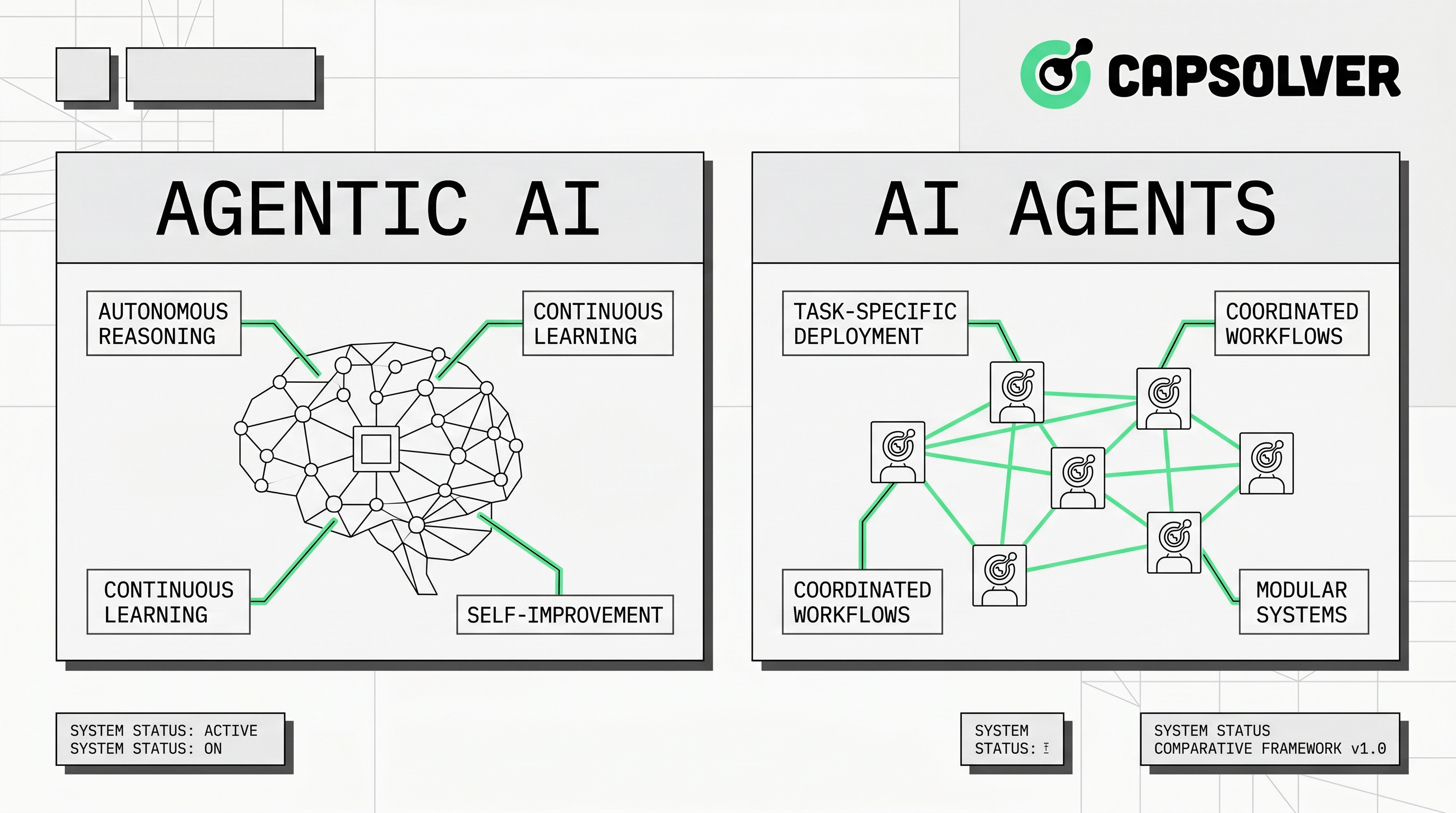
- AI Agents are task-focused components designed to execute specific, well-defined actions within explicit boundaries.
- Agentic AI is a broader system that orchestrates multiple agents, plans multi-step workflows, and adapts to dynamic environments autonomously.
- Automation engineers must understand this distinction to build scalable, resilient systems rather than brittle, single-purpose scripts.
- While Agentic AI excels at complex reasoning, it still struggles with security mechanisms like CAPTCHAs, requiring specialized solutions.
- Integrating services like CapSolver into agentic workflows ensures seamless data extraction and uninterrupted automation.
Introduction
The landscape of enterprise automation is evolving rapidly, shifting from rigid scripts to intelligent, autonomous systems. For automation engineers, understanding the distinction between agentic ai vs ai agents is no longer just an academic exercise; it is a critical requirement for designing resilient workflows. While AI agents have proven invaluable for executing specific tasks, they often fall short when faced with complex, multi-step processes that require dynamic reasoning. This is where Agentic AI steps in, offering a higher-level orchestration layer that can plan, adapt, and coordinate multiple tools to achieve broader business goals. This article explores the fundamental differences between these two concepts, their practical applications, and how engineers can overcome common automation hurdles like CAPTCHA challenges.
What Are AI Agents?
An AI agent is a specialized software entity designed to perform a single, well-defined task. It operates within explicit boundaries set by its design and permissions, relying on predefined rules, machine learning models, or natural language processing to interpret inputs and execute actions.
AI agents are highly effective at focused automation. For instance, a data extraction agent might pull specific fields from an invoice, while a customer support agent might route tickets based on keywords. However, they lack true autonomy. They do not set their own goals, nor do they possess the ability to adapt when conditions change unexpectedly. According to ISACA, traditional AI agents often work independently on specific tasks and require human intervention for complex decisions.
Types of AI Agents in Automation
Automation engineers typically deploy several types of AI agents, each suited for different scenarios:
- Reactive Agents: These respond directly to incoming inputs using predefined rules, such as triggering an alert when a server goes offline.
- Model-Based Agents: These maintain an internal representation of their environment, allowing them to make informed decisions, like updating access permissions based on user context.
- Learning Agents: These improve over time by adjusting their behavior based on outcomes and feedback, such as refining search relevance based on user queries.
What Is Agentic AI?
Agentic AI represents a paradigm shift from task execution to goal orchestration. It is not a single entity but a comprehensive system that coordinates multiple AI agents, data sources, and external tools to execute complex, multi-step workflows.
The core defining feature of Agentic AI is its autonomy. Instead of simply following instructions, an agentic system is given a high-level objective. It then independently determines the necessary sequence of actions, selects the appropriate agents for each step, and adapts its plan based on real-time feedback. As noted by Moveworks, Agentic AI introduces the ability to plan, reason, and route across multiple systems, turning isolated tasks into unified outcomes.
Core Capabilities of Agentic Systems
To achieve this level of autonomy, Agentic AI relies on several advanced capabilities:
- Goal-Oriented Reasoning: Interpreting the end goal and selecting the optimal sequence of actions to reach it.
- Multi-Step Planning: Breaking down complex workflows into manageable sub-tasks and coordinating the necessary resources.
- Dynamic Adaptation: Adjusting plans in real-time based on new information, exceptions, or changing environmental conditions.
- Cross-System Orchestration: Executing work across various applications and APIs while maintaining context and governance.
Agentic AI vs AI Agents: Comparison Summary
To clarify the agentic ai vs ai agents debate, it is helpful to look at their characteristics side-by-side. The following table highlights the key differences that matter most for automation engineers.
| Feature | AI Agents | Agentic AI |
|---|---|---|
| Primary Focus | Executing specific, well-defined tasks | Orchestrating complex, multi-step workflows |
| Autonomy Level | Low; operates within explicit boundaries | High; plans and adapts independently |
| Goal Management | Follows predefined rules or instructions | Sets sub-goals to achieve a high-level objective |
| Adaptability | Limited; struggles with unexpected changes | Dynamic; adjusts strategy based on real-time feedback |
| System Role | Acts as a building block or component | Acts as the orchestrator or "conductor" |
| Ideal Use Case | Data extraction, ticket routing, basic Q&A | End-to-end process automation, autonomous research |
The Role of Agentic AI in Web Automation
For automation engineers, web automation is one of the most compelling applications of Agentic AI. Traditional web scraping relies on rigid scripts that easily break when a website's layout changes. In contrast, an agentic system can visually parse a webpage, identify necessary elements, and adapt to structural changes on the fly.
This capability is invaluable for tasks like market research, competitor analysis, and dynamic pricing models. An agentic AI system can navigate paginated results, handle complex login flows, and extract structured data from JavaScript-rendered pages. By leveraging Agentic AI Overview: Use Cases in Web Automation, engineers can build robust data pipelines that require significantly less maintenance than conventional scripts.
The CAPTCHA Challenge in Agentic Workflows
Despite their advanced reasoning capabilities, Agentic AI systems face a significant technical hurdle when interacting with the web: CAPTCHAs. These security mechanisms are specifically designed to differentiate between human users and automated bots, posing a persistent challenge for even the most sophisticated AI.
Why Agentic AI Struggles with CAPTCHAs
Agentic systems encounter several difficulties when attempting to solve CAPTCHAs autonomously:
- Precision Gaps: Many CAPTCHAs, such as slider puzzles, require fine-grained spatial control and pixel-perfect accuracy that multimodal AI models often lack.
- Cognitive Limitations: Humans use intuition to quickly recognize patterns in distorted text or ambiguous images, a task that can confuse AI vision models.
- Behavioral Detection: Modern CAPTCHAs analyze user behavior, such as mouse movements and typing speed. AI agents often exhibit mechanical patterns that trigger security blocks.
According to research on traditional automation vs agentic AI, while autonomy covers messy work, security mechanisms still require specialized handling to prevent workflow interruptions.
Redeem Your CapSolver Bonus Code
Boost your automation budget instantly!
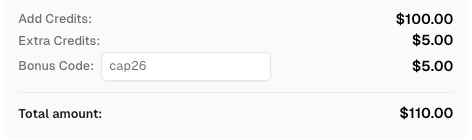
Use bonus code CAP26 when topping up your CapSolver account to get an extra 5% bonus on every recharge — with no limits.
Redeem it now in your CapSolver Dashboard
Bridging the Gap with CapSolver
To ensure uninterrupted automation, engineers must integrate specialized CAPTCHA-solving services into their agentic workflows. This is where CapSolver becomes an essential tool. CapSolver provides an enterprise-grade infrastructure for seamless CAPTCHA recognition, allowing Agentic AI systems to bypass security checks without manual intervention.
By utilizing CapSolver's API, automation engineers can handle a wide variety of challenges, including reCAPTCHA, Cloudflare Turnstile, and AWS WAF. This integration ensures that the agentic system can focus on high-level reasoning and data extraction, while CapSolver handles the complex task of human verification. For teams building scrapers in platforms like n8n, integrating CapSolver is straightforward and highly effective, as detailed in this guide on How to Build Scrapers for Web Scraping in n8n with CapSolver.
Code Example: Integrating CapSolver
When building an agentic workflow, integrating CapSolver requires minimal code. Below is a basic example of how an automation engineer might use Python to solve a reCAPTCHA v2 challenge using the CapSolver API.
python
import requests
import time

API_KEY = "YOUR_CAPSOLVER_API_KEY"
SITE_KEY = "PAGE_SITE_KEY"
PAGE_URL = "PAGE_URL"

def solve_recaptcha():
    payload = {
        "clientKey": API_KEY,
        "task": {
            "type": "ReCaptchaV2TaskProxyLess",
            "websiteURL": PAGE_URL,
            "websiteKey": SITE_KEY
        }
    }

    response = requests.post("https://api.capsolver.com/createTask", json=payload)
    task_id = response.json().get("taskId")

    if not task_id:
        print("Failed to create task")
        return None

    print(f"Task created: {task_id}. Waiting for solution...")

    while True:
        time.sleep(3)
        result = requests.post("https://api.capsolver.com/getTaskResult", json={
            "clientKey": API_KEY,
            "taskId": task_id
        })

        status = result.json().get("status")
        if status == "ready":
            print("CAPTCHA solved successfully!")
            return result.json().get("solution").get("gRecaptchaResponse")
        elif status == "failed":
            print("Failed to solve CAPTCHA")
            return None

# Use the token in your agentic workflow
token = solve_recaptcha()
Note: Always refer to the official CapSolver Documentation for the most up-to-date integration methods.
Conclusion
The evolution from AI agents to Agentic AI marks a significant milestone in enterprise automation. While AI agents are excellent for executing specific tasks, Agentic AI provides the orchestration, reasoning, and adaptability needed to automate complex, end-to-end workflows. For automation engineers, mastering the differences between agentic ai vs ai agents is essential for building scalable and resilient systems.
However, as these systems interact with the web, they inevitably encounter security mechanisms designed to block automated traffic. By integrating specialized solutions like CapSolver, engineers can overcome these hurdles, ensuring their agentic workflows operate smoothly, efficiently, and without interruption.
FAQ
1. What is the main difference between an AI agent and Agentic AI?
An AI agent is a specialized component designed to execute a single, specific task within predefined rules. Agentic AI is a broader system that orchestrates multiple agents, plans multi-step workflows, and adapts autonomously to achieve a high-level goal.
2. Why do automation engineers need Agentic AI?
Automation engineers need Agentic AI to handle complex, dynamic processes that traditional scripts or single-purpose AI agents cannot manage. Agentic systems can adapt to changes, such as website layout updates, reducing the need for constant maintenance.
3. Can Agentic AI solve CAPTCHAs on its own?
Generally, no. While Agentic AI has advanced reasoning capabilities, it often lacks the pixel-perfect precision and human-like behavioral patterns required to solve modern CAPTCHAs. Specialized services are usually required.
4. How does CapSolver help in agentic workflows?
CapSolver provides an API that seamlessly integrates into agentic workflows to solve various CAPTCHA types (like reCAPTCHA and Cloudflare) automatically. This allows the AI system to continue its data extraction or automation tasks without being blocked.
5. Is it difficult to integrate CapSolver into existing automation tools?
No, integrating CapSolver is straightforward. It offers comprehensive APIs and supports popular automation frameworks like n8n, Puppeteer, and Selenium, making it easy for engineers to add CAPTCHA-solving capabilities to their existing pipelines.
More
AIApr 28, 2026
AI Agents in Web Scraping & Competitive Intelligence Guide
Discover how AI agents transform web scraping and competitive intelligence. Learn about automated data collection, anti-bot challenges, and CAPTCHA solutions for scalable workflows.

AIApr 24, 2026
AI Agent vs Chatbot: Key Differences in Automation Capabilities
Discover the key differences between AI agent vs chatbot. Learn how agentic AI outperforms traditional AI in automation, decision-making, and complex workflows.