AI Agent vs Chatbot: Key Differences in Automation Capabilities

Emma Foster
Machine Learning Engineer
TL;Dr
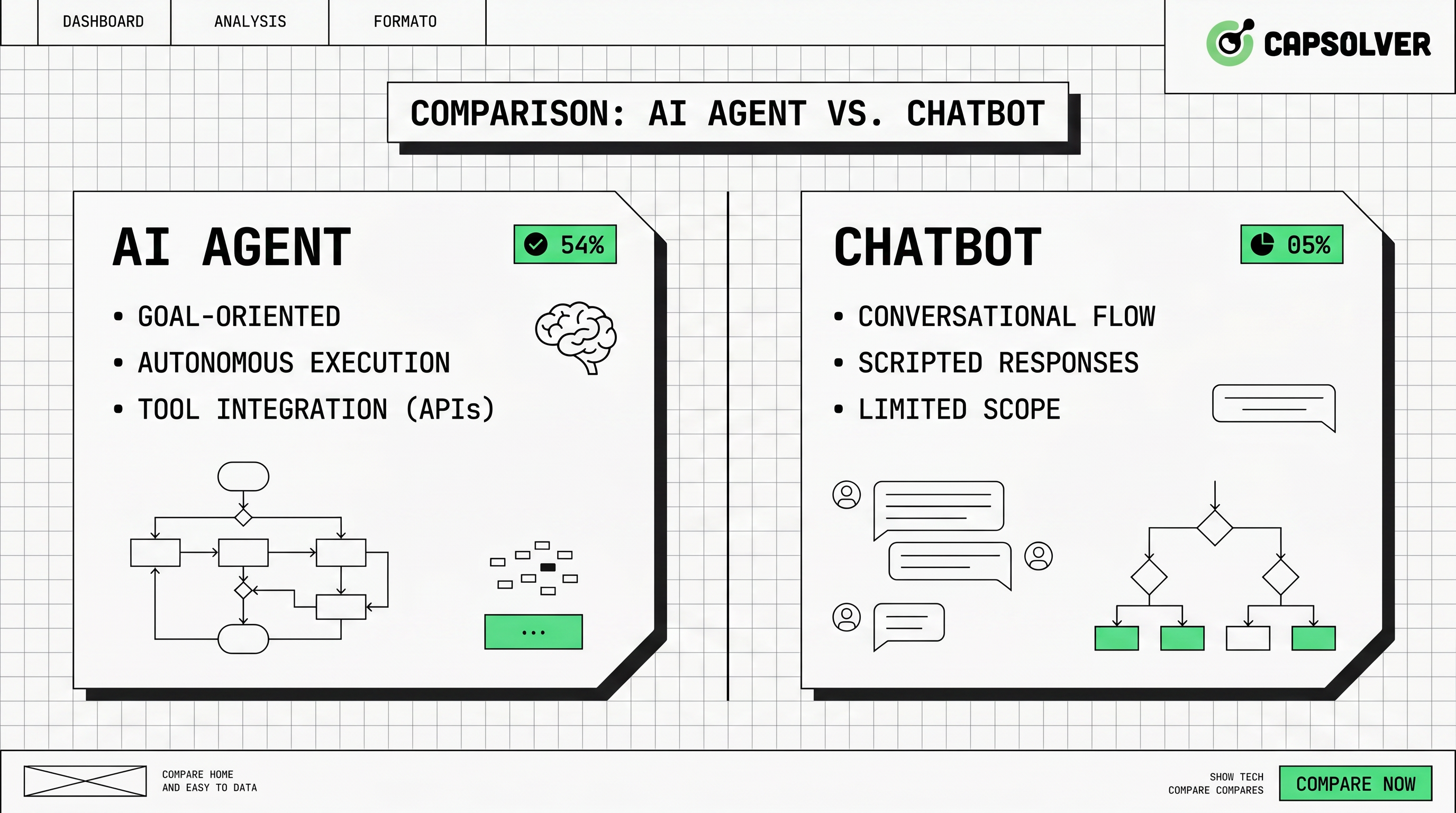
- Core Distinction: Chatbots are reactive, script-driven conversational interfaces designed for simple Q&A, whereas AI agents are proactive, autonomous systems capable of multi-step reasoning and executing complex workflows.
- Agentic AI vs Traditional AI: Traditional AI (like standard chatbots) waits for user prompts and follows predefined paths. Agentic AI sets sub-goals, uses external tools, and adapts to dynamic environments without human intervention.
- Automation Impact: While chatbots handle routine customer service, AI agents can orchestrate end-to-end business processes, from data extraction to supply chain optimization.
- The CAPTCHA Challenge: Even the most advanced AI agents struggle with security mechanisms like CAPTCHAs during web automation. Integrating specialized solutions like CapSolver is essential for uninterrupted agentic workflows.
Introduction
For years, businesses have relied on digital assistants to handle routine customer inquiries and basic tasks. However, as enterprise automation demands grow more complex, the limitations of these early systems have become glaringly apparent. Today, the conversation has shifted from simple conversational interfaces to autonomous systems that can actually get work done. Understanding the ai agent vs chatbot differences is no longer just a technical exercise; it is a strategic imperative for organizations looking to scale their operations. This article explores the fundamental distinctions between an AI agent and a chatbot, the rise of agentic AI vs traditional AI, and how these technologies impact real-world automation capabilities. By the end, you will understand which system fits your business needs and how to overcome common automation hurdles.
What is a Chatbot? The Foundation of Conversational AI
A chatbot is a software application designed to simulate human conversation through text or voice interactions. At its core, a traditional chatbot operates on predefined rules, decision trees, and scripted responses. When a user asks a question, the chatbot uses basic natural language processing (NLP) to identify keywords and deliver a pre-programmed answer.
How Chatbots Work
Chatbots function much like a digital vending machine. They possess a fixed inventory of responses and require specific inputs to dispense the correct information. They are highly effective for straightforward, repetitive tasks but lack the ability to understand deep context or deviate from their programmed conversational flows.
Common Chatbot Use Cases
- Customer Service FAQs: Answering common questions about store hours, return policies, or shipping status.
- Basic IT Support: Guiding employees through simple password resets or software installation steps.
- Lead Qualification: Collecting basic contact information from website visitors before routing them to a human sales representative.
While the global chatbot market is projected to reach $60.21 billion by 2034, their role remains largely confined to reactive, single-turn interactions rather than proactive problem-solving.
What is an AI Agent? The Evolution of Autonomous Action
An AI agent represents a significant leap forward in artificial intelligence. Unlike a chatbot, an AI agent is an autonomous system capable of reasoning, planning, and taking independent actions to achieve a specific goal. It does not merely answer questions; it executes complex, multi-step workflows across various applications and data sources.
The Mechanics of AI Agents
AI agents operate on a continuous perception-reasoning-action loop. They perceive their environment (such as reading a webpage or analyzing a database), reason about the best course of action to achieve their objective, and then execute that action using external tools or APIs. If they encounter an obstacle, they can dynamically adjust their plan.
Agentic AI vs Traditional AI
The distinction between agentic ai vs traditional ai is crucial here. Traditional AI (including standard chatbots) is reactive; it waits for a prompt and generates an output based on its training data. Agentic AI, on the other hand, is proactive. It can break down a high-level command like "research our top three competitors and summarize their pricing models" into a series of logical steps, execute web searches, scrape data, and compile a final report without further human guidance.
According to recent industry studies, 90% of enterprises are actively adopting AI agents to streamline operations and reduce manual workloads. For a deeper technical understanding of how these systems operate, see What Is Agentic AI and How It Works.
AI Agent vs Chatbot Differences: A Detailed Comparison
To fully grasp the ai agent vs chatbot dynamic, we must examine how they differ across several critical dimensions of automation.
1. Autonomy and Decision-Making
Chatbots require constant human direction. They follow a script and stop working when the conversation falls outside their predefined parameters. AI agents possess high autonomy. They can make independent decisions, choose which tools to use, and navigate ambiguous situations to complete their assigned tasks.
2. Task Complexity and Workflow Orchestration
A chatbot is designed for single-turn interactions—answering one question at a time. AI agents excel at multi-step orchestration. For example, while a chatbot might tell a user how to book a flight, an AI agent can check multiple airline websites, compare prices, select the best option based on user preferences, and complete the booking process autonomously.
3. Learning and Memory
Traditional chatbots have limited memory, often forgetting the context of a conversation once the session ends. AI agents utilize both short-term and long-term memory. They remember past interactions, learn from their successes and failures, and continuously improve their performance over time.
Comparison Summary Table
| Feature | Chatbot | AI Agent |
|---|---|---|
| Primary Function | Simulating conversation and answering queries | Executing complex tasks and achieving goals |
| Operational Mode | Reactive (waits for user input) | Proactive (takes independent action) |
| Decision Making | Rule-based, follows predefined scripts | Autonomous reasoning and dynamic planning |
| Task Complexity | Simple, single-step interactions | Complex, multi-step workflow orchestration |
| Tool Integration | Limited to internal databases | Extensive use of external APIs and web tools |
| Adaptability | Fails when encountering unknown scenarios | Adapts to changes and finds alternative solutions |
The Role of AI Agents in Web Automation
One of the most powerful applications of AI agents is in the realm of web automation and data extraction. Traditional web scraping relies on rigid scripts that break easily when a website updates its layout. Agentic AI systems, however, can visually parse a webpage, identify the necessary elements, and adapt to structural changes on the fly.
This capability is transforming how businesses gather intelligence. By leveraging Agentic AI Overview: Use Cases in Web Automation, engineers can build robust data pipelines that require significantly less maintenance. Whether it is monitoring competitor pricing, aggregating financial data, or automating supply chain logistics, AI agents provide a level of resilience that traditional automation tools simply cannot match.
The Hidden Barrier: CAPTCHAs in Agentic Workflows
Despite their advanced reasoning and autonomous capabilities, AI agents face a significant technical hurdle when interacting with the web: CAPTCHAs. These security mechanisms are specifically designed to differentiate between human users and automated bots, posing a persistent challenge for even the most sophisticated agentic systems.
Why Agentic AI Struggles with CAPTCHAs
When an AI agent attempts to scrape data or automate a process on a protected website, it often encounters CAPTCHAs (Completely Automated Public Turing test to tell Computers and Humans Apart). Agentic systems struggle here for several reasons:
- Precision Requirements: Many CAPTCHAs, such as slider puzzles or complex image recognition tasks, require fine-grained spatial control and pixel-perfect accuracy that multimodal AI models often lack.
- Behavioral Analysis: Modern CAPTCHAs (like reCAPTCHA v3 or Cloudflare Turnstile) analyze user behavior, including mouse movements, click patterns, and typing speed. AI agents often exhibit mechanical, predictable patterns that immediately trigger security blocks.
- Dynamic Risk Scoring: Anti-bot systems continuously update their risk scoring algorithms. An AI agent that successfully navigates a site today might be blocked tomorrow if its digital fingerprint is flagged.
As organizations scale their data collection efforts, understanding How to Choose CAPTCHA Solving API becomes critical to maintaining uninterrupted automation pipelines.
Bridging the Automation Gap with CapSolver
To fully realize the potential of agentic AI in web automation, businesses must address the CAPTCHA bottleneck. This is where specialized solutions like CapSolver become indispensable.
CapSolver provides a robust, AI-powered infrastructure designed to seamlessly integrate with your automation workflows. By handling complex security challenges in the background, CapSolver allows your AI agents to focus on their primary objectives—whether that is data extraction, market research, or process automation.
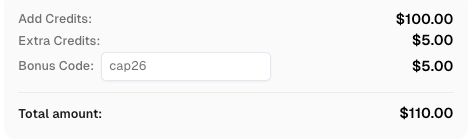
Use code
CAP26when signing up at CapSolver to receive bonus credits!
How CapSolver Enhances Agentic Workflows
- Comprehensive Coverage: CapSolver supports a wide range of security mechanisms, including reCAPTCHA, hCaptcha, Cloudflare Turnstile, and AWS WAF, ensuring your agents can navigate diverse web environments.
- High Success Rates: Utilizing advanced machine learning algorithms, CapSolver delivers high accuracy and fast response times, minimizing workflow interruptions.
- Seamless Integration: CapSolver can be easily integrated into existing automation frameworks, including headless browsers. For developers looking to optimize their setups, reading about Automating CAPTCHA Solving in Headless Browsers provides practical implementation strategies.
By offloading the burden of CAPTCHA resolution to CapSolver, organizations can ensure their AI agents operate at peak efficiency, delivering reliable and scalable automation.
CapSolver Code Example
Integrating CapSolver into your Python automation script is straightforward. Here is a basic example of how to solve a reCAPTCHA v2 challenge using the CapSolver API:
python
import requests
import time

API_KEY = "YOUR_CAPSOLVER_API_KEY"
SITE_KEY = "PAGE_SITE_KEY"
PAGE_URL = "PAGE_URL"

def solve_recaptcha():
    payload = {
        "clientKey": API_KEY,
        "task": {
            "type": "ReCaptchaV2TaskProxyLess",
            "websiteURL": PAGE_URL,
            "websiteKey": SITE_KEY
        }
    }

    # Create the task
    res = requests.post("https://api.capsolver.com/createTask", json=payload)
    task_id = res.json().get("taskId")

    if not task_id:
        print("Failed to create task:", res.text)
        return None

    print(f"Task created: {task_id}. Waiting for solution...")

    # Poll for the result
    while True:
        time.sleep(3)
        res = requests.post("https://api.capsolver.com/getTaskResult", json={
            "clientKey": API_KEY,
            "taskId": task_id
        })
        status = res.json().get("status")

        if status == "ready":
            print("CAPTCHA solved successfully!")
            return res.json().get("solution").get("gRecaptchaResponse")
        elif status == "failed":
            print("Failed to solve CAPTCHA:", res.text)
            return None

# Execute the solver
response_token = solve_recaptcha()
Conclusion
The transition from reactive chatbots to proactive AI agents marks a fundamental shift in enterprise technology. Gartner predicts that by 2028, 33% of enterprise software applications will include agentic AI, up from less than 1% in 2024. While chatbots remain useful for basic, scripted interactions, AI agents offer the autonomy, reasoning, and adaptability required to orchestrate complex business workflows. Understanding the ai agent vs chatbot differences allows organizations to deploy the right tool for the right job.
However, as agentic AI takes on more advanced web automation tasks, it inevitably encounters sophisticated anti-bot security measures. To maintain scalable and resilient data pipelines, integrating a reliable CAPTCHA solving service is essential. By leveraging CapSolver, businesses can empower their AI agents to navigate the web seamlessly, unlocking the true potential of autonomous automation.
FAQ
1. What is the main difference between an AI agent and a chatbot?
The primary difference lies in autonomy and capability. A chatbot is a reactive interface that answers questions based on predefined scripts or training data. An AI agent is a proactive system that can reason, plan multi-step workflows, use external tools, and take independent action to achieve a specific goal.
2. What does "Agentic AI" mean?
Agentic AI refers to artificial intelligence systems that possess agency—the ability to act autonomously. Unlike traditional AI that waits for user prompts, agentic AI can set sub-goals, adapt to changing environments, and execute complex tasks without continuous human intervention.
3. Can AI agents replace chatbots entirely?
Not necessarily. Chatbots are still highly cost-effective and efficient for handling simple, high-volume inquiries like basic customer service FAQs. AI agents are better suited for complex, multi-step processes that require reasoning and integration with external systems. Businesses will likely use a hybrid approach, deploying both technologies where they fit best.
4. Why do AI agents struggle with CAPTCHAs during web automation?
AI agents struggle with CAPTCHAs because these security measures are designed to detect non-human behavior. Agents often lack the pixel-perfect precision required for complex image puzzles and tend to exhibit mechanical browsing patterns (like uniform typing speed or linear mouse movements) that trigger anti-bot defenses.
5. How does CapSolver help AI agents in automation workflows?
CapSolver provides an API that automatically solves various types of CAPTCHAs (such as reCAPTCHA, Turnstile, and AWS WAF) in the background. By integrating CapSolver, AI agents can bypass these security roadblocks seamlessly, ensuring uninterrupted data extraction and web automation processes.
More
AIApr 28, 2026
AI Agents in Web Scraping & Competitive Intelligence Guide
Discover how AI agents transform web scraping and competitive intelligence. Learn about automated data collection, anti-bot challenges, and CAPTCHA solutions for scalable workflows.

AIApr 24, 2026
Agentic AI vs AI Agents: Key Differences for Automation Engineers
Discover the key differences between Agentic AI and AI Agents. Learn how automation engineers can build scalable workflows and solve CAPTCHAs efficiently.