
🎉NEWCapSolver for AI agents-MCP, agent tools, and SDK integrations

Ethan Collins
AI Agent Workflow Engineer
Published Jul 08, 2026
Updated Jul 08, 2026 · min read
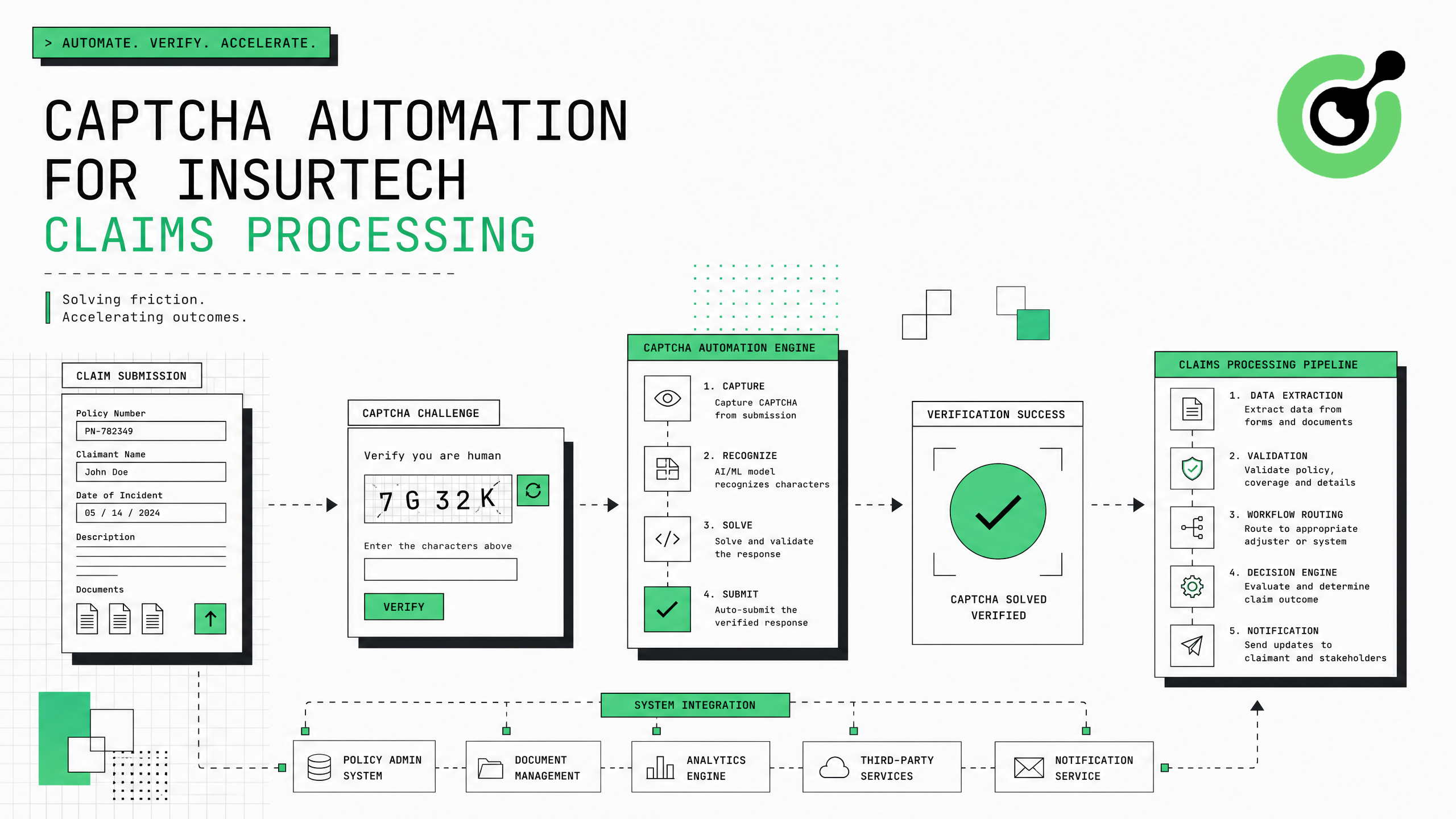
Insurance technology companies automate claims processing by accessing carrier portals, regulatory databases, and medical record systems. CAPTCHA challenges on these platforms create delays in claims adjudication, policy verification, and fraud detection workflows. This guide covers how to implement CAPTCHA automation for InsurTech claims processing pipelines, including carrier portal integration, compliance requirements, and production-grade architecture patterns.
Insurance claims processing requires accessing multiple external systems: carrier portals for policy verification, state insurance department databases for regulatory compliance, medical coding systems for claims validation, and fraud detection databases for risk assessment. These systems deploy CAPTCHA protection to prevent unauthorized bulk access and manage server load.
The timing pressure in claims processing makes CAPTCHA challenges particularly disruptive. NAIC guidelines require insurers to acknowledge claims within specific timeframes — typically 15-30 days depending on state regulations. When automated systems encounter CAPTCHAs on carrier portals, claims sit in processing queues, potentially violating regulatory timelines.
Common scenarios where CAPTCHAs interrupt InsurTech workflows include policy status verification on carrier portals, eligibility checks on state insurance databases, medical record retrieval from healthcare information exchanges, subrogation research across multiple carrier systems, and fraud indicator checks on industry databases. Each portal may use different CAPTCHA types, from reCAPTCHA v2 on older carrier systems to Cloudflare Turnstile on modern platforms.
Prepare these components for your InsurTech CAPTCHA automation implementation:
aiohttp, requests, and your RPA framework (UiPath, Automation Anywhere, or custom)Ensure your organization has proper Business Associate Agreements (BAAs) in place with any third-party services that may process or transmit protected health information (PHI) during claims automation.
Insurance claims processing typically involves 20-50 different carrier portals. Document the CAPTCHA configuration for each portal in a structured registry:
CARRIER_PORTALS = {
    "carrier_a_claims": {
        "name": "Major Carrier A - Claims Portal",
        "url": "https://claims.carrier-a.com",
        "captcha_type": "ReCaptchaV2TaskProxyLess",
        "site_key": "6Le...",
        "trigger": "login_and_every_50_requests",
        "phi_present": True,
        "baa_required": True
    },
    "state_insurance_db": {
        "name": "State Insurance Department Database",
        "url": "https://insurance.state.gov/verify",
        "captcha_type": "ImageToTextTask",
        "trigger": "every_request",
        "phi_present": False,
        "baa_required": False
    },
    "medical_records_hie": {
        "name": "Health Information Exchange",
        "url": "https://hie-portal.example.com",
        "captcha_type": "AntiTurnstileTaskProxyLess",
        "site_key": "0x4B...",
        "trigger": "after_authentication",
        "phi_present": True,
        "baa_required": True
    },
    "fraud_detection_db": {
        "name": "Industry Fraud Database",
        "url": "https://fraud-check.insurance-industry.org",
        "captcha_type": "ReCaptchaV3TaskProxyLess",
        "site_key": "6Ld...",
        "page_action": "verify",
        "min_score": 0.7,
        "trigger": "rate_limited",
        "phi_present": False,
        "baa_required": False
    }
}
Use the CapSolver browser extension to identify CAPTCHA parameters on each carrier portal during your initial setup phase. Record whether each portal contains PHI to determine appropriate security controls.
InsurTech companies interact with dozens of carrier systems. A centralized CAPTCHA registry ensures consistent handling across all portals and simplifies maintenance when carriers update their protection systems. The PHI classification drives security architecture decisions for the solving pipeline.
InsurTech CAPTCHA automation must comply with healthcare data protection requirements. The solving pipeline must ensure that no PHI is transmitted to external services during the CAPTCHA solving process:
import asyncio
import aiohttp
import time
import logging
from typing import Dict, Optional
from dataclasses import dataclass

CAPSOLVER_API_KEY = "YOUR_API_KEY"
CAPSOLVER_BASE = "https://api.capsolver.com"

@dataclass
class SolveAuditEntry:
    """Audit record for compliance documentation."""
    timestamp: float
    claim_id: str
    portal_name: str
    captcha_type: str
    solve_duration: float
    success: bool
    phi_context: bool  # Whether PHI was present on the page

class InsurTechCaptchaSolver:
    """CAPTCHA solver with HIPAA compliance controls."""

    def __init__(self, api_key: str, audit_logger: logging.Logger):
        self.api_key = api_key
        self.audit = audit_logger
        self.session: Optional[aiohttp.ClientSession] = None

    async def solve_for_claim(self, portal_config: Dict, claim_id: str) -> Dict:
        """Solve CAPTCHA with compliance-aware processing."""
        # Verify no PHI is included in the solving request
        self._validate_no_phi_in_request(portal_config)

        start_time = time.time()
        session = await self._get_session()

        # Build task payload - only CAPTCHA parameters, never page content
        task_payload = {
            "type": portal_config["captcha_type"],
            "websiteURL": portal_config["url"],
        }

        if "site_key" in portal_config:
            task_payload["websiteKey"] = portal_config["site_key"]
        if "page_action" in portal_config:
            task_payload["pageAction"] = portal_config["page_action"]
        if "min_score" in portal_config:
            task_payload["minScore"] = portal_config["min_score"]

        # Submit solving task
        create_payload = {"clientKey": self.api_key, "task": task_payload}
        async with session.post(f"{CAPSOLVER_BASE}/createTask", json=create_payload) as resp:
            result = await resp.json()
            if result.get("errorId") != 0:
                self._log_failure(claim_id, portal_config, result)
                raise Exception(f"Task creation failed: {result.get('errorDescription')}")
            task_id = result["taskId"]

        # Poll for result with timeout
        solution = await self._poll_result(task_id, timeout=90)
        solve_duration = time.time() - start_time

        # Audit log
        self.audit.info(
            f"CAPTCHA_SOLVE claim={claim_id} portal={portal_config['name']} "
            f"type={portal_config['captcha_type']} duration={solve_duration:.1f}s success=True"
        )

        return solution

    def _validate_no_phi_in_request(self, portal_config: Dict):
        """Ensure CAPTCHA solving request contains no PHI."""
        # Only URL, sitekey, and type are sent - never page content
        # This validation confirms the architecture is correct
        assert "content" not in portal_config, "Page content must never be sent to solver"
        assert "patient" not in str(portal_config).lower(), "PHI detected in config"

    async def _poll_result(self, task_id: str, timeout: int = 90) -> Dict:
        session = await self._get_session()
        start = time.time()
        while time.time() - start < timeout:
            await asyncio.sleep(2)
            async with session.post(f"{CAPSOLVER_BASE}/getTaskResult", json={
                "clientKey": self.api_key, "taskId": task_id
            }) as resp:
                result = await resp.json()
                if result.get("status") == "ready":
                    return result["solution"]
        raise TimeoutError("CAPTCHA solving exceeded timeout")

    async def _get_session(self):
        if self.session is None or self.session.closed:
            self.session = aiohttp.ClientSession()
        return self.session
The critical design principle: only CAPTCHA parameters (URL, sitekey, type) are sent to the solving API. Page content, claim data, patient information, and other PHI never leaves your infrastructure during the solving process.
HIPAA violations carry penalties of $100-$50,000 per incident, with annual maximums of $1.5 million per violation category. Ensuring your CAPTCHA solving pipeline never transmits PHI to external services is a fundamental compliance requirement. The architecture above achieves this by design — only generic CAPTCHA parameters are sent externally.
Connect the CAPTCHA solving layer to your claims processing pipeline. This example demonstrates integration with a typical multi-step claims adjudication workflow:
class ClaimsProcessor:
    """Automated claims processing with CAPTCHA handling."""

    def __init__(self, solver: InsurTechCaptchaSolver):
        self.solver = solver
        self.processed = 0
        self.failed = 0

    async def process_claim(self, claim: Dict) -> Dict:
        """Process a single insurance claim across multiple portals."""
        results = {}

        # Step 1: Verify policy status
        results["policy_verification"] = await self._verify_policy(claim)

        # Step 2: Check eligibility
        results["eligibility"] = await self._check_eligibility(claim)

        # Step 3: Validate medical codes
        if claim.get("type") == "medical":
            results["code_validation"] = await self._validate_codes(claim)

        # Step 4: Fraud screening
        results["fraud_check"] = await self._screen_fraud(claim)

        # Determine claim decision
        results["decision"] = self._adjudicate(results)
        self.processed += 1

        return results

    async def _verify_policy(self, claim: Dict) -> Dict:
        """Verify policy on carrier portal with CAPTCHA handling."""
        portal = CARRIER_PORTALS["carrier_a_claims"]

        # Attempt portal access
        response = await self._access_portal(portal, claim["policy_number"])

        if self._is_captcha_response(response):
            # Solve CAPTCHA
            solution = await self.solver.solve_for_claim(portal, claim["claim_id"])
            token = solution.get("gRecaptchaResponse") or solution.get("token")
            # Retry with token
            response = await self._access_portal(
                portal, claim["policy_number"], captcha_token=token
            )

        return self._parse_policy_response(response)

    async def process_batch(self, claims: list, concurrency: int = 5) -> list:
        """Process a batch of claims with controlled concurrency."""
        semaphore = asyncio.Semaphore(concurrency)

        async def process_with_limit(claim):
            async with semaphore:
                try:
                    return await self.process_claim(claim)
                except Exception as e:
                    self.failed += 1
                    return {"claim_id": claim["claim_id"], "error": str(e)}

        tasks = [process_with_limit(claim) for claim in claims]
        return await asyncio.gather(*tasks)
For RPA-based implementations, the CapSolver automation integration provides patterns that work with UiPath, Automation Anywhere, and similar platforms used in insurance operations.
Insurance companies process hundreds to thousands of claims daily. Each claim may require accessing 3-5 external portals. Without automated CAPTCHA handling, a single claims processor spends 20-30% of their time manually solving CAPTCHAs — time that could be spent on complex claims requiring human judgment.
Claims processing has predictable peak periods: Monday mornings (weekend accumulation), month-end (deadline-driven submissions), and post-catastrophe events (natural disaster claims surges). Your CAPTCHA automation must scale for these peaks.
| Scenario | Claims Volume | CAPTCHA Encounters | Architecture Need |
|---|---|---|---|
| Normal daily | 200-500 claims | 50-150 CAPTCHAs | Single worker instance |
| Monday surge | 800-1,200 claims | 200-400 CAPTCHAs | Auto-scaling workers |
| Month-end peak | 1,500-2,500 claims | 400-750 CAPTCHAs | Queue-based with 3-5 workers |
| Catastrophe event | 5,000-20,000 claims | 1,500-6,000 CAPTCHAs | Full horizontal scaling |
Implement a queue-based architecture that decouples claim submission from processing:
class ScalableClaimsQueue:
    """Queue-based claims processing for peak volume handling."""

    def __init__(self, solver: InsurTechCaptchaSolver, max_workers: int = 10):
        self.solver = solver
        self.max_workers = max_workers
        self.queue = asyncio.Queue()
        self.results = []

    async def worker(self, worker_id: int):
        """Process claims from queue with CAPTCHA handling."""
        processor = ClaimsProcessor(self.solver)
        while True:
            claim = await self.queue.get()
            if claim is None:  # Shutdown signal
                break
            try:
                result = await processor.process_claim(claim)
                self.results.append(result)
            except Exception as e:
                self.results.append({"claim_id": claim["claim_id"], "error": str(e)})
            finally:
                self.queue.task_done()

    async def process_batch(self, claims: list):
        """Submit claims batch and process with worker pool."""
        # Start workers
        workers = [asyncio.create_task(self.worker(i)) for i in range(self.max_workers)]

        # Submit claims to queue
        for claim in claims:
            await self.queue.put(claim)

        # Wait for completion
        await self.queue.join()

        # Shutdown workers
        for _ in workers:
            await self.queue.put(None)
        await asyncio.gather(*workers)

        return self.results
The CapSolver API supports thousands of concurrent solving tasks, making it suitable for catastrophe-event scaling without pre-provisioning.
Claim Your Bonus Code: Use code WEBS at CapSolver Dashboard to get an extra 5% bonus on every recharge. Designed for InsurTech teams processing high-volume claims with automated CAPTCHA handling.
Insurance regulators require documentation of automated processes that affect claims handling. Build monitoring that tracks both operational metrics and compliance indicators:
class ClaimsMonitoring:
    """Monitoring for InsurTech CAPTCHA automation compliance."""

    def generate_regulatory_report(self, period: str) -> Dict:
        """Generate report for insurance department audits."""
        return {
            "reporting_period": period,
            "total_claims_processed": self.metrics["claims_processed"],
            "automated_portal_accesses": self.metrics["portal_accesses"],
            "captcha_encounters": self.metrics["captcha_count"],
            "average_processing_time": self.metrics["avg_processing_time"],
            "compliance_controls": {
                "phi_protection": "No PHI transmitted to external services",
                "audit_trail": "Complete logging of all portal interactions",
                "data_retention": "Portal responses retained per policy schedule",
                "access_controls": "Role-based access to automation systems"
            },
            "sla_compliance": {
                "claims_acknowledged_within_deadline": self.metrics["sla_met_pct"],
                "average_acknowledgment_time": self.metrics["avg_ack_time"]
            }
        }
Key metrics for InsurTech CAPTCHA automation:
Different insurance carriers use different technology stacks. Legacy carriers often run older portal systems with image-based CAPTCHAs, while modern InsurTech carriers deploy Cloudflare or reCAPTCHA v3. Your automation must handle this diversity.
For reCAPTCHA v3 challenges on modern carrier portals, specify the correct pageAction parameter and request a minimum score of 0.7. Carrier portals typically set their acceptance threshold at 0.5-0.7, so requesting 0.7 from CapSolver ensures consistent access.
For legacy portals using image-based CAPTCHAs, the ImageToTextTask type handles distorted text challenges with 90-95% accuracy. These older systems are common on state insurance department databases and smaller carrier portals.
When accessing portals protected by Cloudflare, the Turnstile solving approach provides tokens that work for the full session duration, reducing the number of solves needed per claims batch.
Implementing CAPTCHA automation for InsurTech claims processing requires cataloging carrier portal systems, building a HIPAA-compliant solving pipeline, integrating with claims workflows, and scaling for peak volumes. CapSolver provides the solving infrastructure to handle diverse CAPTCHA types across carrier portals while maintaining the security boundaries required for healthcare data compliance.
Start with your highest-volume carrier portals, validate the integration with a small claims batch, then expand to additional portals. The queue-based architecture ensures your system scales for catastrophe events and month-end peaks without manual intervention. Monitor SLA compliance metrics to demonstrate that automation improves rather than hinders regulatory adherence.
CAPTCHA solving through CapSolver is HIPAA-compatible because only generic CAPTCHA parameters (URL, sitekey, challenge type) are transmitted to the solving service. No patient data, claim details, or protected health information leaves your infrastructure. The solving API receives and returns only CAPTCHA tokens — never page content or PHI.
For a typical claim requiring access to 3-4 carrier portals with a 40% CAPTCHA encounter rate, the CAPTCHA solving cost averages $0.003-0.01 per claim. At 500 claims per day, monthly CAPTCHA solving costs range from $45-150. This compares favorably to the $2-5 per claim cost of manual CAPTCHA handling by claims processors.
Yes. Many carrier portals present CAPTCHAs during the login process. Your automation should detect the CAPTCHA on the login page, solve it via the API, inject the token, and then proceed with authentication. Session cookies from successful login typically prevent additional CAPTCHAs for the duration of the session (usually 30-60 minutes).
The queue-based architecture handles volume spikes by adding worker instances. CapSolver's API supports thousands of concurrent solving tasks without rate limiting, so the solving capacity scales with your worker count. Pre-configure auto-scaling rules that add workers when queue depth exceeds thresholds, and ensure your API credit balance can handle peak volumes.
Implement CAPTCHA type detection in your automation rather than hardcoding types per portal. When detection identifies a new CAPTCHA type, the system automatically selects the correct solving approach. Maintain a monitoring dashboard that alerts when solve success rates drop below 90% for any portal, indicating a potential system change that requires configuration updates.
Ethan Collins
AI Agent Workflow Engineer
Building clearer handoffs between AI agents and tools.
ABOUT THE AUTHOR
Fix common Selenium CAPTCHA integration problems by checking test configuration, extensions, waits, iframe context, solver responses, and application results.

Choose the CapSolver Python Core SDK or direct HTTP API by task support, page access, response handling, and the responsibilities your application owns.