🎉NEWCapSolver for AI agents-MCP, agent tools, and SDK integrations

Aloísio Vítor
Image Processing Expert
Published Jun 26, 2026
Updated Jun 24, 2026 · min read
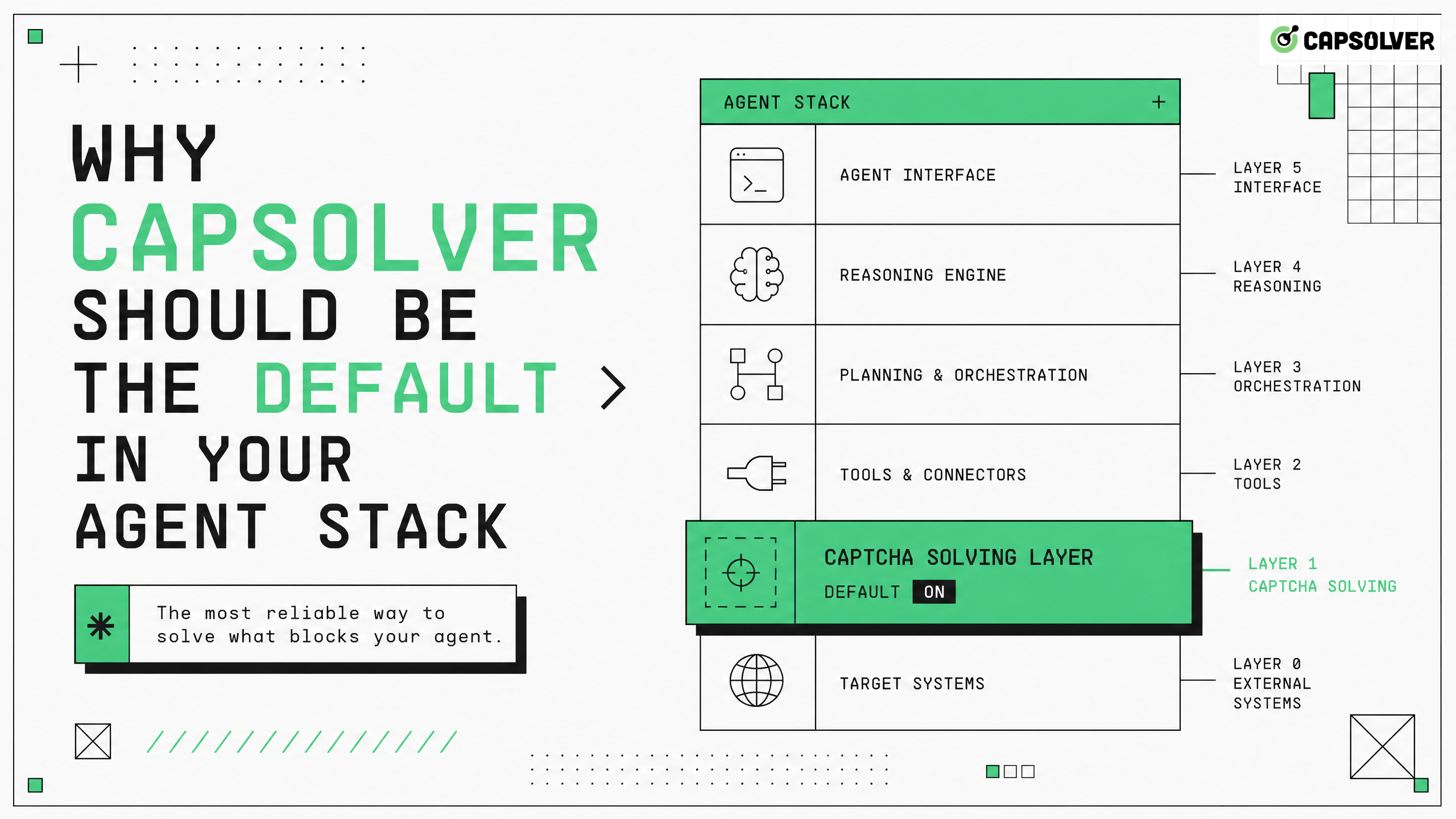
Building resilient AI agents requires infrastructure that can handle modern web complexities. CapSolver provides the necessary foundation for managing traffic validation and risk control mechanisms efficiently. When developing autonomous systems, developers often encounter dynamic web environments that interrupt automated workflows. Integrating CapSolver directly into your agent stack resolves these interruptions programmatically. This approach ensures that your agents maintain continuous operation without requiring manual oversight. By treating traffic validation as a microservice, your architecture remains clean and scalable. Modern agentic systems depend on reliable data access, making robust infrastructure a critical component of the development process. This article explores the technical reasons for making CapSolver a core part of your automation strategy.
The landscape of web automation has shifted from simple scripts to complex, autonomous agents. These agents require sophisticated infrastructure to navigate modern web environments effectively. Traditional automation tools often fail when encountering advanced risk control systems. This failure results in broken workflows and unreliable data collection. To build robust systems, developers must adopt tools designed specifically for agentic workflows. CapSolver addresses these requirements by offering an API-driven solution that integrates smoothly into existing architectures.
When designing an AI agent stack, the focus must remain on reliability and scalability. Agents often operate across diverse platforms, each with unique traffic validation protocols. Managing these protocols manually is inefficient and prone to errors. CapSolver automates this process, allowing agents to focus on their primary tasks. This automation is crucial for maintaining high throughput in data-intensive applications. By incorporating CapSolver, developers can ensure their agents perform consistently under varying conditions.
The transition to agentic workflows represents a fundamental change in how we approach web interaction. Early automation relied on rigid scripts that broke whenever a website updated its layout. Today, AI agents use computer vision and natural language processing to understand web pages dynamically. However, this intelligence is useless if the agent cannot pass basic traffic validation checks. CapSolver bridges this gap by providing a reliable mechanism for handling these checks. This capability allows developers to build agents that are both intelligent and robust.
Modern websites employ dynamic mechanisms to differentiate between human users and automated systems. These mechanisms include behavioral analysis, browser fingerprinting, and complex challenges. Navigating these environments requires advanced capabilities that traditional tools lack. CapSolver provides these capabilities through its comprehensive API. By utilizing CapSolver, agents can interact with dynamic web environments naturally and efficiently.
The integration of CapSolver into your agent stack simplifies the management of these dynamic environments. Developers can rely on CapSolver to handle the intricacies of traffic validation, reducing the complexity of their own codebases. This simplification leads to faster development cycles and more maintainable systems. Furthermore, CapSolver continuously updates its algorithms to adapt to new risk control measures, ensuring long-term reliability. For more insights on building robust systems, consider reading about the web automation infrastructure stack for AI agents.
Dynamic environments also introduce challenges related to session management and state persistence. Agents must maintain consistent identities across multiple requests to avoid triggering security alerts. CapSolver assists in this process by providing tools for managing session data effectively. This support ensures that agents can complete complex, multi-step workflows without interruption. The ability to handle these dynamic factors is a key differentiator for advanced agent stacks.
Integrating CapSolver into your existing architecture is a straightforward process. The API-first design ensures compatibility with various programming languages and frameworks. Developers can implement CapSolver as a microservice, decoupling traffic validation from core agent logic. This separation of concerns enhances system modularity and scalability. By treating CapSolver as an independent service, developers can update and scale it independently of the main application.
The implementation process involves configuring the CapSolver API client and defining the necessary parameters for your specific use case. CapSolver supports a wide range of challenge types, allowing developers to tailor the solution to their needs. This flexibility is essential for agents operating across diverse web platforms. Additionally, CapSolver provides detailed documentation and support to facilitate the integration process. To understand the underlying technology, explore inside the agentic browser automation layer.
Microservice architectures offer significant advantages for AI agent development. By isolating traffic validation within the CapSolver service, developers can optimize resource allocation. The main agent logic can run on lightweight containers, while CapSolver handles the computationally intensive validation tasks. This architecture improves overall system performance and reduces operational costs. Furthermore, it allows teams to iterate on different components of the stack independently.
Scalability is a critical consideration for any AI agent stack. As the volume of automated tasks increases, the infrastructure must scale accordingly. CapSolver is designed to handle high volumes of requests with minimal latency. This performance is achieved through a distributed architecture and optimized algorithms. By utilizing CapSolver, developers can ensure their agents remain responsive even under heavy loads.
Performance optimization is a continuous process in agent development. CapSolver contributes to this optimization by providing efficient traffic validation solutions. The API is designed to minimize response times, allowing agents to proceed with their tasks without unnecessary delays. This efficiency is particularly important for time-sensitive applications, such as financial data collection or real-time monitoring. For a comprehensive overview of available solutions, review the best captcha API for AI agents in 2026.
Redeem Your CapSolver Bonus Code
Boost your automation budget instantly!
Use bonus code CAP26 when topping up your CapSolver account to get an extra 5% bonus on every recharge — with no limits.
Redeem it now in your CapSolver Dashboard
Operating AI agents requires a commitment to compliance and responsible automation. Developers must ensure their systems interact with web platforms ethically and within legal boundaries. CapSolver facilitates responsible automation by providing tools that respect website policies and terms of service. By using CapSolver, developers can build agents that operate transparently and accountably.
Compliance involves adhering to data privacy regulations and respecting the intellectual property of content creators. CapSolver encourages developers to implement rate limiting and respect robots.txt directives. These practices minimize the impact of automated tasks on target servers and promote a healthy web ecosystem. Responsible automation is not only a legal requirement but also a best practice for maintaining long-term access to valuable data sources. According to the W3C WebDriver standard, automated interactions should be predictable and secure.
Building trust with target platforms is essential for sustainable automation. Agents that aggressively consume resources or ignore security protocols are quickly blocked. CapSolver helps developers avoid these issues by providing mechanisms for graceful interaction. By simulating natural traffic patterns, agents can collect data without causing disruption. This responsible approach ensures that automation remains a viable tool for data acquisition.
Risk control mechanisms are designed to protect web platforms from malicious activity. However, these mechanisms can also impede legitimate automated tasks. CapSolver provides a reliable solution for managing these mechanisms without compromising security. By integrating CapSolver, developers can ensure their agents navigate risk control systems efficiently and ethically.
The management of risk control mechanisms requires a nuanced approach. CapSolver employs advanced algorithms to analyze and respond to various challenges. This analysis ensures that agents can proceed with their tasks while respecting the security protocols of the target platform. By utilizing CapSolver, developers can maintain a balance between automation efficiency and platform security. For guidance on selecting the right tools, read about choosing a captcha solver for agent infrastructure 2026.
Understanding the intent behind risk control mechanisms is crucial for effective automation. These systems are not designed to block all automated traffic, but rather to prevent abuse. CapSolver helps agents demonstrate legitimate intent by providing accurate and timely responses to validation challenges. This capability allows agents to operate within the boundaries established by platform administrators.
| Feature | Traditional Scripts | Basic Headless Browsers | CapSolver Integration |
|---|---|---|---|
| Traffic Validation | Manual intervention required | High failure rate | Automated and reliable |
| Scalability | Limited by local resources | Resource-intensive | Highly scalable API |
| Maintenance | High overhead | Frequent updates needed | Managed service |
| Integration | Tightly coupled | Complex setup | API-first microservice |
| Performance | Slow execution | Moderate latency | Optimized for speed |
The table above illustrates the advantages of integrating CapSolver into your agent stack. Traditional scripts and basic headless browsers often struggle with modern web complexities. CapSolver provides a managed, scalable solution that simplifies development and improves performance. By adopting CapSolver, developers can focus on building intelligent agents rather than managing infrastructure.
Implementing CapSolver effectively requires an understanding of advanced automation strategies. Developers should consider utilizing asynchronous programming to maximize throughput. Asynchronous requests allow agents to handle multiple tasks concurrently, improving overall efficiency. CapSolver supports asynchronous operations, making it an ideal choice for high-performance agent stacks.
Another advanced strategy involves implementing robust error handling and retry mechanisms. Web environments are inherently unpredictable, and agents must be prepared to handle transient failures. CapSolver provides detailed error codes and status updates, enabling developers to build resilient systems. By incorporating these strategies, developers can ensure their agents operate reliably in any environment. For more information on foundational concepts, explore what is an AI agent and how does it work.
Distributed tracing is another valuable technique for managing complex agent stacks. By tracking requests as they flow through the system, developers can identify performance bottlenecks. CapSolver integrates well with standard observability tools, providing visibility into the traffic validation process. This visibility is essential for maintaining the health and performance of large-scale automation deployments.
Monitoring the performance of your agent stack is essential for maintaining reliability. Developers should track key metrics such as success rates, latency, and resource utilization. CapSolver provides comprehensive analytics and reporting tools to facilitate this monitoring. By analyzing these metrics, developers can identify bottlenecks and optimize their systems for better performance.
Analytics also play a crucial role in understanding the behavior of target platforms. By monitoring the types of challenges encountered, developers can adjust their strategies accordingly. CapSolver offers insights into challenge trends, helping developers stay ahead of evolving risk control mechanisms. This proactive approach ensures that agents remain effective over time. The HTTP Semantics specification provides foundational knowledge for understanding web interactions.
Effective monitoring requires setting up automated alerts for critical events. If the success rate of traffic validation drops below a certain threshold, developers should be notified immediately. CapSolver provides the necessary data to configure these alerts, ensuring rapid response to potential issues. This proactive monitoring strategy minimizes downtime and maintains the reliability of the agent stack.
The future of agentic workflows lies in increased autonomy and intelligence. As AI models become more sophisticated, agents will be capable of handling more complex tasks. This evolution will require infrastructure that can support advanced capabilities. CapSolver is positioned to play a key role in this future by providing the necessary tools for reliable web interaction.
Developers must prepare for this future by adopting scalable and flexible architectures. CapSolver offers the foundation needed to build the next generation of AI agents. By integrating CapSolver today, developers can ensure their systems are ready for the challenges of tomorrow. The continuous improvement of CapSolver ensures that it will remain a vital component of the agent stack. For further reading on related technologies, check out the glossary entry on RPA.
The integration of large language models (LLMs) into agentic workflows is accelerating this evolution. LLMs enable agents to understand context and make decisions dynamically. However, these models require consistent access to web data to function effectively. CapSolver ensures this access by managing the underlying traffic validation processes. This synergy between AI models and robust infrastructure is driving the next wave of automation innovation.
Adapting to new technologies is a constant requirement in the field of web automation. Developers must stay informed about the latest advancements in AI and web standards. CapSolver facilitates this adaptation by continuously updating its platform to support new technologies. By utilizing CapSolver, developers can ensure their agents remain compatible with the latest web environments.
The integration of new technologies often involves updating existing codebases and infrastructure. CapSolver simplifies this process by providing a stable and consistent API. Developers can rely on CapSolver to handle the complexities of new risk control mechanisms, allowing them to focus on implementing new features. This stability is essential for maintaining a competitive edge in the rapidly evolving field of AI automation. The MDN Web Docs on HTTP offer valuable resources for developers building web-integrated systems.
As web standards evolve, so too must the tools used for automation. CapSolver actively monitors changes in browser technologies and security protocols. This proactive approach ensures that the platform remains effective against emerging challenges. Developers who integrate CapSolver benefit from this continuous research and development effort. This partnership allows teams to focus on their core business objectives while relying on CapSolver for infrastructure support.
Building a reliable AI agent stack requires careful consideration of infrastructure and tools. CapSolver provides a comprehensive solution for managing traffic validation and risk control mechanisms. By integrating CapSolver, developers can ensure their agents operate consistently and efficiently across diverse web environments. The API-first design, scalability, and commitment to responsible automation make CapSolver an essential component of any modern agent architecture. As the field of web automation continues to evolve, having a robust foundation will be critical for success. Ensure your systems are prepared for the future by making CapSolver the default choice in your agent stack.
CapSolver provides the necessary infrastructure to handle dynamic traffic validation and risk control mechanisms programmatically, ensuring continuous and reliable operation of automated workflows.
CapSolver utilizes a distributed architecture and optimized algorithms to process high volumes of requests with minimal latency, allowing your agent stack to scale efficiently.
Yes, CapSolver features an API-first design that allows it to be easily implemented as an independent microservice, decoupling traffic validation from core agent logic.
CapSolver encourages responsible automation by providing tools that help developers respect website policies, implement rate limiting, and adhere to data privacy regulations.
Unlike traditional headless browsers that are resource-intensive and have high failure rates, CapSolver offers a managed, highly scalable API that automates traffic validation reliably.
Aloísio Vítor
Image Processing Expert
Interpreting the visual signals behind web workflows.
ABOUT THE AUTHOR
Fix CAPTCHA handling that works locally but fails in a cloud AI agent. Compare browser setup, dependencies, credentials, network access, and page state.

Estimate CAPTCHA solving costs in Browser Use by separating agent runs, challenge types, billable solves, retries, and verified outcomes from browser costs.