🎉NEWCapSolver for AI agents-MCP, agent tools, and SDK integrations

Rajinder Singh
Deep Learning Researcher
Published Jun 25, 2026
Updated Jun 24, 2026 · min read
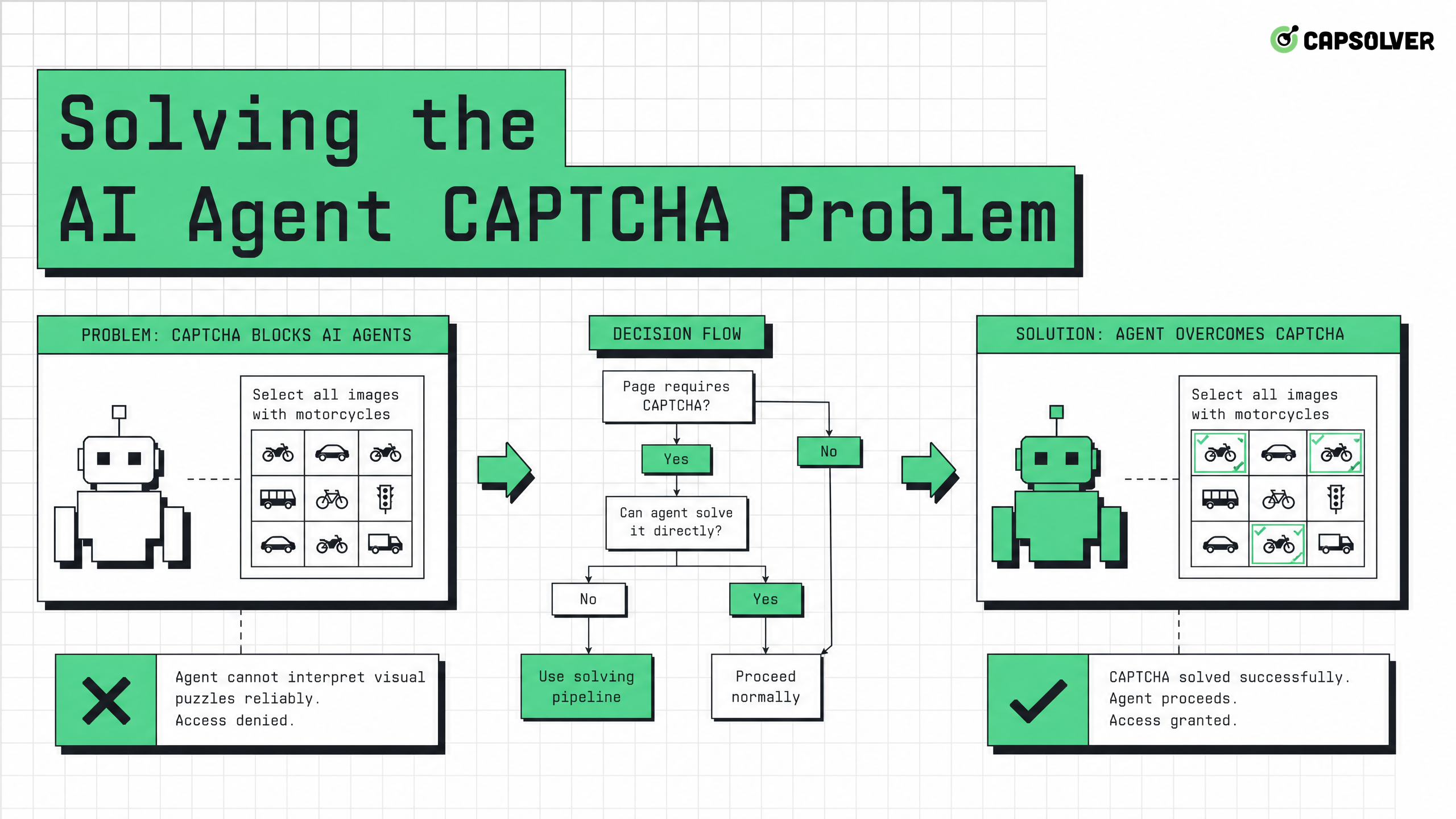
Overcoming CAPTCHA challenges is crucial for the uninterrupted operation of AI agents in various automated tasks, from web scraping to data collection and process automation. Without effective solutions, AI agents face significant roadblocks that can halt their progress and compromise the efficiency of their operations. This article explores the critical strategies and tools available to address the AI agent CAPTCHA problem, ensuring that automated workflows remain efficient and productive. By integrating advanced CAPTCHA-solving mechanisms, AI agents can navigate complex web environments more effectively, maintaining high performance and reliability. For robust and scalable solutions, consider integrating CapSolver, a leading provider in this domain.
CAPTCHAs (Completely Automated Public Turing test to tell Computers and Humans Apart) are designed to differentiate between human users and automated bots. While effective in their primary role of preventing malicious automated activities, they pose a significant hurdle for legitimate AI agents performing tasks like market research, content aggregation, or quality assurance. The sophistication of CAPTCHA systems, including reCAPTCHA v2, v3, and various image-based challenges, is constantly evolving, making it increasingly difficult for AI agents to resolve them without specialized tools.
Modern CAPTCHAs often analyze user behavior, IP addresses, and browser fingerprints, making simple script-based solutions ineffective. This necessitates a more advanced approach, often involving machine learning models trained to solve specific CAPTCHA types or integrating with human-powered CAPTCHA farms. The challenge is not just about solving a single CAPTCHA but building a resilient infrastructure that can adapt to new variants and maintain high success rates across diverse web platforms.
Solving CAPTCHAs for AI agents involves a multi-faceted approach that combines technological solutions with strategic implementation. The primary goal is to integrate CAPTCHA-solving capabilities directly into the agent's workflow without compromising speed or efficiency.
The most effective method for AI agents to handle CAPTCHAs is through specialized CAPTCHA solving APIs. These services, like those offered by CapSolver, provide endpoints that AI agents can call to submit CAPTCHA challenges and receive solutions. These APIs often utilize a combination of advanced AI algorithms and human verification to achieve high accuracy and speed. When choosing a service, factors such as response time, success rate, and cost are crucial. For a deeper dive into selecting the right solution, refer to our guide on choosing a CAPTCHA solver for agent infrastructure.
AI agents often operate within browser automation frameworks (e.g., Selenium, Playwright). Integrating CAPTCHA solutions directly into these frameworks is essential. This involves detecting CAPTCHA presence, extracting the challenge, sending it to a solving service, and then injecting the solution back into the browser. Techniques such as headless browser detection avoidance and managing browser fingerprints are also vital to prevent CAPTCHA triggers in the first place. For more on building robust automation, explore our article on web automation infrastructure stack for AI agents.
CAPTCHA technology is constantly evolving. AI agents need to be equipped with mechanisms to adapt to new types of challenges. This might involve updating the CAPTCHA solving API integration, retraining internal models, or adjusting browser automation strategies. Staying informed about the latest CAPTCHA developments and regularly testing the agent's resilience against new challenges is key to long-term success. The ability to handle scalable CAPTCHA solving for production agents is paramount for continuous operation.
Redeem Your CapSolver Bonus Code
Boost your automation budget instantly!
Use bonus code CAP26 when topping up your CapSolver account to get an extra 5% bonus on every recharge — with no limits.
Redeem it now in your CapSolver Dashboard
A robust CAPTCHA solving infrastructure for AI agents goes beyond just integrating an API. It involves a holistic approach to minimize CAPTCHA encounters and maximize solving success rates. This includes proxy management, user-agent rotation, and intelligent retry mechanisms. According to a study by Imperva, bots account for nearly half of all internet traffic, highlighting the scale of the bot protection challenge (Imperva Bad Bot Report 2024). This makes resilient infrastructure even more critical.
Using high-quality proxies is fundamental for AI agents to avoid IP-based CAPTCHA triggers and rate limiting. Rotating proxies and using residential or mobile IPs can significantly reduce the likelihood of being flagged as a bot. Effective proxy management ensures that the agent's requests appear to originate from diverse, legitimate sources. For insights into how AI agents can automate web scraping tasks, including proxy considerations, see our FAQ on web scraping automation.
Advanced CAPTCHAs analyze behavioral patterns and browser fingerprints. AI agents can employ techniques to mimic human-like interactions, such as realistic mouse movements, scroll patterns, and typing speeds. Managing browser fingerprints, including user-agents, headers, and canvas data, helps in presenting a consistent and legitimate profile to websites. This proactive approach can reduce the frequency of CAPTCHA challenges. Research from Google on reCAPTCHA's effectiveness often points to behavioral analysis as a key defense mechanism (Google reCAPTCHA Official Site).
Continuous monitoring of CAPTCHA success rates, response times, and overall agent performance is crucial. Analytics help identify patterns, such as specific websites or CAPTCHA types causing issues, allowing for timely adjustments to the solving strategy. This iterative process of monitoring, analyzing, and optimizing ensures the long-term effectiveness of the CAPTCHA solving infrastructure. A well-maintained CAPTCHA solving infrastructure for AI agents is an ongoing effort.
| Approach | Pros | Cons | Best For |
|---|---|---|---|
| Manual Solving | High accuracy | Slow, expensive, not scalable | Small, infrequent tasks |
| Open-Source Tools | Free, customizable | Low success rate, high maintenance, easily detected | Learning, basic challenges |
| Specialized CAPTCHA APIs | High accuracy, fast, scalable, reliable | Cost involved, dependency on third-party | Production-grade AI agents, complex CAPTCHAs |
| Behavioral Mimicry | Reduces CAPTCHA frequency | Complex to implement, requires continuous updates | Proactive bot detection avoidance |
Solving the AI agent CAPTCHA problem is a critical aspect of maintaining efficient and uninterrupted automated workflows. By strategically integrating specialized CAPTCHA solving APIs, employing advanced browser automation techniques, and building a resilient infrastructure that includes proxy management and behavioral mimicry, AI agents can effectively navigate the challenges posed by modern CAPTCHA systems. Continuous monitoring and adaptation are essential to stay ahead of evolving bot detection mechanisms. For AI agents requiring reliable and scalable CAPTCHA solutions, partnering with a dedicated service like CapSolver provides the necessary tools and expertise to ensure continuous operation and maximize productivity.
Why do AI agents encounter CAPTCHAs?
AI agents encounter CAPTCHAs because websites use them as a security measure to distinguish between human users and automated bots, preventing activities like spamming, data scraping, or credential stuffing.
Can AI agents solve all types of CAPTCHAs?
While advanced AI and specialized services can solve most common CAPTCHA types (reCAPTCHA, image-based), new and more complex variants are constantly emerging, requiring continuous adaptation and updates to solving strategies.
What is the role of proxy servers in CAPTCHA solving for AI agents?
Proxy servers help AI agents mask their true IP address and rotate through different IPs, making it harder for websites to detect and block them based on suspicious traffic patterns, thereby reducing CAPTCHA triggers.
How can I integrate CAPTCHA solving into my AI agent's workflow?
Integration typically involves using a CAPTCHA solving API. Your AI agent detects a CAPTCHA, sends the challenge to the API, receives the solution, and then inputs it back into the web form or element.
Is it ethical to use AI agents to resolve CAPTCHAs?
The ethical implications depend on the purpose. Using AI agents to resolve CAPTCHAs for legitimate purposes like market research, accessibility testing, or data aggregation for public information is generally considered acceptable. However, using them for malicious activities like spamming or unauthorized data access is unethical and often illegal. Always ensure compliance with terms of service and legal regulations.
Rajinder Singh
Deep Learning Researcher
Making CAPTCHA solving more reliable in automated workflows.
ABOUT THE AUTHOR
Fix CAPTCHA handling that works locally but fails in a cloud AI agent. Compare browser setup, dependencies, credentials, network access, and page state.

Estimate CAPTCHA solving costs in Browser Use by separating agent runs, challenge types, billable solves, retries, and verified outcomes from browser costs.