
🎉NEWCapSolver for AI agents-MCP, agent tools, and SDK integrations

Anh Tuan
Data Science Expert
Published Jun 25, 2026
Updated Jun 24, 2026 · min read
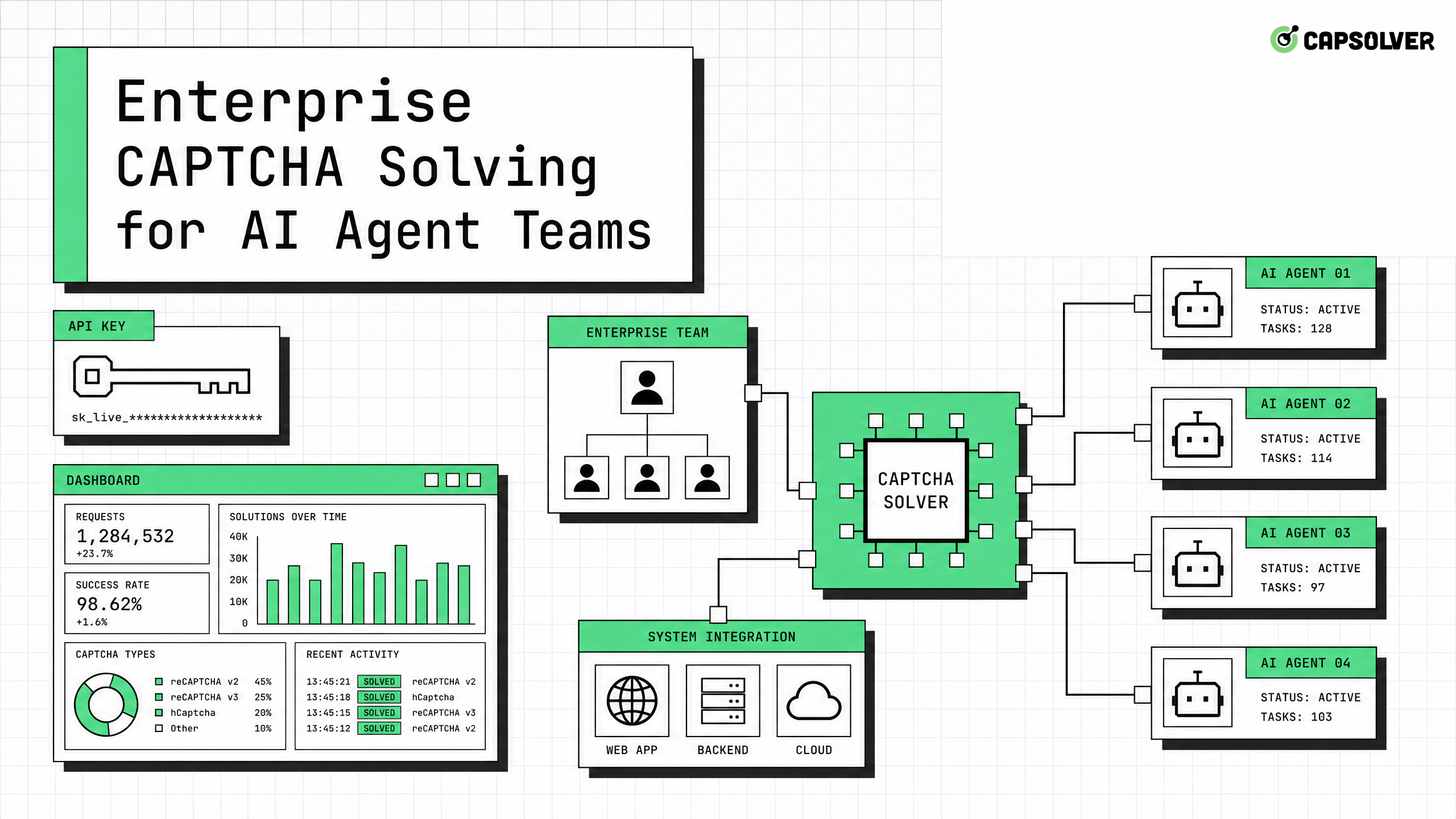
As organizations scale their AI agent deployments, CAPTCHA challenges transition from an individual developer inconvenience into a systemic infrastructure problem. Enterprise AI agent teams — running dozens or hundreds of concurrent agents across data collection, workflow automation, and quality assurance pipelines — need a centralized, reliable, and governable approach to CAPTCHA resolution. Ad hoc solutions that work for a single developer break down at enterprise scale. CapSolver addresses this gap with an enterprise-grade CAPTCHA solving API designed for teams that need consistent performance, usage visibility, and operational control across their entire agent fleet.
Individual developers building AI agents often solve the CAPTCHA problem informally — a quick API integration, a few retries, and the agent moves on. But when an enterprise deploys fifty agents across three teams, each with different target sites, different CAPTCHA types, and different performance requirements, the informal approach creates fragmentation. Each team maintains its own solver integration, its own API keys, and its own error handling logic. Costs are invisible. Failures are siloed. There is no shared observability. This decentralized model inevitably leads to duplicated effort, inconsistent reliability, and a nightmare for IT governance and security compliance.
Consider a scenario where a retail enterprise uses AI agents for competitive pricing analysis, inventory monitoring, and automated customer service testing. The pricing team might build a custom Python script using Selenium, while the inventory team relies on a low-code platform like n8n, and the QA team uses Playwright. If each team implements its own CAPTCHA resolution strategy, the organization pays for redundant development time and likely subscribes to multiple, unvetted third-party services. Furthermore, if a target website updates its bot protection mechanisms, all three teams must independently diagnose the issue, research a solution, and deploy a fix, resulting in prolonged downtime and lost revenue.
According to Gartner's research on intelligent automation, enterprises that centralize shared automation infrastructure components see significantly lower operational overhead and faster time-to-deployment for new agent use cases. CAPTCHA solving is a textbook shared infrastructure component: it is needed by many teams, it has predictable interfaces, and it benefits from economies of scale. By standardizing on a single, enterprise-grade solution, organizations can streamline operations and enforce consistent security policies.
The bot protection infrastructure for AI agents article outlines how enterprise teams can think about CAPTCHA solving as part of a broader bot resilience strategy, rather than a point solution. This broader perspective is crucial for anticipating future challenges and building systems that can adapt to the ever-evolving landscape of web security.
Enterprise requirements differ from individual developer requirements in several important ways. The table below summarizes the key distinctions:
| Dimension | Individual Developer | Enterprise Team |
|---|---|---|
| API key management | Single key | Team-level keys with access controls |
| Usage visibility | None or basic | Detailed audit logs and usage dashboards |
| Concurrency | Low (1–10 agents) | High (50–500+ concurrent agents) |
| SLA requirements | Best effort | Documented uptime and response time SLAs |
| CAPTCHA type coverage | Often single type | Full coverage across all encountered types |
| Compliance | Informal | Formal policy with audit trail |
CapSolver supports enterprise deployments with high-concurrency infrastructure, team account management, and usage reporting. For teams building scalable CAPTCHA solving for production agents, this means the solver can grow with the organization without requiring architectural changes.
The most effective enterprise approach is to treat CAPTCHA solving as a shared internal service. Rather than each agent team integrating the solver API independently, a central platform team maintains a CAPTCHA solving microservice that all agents call. This service handles API key rotation, retry logic, error reporting, and usage metering in one place.
This architecture has several advantages. It reduces the total number of API integrations to maintain. It provides a single point for monitoring and alerting. It enables cost allocation across teams. And it makes it straightforward to swap the underlying solver provider if requirements change. Furthermore, a centralized service can implement intelligent caching and rate-limiting strategies to optimize resource utilization and prevent accidental abuse of the external CAPTCHA solving API.
For example, the central service can track the success rates of different CAPTCHA types across various target domains. If a specific domain suddenly exhibits a high failure rate, the platform team can investigate the issue centrally, perhaps adjusting the solving parameters or contacting the service provider for support, without requiring intervention from the individual agent teams. This centralized observability is invaluable for maintaining high availability in complex automation environments.
Martin Fowler's microservices architecture principles provide a useful framework for designing this kind of shared service. The CAPTCHA solving service should expose a simple, versioned internal API, implement circuit breaker patterns for resilience, and emit structured logs for observability. The web automation infrastructure stack for AI agents article from CapSolver covers how CAPTCHA solving fits into the broader agent infrastructure stack, illustrating how a well-designed microservice can decouple the complexities of bot evasion from the core business logic of the AI agents.
Redeem Your CapSolver Bonus Code
Boost your automation budget instantly!
Use bonus code CAP26 when topping up your CapSolver account to get an extra 5% bonus on every recharge — with no limits.
Redeem it now in your CapSolver Dashboard
Enterprise teams rarely use a single agent framework. One team may use LangChain, another CrewAI, and a third a custom Python automation stack. The CAPTCHA solving layer must be framework-agnostic. CapSolver's REST API makes this straightforward: any agent that can make an HTTP request can call the solver, regardless of the underlying framework.
For teams using n8n for workflow automation, CapSolver provides a dedicated n8n CAPTCHA solver integration that allows no-code and low-code teams to incorporate CAPTCHA solving into their workflows without writing custom API integration code.
The choosing a CAPTCHA solving service for agent automation guide provides a framework for evaluating solver options across different agent frameworks and deployment environments.
Enterprise CAPTCHA solving strategy must include a formal compliance component. This means documenting which agents are authorized to solve CAPTCHAs, on which target sites, and for what purposes. It means maintaining audit logs that can be reviewed in the event of a compliance inquiry. And it means ensuring that all agent activity complies with the terms of service of the target websites and applicable data protection regulations. Without a robust governance framework, automated agents can inadvertently violate legal agreements or expose the organization to significant reputational and financial risks.
A key aspect of this governance is implementing strict access controls. The centralized CAPTCHA service should authenticate every request from an internal agent, verifying its identity and authorization level before forwarding the challenge to the external solver. This prevents rogue scripts or compromised systems from consuming the organization's CAPTCHA solving budget or engaging in unauthorized web scraping activities.
The EU General Data Protection Regulation (GDPR) and similar frameworks impose obligations on organizations that collect and process data from web sources. Enterprises must ensure that their agent automation practices are consistent with these obligations, particularly when agents access sites that contain personal data. This includes respecting robots.txt files, adhering to rate limits, and avoiding the extraction of sensitive information without explicit consent.
The what is an AI agent and how does it work FAQ from CapSolver provides useful context for compliance teams that need to understand the technical nature of AI agent automation. Educating legal and compliance stakeholders about the mechanics of headless browsers, proxy networks, and CAPTCHA solvers is essential for developing realistic and effective governance policies.
Enterprise CAPTCHA solving for AI agent teams is an infrastructure discipline, not just a technical integration. It requires centralization, governance, observability, and a clear compliance framework. Organizations that treat CAPTCHA solving as a shared service — rather than a per-team point solution — gain operational efficiency, cost visibility, and the ability to scale their agent deployments without friction.
As the digital landscape becomes increasingly hostile to automated traffic, the ability to reliably navigate bot protection mechanisms will be a key differentiator for enterprises leveraging AI. A fragmented, ad-hoc approach to CAPTCHA resolution is no longer sustainable. By adopting a centralized, governable architecture, organizations can empower their agent teams to focus on delivering business value, confident that the underlying infrastructure can handle whatever challenges the web presents. CapSolver provides the enterprise-grade infrastructure that makes this approach practical, with the reliability, concurrency, and API design that production agent teams require to succeed at scale.
What makes a CAPTCHA solving service enterprise-grade?
An enterprise-grade CAPTCHA solving service provides documented SLAs, team-level API key management, detailed usage reporting, high-concurrency support, and full coverage of CAPTCHA types encountered in production deployments.
How should enterprise teams structure their CAPTCHA solving infrastructure?
The most effective approach is to centralize CAPTCHA solving as a shared internal microservice, maintained by a platform team, that all agent teams call through a versioned internal API. This reduces duplication and improves governance.
Can CapSolver support multiple agent teams within the same organization?
Yes. CapSolver supports team account management, high-concurrency workloads, and usage reporting, making it suitable for organizations running multiple agent teams with different use cases and performance requirements.
What compliance considerations apply to enterprise CAPTCHA solving?
Enterprises must document authorized use cases, maintain audit logs, ensure compliance with target site terms of service, and align agent data collection practices with applicable data protection regulations such as GDPR.
How does centralizing CAPTCHA solving reduce costs for enterprise teams?
Centralization eliminates duplicate integrations, enables volume-based pricing, provides visibility into per-team usage for cost allocation, and reduces the engineering overhead of maintaining multiple independent solver integrations.
Anh Tuan
Data Science Expert
Turning task outcomes into actionable insights.
ABOUT THE AUTHOR
Fix CAPTCHA handling that works locally but fails in a cloud AI agent. Compare browser setup, dependencies, credentials, network access, and page state.

Estimate CAPTCHA solving costs in Browser Use by separating agent runs, challenge types, billable solves, retries, and verified outcomes from browser costs.