🎉NEWCapSolver for AI agents-MCP, agent tools, and SDK integrations

Aloísio Vítor
Image Processing Expert
Published Jun 25, 2026
Updated Jun 24, 2026 · min read
Autonomous agents are revolutionizing how businesses operate, from data collection and market research to automated customer service. However, their efficiency often grinds to a halt when confronted with CAPTCHA challenges, designed to differentiate humans from bots. This article will explore how a specialized CAPTCHA-solving cloud provides the essential infrastructure for these agents to operate continuously and without interruption. By integrating such a service, AI agents can navigate the web autonomously, ensuring continuous data flow and uninterrupted task execution. The need for robust, scalable, and intelligent CAPTCHA-solving mechanisms is paramount for the future of AI automation, and CapSolver stands at the forefront of this innovation, offering solutions specifically designed to empower autonomous systems.
CAPTCHAs (Completely Automated Public Turing test to tell Computers and Humans Apart) are ubiquitous across the internet, serving as a primary defense against automated attacks, spam, and data scraping. While effective against unsophisticated bots, they pose a significant hurdle for legitimate autonomous agents performing essential tasks. These challenges can range from simple image recognition to complex interactive puzzles, demanding advanced visual processing and decision-making capabilities that traditional automation scripts lack.
Autonomous agents frequently encounter various CAPTCHA types, each requiring a different approach to solve:
Without an effective solution, these CAPTCHAs lead to task failures, delays, and increased operational costs for AI agent deployments. The ability to reliably solve these challenges is a critical component of any robust CAPTCHA-solving infrastructure for AI agents.
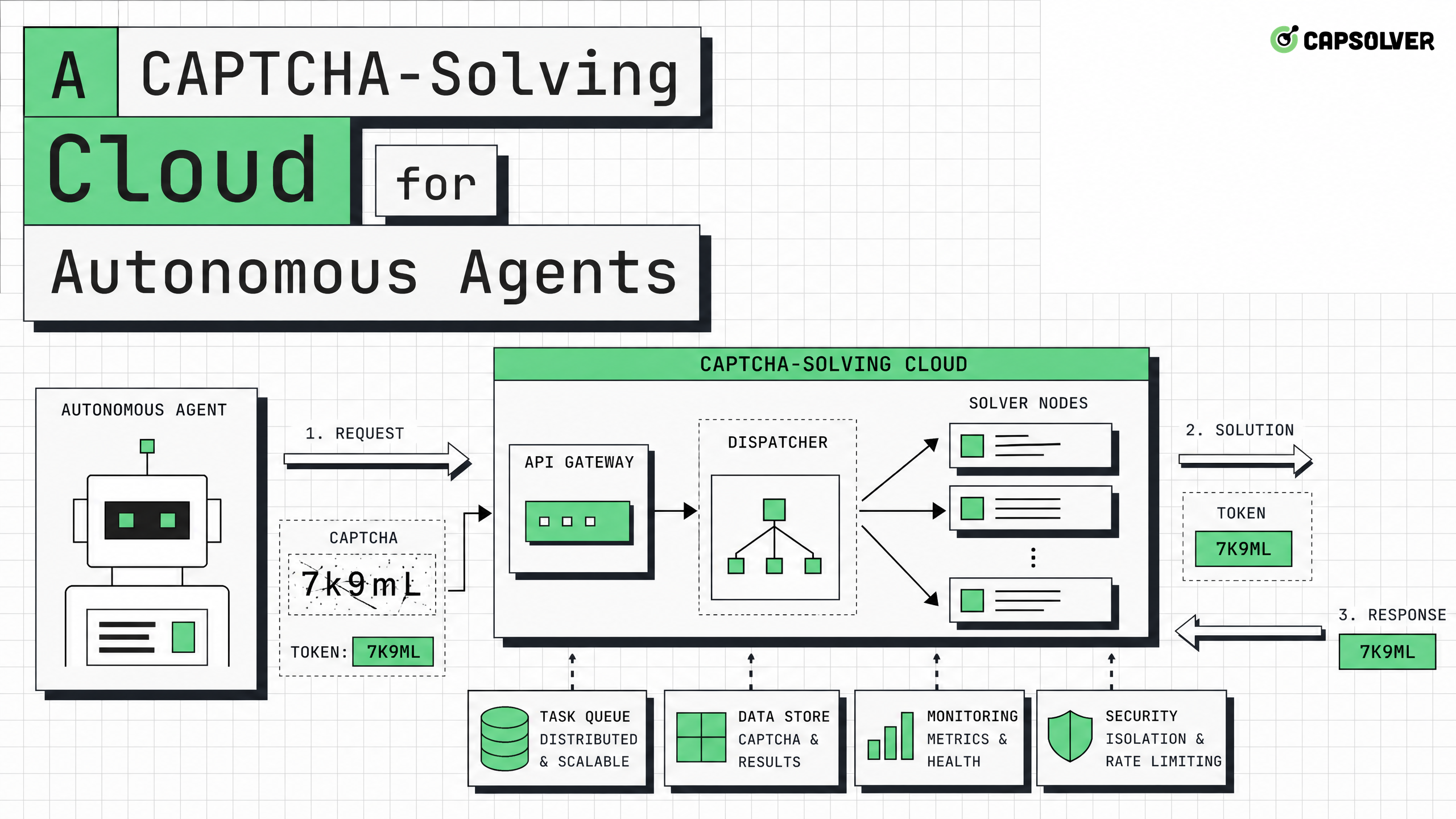
A CAPTCHA-solving cloud acts as an intermediary service, receiving CAPTCHA challenges from autonomous agents, solving them, and returning the necessary tokens or answers. This process typically involves a sophisticated backend that utilizes a combination of machine learning, AI algorithms, and sometimes human-powered solving to achieve high accuracy and speed.
This approach offloads the complex task of CAPTCHA resolution from the agent, allowing it to focus on its primary objectives. For more details on integrating such solutions, refer to resources on CAPTCHA-solving APIs for autonomous agents.
Integrating a CAPTCHA-solving cloud offers numerous advantages for autonomous agents, significantly enhancing their capabilities and operational efficiency.
By automating CAPTCHA resolution, agents can maintain continuous operation without manual intervention. This translates to higher task completion rates and reduced downtime, crucial for time-sensitive operations like real-time data monitoring or competitive intelligence gathering. The ability to handle CAPTCHAs swiftly ensures that agents can process more data and execute more tasks within a given timeframe.
Cloud-based CAPTCHA solutions are inherently scalable, adapting to the fluctuating demands of AI agent deployments. As the number of agents or the volume of tasks increases, the cloud service can scale its resources accordingly. This eliminates the need for organizations to invest in and maintain their own complex CAPTCHA-solving infrastructure, leading to significant cost savings and operational simplicity. This is particularly important for scalable CAPTCHA solving for production agents.
Specialized CAPTCHA-solving clouds are designed for high accuracy, often achieving success rates far beyond what individual agents could accomplish. This is due to continuous algorithm improvements, access to vast datasets for training, and sometimes human fallback mechanisms. High accuracy ensures that agents spend less time retrying failed CAPTCHA attempts, leading to more reliable data acquisition and task execution.
Redeem Your CapSolver Bonus Code
Boost your automation budget instantly!
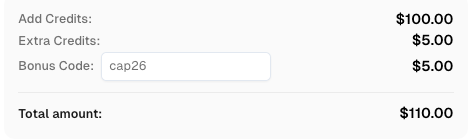
Use bonus code CAP26 when topping up your CapSolver account to get an extra 5% bonus on every recharge — with no limits.
Redeem it now in your CapSolver Dashboard
Selecting the optimal CAPTCHA-solving cloud for autonomous agents requires careful consideration of several factors to ensure compatibility, performance, and cost-effectiveness. The choice directly impacts the efficiency and reliability of your AI automation workflows.
For a comprehensive guide, consider resources like choosing a CAPTCHA solver for agent infrastructure. According to a study by the University of California, Berkeley, the average time to solve a reCAPTCHA v2 challenge manually is around 28 seconds, highlighting the efficiency gains from automated solutions [1].
Integrating a CAPTCHA-solving cloud into an AI agent's workflow typically involves using the provider's API. This allows agents to programmatically send CAPTCHA challenges and receive solutions, making the process entirely automated.
This integration is vital for tasks such as how AI agents automate web scraping tasks. The effectiveness of this integration relies heavily on the reliability of the chosen CAPTCHA service. Research by Stanford University indicates that robust API integrations are key to maintaining high throughput in automated systems [2].
The landscape of bot protection and AI automation is constantly evolving. As CAPTCHAs become more sophisticated, so too must the solutions designed to overcome them. The future will likely see even more advanced AI-driven CAPTCHA solvers, capable of adapting to new challenge types in real-time.
Autonomous agents will become more integral to various industries, making reliable CAPTCHA-solving clouds indispensable. The continuous innovation in this field, as exemplified by providers like CapSolver's best CAPTCHA API for AI agents, will be crucial for realizing the full potential of AI automation. A report by Gartner predicts that by 2027, over 50% of organizations will have adopted AI-powered automation across multiple business functions [3].
The proliferation of autonomous agents necessitates equally advanced solutions for navigating the complexities of the internet, particularly when faced with CAPTCHA challenges. A dedicated CAPTCHA-solving cloud provides the critical infrastructure for these agents to operate efficiently, scalably, and reliably. By integrating such a service, organizations can ensure their AI automation initiatives remain uninterrupted, enabling new levels of productivity and data accessibility. As AI agents continue to evolve, the demand for sophisticated CAPTCHA resolution will only grow, making services like CapSolver essential partners in the journey towards fully autonomous web operations.
What is a CAPTCHA-solving cloud?
A CAPTCHA-solving cloud is an online service that uses AI, machine learning, or human solvers to automatically solve CAPTCHA challenges and return the solutions to integrated applications or autonomous agents.
Why do autonomous agents need a CAPTCHA-solving cloud?
Autonomous agents need a CAPTCHA-solving cloud to overcome bot detection mechanisms, ensuring uninterrupted web automation, data scraping, and task execution without manual intervention.
How does an AI agent integrate with a CAPTCHA-solving cloud?
AI agents typically integrate with a CAPTCHA-solving cloud via an API. The agent sends CAPTCHA data to the cloud, which then solves it and returns the solution for the agent to submit.
What types of CAPTCHAs can a cloud service solve?
A comprehensive CAPTCHA-solving cloud can solve various types, including reCAPTCHA v2/v3, Cloudflare Turnstile, GeeTest, and traditional image-based CAPTCHAs.
Are CAPTCHA-solving clouds legal?
The legality of CAPTCHA-solving clouds depends on their use case. They are generally legal when used for legitimate purposes like web scraping public data, market research, or testing automation, but not for malicious activities or violating terms of service.
Aloísio Vítor
Image Processing Expert
Interpreting the visual signals behind web workflows.
ABOUT THE AUTHOR
Fix CAPTCHA handling that works locally but fails in a cloud AI agent. Compare browser setup, dependencies, credentials, network access, and page state.

Estimate CAPTCHA solving costs in Browser Use by separating agent runs, challenge types, billable solves, retries, and verified outcomes from browser costs.