Ecommerce Product Data Collection for AI Agents: A Complete Guide

Ethan Collins
Pattern Recognition Specialist
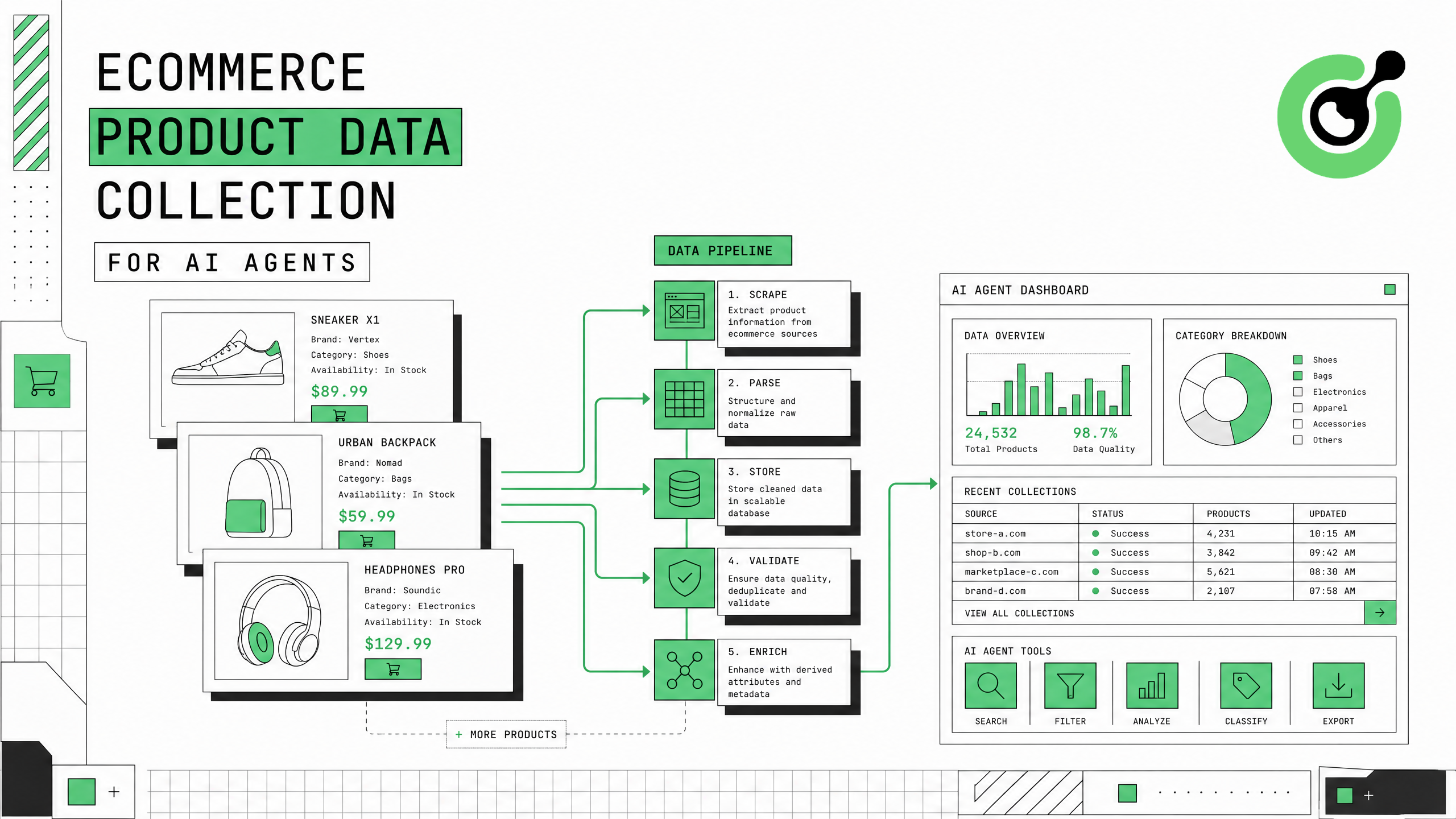
AI-powered ecommerce agents need structured product data — prices, descriptions, inventory status, reviews, and competitor listings — to deliver personalized recommendations, dynamic pricing, and market intelligence. Major ecommerce platforms protect this data with CAPTCHA systems that block automated collection after a few dozen requests. This guide covers building a production-grade ecommerce product data pipeline for AI agents, using CapSolver to maintain continuous access to Amazon, Shopify stores, and marketplace platforms.
TL;DR
- Ecommerce platforms trigger CAPTCHAs after 40-100 product page views, blocking AI agent data pipelines
- CapSolver handles Amazon's image CAPTCHAs, Shopify's Cloudflare Turnstile, and marketplace reCAPTCHA in 3-12 seconds
- A production pipeline collects product details, pricing, reviews, and inventory across multiple platforms
- The data enables AI agents to provide price comparisons, product recommendations, and competitive analysis
- Combining proxy rotation with CAPTCHA solving achieves 95%+ data collection success rates at scale
Why Ecommerce Data Collection Requires CAPTCHA Solving
Ecommerce platforms contain the most commercially valuable product data on the internet. Pricing intelligence, inventory levels, product specifications, and customer reviews drive purchasing decisions worth trillions of dollars annually. These platforms invest heavily in bot protection because competitors, price aggregators, and data resellers all want this information.
When an AI ecommerce agent attempts to collect product data at scale — comparing prices across sellers, monitoring inventory changes, aggregating reviews for sentiment analysis — it generates request patterns that trigger verification challenges. Cloudflare's bot management research shows that ecommerce sites experience among the highest bot traffic volumes of any industry, leading to aggressive protection thresholds.
The CAPTCHA landscape across ecommerce platforms is diverse: Amazon uses custom image-based CAPTCHAs, Shopify stores deploy Cloudflare Turnstile, eBay uses reCAPTCHA v2, and Walmart implements Turnstile with additional behavioral checks. An AI agent's data pipeline must handle all these types to maintain comprehensive product coverage.
What You Need Before Starting
bash
pip install git+https://github.com/capsolver-ai/capsolver-core.git
pip install aiohttp beautifulsoup4 pandas
bash
export CAPSOLVER_API_KEY="your-capsolver-api-key"Additional requirements:
- A CapSolver account with credits
- Residential proxy pool (ecommerce sites block datacenter IPs immediately)
- Database for product catalog and price history
- Target product categories and competitor lists
Platform-Specific CAPTCHA Handling
python
ECOMMERCE_PLATFORMS = {
    "amazon": {
        "captcha_type": "ImageToTextTask",
        "trigger": "after_80_requests_or_rapid_navigation",
        "data": ["title", "price", "rating", "reviews_count", "availability", "seller"]
    },
    "shopify_stores": {
        "captcha_type": "AntiTurnstileTaskProxyLess",
        "trigger": "cloudflare_managed_challenge",
        "data": ["title", "price", "variants", "inventory", "description", "images"]
    },
    "ebay": {
        "captcha_type": "ReCaptchaV2TaskProxyLess",
        "trigger": "after_60_searches",
        "data": ["title", "price", "bids", "seller_rating", "shipping", "condition"]
    },
    "walmart": {
        "captcha_type": "AntiTurnstileTaskProxyLess",
        "trigger": "rate_limit_and_behavioral",
        "data": ["title", "price", "availability", "pickup_options", "reviews"]
    }
}
Building the Collection Engine
python
import asyncio
from capsolver_core import create_capsolver, CaptchaType, CaptchaInfo

class EcommerceDataCollector:
    """Collect ecommerce product data with CAPTCHA handling."""

    def __init__(self, api_key: str, proxies: list):
        self.cap = create_capsolver(api_key=api_key)
        self.proxies = proxies
        self.proxy_idx = 0

    async def collect_product(self, url: str, platform: str) -> dict:
        """Collect product data from a specific URL with CAPTCHA handling."""
        proxy = self.proxies[self.proxy_idx % len(self.proxies)]
        self.proxy_idx += 1

        html = await self._fetch(url, proxy)

        if self._is_captcha(html):
            token = await self._solve(platform, url)
            html = await self._retry(url, proxy, token)

        return self._parse_product(html, platform)

    async def _solve(self, platform: str, url: str) -> str:
        config = ECOMMERCE_PLATFORMS[platform]
        type_map = {
            "ImageToTextTask": CaptchaType.RECAPTCHA_V2,  # Handled differently
            "ReCaptchaV2TaskProxyLess": CaptchaType.RECAPTCHA_V2,
            "AntiTurnstileTaskProxyLess": CaptchaType.CLOUDFLARE
        }

        info = CaptchaInfo(
            type=type_map.get(config["captcha_type"], CaptchaType.RECAPTCHA_V2),
            website_url=url,
            website_key=config.get("site_key", "")
        )
        solution = await self.cap.solve(info)
        return solution.token

    async def monitor_prices(self, product_urls: list, platform: str) -> list:
        """Monitor prices for a list of products."""
        results = []
        for url in product_urls:
            data = await self.collect_product(url, platform)
            results.append(data)
            await asyncio.sleep(5)
        return results

    async def close(self):
        await self.cap.aclose()
AI Agent Use Cases for Ecommerce Data
| Use Case | Data Required | Collection Frequency | Value |
|---|---|---|---|
| Price comparison | Prices across sellers | Every 2-4 hours | Dynamic pricing decisions |
| Inventory monitoring | Stock levels, availability | Every 1-2 hours | Supply chain alerts |
| Review aggregation | Ratings, review text | Daily | Sentiment analysis |
| Competitor tracking | New products, price changes | Daily | Market intelligence |
| Product matching | Titles, specs, images | Weekly | Catalog enrichment |
Cost Optimization
| Scale | Daily Products | Monthly CAPTCHAs | Monthly Cost |
|---|---|---|---|
| Small (100 products) | 400 checks | ~1,200 | $2.40-3.60 |
| Medium (1,000 products) | 2,000 checks | ~6,000 | $12-18 |
| Large (10,000 products) | 10,000 checks | ~30,000 | $60-90 |
Optimization strategies: session persistence reduces encounters by 40-60%, smart scheduling during off-peak hours reduces by 15-25%, and residential proxies reduce by 30-40%.
Claim Your Bonus Code: Use code WEBS at CapSolver Dashboard to get an extra 5% bonus on every recharge.
The CapSolver ecommerce CAPTCHA guide covers platform-specific implementation patterns. For Shopify stores protected by Cloudflare Turnstile, the Turnstile documentation provides detailed code examples. The CapSolver web scraping guide covers infrastructure best practices for large-scale collection.
Conclusion
Ecommerce product data collection for AI agents requires handling diverse CAPTCHA systems across Amazon, Shopify, eBay, and Walmart. CapSolver provides unified solving infrastructure that handles image CAPTCHAs, reCAPTCHA, and Cloudflare Turnstile through a single API, enabling continuous data collection at scale. The combination of residential proxies, session management, and automated solving delivers the reliable product data AI agents need for pricing, recommendations, and competitive intelligence.
FAQ
Which ecommerce platforms can be monitored?
All major platforms using standard CAPTCHA systems: Amazon, Shopify stores, eBay, Walmart, Target, Best Buy, and most marketplace platforms. Each requires platform-specific CAPTCHA parameter identification.
What data fields can AI agents extract from product pages?
Typical fields include title, price, availability, seller information, ratings, review count, product specifications, images, and variant options. The specific fields depend on the platform and product category.
Is ecommerce data collection legal?
Collecting publicly displayed product information (prices, descriptions, availability) is generally permissible for price comparison and market analysis. Review platform terms of service and applicable laws in your jurisdiction. Focus on publicly accessible data rather than behind-login content.
More
AutomationJul 30, 2026
Business Registry Data Extraction for AI Agents: Automate Company Verification
Automate company verification with business registry data extraction for AI agents.
AutomationJul 30, 2026
ChatGPT Search Brand Mention Monitoring: Track Your Brand in AI Answers
Track when ChatGPT Search mentions your brand in AI-generated answers with automated monitoring.