🎉NEWCapSolver for AI agents-MCP, agent tools, and SDK integrations

Nikolai Smirnov
Software Development Lead
Published Jun 25, 2026
Updated Jun 24, 2026 · min read
AI agents deployed in production environments face a persistent and often underestimated obstacle: CAPTCHA challenges. Whether an agent is collecting public data, executing automated workflows, or navigating multi-step web processes, a single unsolved CAPTCHA can stall an entire pipeline. A production-grade CAPTCHA solution for AI agents must go beyond occasional solving — it must be reliable, fast, and built to handle high concurrency without degrading performance. CapSolver is designed precisely for this use case, offering an API-first infrastructure that integrates directly into agent workflows and resolves CAPTCHA challenges programmatically at scale.
The term "production-grade" carries specific meaning in software engineering. It implies that a system has been designed, tested, and hardened for real-world deployment — not just for a proof of concept. For a CAPTCHA solving solution used by AI agents, production-grade means several things simultaneously. It demands an infrastructure that can scale dynamically, self-heal during outages, and adapt to the constantly shifting landscape of web security.
First, it means high solve rates across CAPTCHA types. A production agent may encounter reCAPTCHA v2, reCAPTCHA v3, Cloudflare Turnstile, AWS WAF CAPTCHA, or image-based challenges depending on the target site. A solution that handles only one type is insufficient. According to Cloudflare's overview of CAPTCHA technology, modern bot protection systems increasingly combine multiple challenge types to filter automated traffic, which means any production solver must be broadly capable. The complexity of these challenges requires advanced machine learning models and computer vision techniques to interpret distorted text, identify objects in noisy images, and simulate human-like interaction patterns.
Second, it means low and predictable latency. An agent that waits 10–15 seconds for a CAPTCHA token on every page load will fail SLA requirements and create downstream bottlenecks. A production-grade solver should return tokens in under two seconds for most challenge types. This speed is critical for time-sensitive operations, such as real-time market data aggregation or high-frequency trading bots, where milliseconds can determine the success or failure of a task. The architecture must minimize network round trips and optimize the processing pipeline to ensure rapid token generation.
Third, it means API reliability and uptime. If the CAPTCHA solving service goes down, the agent goes down with it. Production deployments require a solver with documented uptime guarantees, robust retry logic, and graceful fallback behavior. The CAPTCHA solving infrastructure for AI agents article from CapSolver covers the architectural considerations in detail, emphasizing the need for distributed systems, load balancing, and proactive monitoring to maintain continuous service availability.
Fourth, a production-grade solution requires comprehensive monitoring and analytics. Engineering teams need visibility into solve rates, latency distributions, and error frequencies to diagnose issues and optimize agent performance. A robust dashboard that provides real-time metrics and historical trends is essential for maintaining the health of the automation pipeline. This data allows teams to identify specific target sites that are causing difficulties and adjust their strategies accordingly.
The arms race between automated agents and bot protection systems has accelerated significantly in recent years. Early CAPTCHAs, which primarily relied on distorted text, were easily defeated by basic OCR (Optical Character Recognition) software. In response, security providers developed more sophisticated challenges, such as image classification tasks and behavioral analysis algorithms. Today's advanced systems evaluate a multitude of signals, including mouse movements, typing speed, browser fingerprints, and network reputation, to determine the likelihood that a user is human.
This evolution necessitates a corresponding advancement in CAPTCHA solving technologies. Simple script-based approaches are no longer viable for production environments. Instead, modern solvers must employ complex AI models capable of mimicking human behavior and generating valid interaction telemetry. They must also manage proxy networks effectively to ensure that requests originate from reputable IP addresses, further reducing the risk of detection. Understanding this dynamic landscape is crucial for anyone designing or deploying AI agents for web automation.
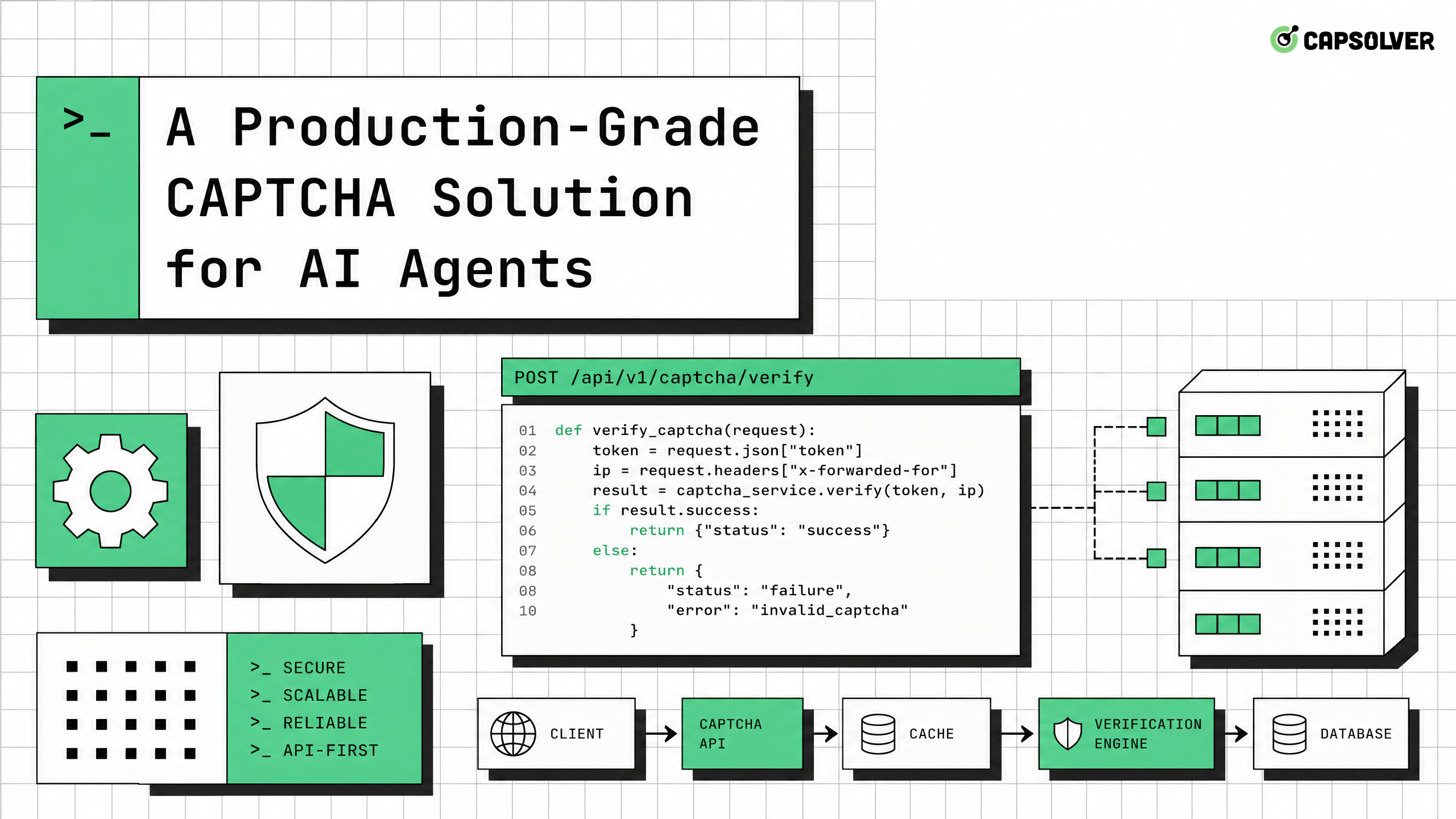
A well-designed production CAPTCHA layer sits between the agent's browser automation stack and the target web service. When the agent detects a CAPTCHA challenge — either by DOM inspection, HTTP response code, or a dedicated detection module — it pauses the current task, submits the challenge parameters to the CAPTCHA solving API, waits for the token, and then injects the token into the browser session before resuming.
This architecture has several important properties. It is non-blocking at the task queue level: while one agent thread waits for a CAPTCHA token, other threads can continue processing unblocked tasks. It is stateless from the solver's perspective: each CAPTCHA request is independent, which simplifies retry logic and error handling. And it is composable: the same CAPTCHA layer can be reused across different agent types, whether the agent is built on LangChain, CrewAI, browser-use, or a custom automation framework.
For teams building scalable CAPTCHA solving for production agents, the key design decision is whether to implement the CAPTCHA layer as a middleware component, a dedicated microservice, or a direct SDK integration. Each approach has trade-offs in terms of latency, maintainability, and operational overhead. A microservice architecture, for example, allows the CAPTCHA solving logic to be scaled independently of the main agent application, providing greater flexibility for high-volume workloads. Conversely, a direct SDK integration might offer lower latency by eliminating an extra network hop, making it suitable for latency-sensitive applications.
Furthermore, a robust architecture must incorporate intelligent error handling and retry mechanisms. CAPTCHA solving is an inherently probabilistic process; even the best systems will occasionally fail or encounter timeouts. The agent must be equipped to handle these scenarios gracefully, perhaps by retrying the request with a different proxy or escalating the issue to a human operator if a persistent failure occurs. This resilience is a hallmark of true production-grade engineering.
Redeem Your CapSolver Bonus Code
Boost your automation budget instantly!
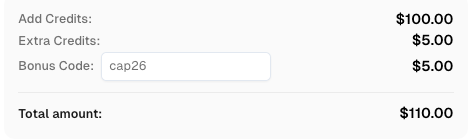
Use bonus code CAP26 when topping up your CapSolver account to get an extra 5% bonus on every recharge — with no limits.
Redeem it now in your CapSolver Dashboard
When evaluating a CAPTCHA solution for production use, engineering teams should assess the following criteria meticulously. A superficial evaluation can lead to costly integration issues and operational instability down the line.
| Requirement | Description |
|---|---|
| Multi-type support | Handles reCAPTCHA v2/v3, Cloudflare Turnstile, AWS WAF, image CAPTCHAs |
| Solve speed | Average token delivery under 2 seconds for proxyless tasks |
| Concurrency | Supports hundreds of simultaneous solve requests without rate limiting |
| Uptime SLA | Documented availability guarantee with status monitoring |
| SDK availability | Official SDKs for Python, Node.js, and other common agent languages |
| Compliance tooling | Supports responsible use policies and usage auditing |
| Proxy integration | Seamless support for external proxy networks to manage IP reputation |
| Behavioral telemetry | Capability to generate human-like interaction data for advanced challenges |
CapSolver meets all of these requirements comprehensively. Its API supports the full range of CAPTCHA types encountered in production agent deployments, and its infrastructure is built for high-concurrency workloads. The best CAPTCHA API for AI agents in 2026 comparison provides a detailed breakdown of how different services perform across these dimensions, consistently highlighting CapSolver's leadership in reliability and feature depth.
The integration process is straightforward. An agent sends a POST request to the CapSolver API with the task type, the target URL, and the site key. The API returns a task ID. The agent polls the API until the task status changes to "ready," at which point it retrieves the CAPTCHA token and submits it to the target site.
Here is a simplified example using Python:
import requests, time

API_KEY = "YOUR_API_KEY"

def solve_recaptcha(site_url, site_key):
    task_payload = {
        "clientKey": API_KEY,
        "task": {
            "type": "ReCaptchaV2TaskProxyless",
            "websiteURL": site_url,
            "websiteKey": site_key
        }
    }
    res = requests.post("https://api.capsolver.com/createTask", json=task_payload)
    task_id = res.json().get("taskId")

    while True:
        time.sleep(2)
        result = requests.post("https://api.capsolver.com/getTaskResult", json={
            "clientKey": API_KEY,
            "taskId": task_id
        }).json()
        if result.get("status") == "ready":
            return result["solution"]["gRecaptchaResponse"]
This pattern integrates cleanly into any agent framework. For teams using adding CAPTCHA handling middleware to your agent as a design pattern, the same logic can be wrapped into a reusable middleware class.
A production-grade CAPTCHA solution is not just a technical system — it is also a compliance responsibility. Agents that access web services must do so in accordance with those services' terms of use. CAPTCHA solving is a legitimate tool for authorized automation, data collection for public information, and quality assurance testing. It does not grant permission to access private, restricted, or sensitive data without authorization.
The OWASP Automated Threat Handbook provides a useful framework for understanding the boundary between legitimate automation and abusive bot behavior. Engineering teams should review this guidance when designing agent workflows that interact with third-party web services. Similarly, Google's reCAPTCHA documentation outlines the intended use cases for CAPTCHA technology and the expectations placed on integrators.
Building a production-grade CAPTCHA solution for AI agents requires more than calling a solving API. It requires architectural planning, reliability engineering, and a clear understanding of compliance boundaries. The agents that perform best in production are those whose CAPTCHA handling is treated as a first-class infrastructure concern — not an afterthought. With the right solver integrated at the right layer of the stack, CAPTCHA challenges become a solved problem rather than a recurring bottleneck.
As AI agents become more sophisticated and autonomous, their ability to navigate complex web environments will be a primary determinant of their value. Investing in a robust, scalable, and reliable CAPTCHA solving infrastructure is essential for unlocking this value. By prioritizing high solve rates, low latency, and architectural resilience, engineering teams can ensure that their automated workflows operate smoothly and efficiently, regardless of the security measures they encounter. Explore CapSolver to see how its production-ready infrastructure can support your agent deployment at any scale, providing the foundation for next-generation web automation.
What is a production-grade CAPTCHA solution for AI agents?
A production-grade CAPTCHA solution is a CAPTCHA solving system designed for reliability, high concurrency, and low latency in real-world agent deployments. It must support multiple CAPTCHA types, offer documented uptime, and integrate cleanly into the agent's automation stack.
How does a CAPTCHA solving API integrate with an AI agent?
The agent detects a CAPTCHA challenge, sends the challenge parameters to the solving API, polls for the result, and injects the returned token into the browser session. This process is typically implemented as middleware or a utility function within the agent's codebase.
What CAPTCHA types does CapSolver support for production agents?
CapSolver supports reCAPTCHA v2, reCAPTCHA v3, reCAPTCHA Enterprise, Cloudflare Turnstile, Cloudflare Challenge, AWS WAF CAPTCHA, and image-based OCR challenges.
Is it legal to use a CAPTCHA solving service in an AI agent?
Using a CAPTCHA solving service is legal for authorized automation, public data collection, and testing purposes. However, it does not grant permission to access restricted or private data. Always review the terms of service of the target website before deploying an agent.
What should I look for when choosing a CAPTCHA solver for production?
Prioritize multi-type support, solve speed under two seconds, high concurrency capacity, documented uptime, and official SDK availability. Also evaluate the provider's compliance posture and whether they offer usage auditing tools.
Nikolai Smirnov
Software Development Lead
Building dependable software for complex automation.
ABOUT THE AUTHOR
Fix CAPTCHA handling that works locally but fails in a cloud AI agent. Compare browser setup, dependencies, credentials, network access, and page state.

Estimate CAPTCHA solving costs in Browser Use by separating agent runs, challenge types, billable solves, retries, and verified outcomes from browser costs.