🎉NEWCapSolver for AI agents-MCP, agent tools, and SDK integrations

Ethan Collins
AI Agent Workflow Engineer
Published Sep 10, 2026
Updated Sep 10, 2026 · min read
An enterprise pilot is useful when it changes a purchasing or deployment decision. A demonstration that returns one CAPTCHA solution answers a narrow technical question. It leaves open whether the service fits your task mix, whether another team can operate the integration, and what happens when the browser workflow stops halfway through.
For enterprise CAPTCHA handling services, the most valuable pilot artifact is a short decision record supported by representative observations. CapSolver provides documented CAPTCHA task interfaces that a team can evaluate within an authorized workload. The enterprise decision also needs evidence about your own controls and any account-specific terms. This guide explains how to structure that evaluation without converting product claims, hypothetical targets, or a small demonstration into an unsupported production guarantee.
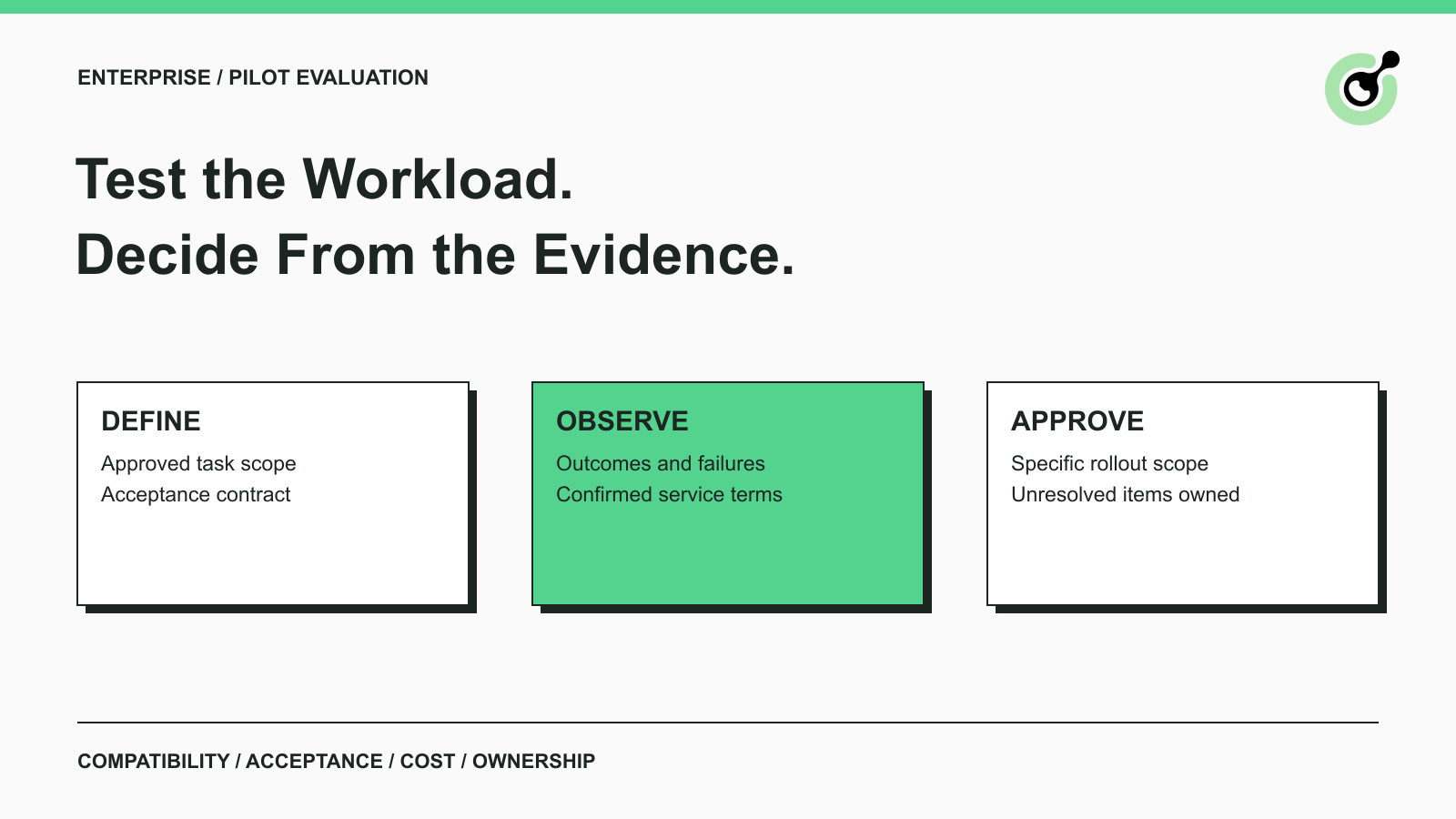
A pilot should answer a bounded question such as whether a platform team can operate one supported challenge path for an approved application. Define the account owner, destination, task family, expected output, and deployment environment before calling a service.
Write down what approval would enable. It might permit a limited rollout to one data-collection job or an integration in an owned test environment. It should not silently approve every agent, account, or destination used by the organization. A clear scope makes both success and refusal easier to interpret.
Also identify the alternative if the pilot fails. The team may use an approved data feed, retain a human step, reduce the workload, or postpone automation. This prevents a trial from becoming an open-ended exercise in making a preferred vendor appear acceptable.
Assign a decision owner and an operational owner. The decision owner accepts the evidence and the remaining limitations. The operational owner maintains credentials, observes failures, and knows how to stop the workflow. One person can fill both roles in a small team, but the responsibilities should remain explicit.
A representative workload includes the tasks you expect to run and the conditions under which they should stop. Sampling only easy challenges hides the cost and operational behavior that often determine deployment suitability.
Group permitted work by task type, application flow, and required result. Include an ordinary completion path, an application that rejects the returned result, an unsupported input, and a business deadline that expires. Treat these as proposed pilot cases, not claims that a particular provider will behave in a predetermined way.
Choose sample sizes based on the decision's consequences and the workload's variability. A small demonstration can validate request shape; it cannot establish a rare-failure rate. Record the size and composition of the sample so a later reader can tell what was actually evaluated.
For an agent project, describe what the agent is allowed to decide. A fixed collector and an agent that chooses browser actions create different sources of variation. Hold the prompt, browser configuration, parser, and acceptance rule stable during the first comparison so changes in those components do not become unexplained provider differences.
The AI web scraping glossary entry explains the broader collection context. A CAPTCHA service supplies one capability within that workflow; the pilot must still verify that the intended application output is usable.
Acceptance criteria should separate service behavior, application behavior, and the business result. A successful task response is evidence about the service layer. A permitted browser continuation is evidence about the application layer. A validated record or completed workflow is the business result.
The CapSolver createTask interface documents task creation and the distinction between asynchronous and direct-result responses. The getTaskResult interface describes asynchronous result retrieval. Use those contracts when recording service outcomes, then define your own application acceptance check separately.
For a hypothetical product-observation pilot, a service task might complete while the resulting page contains a different product variant. Record service completion and reject the observation for the business purpose. This is not a reason to relabel the task response as failed; it is a reason to keep the measurements distinct.
| Decision area | Evidence to retain | What the evidence does not establish |
|---|---|---|
| Task compatibility | Documented task type, inputs, observed response | Coverage of untested challenge configurations |
| Application acceptance | Expected page or action and validation result | Permission for unrelated destinations |
| Operating cost | Actual billed usage plus allocated integration effort | A universal price for future workloads |
| Security controls | Access review and revocation observations | Controls that were only requested in a questionnaire |
| Support | A real scoped inquiry and its resolution | An SLA unless the agreement provides one |
Define exclusions before calculating success rates. If unsupported work is excluded from a supported-task measure, still show how much of the intended workload it represents. Otherwise a high percentage can conceal a service that covers only a small part of the business need.
Enterprise security evidence must distinguish provider capabilities from controls implemented by your team. An internal gateway that allocates spending by department does not prove that a vendor offers department-level accounts or native role controls.
Review who can create tasks, see results, rotate credentials, and change destination policy. Apply least privilege to your own service layer. OWASP's authorization guidance supports explicit permission checks and access decisions rather than trusting a tool simply because it exists.
Ask the provider to confirm account-specific requirements such as support commitments, retention terms, available access controls, and contractual limits. Mark each answer as documented, demonstrated, contractually agreed, or unresolved. These labels prevent a sales conversation from becoming an implemented control in the final report.
The same discipline applies to credentials. OWASP's secrets management guidance covers credential lifecycle and restricted access. Test that your worker obtains credentials through the intended path and that a revoked internal permission actually stops future calls.
Redeem Your CapSolver Bonus Code
Boost your automation budget instantly!
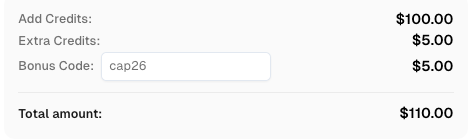
Use bonus code CAP26 when topping up your CapSolver account to get an extra 5% bonus on every recharge — with no limits.
Redeem it now in your CapSolver Dashboard
A small pilot is the right place to discover who owns a stalled task, a lost response, or a revoked account permission. Establish these responsibilities before expanding the workload.
An uncertain submission occurs when the application cannot establish whether task creation succeeded. Make that state visible in the test harness. Verify that the workflow does not automatically create more tasks just because a response was lost. Retain the original deadline and a redacted correlation reference for review.
A permission-change case checks what happens after a job starts but before it completes. Use an owned environment and revoke the relevant internal permission. The application should apply the current policy before taking the next protected action. Do not confuse stopping your workflow with cancelling a remote task unless cancellation is explicitly supported and confirmed.
A support trial should contain a documented task category, a redacted error, timestamps, and a concrete question. Ask what evidence is needed to investigate an uncertain result or an unsupported configuration. Record the actual response and whether it resolves the question. Avoid deriving a contractual response-time promise from one successful exchange.
Store the pilot evidence where the next operator can find it. OWASP's logging recommendations provide a useful basis for excluding credentials and protecting sensitive event data. A reproducible failure report needs context, not a complete copy of the authenticated browser session.
Pilot cost should include the work consumed to obtain accepted outcomes, including attempts that do not produce usable output. Separate provider charges from browser infrastructure, data processing, and operator effort rather than presenting a single opaque number.
Suppose a hypothetical trial plans 100 authorized observations and accepts 80. The accepted-outcome denominator is 80, while coverage is 80 out of 100. If five more results contain the wrong variant, do not add them to the accepted denominator simply because they have a price field.
Report the excluded outcomes alongside cost. A service can appear cheaper if the experiment quietly abandons difficult destinations or ignores stale records. Compare like-for-like workload groups and show missing coverage explicitly. This makes the purchasing decision more useful than a single average.
Use actual account billing and the applicable agreement for service costs. Do not infer enterprise discounts, refunds, minimum commitments, or included support from a public feature list. If a term is unresolved, keep it as an open item with an owner and an effect on the decision.
The enterprise AI agent infrastructure discussion gives broader organizational context. A pilot adds the local evidence needed to decide which responsibilities your central team will actually take on.
A rollout decision should state what is approved, why the evidence supports it, and what remains outside scope. Use a short record that someone unfamiliar with the pilot can review without reconstructing every meeting.
Include the tested workload, relevant configuration versions, acceptance results, observed failure behavior, cost basis, and unresolved questions. Name the person responsible for each unresolved question. If a missing control is essential, keep that workload out of production until the issue is resolved.
A conditional approval is often more precise than a universal verdict. For example, the evidence may support one documented task family in an owned workflow with a bounded daily budget. Another application may still require a separate pilot because its session handling, data sensitivity, or destination policy differs.
Define the trigger for reevaluation. A material task-type change, new account boundary, repeated unknown outcomes, or unexpected spending can justify another review. Choose triggers from the actual workload; there is no universal threshold that makes every deployment safe or economical.
A useful enterprise CAPTCHA pilot leaves the team with an operating decision and reusable evidence. Preserve the request contract, application acceptance rule, ownership map, and limited rollout scope together. That package lets another operator understand what was demonstrated and what was only proposed.
Evaluate CapSolver against supported tasks in your authorized environment, then base expansion on observed application outcomes and confirmed terms. The result should be a deployment that the team can explain, maintain, and stop when its assumptions no longer hold.
Q: What makes an enterprise CAPTCHA pilot different from an API demo?
An enterprise pilot evaluates operating fit, ownership, failure behavior, cost, and required terms. An API demo establishes a much narrower technical result and should be reported as such.
Q: Should solver completion rate be the main purchasing metric?
Solver completion is one useful metric, but the purchasing decision also needs accepted business outcomes, workload coverage, operating cost, and evidence for required controls. Keep those measurements separate.
Q: Can public documentation establish an enterprise SLA?
Only the applicable documented commitment or agreement establishes the relevant SLA. Ask for confirmation of the terms that apply to your account instead of inferring them from general product language.
Q: Must every agent team repeat the entire pilot?
Teams can reuse evidence when the task, environment, permissions, and acceptance rules remain applicable. A materially different workflow needs its own gap review and any additional testing that the differences require.
Ethan Collins
AI Agent Workflow Engineer
Building clearer handoffs between AI agents and tools.
ABOUT THE AUTHOR
Add a CAPTCHA inspection tool to Haystack, read reCAPTCHA parameters with the official SDK, and verify the connection before a separate solving step.

Add CAPTCHA solver tools to Goose with a local MCP extension. Configure Python, inspect tool discovery, and troubleshoot the setup before a solving task.