🎉NEWCapSolver for AI agents-MCP, agent tools, and SDK integrations

Anh Tuan
Data Science Expert
Published Jun 26, 2026
Updated Jun 24, 2026 · min read
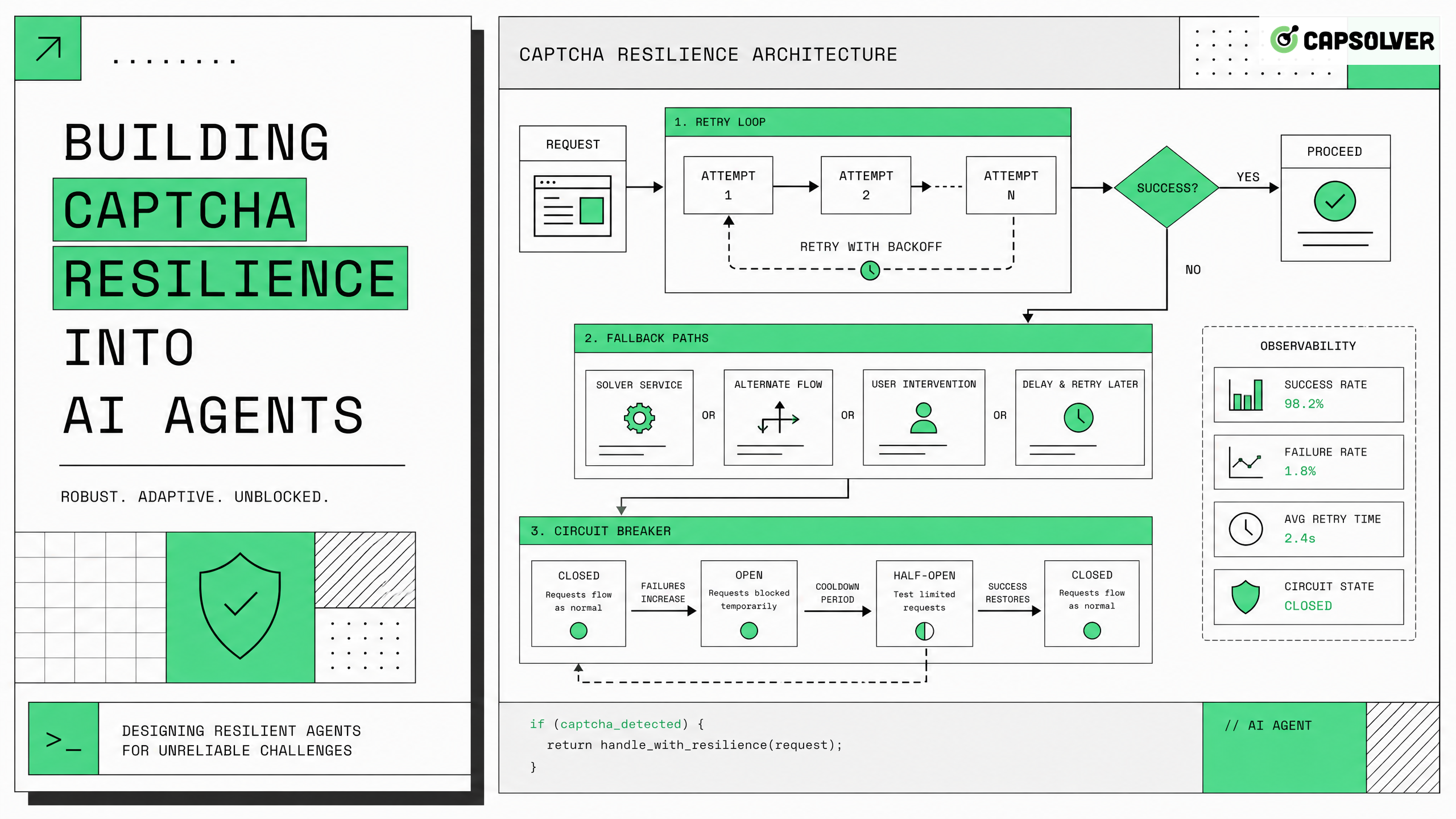
Building CAPTCHA resilience into AI agents is a fundamental requirement for modern automation systems. As websites increasingly deploy sophisticated risk control measures, autonomous agents frequently encounter traffic validation challenges that can halt their operations. A robust architecture anticipates these interruptions and integrates specialized solutions to handle them efficiently. By incorporating CapSolver into the automation pipeline, developers can ensure their agents maintain high availability and performance. This approach separates the core logic of the AI agent from the complexities of bot protection management. The result is a more stable, scalable, and compliant automation infrastructure capable of navigating the modern web with minimal manual intervention.
AI agents are designed to perform complex tasks autonomously, from data collection to workflow automation. However, the modern web is heavily fortified with risk control systems designed to differentiate human users from automated scripts. When an AI agent encounters a traffic validation challenge, it must possess the capability to resolve it without manual intervention. This capability is what we define as CAPTCHA resilience.
Without CAPTCHA resilience, an AI agent's reliability drops significantly. A single unresolved challenge can cause a critical process to fail, leading to incomplete data or broken workflows. Therefore, integrating a robust CAPTCHA solving API for autonomous agents is not just an optional enhancement; it is a core component of the agent's infrastructure. This integration allows the agent to delegate the resolution process to a specialized service, ensuring continuous operation.
To achieve true CAPTCHA resilience, developers must adopt a proactive approach. This involves understanding the types of challenges the agent might face and implementing fallback mechanisms. For instance, when a primary resolution method fails, the system should automatically retry or switch to an alternative strategy. This level of adaptability is crucial for maintaining the agent's effectiveness in dynamic environments. The ability to sustain operations despite encountering frequent validation requests is the hallmark of a well-engineered system.
Furthermore, the concept of CAPTCHA resilience extends beyond mere technical resolution. It encompasses the entire lifecycle of the automated interaction, from the initial request to the final data extraction. Every step must be optimized to minimize the likelihood of triggering risk control mechanisms. This holistic approach ensures that the AI agent operates efficiently and sustainably over long periods.
Designing an architecture that supports CAPTCHA resilience requires careful planning. The most effective approach is to decouple the agent's primary logic from the traffic validation handling mechanism. This separation of concerns ensures that the agent remains focused on its core tasks while a dedicated module manages the complexities of risk control systems.
One common strategy is to implement a middleware layer that intercepts network requests and responses. When this layer detects a traffic validation challenge, it pauses the agent's execution, resolves the challenge using a service like a CapSolver agent-ready CAPTCHA solver, and then resumes the operation. This transparent handling mechanism simplifies the agent's codebase and improves overall maintainability.
Another critical aspect of the architecture is the management of browser environments. Many modern risk control systems analyze the browser's fingerprint to detect automation. Utilizing an agentic browser automation layer can help mitigate this issue by providing a more authentic browsing context. This layer manages cookies, headers, and other fingerprinting attributes, reducing the likelihood of triggering aggressive traffic validation measures.
Furthermore, developers should consider the scalability of their CAPTCHA resilience infrastructure. As the number of AI agents increases, the volume of traffic validation challenges will also grow. Implementing a robust CAPTCHA solving infrastructure for AI agents ensures that the system can handle high loads without degrading performance. This might involve load balancing, caching resolution results, and optimizing network communication.
A well-architected system also includes comprehensive logging and monitoring capabilities. By tracking the frequency and types of challenges encountered, developers can continuously refine their CAPTCHA resilience strategies. This data-driven approach allows for proactive adjustments, ensuring the agents remain effective even as risk control technologies evolve.
Even with the best CAPTCHA resilience strategies in place, occasional failures are inevitable. Network issues, changes in risk control algorithms, or service outages can all disrupt the resolution process. To mitigate these risks, AI agents must incorporate robust fallback and retry mechanisms.
A well-designed retry mechanism should employ exponential backoff to avoid overwhelming the target server or the resolution service. If a challenge cannot be resolved after a certain number of attempts, the agent should log the error and either move on to the next task or alert a human operator. This graceful degradation ensures that a single failure does not bring down the entire automation pipeline.
In addition to retries, fallback mechanisms can provide an extra layer of CAPTCHA resilience. For example, if an automated resolution service fails, the system could temporarily route the challenge to a human-in-the-loop interface. While this approach introduces latency, it guarantees that critical tasks can still be completed. Understanding the core principles of automation helps in designing these fallback workflows effectively.
Moreover, fallback strategies should be context-aware. If an agent is performing a time-sensitive task, a rapid retry with a different resolution provider might be preferable to a human fallback. Conversely, for background data collection, a slower, more deliberate fallback process might be acceptable. Tailoring these mechanisms to the specific use case enhances the overall CAPTCHA resilience of the system.
Redeem Your CapSolver Bonus Code
Boost your automation budget instantly!
Use bonus code CAP26 when topping up your CapSolver account to get an extra 5% bonus on every recharge — with no limits.
Redeem it now in your CapSolver Dashboard
Selecting the right tools is a critical step in building CAPTCHA resilience. The market offers various solutions, each with its own strengths and weaknesses. Developers must evaluate these tools based on their accuracy, speed, reliability, and integration capabilities.
When choosing a CAPTCHA solver for agent infrastructure, it is essential to consider the specific types of challenges the agent will encounter. Some tools specialize in image-based challenges, while others excel at behavioral analysis. A comprehensive solution should support a wide range of challenge types to ensure maximum CAPTCHA resilience.
Furthermore, the integration process should be straightforward. The chosen tool should offer well-documented APIs and SDKs for popular programming languages. This reduces development time and minimizes the risk of implementation errors. For a detailed comparison of available options, developers can refer to guides on the best CAPTCHA API for AI agents.
It is also important to consider the provider's track record and support infrastructure. A reliable partner will offer prompt assistance when issues arise and continuously update their service to handle new risk control measures. This ongoing support is a vital component of long-term CAPTCHA resilience.
| Approach | Description | Pros | Cons |
|---|---|---|---|
| Manual Resolution | Human operators solve challenges as they appear. | High accuracy, adaptable to new challenge types. | Not scalable, introduces significant latency, high cost. |
| In-house Machine Learning | Developing custom models to solve specific challenges. | Complete control over the process, potentially lower long-term costs. | Requires significant expertise, high initial development cost, constant maintenance needed. |
| Third-party API Integration | Utilizing specialized services to handle traffic validation. | High scalability, easy integration, continuous updates by the provider. | Recurring costs, reliance on external service availability. |
| Hybrid Approach | Combining automated APIs with human fallback for complex cases. | Maximizes success rates, balances cost and reliability. | More complex to implement and manage. |
To ensure that AI agents remain effective over time, CAPTCHA resilience must be integrated into the continuous integration and continuous deployment (CI/CD) pipelines. This approach guarantees that any updates to the agent's code or underlying infrastructure do not inadvertently compromise its ability to handle traffic validation challenges. Automated testing should include scenarios where the agent encounters various risk control measures, verifying that the resolution mechanisms function correctly before the code is deployed to production.
During the testing phase, developers can use simulated environments to mimic the behavior of target websites. This allows for comprehensive evaluation of the agent's CAPTCHA resilience without risking IP bans or other penalties on live servers. By incorporating these tests into the CI/CD pipeline, teams can catch potential issues early in the development cycle, reducing the likelihood of failures in the production environment.
Furthermore, deployment strategies should account for the need to update resolution logic rapidly. If a target website introduces a new type of traffic validation, the agent must be updated quickly to maintain its CAPTCHA resilience. Utilizing containerization and microservices architectures can facilitate these rapid updates, allowing developers to deploy changes to the resolution module independently of the core agent logic. This agility is essential for maintaining continuous operation in a rapidly changing web landscape.
As AI agents become more capable, it is crucial to address the ethical and compliance aspects of automated web interactions. Building CAPTCHA resilience should not be viewed as a means to circumvent legitimate security measures maliciously. Instead, it should be approached as a way to facilitate authorized and responsible automation.
Developers must ensure that their AI agents operate within the bounds of the target website's terms of service. This includes respecting rate limits, identifying the agent appropriately via user-agent strings, and avoiding actions that could degrade the website's performance. Responsible automation practices are essential for maintaining a healthy ecosystem and avoiding legal repercussions.
Furthermore, organizations should implement strict access controls and auditing mechanisms for their automation infrastructure. This ensures that AI agents are only used for authorized purposes and that any misuse can be quickly identified and addressed. By prioritizing compliance, organizations can build CAPTCHA resilience while maintaining trust and transparency. The W3C WebDriver standard provides guidelines for browser automation that can help ensure compliant behavior.
Data privacy is another critical consideration. When agents interact with web services, they may inadvertently collect sensitive information. Implementing robust data anonymization and secure storage practices is necessary to protect user privacy and comply with regulations such as GDPR or CCPA. Ethical CAPTCHA resilience involves not only technical proficiency but also a commitment to data security.
To achieve the highest level of CAPTCHA resilience, developers can employ advanced techniques that go beyond basic API integration. One such technique is the use of proxy networks to distribute the agent's requests across multiple IP addresses. This reduces the likelihood of triggering IP-based risk control measures and improves the overall success rate of the automation process.
Another advanced approach involves simulating human-like behavior during web interactions. This includes adding random delays between actions, moving the mouse cursor naturally, and scrolling the page at varying speeds. By mimicking human behavior, the agent can often avoid triggering behavioral analysis systems entirely, thereby reducing the need for explicit traffic validation resolution.
Additionally, monitoring and analytics play a vital role in maintaining CAPTCHA resilience. Developers should track metrics such as resolution success rates, average response times, and the frequency of different challenge types. This data can provide valuable insights into the effectiveness of the current strategy and highlight areas for improvement. For instance, a sudden drop in success rates might indicate a change in the target website's risk control mechanisms, prompting a review of the agent's configuration.
Implementing machine learning models to predict when a challenge is likely to occur can also enhance CAPTCHA resilience. By analyzing historical data, these models can adjust the agent's behavior preemptively, such as slowing down request rates or switching IP addresses before a block occurs. This proactive stance significantly improves the stability of the automation infrastructure. The IETF standards on network protocols offer foundational knowledge for optimizing these network-level interactions.
The landscape of web automation and risk control is constantly evolving. As AI agents become more sophisticated, so too will the systems designed to detect and manage them. Maintaining CAPTCHA resilience will require continuous adaptation and innovation.
Future developments may include more advanced behavioral analysis techniques, biometric verification, and decentralized identity systems. To stay ahead of these trends, developers must remain informed about the latest advancements in both automation and security technologies. Engaging with the community, attending industry conferences, and participating in open-source projects can provide valuable insights and foster collaboration.
Ultimately, the goal of building CAPTCHA resilience is to enable AI agents to perform their tasks reliably and efficiently, while respecting the security and integrity of the web ecosystem. By adopting a proactive and responsible approach, developers can maximize the potential of autonomous automation and drive innovation across various industries. Organizations like the OWASP Foundation provide valuable resources for understanding automated threats and defensive strategies.
As the industry progresses, we can expect to see tighter integration between AI agents and the platforms they interact with. Standardized APIs for data access could eventually reduce the reliance on traditional web scraping, thereby altering the context of CAPTCHA resilience. However, until such standards are universally adopted, robust traffic validation handling will remain a critical competency for automation engineers.
Building CAPTCHA resilience into AI agents is a complex but essential undertaking for any organization relying on automated web interactions. By understanding the challenges, implementing robust architectural strategies, and selecting the right tools, developers can ensure their agents operate reliably in the face of sophisticated risk control measures. It is crucial to prioritize ethical practices and compliance throughout the development process. As the web continues to evolve, maintaining this resilience will require ongoing monitoring and adaptation. For a comprehensive solution to manage traffic validation effectively and keep your automation running smoothly, consider integrating CapSolver into your automation infrastructure today.
CAPTCHA resilience refers to an AI agent's ability to automatically handle and resolve traffic validation challenges without requiring manual human intervention, ensuring continuous operation.
Separating these concerns simplifies the agent's codebase, makes the system more maintainable, and allows for specialized handling of risk control mechanisms without disrupting the primary task.
Developers should respect website terms of service, adhere to rate limits, use appropriate user-agent identification, and follow established standards for responsible web automation.
Proxy networks distribute requests across multiple IP addresses, which helps prevent IP-based blocking and reduces the likelihood of triggering aggressive traffic validation measures.
Yes, incorporating natural delays, mouse movements, and scrolling patterns can help agents appear more human-like, potentially avoiding behavioral analysis triggers entirely.
Anh Tuan
Data Science Expert
Turning task outcomes into actionable insights.
ABOUT THE AUTHOR
Estimate CAPTCHA solving costs in Browser Use by separating agent runs, challenge types, billable solves, retries, and verified outcomes from browser costs.

Set up CapSolver MCP in Claude Code, check the available CAPTCHA tools, and choose token or page solving for a supported, authorized browser task.