🎉NEWCapSolver for AI agents-MCP, agent tools, and SDK integrations

Lucas Mitchell
Automation Engineer
Published Jul 03, 2026
Updated Jul 03, 2026 · min read
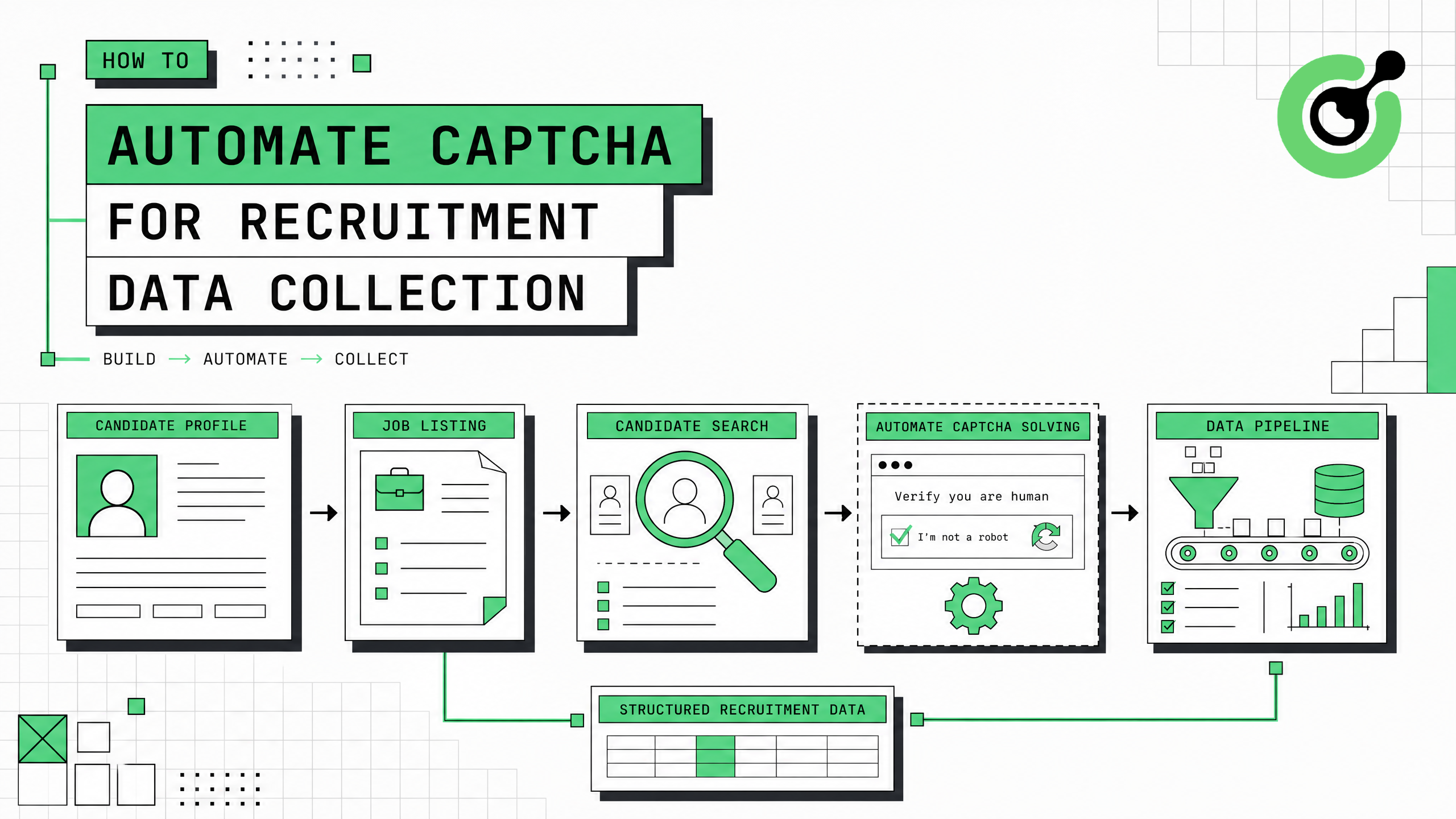
Recruitment teams and HR technology platforms need to collect candidate data, job market intelligence, and salary benchmarks from multiple sources. Job boards, professional networks, and government labor databases increasingly deploy CAPTCHA challenges that block automated data collection. This guide walks through integrating CAPTCHA solving into recruitment automation workflows, covering job board scraping, candidate sourcing pipelines, labor market research, and compliance with data collection regulations.
The recruitment industry relies heavily on data from job boards, professional networks, and labor market databases. According to SHRM, the average cost-per-hire in the US is $4,700, and reducing time-to-fill directly impacts this cost. Recruitment technology platforms that aggregate job postings, track salary trends, and source candidates must access dozens of protected websites daily. CAPTCHA challenges on these platforms create bottlenecks that slow down hiring pipelines and reduce the volume of market intelligence available to recruiters. This guide shows how to build CAPTCHA-resilient recruitment data collection systems that operate within responsible use boundaries.
Prepare these components before adding CAPTCHA handling to your recruitment automation:
The CapSolver guide to web scraping with Python provides foundational patterns that apply directly to recruitment data collection scenarios.
Document the CAPTCHA systems deployed across your target recruitment data sources:
Common CAPTCHA systems on recruitment platforms:
| Platform Type | Protection System | CAPTCHA Trigger | Challenge Type |
|---|---|---|---|
| Major job boards (Indeed) | Custom + reCAPTCHA v3 | Score-based, 20-50 requests | Invisible + image fallback |
| Professional networks (LinkedIn) | Custom bot detection | Behavioral analysis | Account restriction + CAPTCHA |
| Salary databases (Glassdoor) | Cloudflare | Session-based | Turnstile |
| Government labor portals | reCAPTCHA v2 | Every search or after 10 requests | Checkbox + image grid |
| Niche job boards | reCAPTCHA v2 | Per-session | Standard checkbox |
| ATS career pages | Cloudflare/DataDome | Rate-based | Turnstile or custom |
Each recruitment platform has different sensitivity levels and trigger thresholds. LinkedIn's behavioral detection is far more sophisticated than a small niche job board's reCAPTCHA v2. Understanding these differences lets you allocate your CAPTCHA solving budget efficiently and avoid unnecessary account restrictions on high-value platforms.
Implement a CAPTCHA handler tailored for recruitment data collection patterns:
import requests
import time
from datetime import datetime, timedelta
from collections import defaultdict

CAPSOLVER_KEY = "your-api-key"

class RecruitmentCaptchaHandler:
    def __init__(self):
        self.platform_stats = defaultdict(lambda: {
            "solves_today": 0,
            "last_solve": None,
            "success_rate": 1.0
        })
        self.daily_budget_limit = 1000  # Max solves per day across all platforms
        self.total_solves_today = 0

    def solve_job_board_captcha(self, platform_name, site_key, page_url, captcha_type="ReCaptchaV2TaskProxyLess"):
        """Solve CAPTCHA for a job board with platform-aware rate tracking."""
        if self.total_solves_today >= self.daily_budget_limit:
            raise Exception("Daily CAPTCHA budget exhausted")

        # Build task parameters based on CAPTCHA type
        task_params = {"type": captcha_type, "websiteURL": page_url}

        if captcha_type in ["ReCaptchaV2TaskProxyLess", "ReCaptchaV3TaskProxyLess"]:
            task_params["websiteKey"] = site_key
            if captcha_type == "ReCaptchaV3TaskProxyLess":
                task_params["pageAction"] = "search"  # Common action for job searches
        elif captcha_type == "AntiCloudflareTask":
            task_params["websiteURL"] = page_url

        # Create and solve task
        response = requests.post("https://api.capsolver.com/createTask", json={
            "clientKey": CAPSOLVER_KEY,
            "task": task_params
        })

        result = response.json()
        if result.get("errorId") != 0:
            self.platform_stats[platform_name]["success_rate"] *= 0.95
            raise Exception(f"Task creation failed: {result.get('errorDescription')}")

        task_id = result["taskId"]

        # Poll for result
        for _ in range(40):
            poll_result = requests.post("https://api.capsolver.com/getTaskResult", json={
                "clientKey": CAPSOLVER_KEY,
                "taskId": task_id
            }).json()

            if poll_result.get("status") == "ready":
                self.total_solves_today += 1
                stats = self.platform_stats[platform_name]
                stats["solves_today"] += 1
                stats["last_solve"] = datetime.utcnow()
                stats["success_rate"] = min(1.0, stats["success_rate"] * 1.01)
                return poll_result["solution"]
            time.sleep(3)

        raise TimeoutError(f"CAPTCHA solve timed out for {platform_name}")

    def get_daily_report(self):
        """Generate daily CAPTCHA solving report for cost tracking."""
        report = {"total_solves": self.total_solves_today, "platforms": {}}
        for platform, stats in self.platform_stats.items():
            report["platforms"][platform] = {
                "solves": stats["solves_today"],
                "success_rate": f"{stats['success_rate']:.1%}"
            }
return reportRecruitment data collection often involves multiple platforms simultaneously. A recruiter filling 20 positions may need to search Indeed, LinkedIn, Glassdoor, and 5 niche boards for each role. Tracking CAPTCHA solving per platform helps identify which sources are most expensive to access and whether alternative data sources might be more cost-effective.
Build data collection workflows that handle CAPTCHAs transparently during recruitment research:
class RecruitmentDataCollector:
    def __init__(self, captcha_handler: RecruitmentCaptchaHandler):
        self.handler = captcha_handler
        self.session = requests.Session()
        self.collected_data = []

    def search_job_listings(self, keywords, location, platform_config):
        """Search job listings with automatic CAPTCHA handling."""
        search_url = platform_config["search_url"]
        params = {
            "q": keywords,
            "l": location,
            "sort": "date"
        }

        response = self.session.get(search_url, params=params)

        # Check for CAPTCHA
        if self.is_captcha_page(response):
            solution = self.handler.solve_job_board_captcha(
                platform_name=platform_config["name"],
                site_key=platform_config["site_key"],
                page_url=search_url,
                captcha_type=platform_config["captcha_type"]
            )
            # Inject token and retry
            token = solution.get("gRecaptchaResponse") or solution.get("token")
            response = self.submit_with_captcha(search_url, params, token)

        if response.status_code == 200:
            return self.parse_job_listings(response.text)
        return []

    def collect_salary_data(self, job_title, location, platform="glassdoor"):
        """Collect salary benchmark data with CAPTCHA handling."""
        # Glassdoor typically uses Cloudflare Turnstile
        salary_url = f"https://www.glassdoor.com/Salaries/{location}-{job_title}-salary"

        response = self.session.get(salary_url)
        if self.is_cloudflare_challenge(response):
            solution = self.handler.solve_job_board_captcha(
                platform_name="glassdoor",
                site_key=None,
                page_url=salary_url,
                captcha_type="AntiCloudflareTask"
            )
            # Use Cloudflare clearance cookies
            response = self.retry_with_clearance(salary_url, solution)

        return self.parse_salary_data(response.text)

    def bulk_collect_market_data(self, job_titles, locations, delay=8):
        """Collect market intelligence across multiple searches."""
        results = []
        for title in job_titles:
            for location in locations:
                try:
                    listings = self.search_job_listings(title, location, self.get_platform_config())
                    salary = self.collect_salary_data(title, location)
                    results.append({
                        "title": title,
                        "location": location,
                        "listing_count": len(listings),
                        "salary_data": salary,
                        "status": "success"
                    })
                except Exception as e:
                    results.append({
                        "title": title,
                        "location": location,
                        "status": "failed",
                        "error": str(e)
                    })
                time.sleep(delay)  # Respectful rate limiting
return resultsRecruitment data collection is time-sensitive. When a client needs to fill a senior engineering position, the recruiter needs current market data — how many similar roles are open, what salaries are being offered, and which companies are hiring. Delays caused by CAPTCHA challenges mean working with stale data that may not reflect current market conditions.
Modern recruitment technology stacks include ATS systems (Greenhouse, Lever, Workday), sourcing tools (LinkedIn Recruiter, Hiretual), and market intelligence platforms. CAPTCHA solving fits as a middleware layer between your data collection scripts and the external platforms they access. When your sourcing automation encounters a challenge on a job board, the CAPTCHA solver resolves it transparently and returns control to the main workflow. This is similar to how proxy services fit into the stack — they handle infrastructure challenges so the business logic can focus on data extraction and analysis. CapSolver's integration with automation tools provides the API patterns that connect to any recruitment platform's data pipeline.
For recruitment agencies monitoring dozens of job boards, implement parallel collection with per-platform rate controls:
import asyncio
from asyncio import Semaphore

class MultiPlatformRecruitmentCollector:
    def __init__(self, captcha_handler):
        self.handler = captcha_handler
        # Different rate limits per platform
        self.platform_semaphores = {
            "indeed": Semaphore(3),      # Max 3 concurrent requests
            "glassdoor": Semaphore(2),   # Max 2 concurrent requests
            "linkedin": Semaphore(1),    # Max 1 concurrent request (most sensitive)
            "ziprecruiter": Semaphore(3),
            "niche_boards": Semaphore(5) # Less protected, higher concurrency
        }
        self.platform_delays = {
            "indeed": 10,       # 10 seconds between requests
            "glassdoor": 15,    # 15 seconds between requests
            "linkedin": 30,     # 30 seconds between requests
            "ziprecruiter": 8,
            "niche_boards": 5
        }

    async def collect_from_platform(self, platform, search_params):
        """Collect data from a single platform with rate limiting."""
        semaphore = self.platform_semaphores.get(platform, Semaphore(2))
        delay = self.platform_delays.get(platform, 10)

        async with semaphore:
            # Perform search with CAPTCHA handling
            result = await self.async_search(platform, search_params)
            await asyncio.sleep(delay)
            return result

    async def run_multi_platform_search(self, job_title, locations):
        """Search across all platforms for a given role."""
        platforms = list(self.platform_semaphores.keys())
        tasks = []

        for platform in platforms:
            for location in locations:
                tasks.append(
                    self.collect_from_platform(platform, {
                        "title": job_title,
                        "location": location
                    })
                )

        results = await asyncio.gather(*tasks, return_exceptions=True)

        # Aggregate results
        successful = [r for r in results if not isinstance(r, Exception)]
        failed = [r for r in results if isinstance(r, Exception)]

        return {
            "total_listings_found": sum(r.get("count", 0) for r in successful),
            "platforms_searched": len(platforms),
            "locations_covered": len(locations),
            "success_rate": f"{len(successful)}/{len(results)}",
            "captcha_solves": self.handler.total_solves_today
}A recruitment agency working on 50 active requisitions needs market data from multiple platforms for each role. Sequential processing across 5 platforms for 50 roles with 3 locations each would take days. Parallel collection with per-platform rate controls completes the same work in hours while respecting each platform's capacity.
| Approach | CAPTCHA Handling | Data Sources/Day | Time Investment | Monthly Cost |
|---|---|---|---|---|
| Manual recruiter browsing | Human solves | 5-10 platforms | 3-5 hours/day | $0 (labor cost: $2,000-$4,000) |
| Basic automation (no CAPTCHA) | Fails on challenge | Limited | 1 hour setup + monitoring | $50-$100 (infra) |
| Automation + CapSolver | Automatic solving | 20+ platforms | 30 min monitoring | $100-$300 (infra + API) |
| Commercial recruitment intelligence | Built-in (limited scope) | Varies | Minimal | $500-$5,000/month |
Claim Your Bonus Code: Use code WEBS at CapSolver dashboard to get an extra 5% bonus on every recharge. Great for recruitment teams scaling their market intelligence operations.
Implement compliance safeguards specific to recruitment data collection:
The CapSolver FAQ on responsible use emphasizes operating within legal boundaries and respecting platform terms — principles that are especially important in recruitment where personal data may be involved.
For platforms that offer official APIs (LinkedIn's Talent Solutions API, Indeed's Publisher API), prefer API access over scraping when available. APIs provide structured data with explicit permission and typically do not require CAPTCHA solving.
Recruitment data collection intersects with employment law, data protection regulations, and platform terms of service. The GDPR Article 6 requires a lawful basis for processing personal data. Collecting aggregated market intelligence (job counts, salary ranges, demand trends) is generally lower-risk than collecting individual candidate data. Clear compliance documentation protects your organization if questions arise.
Automating CAPTCHA for recruitment data collection enables HR technology platforms and recruitment agencies to maintain comprehensive market intelligence without manual bottlenecks. The five-step framework — mapping platform protections, building a CAPTCHA solving integration with budget controls, implementing data collection workflows, scaling across platforms with appropriate rate limits, and ensuring compliance — creates a system that delivers actionable recruitment insights at scale. CapSolver's support for the CAPTCHA types deployed across major job boards and professional networks, combined with fast solve times, makes it the practical infrastructure layer for recruitment automation that needs reliable access to protected data sources.
Build your recruitment data collection pipeline at CapSolver.
Scraping publicly available job listings is generally permitted under the precedent set by the hiQ v. LinkedIn case, which established that accessing public data does not violate the CFAA. However, each platform's terms of service may restrict automated access. Focus on public job postings rather than private candidate profiles, respect rate limits, and consider using official APIs where available. Many job boards offer publisher APIs specifically designed for programmatic access to listing data.
A mid-size recruitment agency monitoring 50 active requisitions across 5 job boards with 3 geographic locations each typically encounters 200-500 CAPTCHAs daily. At CapSolver's pricing of $1.5-$3.0 per 1,000 solves, daily costs range from $0.30 to $1.50. Agencies with larger portfolios (200+ requisitions) may encounter 1,000-2,000 daily CAPTCHAs, costing $1.50-$6.00 per day.
LinkedIn has sophisticated bot detection that goes beyond standard CAPTCHAs. While CapSolver can solve the reCAPTCHA challenges LinkedIn occasionally presents, LinkedIn's primary defense is behavioral analysis and account-level restrictions. For LinkedIn specifically, the most effective approach combines very conservative rate limiting (1 request per 30+ seconds), realistic browser fingerprints, and CAPTCHA solving only for the occasional explicit challenges. Consider LinkedIn's official Talent Solutions API for high-volume needs.
Focus on aggregated market intelligence rather than individual candidate data: job listing counts by role and location, salary range distributions, required skills frequency analysis, company hiring volume trends, and time-to-fill estimates. This aggregated data provides strategic value for recruitment planning while minimizing privacy concerns. Individual candidate sourcing should use platforms' official tools (LinkedIn Recruiter, Indeed Resume) that have built-in consent mechanisms.
Lucas Mitchell
Automation Engineer
Helping browser automation recover and continue.
ABOUT THE AUTHOR
Fix common Selenium CAPTCHA integration problems by checking test configuration, extensions, waits, iframe context, solver responses, and application results.

Choose the CapSolver Python Core SDK or direct HTTP API by task support, page access, response handling, and the responsibilities your application owns.