
🎉NEWCapSolver for AI agents-MCP, agent tools, and SDK integrations

Ethan Collins
AI Agent Workflow Engineer
Published Jul 07, 2026
Updated Jul 07, 2026 · min read
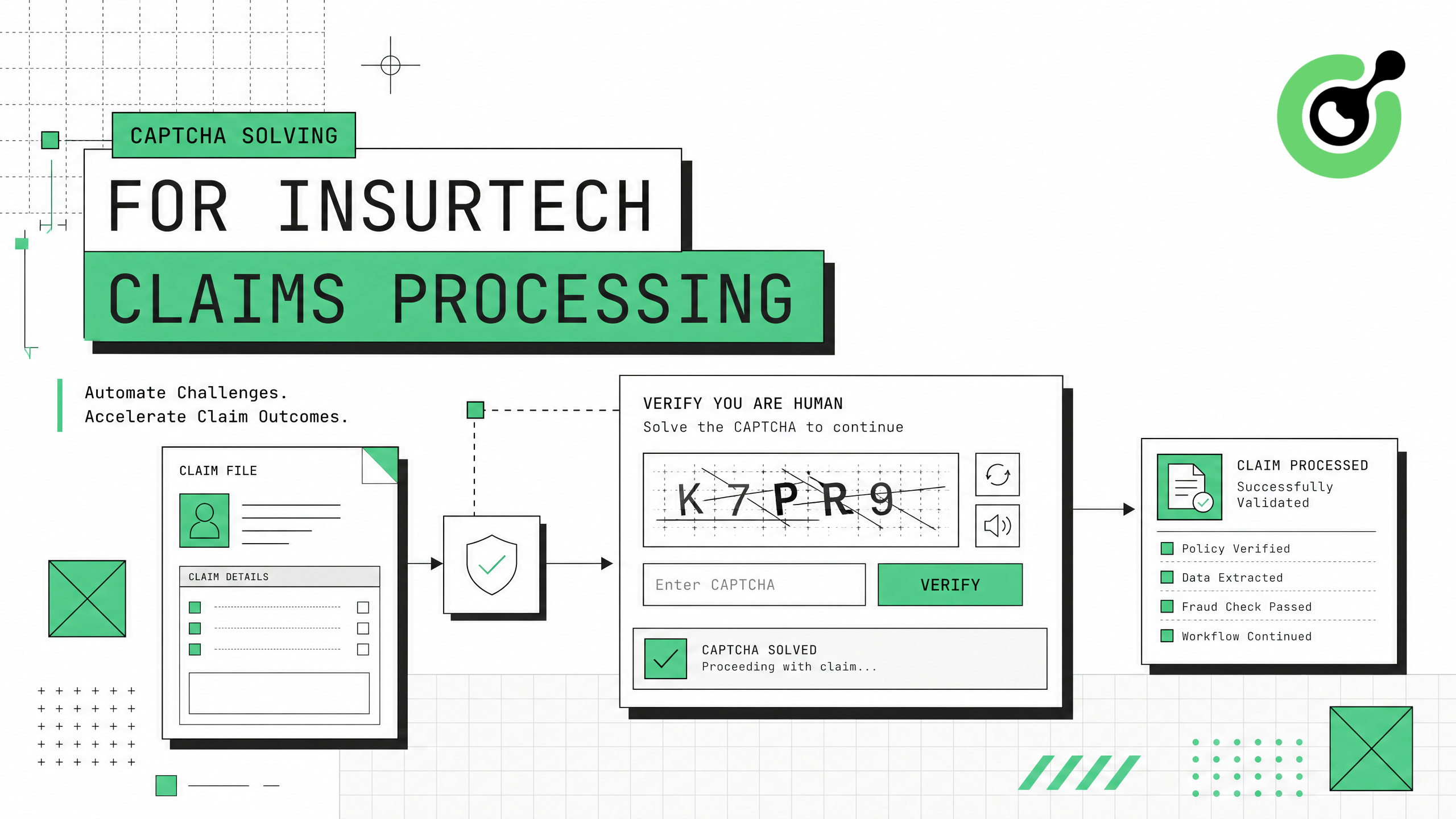
Automated captcha solving, when implemented with proper risk controls, improves throughput and reduces manual friction in claims intake. This article targets InsurTech product managers, claims engineers, fraud teams, and automation architects. It explains practical architectures for captcha solving for insurtech claims processing, outlines legal and operational constraints, and provides a step-by-step checklist to deploy solutions that maintain fraud defenses and customer trust. You will get vendor decision criteria, sample metrics, and integration patterns that align with responsible automation practices.
Captchas are a core traffic validation control at the claims front door. They filter automated spam, protect against bot-driven fraudulent claims spikes, and preserve downstream underwriting quality.
Automated intake systems must sometimes interact with third-party forms, carrier portals, or public webpages protected by captchas. Captcha solving for insurtech claims processing enables legitimate automated workflows to complete these interactions without manual steps, speeding FNOL (first notice of loss) flows and document retrieval.
Removing captchas entirely weakens defenses. Use captcha solving for insurtech claims processing selectively: apply it where identity verification, anti-fraud scoring, or manual review already provide compensating controls. Combine with device fingerprinting, IP reputation, and behavioral signals.
Design patterns matter. Choose an architecture that matches latency, volume, and compliance needs.
Pattern: primary route uses a captcha solving API; if confidence is low or the captcha type is unsupported, route to human-in-the-loop resolution. This hybrid model for captcha solving for insurtech claims processing keeps latency low while ensuring coverage.
Pattern: controlled headless browsers maintain authenticated sessions and solve inline captchas using an API adapter. This is useful when claims bots must have the same session as an authenticated agent.
Pattern: enqueue captcha challenges and process them asynchronously for non-interactive tasks like bulk document retrieval across carrier portals.
Integrate solving endpoints close to the orchestration layer. Emit metrics: solve latency, solve success rate, human fallback frequency, and downstream claim acceptance. Those KPIs show the operational impact of captcha solving for insurtech claims processing and feed fraud models.
Responsible deployment is essential. Captcha solving touches authentication, privacy, and contractual terms.
Review terms of service for external carrier portals and data sources before using automated captcha solving for insurtech claims processing. Where APIs or data-sharing agreements exist, prefer sanctioned integration methods. Work with legal to codify acceptable use and data retention policies.
OWASP Automated Threats Project and NIST guidance provide useful frameworks for threat assessment and control mapping.
Minimize PII exposure in captcha images and transcripts. Log only operational metadata and redact sensitive content. Encrypt traffic between orchestration, captcha providers, and storage to reduce risk when implementing captcha solving for insurtech claims processing.
Record audit trails that show when captcha solving was used and why. Share a summarized provenance with downstream underwriting and fraud teams. Transparency helps maintain trust and allows retrospective reviews of claim decisions involving automated solves.
Deploy with measurable goals and a controlled rollout.
Use vendor and technical documentation; see CapSolver products for solution options and consult the captcha solving FAQ for common integration questions.
For broader automation context and how captcha solving fits into claims pipelines, reference our posts on automation and AI integration. For workflows that involve data harvesting and form interactions, see our web scraping guidance.
| Approach | Latency | Coverage | Cost | Best use case |
|---|---|---|---|---|
| Real-time API + human fallback | Low | High | Medium-High | Interactive FNOL and carrier portal access |
| Browser automation with session preservation | Medium | Medium-High | Medium | Authenticated session tasks and agent workflows |
| Queue-based asynchronous solving | High | Variable | Low | Batch retrieval, reconciliation jobs |
| Manual operator-only | High | High | High | Occasional exceptions, legal constraints |
Bonus Code: A top captcha solutions for captcha solving for insurtech claims processing
Enter your bonus code top captcha solutions; captcha solving for insurtech claims processing to get an extra 5% added to your recharge, after a successful recharge.
Captcha solving for insurtech claims processing can cut manual work and accelerate claims life cycles when deployed with strong risk controls, legal review, and monitoring. Start with a hybrid architecture, instrument KPIs, and ensure traceability for audits. For product options and technical integration guides, visit CapSolver products and our learning resources on the blog. When you’re ready, review the captcha solving FAQ and pilot a controlled rollout. Learn more at https://www.capsolver.com/?utm_source=offcial&utm_medium=blog&utm_campaign=captcha-solving-for-insurtech-claims-processing
Q: Is captcha solving legal for claims automation?
A: It can be legal if you comply with third-party terms, contracts, and data protection laws. Always perform legal and vendor reviews before using captcha solving for insurtech claims processing.
Q: How do I measure the business impact?
A: Track solve success rate, latency, human fallback, and downstream claim acceptance. Correlate these with cycle time and cost per claim to quantify the value of captcha solving for insurtech claims processing.
Q: When should I use human-in-the-loop?
A: Use human fallback when captcha type coverage is incomplete, confidence is low, or the claim has high financial exposure. Human review preserves business continuity while you extend automated coverage for captcha solving for insurtech claims processing.
Q: What are common risks to monitor?
A: Monitor failed solves, spikes in human fallback, unusual IP patterns, and data leakage in logs. Those signals indicate operational or contractual risks when using captcha solving for insurtech claims processing.
Q: Where can I find implementation examples?
A: See product docs and blog posts on integration patterns. Start with our automation and web scraping content for practical examples and code snippets.
For additional best practices and security references, consult authoritative resources like Insurance Information Institute and security standards available at OWASP.
Ethan Collins
AI Agent Workflow Engineer
Building clearer handoffs between AI agents and tools.
ABOUT THE AUTHOR
Fix common Selenium CAPTCHA integration problems by checking test configuration, extensions, waits, iframe context, solver responses, and application results.

Choose the CapSolver Python Core SDK or direct HTTP API by task support, page access, response handling, and the responsibilities your application owns.