🎉NEWCapSolver for AI agents-MCP, agent tools, and SDK integrations

Lucas Mitchell
Automation Engineer
Published Jun 15, 2026
Updated Jun 15, 2026 · min read
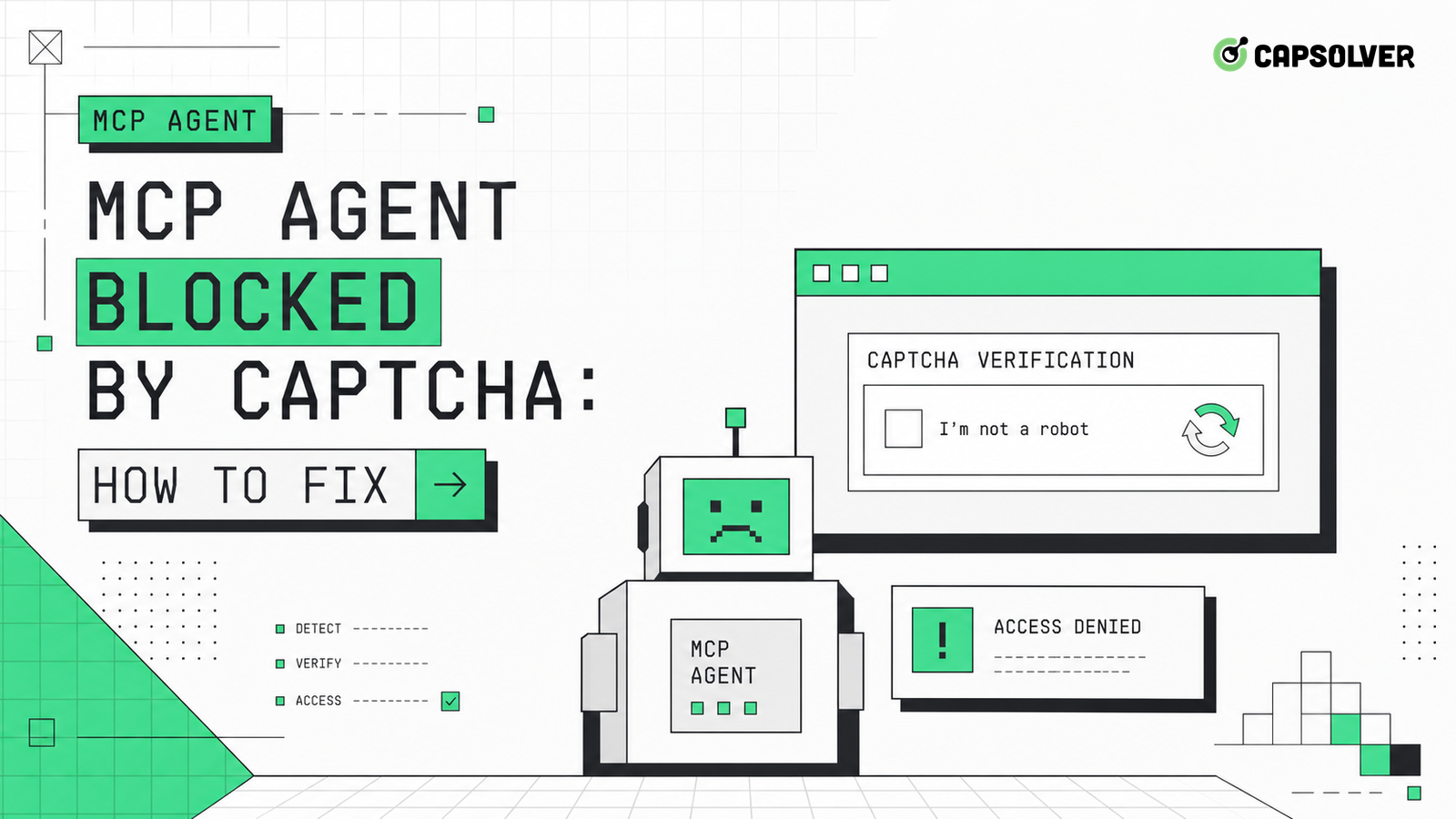
A tool-connected agent usually fails at CAPTCHA because its tools do not describe the obstacle clearly enough. The browser returns text, the planner sees another page, and the loop repeats until the target raises more risk controls. CapSolver can support approved CAPTCHA workflows, but an MCP agent blocked by CAPTCHA first needs better tool contracts. The fix is to model CAPTCHA as a typed state with session memory, allowed handoff, retry limits, and stop rules. Once the agent can name the state, it can choose a responsible next action.
The core failure is semantic. A browser tool that returns only extracted text makes a challenge page look like ordinary content. The planner may summarize it, click the nearest button, or reload the page. An MCP agent blocked by CAPTCHA needs a typed state such as captcha_detected, challenge_pending, rate_limited, auth_required, or access_denied. The Model Context Protocol documentation describes tool and context exchange, and that contract is exactly where state belongs.
CapSolver's MCP concept FAQ can help non-agent teams understand the architecture. The important implementation detail is that the browser tool should return both human-readable text and machine-readable state. The state should include challenge type, current URL, frame count, visible provider name if known, last status code, storage context ID, and suggested allowed actions.
Once CAPTCHA is a state, the planner can stop guessing. It can ask for an approved handoff, cool down, request human review, or end the task. That one change prevents the agent from turning a single validation event into repeated suspicious traffic.
Do not hide the state inside prose. A sentence like the page contains a CAPTCHA is useful to a person, but the planner needs a constrained enum and a policy result. Include allowed_to_continue: true only when the target is approved, the retry budget remains, and the next action has a bounded timeout. This keeps an MCP agent blocked by CAPTCHA from converting vague observations into uncontrolled action.
Include confidence and evidence fields. A high-confidence state can name the provider or widget. A low-confidence state may only know that a page contains challenge-like text and blocked form submission. The planner should act conservatively on low confidence: capture evidence, avoid more traffic, and request review or a safer tool path.
Handoff should be narrow and auditable. Do not send the entire conversation, hidden credentials, or unrelated task data to a challenge handler. Send only the target URL, site context, challenge type, session identifier, allowed action, and timeout. An MCP agent blocked by CAPTCHA should never invent a new browser context unless the orchestration layer explicitly starts a clean session.
CapSolver's article on CAPTCHA errors in MCP servers is a useful operational companion, but the contract should be implemented in your own tool schema. Include fields for authorized_target, max_attempts, cooldown_until, and post_challenge_check. The post-check matters because completing a challenge does not prove that the original task succeeded.
The web security baseline is clear: automation tools can be misused. OWASP's automated web threat categories are useful for policy reviews before adding new agent capabilities. Use challenge handling only for owned properties, contracted QA, public data workflows with permitted access, or other explicitly authorized cases.
Audit the handoff. Log who configured the target, why the target is authorized, which tool initiated the challenge state, and which post-check confirmed success or failure. Store enough information to debug the workflow without storing unnecessary sensitive page content. A narrow, auditable handoff is easier to approve than a general solve whatever appears instruction.
Session memory is where many agent stacks break. The planner calls a browser tool, then a data extraction tool, then another browser action. If cookies, local storage, proxy route, account state, and last challenge outcome are not attached to the task, the next step may start from a contradictory identity. An MCP agent blocked by CAPTCHA often repeats because the tool layer forgot that the challenge happened.
Store session state outside the model prompt. Use a task-scoped store with browser context ID, route ID, account ID, cookie jar reference, challenge state, last protected URL, and retry count. CapSolver's FAQ on LLMs interacting with external tools supports the separation: the model should reason over state summaries, while tools preserve operational details.
HTTP state rules still apply. MDN's cookie management model explains domain, path, expiration, and SameSite behavior that can surprise multi-tool workflows. If the browser handoff solves a challenge in one context and the next tool uses another, the target may challenge again.
Memory should include negative outcomes. If a route was rate limited or a session reached access denial, that fact should follow the task. Otherwise the planner may start a new tool call that unknowingly repeats the same failure. An MCP agent blocked by CAPTCHA becomes safer when failed states are durable enough to influence the next decision.
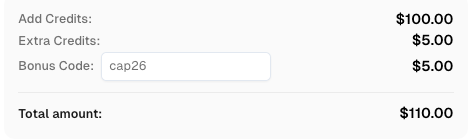
Redeem Your CapSolver Bonus Code
Boost your automation budget instantly!
Use bonus code CAP26 when topping up your CapSolver account to get an extra 5% bonus on every recharge — with no limits.
Redeem it now in your CapSolver Dashboard
Retry budgets belong in orchestration, not inside each tool. A browser tool may see only one failed click, while the planner has already tried the same task through search, navigation, extraction, and form submission. An MCP agent blocked by CAPTCHA needs a shared attempt counter per domain, route, account, and task.
Use HTTP evidence in the budget. MDN's 429 Too Many Requests status should trigger cooldown, not another agent thought. A 403 should trigger access classification. A repeated challenge after a solved handoff should trigger review. CapSolver's n8n CAPTCHA integration illustrates why workflow-level systems need central policy rather than scattered retry code.
The budget should be visible to the planner as a constraint: one challenge handoff allowed, two navigation retries allowed, zero retries after access denial, and a cooldown after rate control. These numbers depend on your authorized use case, but they must exist. Without them, the agent can spend money, load the site, and increase blocking risk without making progress.
Expose budget exhaustion as a normal final state. The answer can say the task could not proceed because the approved access budget was exhausted. That is better than hiding the failure behind a generic browser error. It also gives operators a clear signal to adjust policy, credentials, target permissions, or task design.
Do not label every obstacle as CAPTCHA. A login requirement is not the same as a challenge. A permission error is not the same as a stale token. A private dashboard is not a public data source. The HTTP standard's authentication and authorization semantics help keep these cases separate.
Add tool states for login_required, permission_denied, paid_content, private_data, and challenge_detected. The planner should not pass private or restricted targets into a CAPTCHA workflow. CapSolver's browser MCP article can be useful for architecture ideas, but access policy should remain explicit in your own system.
This separation protects users and improves reliability. If the task needs credentials, ask for the approved credential path. If the target refuses access, stop. If the challenge is inside a permitted workflow, hand off with the narrow contract. An MCP agent blocked by CAPTCHA becomes manageable when every obstacle has the right name.
Add fixtures that simulate challenge states without hitting real protected sites. The browser tool can return known pages for captcha_detected, turnstile_widget, rate_limited, login_required, and access_denied. Then test planner behavior. It should not click random buttons, reload forever, or ask the solver for a private target.
CapSolver's FAQ on combining LLMs with browser automation is relevant to this test design because the challenge is part of the observe-act loop. Validate that session IDs persist, retry budgets decrement, cooldowns are respected, and final task status is clear.
Testing also makes content safety practical. Use synthetic pages to prove that the agent refuses disallowed targets, stops on private data, and records enough evidence for review. This is better than discovering policy gaps during live traffic.
Run these fixtures in continuous integration for every prompt, tool, and planner change. The most dangerous regression is not a crash; it is a planner that used to stop on a challenge and now retries because the observation wording changed. A stable fixture suite keeps the MCP agent blocked by CAPTCHA workflow predictable as the agent evolves.
Add an audit summary to every completed task that touched a challenge state. It should list target, authorization basis, attempts, handoff result, cooldowns, final state, and data accessed. This summary gives operators enough context to improve the workflow and gives reviewers a compact record that the agent respected boundaries.
Keep the summary separate from the model's private reasoning. Operators need facts and outcomes, not hidden deliberation. Facts are enough: state detected, policy applied, tool called, result returned, and task stopped or continued.
Finally, define ownership for each blocked state. Security owns authorization rules, engineering owns tool schemas, operations owns budgets, and product owns allowed use cases. Clear ownership prevents an MCP agent blocked by CAPTCHA from becoming a shared problem with no accountable fix.
Review that ownership quarterly, because agent capabilities, target policies, and business permissions change over time.
Treat stale ownership as a release blocker for new automation targets and integrations.
An MCP agent blocked by CAPTCHA is usually an orchestration problem. Convert challenge pages into typed states, create a narrow handoff contract, persist session memory, enforce retry budgets, and separate authorization failures from validation steps. Those changes make the agent more reliable and easier to govern. For authorized workflows that need CAPTCHA support after the tool contract is sound, integrate the final handoff with CapSolver.
The browser tool probably returns page text without a typed challenge state. The planner treats the obstacle as normal content and keeps choosing browser actions.
Put them in the orchestration layer. It can count attempts across tools, domains, accounts, routes, and task steps, while individual tools only see local failures.
Include target URL, site context, challenge type, session identifier, authorization flag, maximum attempts, timeout, and a post-challenge check. Exclude unrelated user data.
No. Challenge handling should be limited to owned, contracted, or otherwise authorized workflows. It should not be used for private, restricted, sensitive, or disallowed targets.
Lucas Mitchell
Automation Engineer
Helping browser automation recover and continue.
ABOUT THE AUTHOR
Fix CAPTCHA handling that works locally but fails in a cloud AI agent. Compare browser setup, dependencies, credentials, network access, and page state.

Estimate CAPTCHA solving costs in Browser Use by separating agent runs, challenge types, billable solves, retries, and verified outcomes from browser costs.