🎉NEWCapSolver for AI agents-MCP, agent tools, and SDK integrations

Emma Foster
Machine Learning Engineer
Published Jun 23, 2026
Updated Jun 23, 2026 · min read
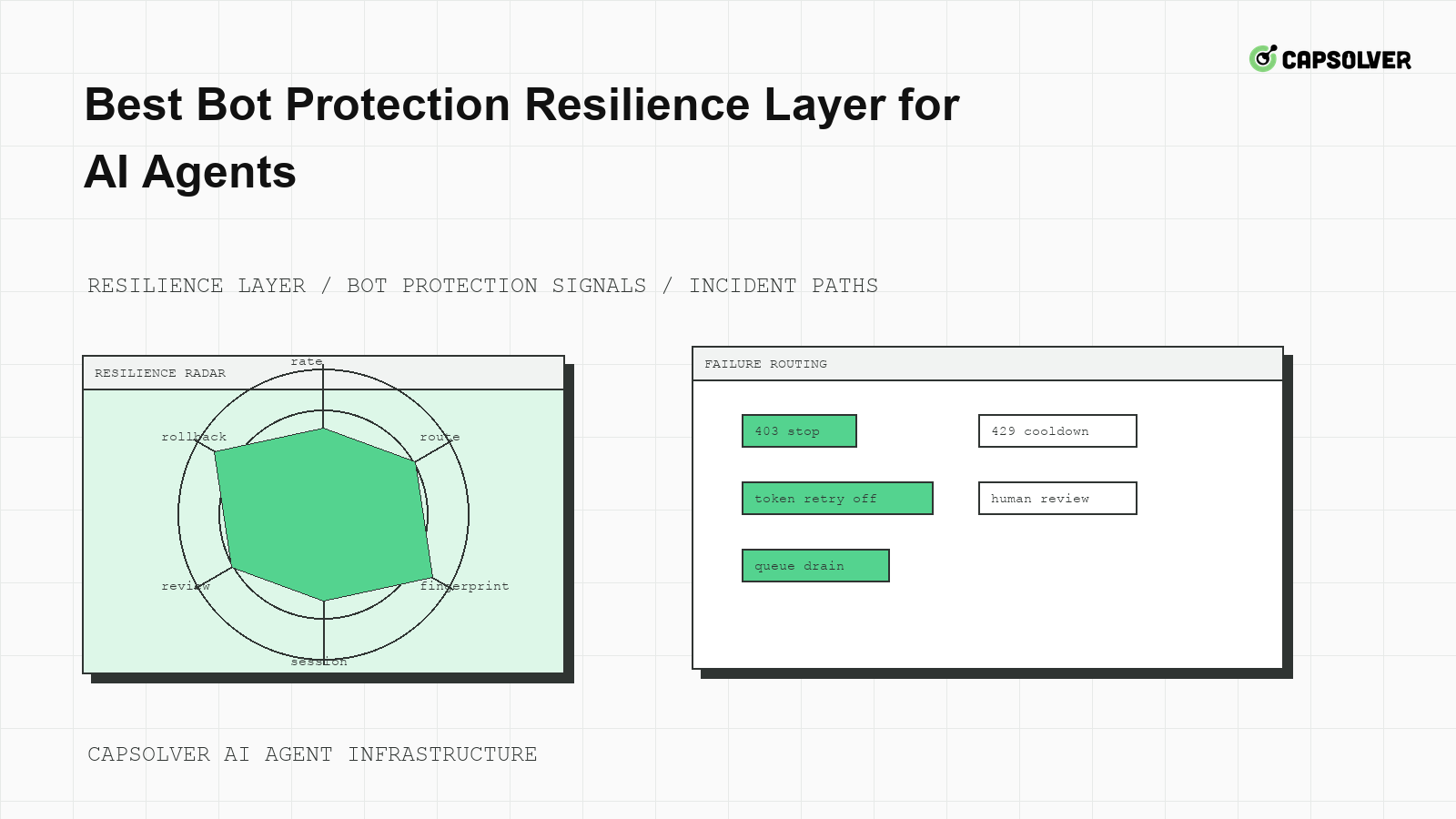
Resilience is the difference between an agent that adapts and an agent that hammers the same blocked path. CapSolver can help with approved challenge handling, but the best bot protection resilience layer for AI agents starts with rate governance, fingerprint coherence, cooldowns, and final outcome checks. A resilient agent does less when signals get worse. It does not hide repeated failures behind more browser launches. The layer should protect the target site, the user account, and your own operating budget.
The best bot protection resilience layer for AI agents should degrade gracefully. When a target returns rate signals, the layer slows down. When authorization is unclear, it stops. When a browser profile drifts, it refreshes state in a controlled way. When a challenge is supported and permitted, it uses a documented path with a bounded budget.
This definition is stricter than ordinary retry logic. Retry logic asks whether another attempt might work. Resilience asks whether another attempt is responsible, useful, and measurable. CapSolver's analysis of rate-limited AI agents is useful because rate failures often begin as small timing problems before they become hard blocks.
Use a state model that separates normal, warmup, cooldown, challenge_eligible, review_required, and disabled. The state should be shared across workers for the same domain and account class. A single agent should not be able to ignore a cooldown that another agent just learned.
resilience_state:
  domain: "example.com"
  mode: "cooldown"
  reason: "http_429"
  resume_after_seconds: 900
  allowed_actions_during_cooldown: ["read_cached_result"]
  disabled_actions: ["protected_submit", "login_attempt"]
This configuration keeps the best bot protection resilience layer for AI agents focused on reducing pressure, not masking it.
HTTP rate signals are not private to one worker. MDN describes HTTP 429 Too Many Requests as a response for excessive request volume, and RFC 9110 defines Retry-After timing for server-directed waiting. Your resilience layer should promote those signals into shared state.
CapSolver's glossary entry on rate limiting gives teams a plain-language way to explain the concept to non-engineering owners. The operational rule is simple: if one run receives a cooldown signal, related runs should not treat the same domain as fresh capacity.
Cooldown ownership belongs to the scheduler, not the prompt. The scheduler can pause queues, reduce concurrency, and notify operators. The browser worker should report the signal and stop. The agent planner may decide what to do after a cooldown expires, but it should not override the timer during the protected workflow.
The best bot protection resilience layer for AI agents should also handle partial cooldowns. A public search page may remain allowed while login or checkout actions pause. A test account may be disabled while public catalog monitoring continues. Domain owners should define those scopes before incidents.
Fingerprint coherence means the browser, network, and account signals describe one plausible session. User-agent family, TLS behavior, viewport, timezone, language, route class, cookies, and local storage should not jump between protected steps. CapSolver's TLS fingerprinting entry is useful because low-level transport differences can matter even when the DOM looks stable.
Release tests should compare headed and headless profiles only for the specific workflow being released. Do not use a generic "stealth" claim as proof. Check whether the same account, route class, viewport, locale, and storage lease survive navigation, challenge handling, and protected submit. Browser instrumentation should record changes as drift events.
OWASP's automated threat categories helps teams understand why repeated automated behavior can trigger risk controls. The resilience layer should reduce abnormal patterns, not simply try to push through them.
Challenge handling is one branch in the best bot protection resilience layer for AI agents. It should run only when the domain is allowed, the challenge type is supported, the session is stable, and the attempt budget remains. CapSolver's task type documentation is the correct starting point for understanding supported task families. If a challenge cannot be mapped to official documentation, the resilience layer should send it to review.
Redeem Your CapSolver Bonus Code
Boost your automation budget instantly!
Use bonus code CAP26 when topping up your CapSolver account to get an extra 5% bonus on every recharge — with no limits.
Redeem it now in your CapSolver Dashboard
Unsupported challenges should not become experimental payloads. Return unsupported_challenge_family with the evidence bundle: URL, route class, session lease, screenshots, frame markers, status history, and final stop reason. CapSolver's article on fingerprint detection in AI agents is useful because it shows how challenge events can be symptoms of broader signal drift.
Raw solve counts are not a resilience metric. The best metric is accepted protected actions per attempt. Track attempted protected actions, challenge events, solver dispatches, backend acceptance, backend rejection, 403 refusals, 429 cooldowns, and review stops. If solve count rises while accepted actions stay flat, the layer is consuming budget without improving reliability.
Use metrics that map to owners. Operations owns cooldowns and route quality. Engineering owns backend rejection after solver readiness. Policy owns unclear authorization and private-data prompts. Product owners decide whether a workflow should continue if it requires too much protected interaction.
CapSolver's guidance on proxy selection for automation can help teams think about route stability, but the resilience layer still needs internal stop rules. Technical capability does not grant permission to access private, restricted, sensitive, or unauthorized data.
Backoff is not only a performance tactic. It is a safety control. If every worker retries at the same moment, a temporary issue becomes synchronized traffic pressure. The best bot protection resilience layer for AI agents should use jitter, central cooldowns, and strict maximum attempts.
pseudocode:
  if response_status == 429:
      set_domain_cooldown(retry_after_or_default)
      stop("cooldown_started")
  if repeated_challenge_after_budget:
      stop("review_required")
  if backend_rejection_after_challenge:
      stop("engineering_review")
  otherwise:
      schedule_next_allowed_action_with_jitter()
This pseudocode is local infrastructure logic. It does not define CapSolver request fields.
Incident review should focus on why the layer continued or stopped. Did a route pool degrade? Did a browser upgrade change the profile? Did a prompt edit increase protected actions? Did a cooldown apply only to one worker instead of the shared scheduler? The best bot protection resilience layer for AI agents improves when incidents become state-machine corrections.
The review should produce one change: lower concurrency, narrow admission rules, fix session drift, update challenge mapping, or retire the workflow. A screenshot-only review is rarely enough because the visible page may not show rate, cookie, or transport evidence.
A resilience layer should also keep a small set of canary workflows. Run them at low frequency with stable accounts and stable routes. If canaries begin seeing more challenges or backend rejection, pause expansion before the main queue is affected. Canary evidence gives teams a baseline that is easier to interpret than emergency logs collected after a failure spike.
Another useful control is a change-freeze trigger. If 429 cooldowns and backend rejection both rise after a browser or route change, freeze prompt edits and infrastructure changes until the owner identifies the cause. The best bot protection resilience layer for AI agents should reduce variables during diagnosis, not introduce more of them.
For Best Bot Protection Resilience Layer for AI Agents, connect bot protection resilience layer to AI agent resilience in one evidence trail. The owner should inspect the queue item, browser session lease, route class, challenge event, and final application result before allowing the next run. This keeps Best Bot Protection Resilience Layer for AI Agents from becoming a hidden retry policy. If permission, session coherence, cooldown state, or backend acceptance is unclear, the next state should be review or cooldown rather than another automated attempt.
The best bot protection resilience layer for AI agents is a governance and reliability layer, not a retry wrapper. It should share rate signals, preserve fingerprint coherence, gate challenge handling, and judge success by accepted protected actions. For teams with approved CAPTCHA workflows, CapSolver can fit inside that layer while cooldowns, permissions, and review states remain under your control.
It is the infrastructure that slows, stops, reroutes, or reviews AI agent traffic when traffic validation, rate limiting, fingerprint drift, or protected workflow failures appear.
Multiple workers can target the same domain. If each worker retries independently after a 429, the system can multiply traffic pressure and make recovery harder.
No. Accepted protected actions per attempt is more useful because it connects challenge handling to the actual workflow result.
It should stop on unclear permission, account warnings, repeated challenges after budget, unsupported challenge families, backend rejection, or active cooldown state.
Emma Foster
Machine Learning Engineer
Where machine learning meets practical AI tooling.
ABOUT THE AUTHOR
Fix CAPTCHA handling that works locally but fails in a cloud AI agent. Compare browser setup, dependencies, credentials, network access, and page state.
Estimate CAPTCHA solving costs in Browser Use by separating agent runs, challenge types, billable solves, retries, and verified outcomes from browser costs.