🎉NEWCapSolver for AI agents-MCP, agent tools, and SDK integrations

Ethan Collins
AI Agent Workflow Engineer
Published Jul 30, 2026
Updated Jul 30, 2026 · min read
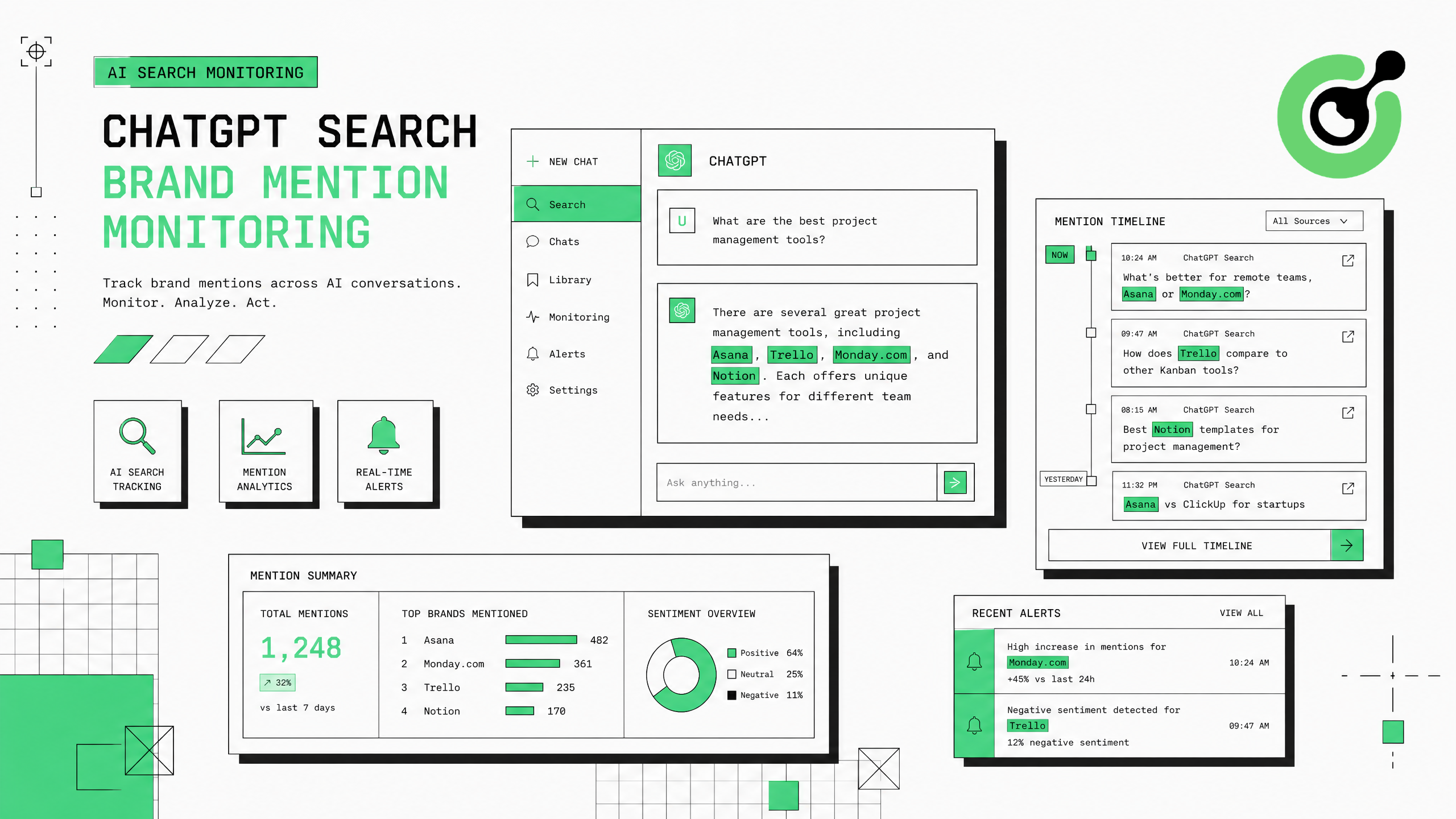
ChatGPT Search now generates real-time answers that cite specific brands, products, and websites. When ChatGPT mentions your brand — or your competitor's — it directly influences purchasing decisions for millions of users. Monitoring these mentions requires automated access to ChatGPT's search results, which are protected by Cloudflare's verification systems. This guide covers building a brand mention monitoring pipeline that tracks when and how ChatGPT cites your brand, using CapSolver to maintain continuous access.
ChatGPT Search represents a fundamental shift in how consumers discover brands and products. When a user asks "best CAPTCHA solving API" or "top project management tools," ChatGPT generates an answer that names specific products — and those named products receive direct consideration from the user. Unlike traditional search where users scan 10 blue links, ChatGPT presents a curated, authoritative answer that heavily influences the user's next action.
For brands, this creates both opportunity and risk. Being mentioned positively in ChatGPT's answers drives awareness and consideration. Being absent — while competitors are mentioned — means losing visibility in a growing discovery channel. OpenAI's announcement of ChatGPT Search indicates the feature is available to hundreds of millions of users, making it a significant brand visibility channel.
The challenge for monitoring is access. ChatGPT's web interface and API are protected by Cloudflare's bot management, which blocks automated queries. Without solving these challenges, brands cannot systematically track their mention frequency, context, or competitive positioning in AI-generated answers.
pip install git+https://github.com/capsolver-ai/capsolver-core.git
pip install aiohttp pandas scheduleexport CAPSOLVER_API_KEY="your-capsolver-api-key"Additional requirements:
from dataclasses import dataclass, field
from typing import List, Optional
import time

@dataclass
class BrandMention:
    """A single brand mention in a ChatGPT answer."""
    query: str
    brand_mentioned: str
    mention_context: str      # Surrounding text
    sentiment: str            # positive, neutral, negative
    position: int             # Order of mention (1st, 2nd, etc.)
    co_mentioned_brands: List[str]
    timestamp: float

@dataclass
class MonitoringResult:
    """Complete monitoring result for one query."""
    query: str
    your_brand_mentioned: bool
    your_mention_position: Optional[int]
    competitor_mentions: List[str]
    answer_text: str
    sources_cited: List[str]
timestamp: floatimport asyncio
from capsolver_core import create_capsolver, CaptchaType, CaptchaInfo
class ChatGPTBrandMonitor:
"""Monitor brand mentions in ChatGPT Search answers."""
def __init__(self, api_key: str, your_brand: str, competitors: list):
self.cap = create_capsolver(api_key=api_key)
self.your_brand = your_brand
self.competitors = competitors
self.history = []
async def check_query(self, query: str) -> MonitoringResult:
"""Check a single query for brand mentions."""
# Access ChatGPT Search (protected by Cloudflare)
answer = await self._fetch_chatgpt_answer(query)
# Analyze brand mentions
your_mentioned = self.your_brand.lower() in answer.lower()
competitor_mentions = [c for c in self.competitors if c.lower() in answer.lower()]
result = MonitoringResult(
query=query,
your_brand_mentioned=your_mentioned,
your_mention_position=self._find_position(answer, self.your_brand),
competitor_mentions=competitor_mentions,
answer_text=answer[:1000],
sources_cited=self._extract_sources(answer),
timestamp=time.time()
)
self.history.append(result)
return result
async def _fetch_chatgpt_answer(self, query: str) -> str:
"""Fetch ChatGPT Search answer with Cloudflare handling."""
# Solve Turnstile if challenged
info = CaptchaInfo(
type=CaptchaType.CLOUDFLARE,
website_url="https://chatgpt.com",
website_key="0x4AAAAAAAx..." # ChatGPT's Turnstile key
)
solution = await self.cap.solve(info)
# Use token to access search results
# Implementation depends on access method
return "" # Parsed answer text
async def monitor_batch(self, queries: list) -> dict:
"""Monitor a batch of queries and generate report."""
results = []
for query in queries:
result = await self.check_query(query)
results.append(result)
await asyncio.sleep(10) # Rate limiting
return self._generate_report(results)
def _generate_report(self, results: list) -> dict:
mentioned_count = sum(1 for r in results if r.your_brand_mentioned)
return {
"total_queries": len(results),
"your_brand_mentioned": mentioned_count,
"mention_rate": f"{mentioned_count/len(results)*100:.1f}%",
"top_competitors": self._rank_competitors(results),
"queries_without_mention": [r.query for r in results if not r.your_brand_mentioned]
}
async def close(self):
await self.cap.aclose()| Metric | What It Tells You | Action |
|---|---|---|
| Mention rate | % of target queries where you appear | Optimize content for low-mention queries |
| Mention position | Where you appear in the answer (1st, 2nd, etc.) | Improve authority signals for higher positioning |
| Competitor co-mentions | Which competitors appear alongside you | Differentiate from frequently co-mentioned brands |
| Sentiment context | How your brand is described | Address negative contexts, amplify positive ones |
| Source citations | Which of your pages get cited | Optimize cited pages, create content for uncited topics |
The monitoring data directly informs your Generative Engine Optimization strategy:
Claim Your Bonus Code: Use code WEBS at CapSolver Dashboard to get an extra 5% bonus on every recharge.
The CapSolver AI blog covers additional patterns for AI-powered data collection. For handling Cloudflare Turnstile on ChatGPT and similar platforms, the Turnstile documentation provides implementation details. The CapSolver products page lists all supported verification systems and pricing.
ChatGPT Search brand mention monitoring requires automated access to AI-generated answers, which are protected by Cloudflare's verification systems. CapSolver clears these challenges in 2-5 seconds, enabling systematic tracking of when, where, and how your brand appears in ChatGPT's answers. The monitoring data directly informs GEO strategy — revealing content gaps, competitive positioning, and citation opportunities that drive AI search visibility.
Yes. Track your brand and any number of competitors simultaneously. The monitoring system checks each query for all tracked brands and reports comparative positioning, co-mentions, and relative visibility.
For active GEO campaigns, daily monitoring of 50-100 target queries provides sufficient data to detect changes. For baseline tracking, 2-3 times per week captures major shifts. ChatGPT's answers can change daily based on content freshness signals.
Focus on queries where your brand should logically appear: product category searches ("best [your category]"), comparison queries ("[your brand] vs [competitor]"), and informational queries in your expertise area. Start with 20-30 high-intent queries and expand based on results.
No. ChatGPT's answers vary based on query phrasing, conversation context, and content freshness. The same query may produce different brand mentions on different days, which is why continuous monitoring is necessary to track trends rather than point-in-time snapshots.
Ethan Collins
AI Agent Workflow Engineer
Building clearer handoffs between AI agents and tools.
ABOUT THE AUTHOR
Choose the CapSolver Python Core SDK or direct HTTP API by task support, page access, response handling, and the responsibilities your application owns.
Build search intent drift monitoring with Search Console data, controlled SERP observations, intent labels, confidence gates, evidence, and safe automation.