🎉NEWCapSolver for AI agents-MCP, agent tools, and SDK integrations

Ethan Collins
AI Agent Workflow Engineer
Published Jun 25, 2026
Updated Jun 24, 2026 · min read
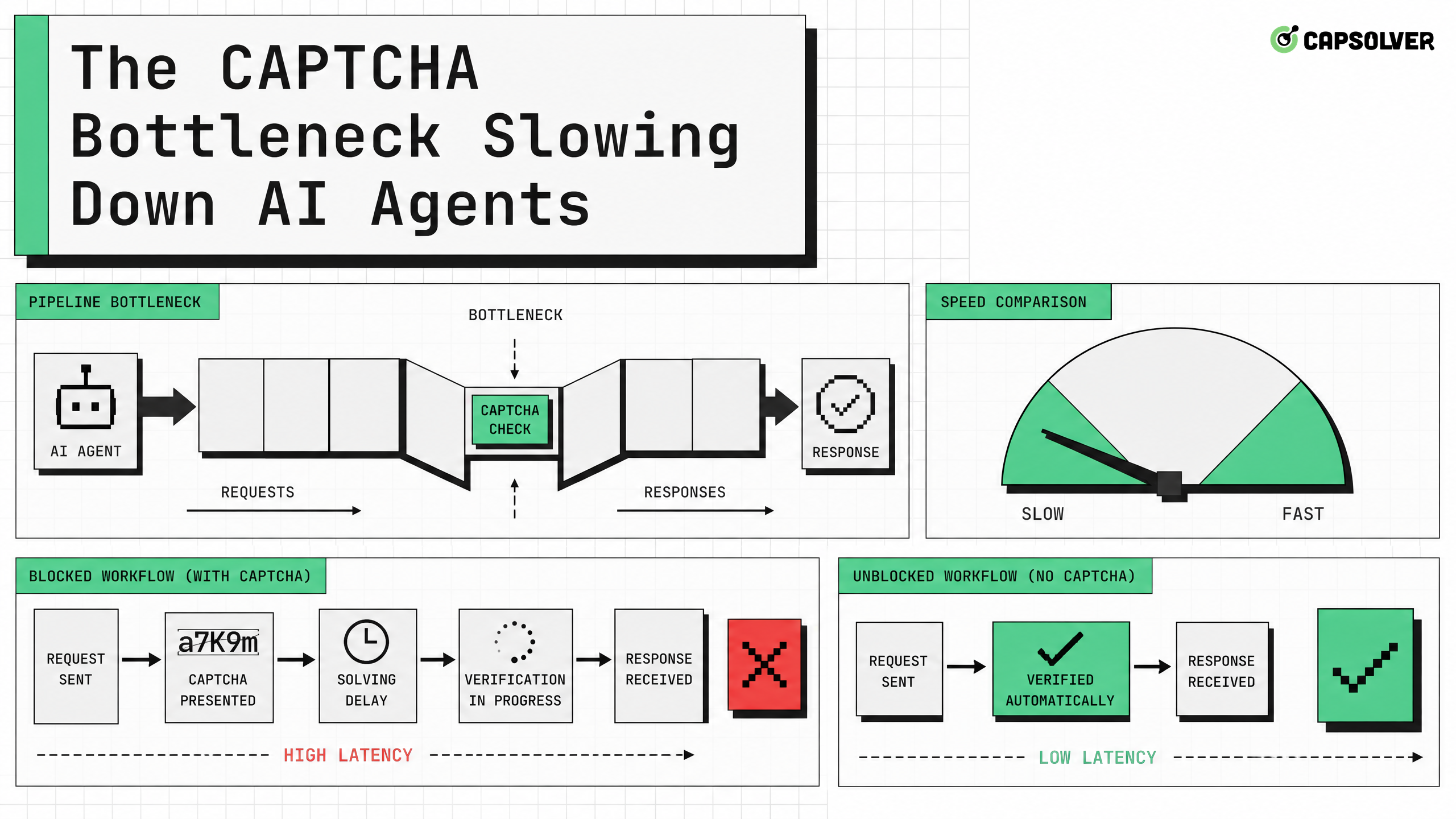
AI agents are capable of extraordinary things — navigating complex websites, filling forms, extracting structured data, and executing multi-step workflows at machine speed. But there is one obstacle that stops them cold, repeatedly and unpredictably: the CAPTCHA. What looks like a minor inconvenience for a human user becomes a systemic bottleneck when it appears in the path of an automated agent. The CAPTCHA bottleneck slowing down AI agents is not a fringe problem — it is one of the most frequently cited causes of agent workflow failure in production deployments. CapSolver was built specifically to eliminate this bottleneck, providing a fast, reliable, and scalable CAPTCHA solving infrastructure that integrates directly into agent workflows.
A CAPTCHA challenge is designed to interrupt automated access. From the perspective of a web service, that is exactly what it should do. From the perspective of an AI agent, it is a hard stop — a point in the workflow where the agent cannot proceed without solving a challenge it was not designed to solve natively.
The bottleneck has several dimensions. First, there is the latency dimension: every second spent waiting for a CAPTCHA to be resolved is a second of throughput lost. For a single agent, this may be acceptable. For a fleet of 100 agents each encountering a CAPTCHA every few minutes, the aggregate latency becomes a serious performance problem. According to Akamai's bot traffic research, a significant proportion of web traffic is automated, and sites increasingly deploy CAPTCHAs at high-traffic entry points specifically to create friction for automated access.
Second, there is the failure dimension: an unsolved CAPTCHA does not just slow the agent — it stops it. If the agent has no CAPTCHA handling logic, the task fails. If the handling logic is poorly implemented, the agent may retry indefinitely, consuming resources without making progress. The why AI agent tasks get stuck on CAPTCHAs article from CapSolver documents the most common failure patterns in detail.
Third, there is the unpredictability dimension: CAPTCHAs do not appear on a fixed schedule. They appear based on behavioral signals — unusual traffic patterns, headless browser fingerprints, IP reputation, and other factors. This means an agent that ran successfully yesterday may encounter CAPTCHAs today, making the bottleneck difficult to plan for and test against.
The CAPTCHA bottleneck is particularly damaging at scale. Consider an agent team running 200 concurrent agents, each processing 50 pages per hour. If 10% of those pages trigger a CAPTCHA, and each CAPTCHA takes an average of 3 seconds to resolve (or fails entirely), the aggregate impact is substantial.
| Scenario | Agents | CAPTCHA Rate | Avg Solve Time | Throughput Loss |
|---|---|---|---|---|
| No solver | 200 | 10% | N/A (fails) | 10% task failure rate |
| Slow solver (5s) | 200 | 10% | 5 seconds | ~2.8% throughput reduction |
| Fast solver (1s) | 200 | 10% | 1 second | ~0.6% throughput reduction |
| CapSolver (<1s) | 200 | 10% | <1 second | Negligible |
The difference between a slow solver and a fast one is not just a few seconds per request — it compounds across thousands of requests per hour. The scalable CAPTCHA solving for production agents article provides a detailed analysis of how solve speed affects production throughput.
Redeem Your CapSolver Bonus Code
Boost your automation budget instantly!
Use bonus code CAP26 when topping up your CapSolver account to get an extra 5% bonus on every recharge — with no limits.
Redeem it now in your CapSolver Dashboard
Several approaches to the CAPTCHA bottleneck have been tried and found wanting in production environments.
Manual solving — routing CAPTCHAs to human workers — introduces latency measured in seconds to minutes, destroys the speed advantage of automation, and does not scale. It is appropriate for occasional, low-volume use cases but not for production agent fleets.
DIY OCR or ML models — training a model to solve image CAPTCHAs — requires significant engineering investment, degrades rapidly as CAPTCHA providers update their challenge designs, and typically achieves lower accuracy than specialized services. Modern CAPTCHAs like reCAPTCHA v3 and Cloudflare Turnstile are not solvable by OCR at all, as they rely on behavioral analysis rather than visual challenges.
Ignoring the problem — hoping that CAPTCHAs will not appear — is not a strategy. As Imperva's Bad Bot Report documents, bot detection and CAPTCHA deployment rates have increased year over year, meaning the problem is getting worse, not better.
The correct approach is to integrate a purpose-built CAPTCHA solving API that handles the challenge programmatically, returns a valid token, and allows the agent to continue without interruption. The adding CAPTCHA handling middleware to your agent guide covers the implementation pattern in detail.
CapSolver addresses the CAPTCHA bottleneck at its root by providing a fast, accurate, and scalable solving infrastructure. When an agent encounters a CAPTCHA, it submits the challenge parameters to the CapSolver API. The API resolves the challenge — using AI-powered recognition for image CAPTCHAs, behavioral simulation for reCAPTCHA v3, and specialized solvers for Cloudflare Turnstile and AWS WAF — and returns a valid token in under one second for most challenge types.
This speed is critical. A sub-second solve time means the CAPTCHA adds negligible latency to the agent's workflow. The agent does not pause, queue, or fail — it continues processing as if the CAPTCHA had not appeared. For teams building bot protection infrastructure for AI agents, CapSolver's solve speed is a key differentiator.
The API also supports the full range of CAPTCHA types encountered in production: reCAPTCHA v2, reCAPTCHA v3, reCAPTCHA Enterprise, Cloudflare Turnstile, Cloudflare Challenge, AWS WAF CAPTCHA, and image-based OCR challenges. This breadth of coverage means a single integration handles all CAPTCHA types the agent may encounter, regardless of the target site.
Eliminating the CAPTCHA bottleneck does not mean ignoring the intent behind CAPTCHA systems. CAPTCHAs exist to protect web services from abusive automated access. Using a CAPTCHA solving service for legitimate automation — public data collection, authorized testing, workflow automation on services the operator controls or has permission to access — is appropriate. Using it to access private, restricted, or unauthorized data is not.
The W3C Web Content Accessibility Guidelines note that CAPTCHAs themselves create accessibility barriers for many users, which is one reason why behavioral CAPTCHAs like reCAPTCHA v3 have become more common — they are less intrusive for legitimate users while still filtering automated traffic. Responsible automation practitioners should be aware of this context and ensure their agent deployments respect both the technical and ethical boundaries of web access.
The CAPTCHA bottleneck is a real, measurable, and solvable problem for AI agent teams. It compounds at scale, causes unpredictable failures, and cannot be addressed by manual or DIY approaches in production environments. The solution is a purpose-built CAPTCHA solving infrastructure integrated directly into the agent stack. With sub-second solve times, broad CAPTCHA type coverage, and a simple REST API, CapSolver converts CAPTCHA challenges from workflow blockers into resolved steps — eliminating the bottleneck and keeping agent pipelines running at full speed.
Why do CAPTCHAs appear more frequently for AI agents than for human users?
AI agents running in headless browsers exhibit behavioral signals — consistent timing, missing browser fingerprints, unusual traffic patterns — that CAPTCHA systems are designed to detect. Sites deploy CAPTCHAs more aggressively against traffic that matches these patterns.
How much throughput does the CAPTCHA bottleneck actually cost?
The impact depends on CAPTCHA frequency and solve time. For a fleet of 200 agents with a 10% CAPTCHA rate and a 5-second solve time, the throughput reduction is approximately 2.8%. At scale, this translates to significant lost capacity and increased infrastructure costs.
Can reCAPTCHA v3 be solved programmatically?
Yes. reCAPTCHA v3 uses behavioral scoring rather than visual challenges. Specialized solvers like CapSolver simulate the required behavioral signals to return a valid high-score token, allowing the agent to proceed.
What happens if the CAPTCHA solving API is unavailable?
Production agent stacks should implement retry logic with exponential backoff and a fallback behavior — such as queuing the task for later retry — when the solver API is unavailable. CapSolver provides documented uptime guarantees to minimize this scenario.
Is it legal to use a CAPTCHA solving service to keep AI agents running?
Using a CAPTCHA solving service is legal for authorized automation and legitimate data collection. The key requirement is that the agent's activities comply with the target site's terms of service and applicable laws. Technical capability does not grant permission to access restricted or private data.
Ethan Collins
AI Agent Workflow Engineer
Building clearer handoffs between AI agents and tools.
ABOUT THE AUTHOR
Fix CAPTCHA handling that works locally but fails in a cloud AI agent. Compare browser setup, dependencies, credentials, network access, and page state.

Estimate CAPTCHA solving costs in Browser Use by separating agent runs, challenge types, billable solves, retries, and verified outcomes from browser costs.