How to Collect Travel Availability Data for AI Agents

Ethan Collins
Pattern Recognition Specialist
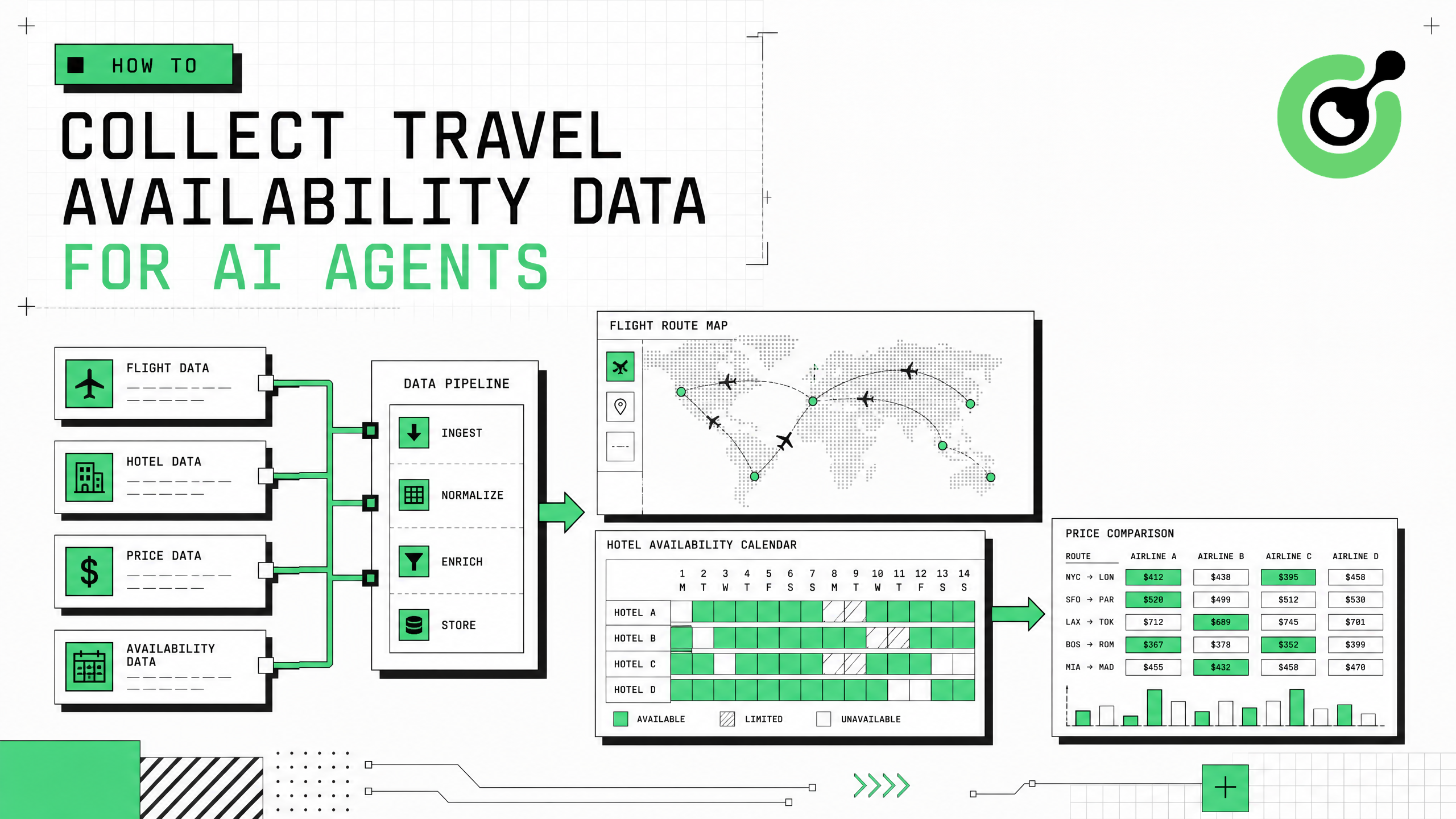
AI travel agents need real-time access to flight availability, hotel inventory, and booking platform data to provide accurate recommendations and automate reservations. Travel websites deploy aggressive CAPTCHA protection — reCAPTCHA, Cloudflare Turnstile, and custom challenges — that blocks automated data collection after just a few dozen requests. This guide shows how to build a travel availability data pipeline for AI agents using CapSolver to maintain continuous access to airline, hotel, and OTA platforms.
TL;DR
- Travel booking platforms trigger CAPTCHAs after 30-80 automated requests, blocking AI agent data collection
- CapSolver clears reCAPTCHA and Cloudflare Turnstile on travel sites in 3-12 seconds per challenge
- A production pipeline monitors flight prices, hotel availability, and package deals across multiple platforms
- Combining session persistence, proxy rotation, and CAPTCHA solving achieves 95%+ collection reliability
- The data enables AI travel agents to provide real-time pricing, availability alerts, and booking recommendations
Why Travel Data Collection Needs CAPTCHA Solving
Online travel agencies (OTAs), airline websites, and hotel booking platforms are among the most heavily protected sites on the internet. These platforms invest significantly in bot detection because pricing data is commercially valuable and server resources are expensive during peak booking periods.
When an AI travel agent attempts to check flight availability across multiple routes, compare hotel prices across dates, or monitor fare changes, it generates request patterns that trigger verification challenges. Cloudflare's bot management reports that travel sites experience 3-5x more bot traffic than average websites, leading to more aggressive protection thresholds.
Common CAPTCHA deployments on travel platforms include reCAPTCHA v2 on search result pages after multiple queries, Cloudflare Turnstile on modern OTA frontends, DataDome on major airline booking engines, and custom JavaScript challenges on hotel aggregators. Without automated solving, an AI travel agent cannot maintain the continuous data access needed for real-time recommendations.
What You Need Before Starting
bash
# CapSolver core engine
pip install git+https://github.com/capsolver-ai/capsolver-core.git

# Data collection dependencies
pip install aiohttp beautifulsoup4 pandas schedule
bash
export CAPSOLVER_API_KEY="your-capsolver-api-key"Additional requirements:
- A CapSolver account with credits
- Residential proxy pool (travel sites block datacenter IPs aggressively)
- Database for storing price history and availability snapshots
- Understanding of CAPTCHA types on your target platforms
Step 1 — Profile Travel Platform CAPTCHA Systems
What to Do
Map the CAPTCHA protection on each travel platform your agent needs to access:
python
TRAVEL_PLATFORMS = {
    "booking_com": {
        "name": "Booking.com",
        "captcha_type": "AntiTurnstileTaskProxyLess",
        "trigger": "after_20_searches_per_session",
        "data_available": ["hotels", "apartments", "pricing", "availability"]
    },
    "skyscanner": {
        "name": "Skyscanner",
        "captcha_type": "ReCaptchaV2TaskProxyLess",
        "trigger": "rate_limit_50_per_hour",
        "data_available": ["flights", "prices", "routes", "airlines"]
    },
    "expedia": {
        "name": "Expedia",
        "captcha_type": "ReCaptchaV3TaskProxyLess",
        "trigger": "behavioral_score_based",
        "data_available": ["flights", "hotels", "packages", "car_rental"]
    },
    "airbnb": {
        "name": "Airbnb",
        "captcha_type": "AntiTurnstileTaskProxyLess",
        "trigger": "after_search_and_listing_views",
        "data_available": ["listings", "pricing", "availability", "reviews"]
    }
}
Use the CapSolver browser extension to identify site keys and CAPTCHA parameters on each platform during development.
Step 2 — Build the Travel Data Collection Engine
What to Do
Create an async collection engine with integrated CAPTCHA solving:
python
import asyncio
import aiohttp
import time
from capsolver_core import create_capsolver, CaptchaType, CaptchaInfo

class TravelDataCollector:
    """Collect travel availability data with CAPTCHA handling."""

    def __init__(self, api_key: str, proxies: list):
        self.cap = create_capsolver(api_key=api_key)
        self.proxies = proxies
        self.proxy_idx = 0
        self.stats = {"queries": 0, "captchas_solved": 0}

    async def search_flights(self, origin: str, destination: str, date: str) -> dict:
        """Search flight availability with CAPTCHA handling."""
        proxy = self.proxies[self.proxy_idx % len(self.proxies)]
        self.proxy_idx += 1

        # Attempt search
        result = await self._make_search_request(
            platform="skyscanner",
            params={"origin": origin, "dest": destination, "date": date},
            proxy=proxy
        )

        # Handle CAPTCHA if triggered
        if self._is_captcha_response(result):
            token = await self._solve_captcha("skyscanner")
            result = await self._retry_with_token(token, proxy)
            self.stats["captchas_solved"] += 1

        self.stats["queries"] += 1
        return self._parse_flight_results(result)

    async def search_hotels(self, location: str, checkin: str, checkout: str) -> dict:
        """Search hotel availability with CAPTCHA handling."""
        proxy = self.proxies[self.proxy_idx % len(self.proxies)]
        self.proxy_idx += 1

        result = await self._make_search_request(
            platform="booking_com",
            params={"location": location, "checkin": checkin, "checkout": checkout},
            proxy=proxy
        )

        if self._is_captcha_response(result):
            token = await self._solve_captcha("booking_com")
            result = await self._retry_with_token(token, proxy)
            self.stats["captchas_solved"] += 1

        self.stats["queries"] += 1
        return self._parse_hotel_results(result)

    async def _solve_captcha(self, platform_key: str) -> str:
        """Solve CAPTCHA for a specific travel platform."""
        platform = TRAVEL_PLATFORMS[platform_key]

        type_map = {
            "ReCaptchaV2TaskProxyLess": CaptchaType.RECAPTCHA_V2,
            "ReCaptchaV3TaskProxyLess": CaptchaType.RECAPTCHA_V3,
            "AntiTurnstileTaskProxyLess": CaptchaType.CLOUDFLARE
        }

        info = CaptchaInfo(
            type=type_map[platform["captcha_type"]],
            website_url=f"https://www.{platform_key.replace('_', '')}.com",
            website_key=platform.get("site_key", "")
        )

        solution = await self.cap.solve(info)
        return solution.token

    async def close(self):
        await self.cap.aclose()
The CapSolver API documentation covers optimizing solve times for high-frequency monitoring scenarios.
Step 3 — Implement Scheduled Monitoring with Price Alerts
python
class TravelPriceMonitor:
    """Monitor travel prices and alert on changes."""

    def __init__(self, collector: TravelDataCollector):
        self.collector = collector
        self.price_history = {}

    async def monitor_route(self, origin: str, dest: str, dates: list) -> list:
        """Monitor a flight route across multiple dates."""
        alerts = []
        for date in dates:
            current = await self.collector.search_flights(origin, dest, date)

            route_key = f"{origin}-{dest}-{date}"
            if route_key in self.price_history:
                prev_price = self.price_history[route_key]
                curr_price = current.get("lowest_price", 0)

                if curr_price < prev_price * 0.9:  # 10%+ price drop
                    alerts.append({
                        "type": "PRICE_DROP",
                        "route": f"{origin} → {dest}",
                        "date": date,
                        "old_price": prev_price,
                        "new_price": curr_price,
                        "savings": f"{(1 - curr_price/prev_price)*100:.0f}%"
                    })

            self.price_history[route_key] = current.get("lowest_price", 0)
            await asyncio.sleep(5)  # Rate limiting

        return alerts
Step 4 — Optimize Cost and Performance
| Monitoring Scope | Daily Queries | Monthly CAPTCHAs (est.) | Monthly Cost |
|---|---|---|---|
| 10 routes, 2x/day | ~60 | ~180 | $0.36-0.54 |
| 50 routes, 2x/day | ~300 | ~900 | $1.80-2.70 |
| 200 routes, 4x/day | ~2,400 | ~7,200 | $14-22 |
| 500 hotels, daily | ~1,500 | ~4,500 | $9-14 |
Optimization strategies:
- Session cookies: Maintain authenticated sessions to reduce CAPTCHA frequency by 40-60%
- Off-peak timing: Run monitoring during 2-6 AM local time for fewer challenges
- Incremental updates: Only re-check routes where prices are volatile
- Proxy quality: Premium residential proxies reduce CAPTCHA encounter rate from 30% to under 10%
Claim Your Bonus Code: Use code WEBS at CapSolver Dashboard to get an extra 5% bonus on every recharge. Ideal for travel AI agents monitoring prices across multiple platforms.
Responsible Use and Compliance
Travel data collection should follow responsible practices:
- Respect
robots.txtdirectives and rate limits - Collect only publicly displayed pricing information
- Do not overload booking engines during peak periods
- Use data for price comparison and consumer benefit
- Review each platform's terms regarding automated access
The CapSolver FAQ on responsible use provides additional guidance. For handling Cloudflare-protected travel sites, the Turnstile solving documentation covers the specific implementation patterns. The CapSolver web scraping guide offers additional infrastructure patterns for high-volume collection.
Conclusion
Building a travel availability data pipeline for AI agents requires profiling platform CAPTCHA systems, implementing async solving with CapSolver, and setting up scheduled monitoring with price alerts. The combination of residential proxies, session persistence, and automated CAPTCHA solving enables reliable data collection across airline, hotel, and OTA platforms at manageable cost.
FAQ
Which travel platforms can be monitored with this approach?
This approach works for platforms using standard CAPTCHA systems: Booking.com, Skyscanner, Expedia, Kayak, Google Flights, Airbnb, and most OTAs. Each platform requires specific CAPTCHA parameter identification, but the solving mechanism is consistent across all of them.
How often should I check travel prices?
For flight monitoring, 2-4 checks per day captures most price changes. For hotel availability during peak seasons, hourly checks may be needed. Balance check frequency against CAPTCHA solving costs and platform rate limits.
What is the cost for monitoring 50 flight routes daily?
At 50 routes checked twice daily with approximately 30% CAPTCHA encounter rate, monthly cost is approximately $1.80-2.70 for CAPTCHA solving. Add proxy costs of $20-50/month for a residential pool. Total infrastructure cost is under $55/month for comprehensive route monitoring.
Can AI agents book travel directly after collecting data?
The data collection pipeline provides pricing and availability information. Actual booking requires additional form submission and payment processing steps. CapSolver can handle CAPTCHAs during the booking flow as well, but ensure you have proper authorization for automated booking on each platform.
How do I handle dynamic pricing that changes during data collection?
Implement timestamp-based snapshots and collect all route data within a short window (under 30 minutes). This ensures price comparisons are based on near-simultaneous data points. Flag any prices that change between collection start and end for re-verification.
More
Web ScrapingApr 22, 2026
Rust Web Scraping Architecture for Scalable Data Extraction
Learn scalable Rust web scraping architecture with reqwest, scraper, async scraping, headless browser scraping, proxy rotation, and compliant CAPTCHA handling.

Web ScrapingApr 17, 2026
How to Scrape Job Listings Without Getting Blocked
Learn the best techniques to scrape job listings without getting blocked. Master Indeed scraping, Google Jobs API, and web scraping API with CapSolver.