CAPTCHA Solver Polling vs Webhooks: How to Choose a Result Flow

Lucas Mitchell
Automation Engineer
TL;DR
- Use polling when a CAPTCHA task runs in a worker that can make outbound requests and does not have a suitable callback receiver.
- Consider webhooks when your application can securely receive completion events and you have confirmed the provider's callback contract.
- Check the task family first: some recognition tasks return their result directly from
createTaskand need neither delivery pattern. - Treat solver completion, delivery to your application, and acceptance by the intended form as separate outcomes.
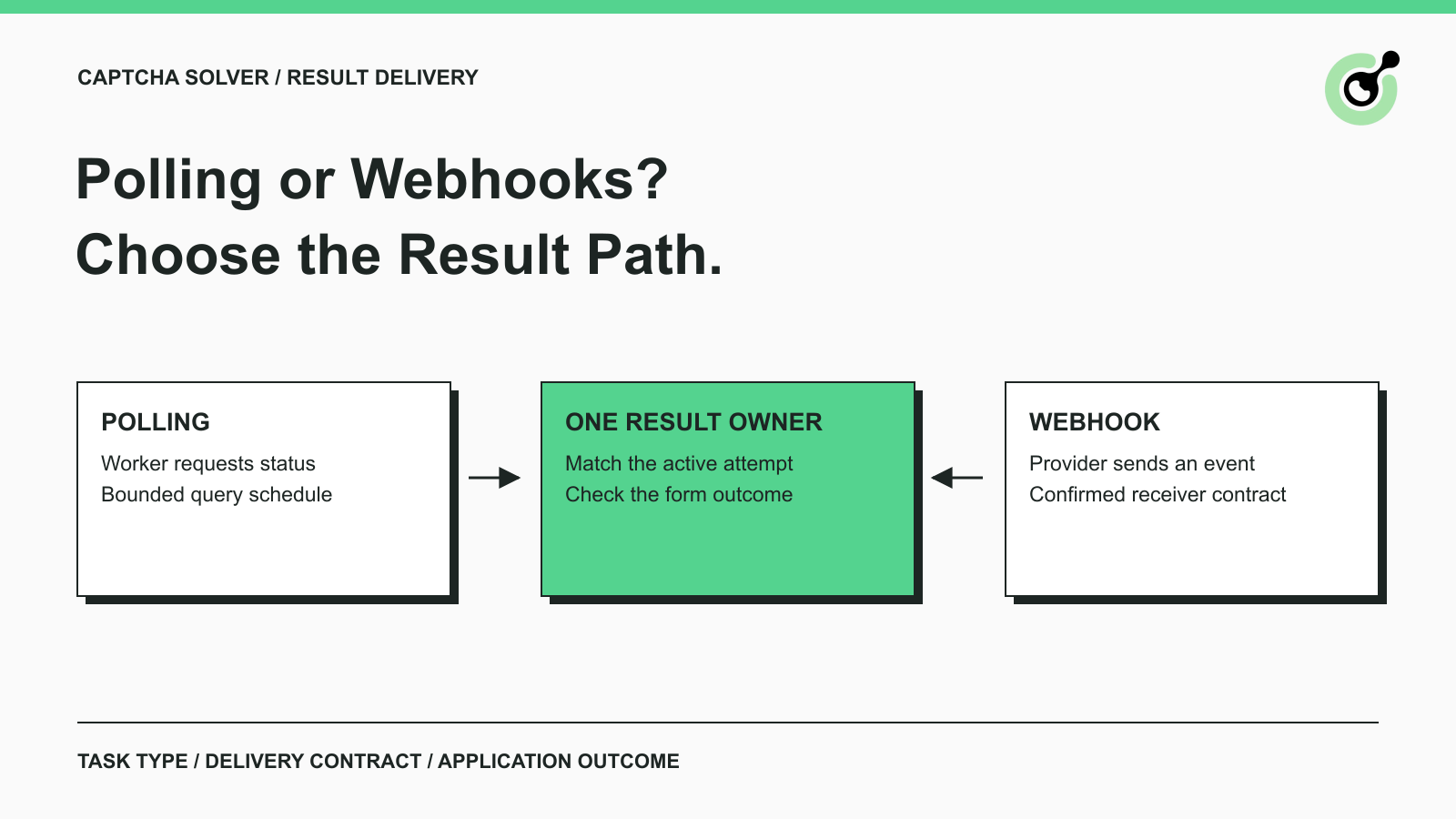
- Keep one result owner per application attempt, even if more than one delivery path can report completion.
What changes when you choose polling or a webhook?
CAPTCHA solver polling asks for a task's status, while a webhook lets the provider send a completion notification to your server. Both patterns move a solver result back into an application waiting to finish an authorized operation, such as a QA check on a form your team owns.
With CapSolver, that decision starts with the selected task type and its documented response. A worker should not assume every successful task-creation request needs a second request. Equally, receiving a task identifier does not mean the application already has a usable answer.
The webhook glossary entry explains the general push model. Here, “webhook” means a server-to-server notification about a solver task. A JavaScript callback inside a CAPTCHA widget is different: it runs in a browser integration and does not create an internet-facing result receiver for your backend.
This comparison covers result delivery and application design. It does not supply a ready-to-deploy callback server or assume undocumented guarantees about provider delivery.
Polling vs webhooks at a glance
Polling is usually the simpler starting point for a bounded worker; webhooks become attractive when an event receiver is already part of the application.
| Decision | Polling | Webhook |
|---|---|---|
| Network direction | Worker requests status from the provider | Provider sends a request to your receiver |
| Main prerequisite | Stored task ID and outbound connectivity | Reachable receiver and confirmed delivery contract |
| Waiting behavior | Scheduled checks until completion or a limit | Application waits for a completion event |
| State to retain | Task owner, deadline, and query history | Task owner, deadline, and delivery disposition |
| Main operational question | How many checks can the worker make? | What happens when the receiver cannot accept an event? |
| Good starting fit | Small authorized QA jobs and existing workers | Applications already operating reliable event intake |
The table describes architectural tradeoffs, not a claim that every provider implements the same callback features. A provider-specific contract determines what the receiver can actually rely on.
Check the documented CapSolver completion flow first
CapSolver documents asynchronous result retrieval and direct recognition responses, so task selection comes before transport selection.
The createTask specification includes an optional callbackUrl and describes a POST carrying the token to that endpoint. The page does not define a complete callback payload schema, signature mechanism, retry policy, or delivery ordering contract. Confirm those details for your integration before treating callback delivery as a production dependency.
For asynchronous tasks, the getTaskResult reference uses clientKey and taskId. It documents idle, processing, and ready states; successful completion requires errorId equal to zero and status equal to ready. The solution structure depends on the task type. The page tells callers to try again after three seconds while processing and lists limits of 120 queries per task and a five-minute query window from creation.
Do not apply that polling loop to every response. The ImageToTextTask documentation describes recognition results returned directly by createTask. A generic wrapper that discards a direct solution and starts waiting for another event can introduce a failure that the solver itself did not cause.
When does polling make the better choice?
Polling fits a worker that already owns the browser action, knows its deadline, and can remain responsible for the task until the result arrives.
Consider a QA worker checking the support form on a staging application. The worker creates a supported solver task, records its task ID with the form attempt, and schedules status checks. When the result is ready, the application checks whether that form attempt is still active before handing the answer to its permitted integration.
This arrangement needs no new inbound endpoint. It also gives the worker one place to explain why the attempt ended: the solver returned an error, the application deadline passed, or the form was replaced before a result could be used.
A practical polling design should make these choices explicit:
- Preserve the provider task ID with the application attempt that created it.
- Schedule checks according to the documented interval and retrieval limits.
- Stop querying on a terminal error, successful completion, cancellation, or the application deadline.
- Validate the expected solution field for the selected task type.
- Confirm that the intended form still exists before passing the result onward.
The application's deadline may be shorter than the provider's retrieval window. A result that remains queryable can still be irrelevant to a browser page that has navigated away. Record that distinction in the worker outcome rather than calling every unused result a solver failure.
What must be confirmed before choosing webhooks?
A webhook is a sound choice only when the receiver can identify an expected task, handle its result safely, and explain failed or late deliveries.
For CapSolver, begin with the documented callbackUrl capability and obtain the missing contract details. Ask what identifies a task in the delivered request, how the sender can be authenticated, which response acknowledges receipt, and what the service does if that response is not received. Do not copy another service's signature header or retry schedule into a CapSolver receiver.
The receiver also needs normal application protections. The OWASP REST security guidance covers HTTPS, request validation, and content handling. These are receiver design principles; they do not prove that a particular callback API supplies signed requests.
Keep incoming payloads out of ordinary request logs when they contain solution tokens. Store only the information needed to associate the delivery with an expected attempt and diagnose its disposition. A callback URL should not expose the CapSolver account key in query strings or logs.
If sender authentication or correlation cannot be established, prefer the documented polling flow while you resolve the gap. A reachable URL alone is insufficient evidence that your receiver can trust and use a notification.
Redeem Your CapSolver Bonus Code
Boost your automation budget instantly!
Use bonus code CAP26 when topping up your CapSolver account to get an extra 5% bonus on every recharge — with no limits.
Redeem it now in your CapSolver Dashboard
How should result delivery connect to form completion?
Result delivery should produce a candidate answer for one current application attempt, followed by a separate check that the intended operation completed.
Imagine an internal test page with a feedback form. The solver result arrives successfully, but the test has already closed the feedback dialog. Your application should record that the answer arrived after the attempt ended. It should not reopen the dialog or submit an unrelated form just because a result is available.
Use a small application record with clearly separated meanings:
| Record field | Meaning in your application |
|---|---|
| Attempt reference | The particular form operation waiting for an answer |
| Provider task reference | The task created for that attempt, when applicable |
| Delivery source | Poll response, callback, or direct response |
| Result disposition | Accepted for use, rejected as unexpected, or no longer needed |
| Application outcome | Intended operation completed, failed, or was cancelled |
These are proposed application fields, not a CapSolver response schema. Their purpose is to stop a transport event from becoming an unsupported claim about business success.
HTTP status also has a narrower meaning than application completion. For example, the HTTP 202 Accepted definition explains that acceptance for processing does not establish completion. That is a general protocol distinction, not a statement that CapSolver uses HTTP 202 for task creation.
Can polling and webhooks be combined?
A combined design is possible only when both paths feed the same application decision and the provider's supported behavior has been confirmed.
Do not let a callback handler and a polling worker independently submit the same form. Both should report to an owner that can accept a result once for the intended attempt. The AWS discussion of idempotent APIs explains why repeated delivery or retries need explicit treatment when operations have side effects. That principle applies to your consumer design; it does not establish an idempotency feature in the CapSolver task API.
Combining delivery paths creates more cases to test. A callback may reach the application while a poll request is in flight. The owner must classify the later observation without issuing another form action. If the page attempt was cancelled, both observations should remain unable to restart it.
Start with one verified delivery method unless a measured operational need justifies a second. More paths can improve visibility in some systems, but they also increase the work needed to explain ownership and timing.
How do you compare operating cost and reliability?
Compare the cost of operating the complete result path, including status requests, receiver maintenance, and failed application attempts.
Polling consumes scheduled worker activity and repeated API requests. Webhooks require receiver availability, request validation, deployment ownership, and delivery diagnostics. Neither architecture automatically lowers the CAPTCHA task price or improves recognition accuracy.
For an evaluation, collect the number of status queries per completed task, time from task creation to application receipt, and the proportion of results that arrive after their application attempt ends. For callbacks, also record deliveries the receiver could not associate with an expected attempt. Avoid putting tokens in these measurements.
Test a slow solver response, worker restart, unavailable receiver, cancelled form, and repeated completion observation. These are proposed acceptance tests, not reported benchmark results. Set acceptable outcomes before testing so “the request returned” cannot become the sole success criterion.
Choose polling when its bounded checks fit your worker and deadline. Choose callbacks when the documented contract and your receiver are both ready. For browser callback details, the separate guide to finding a reCAPTCHA callback addresses the page-side mechanism.
Use CapSolver with a supported task and a result path your application can account for from creation through the intended form outcome.
FAQ
Q: Is a CAPTCHA webhook faster than polling?
A webhook can avoid waiting for the next scheduled poll, but it does not make the underlying CAPTCHA solution faster. Network delivery, receiver processing, and the application's current state still affect when an answer becomes useful. Measure the full path before claiming a latency improvement.
Q: Does CapSolver document signed callback requests?
The linked createTask page documents callbackUrl delivery but does not specify a callback signing scheme. Confirm the supported authentication contract before deploying a receiver. Do not assume a header or secret format from another provider applies.
Q: Should ImageToTextTask results be polled?
ImageToTextTask is documented as returning its recognition result directly through createTask. Read that response before deciding that another result request is necessary.
Q: Is a ready solver result proof that my form succeeded?
A ready result establishes solver completion, not the success of the intended form operation. Your application must associate the answer with the current attempt and verify the form's own completion outcome.
More
The Other CAPTCHASep 15, 2026
ImageToTextTask vs VisionEngine: Choose an Image CAPTCHA Solver
Compare ImageToTextTask and VisionEngine by CAPTCHA input, recognition output, module requirements, and application checks before choosing a solver task.
The Other CAPTCHASep 09, 2026
Selenium CAPTCHA Integration Security: Protect Keys and Sessions
Learn how to protect keys, sessions, logs, and test environments in Selenium CAPTCHA integrations, with practical review checks for authorized automation.