🎉NEWCapSolver for AI agents-MCP, agent tools, and SDK integrations

Rajinder Singh
Deep Learning Researcher
Published Jul 07, 2026
Updated Jul 07, 2026 · min read
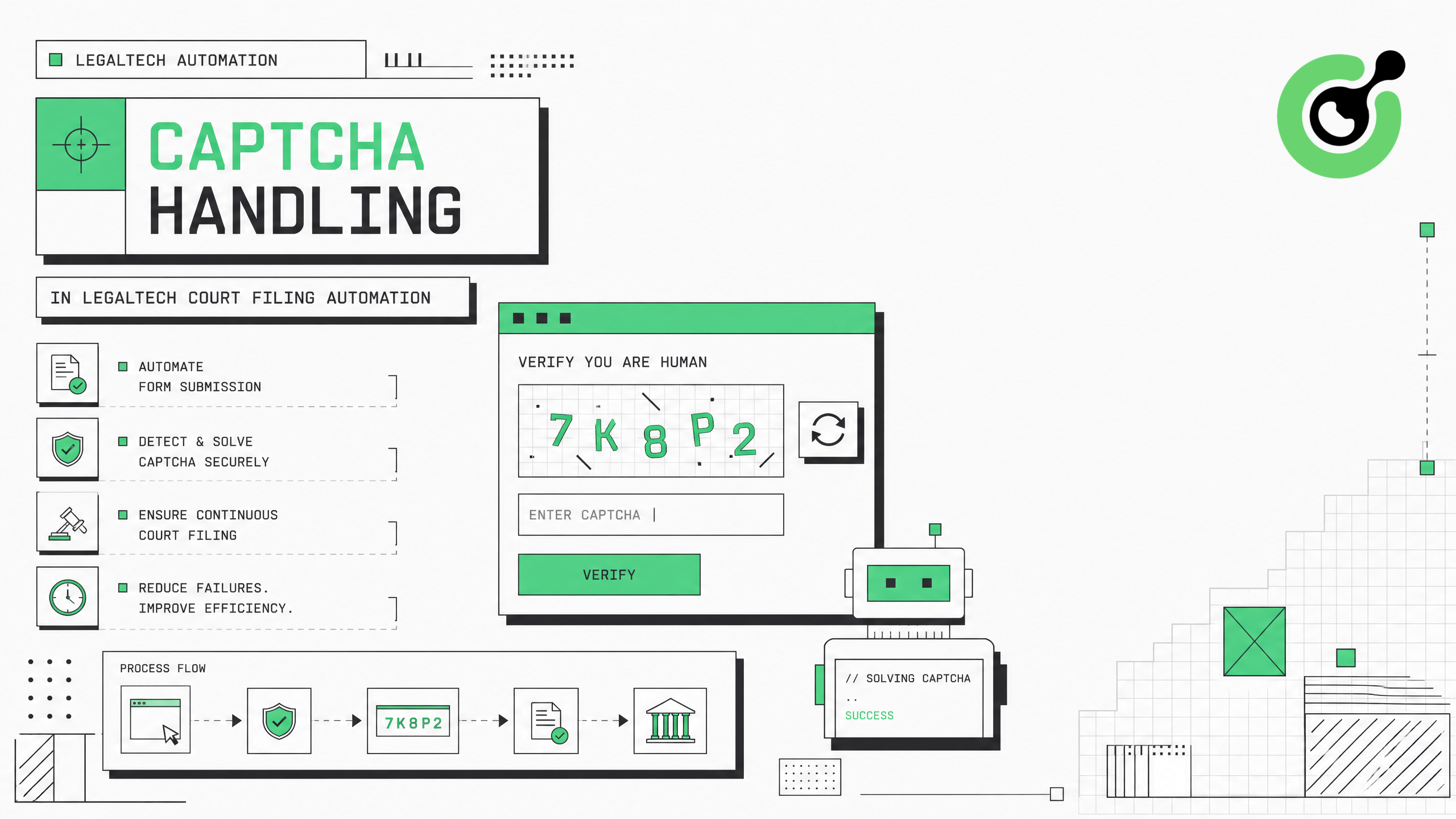
The safest conclusion first: lawful, auditable captcha handling in legaltech court filing automation is achievable with layered techniques and operational controls. This article is for engineers, product managers, and compliance officers building court e-filing workflows. It shows practical methods, compliance checkpoints, and an implementation roadmap. You will learn technology options, when to use each approach, and how to document decisions. The goal is reliable filing while respecting traffic validation and court policies on automated access.
Start with the mechanism. CAPTCHAs present interactive challenges to separate human users from bots. Courts and e-filing portals use them to prevent abuse, manage load, and preserve integrity.
When designing captcha handling in legaltech court filing automation, categorize the target system. Different courts use different providers and versions. That affects detection, solving method, and success rates.
Courts publish e-filing rules and acceptable use policies. Respect those rules. Some jurisdictions explicitly prohibit automated scraping or automated logins. Maintain a defensible record explaining automation design choices. If a court requires human confirmation for filing, automation must incorporate it. For authoritative guidance, review provider or court policy pages such as:
Choose methods aligned with compliance, engineering resources, and acceptable risk.
Main point: prioritize human authorization for critical steps. Prompt a filing clerk to complete or confirm the captcha. This reduces legal risk. It is simple to implement and easy to audit. Use it where court rules discourage full automation.
Include integrations with workflow tools and CapSolver products to manage task handoffs and logs.
Main point: use ML only where permitted and resilient. Train models to identify simple text or selection tasks. Modern approaches use vision models and context features. Test extensively across court environments. Monitor drift and add retraining cycles.
When using automated models in captcha handling in legaltech court filing automation, ensure you keep an audit trail of model decisions. Log inputs, confidence scores, and reasons to retry or escalate to human review.
Refer to technical best practices on automation and AI from product teams for deployment patterns.
Main point: third-party services can increase throughput but add vendor risk. These services may offer APIs that return solved tokens. Evaluate privacy, retention, and contractual protections. Confirm the provider’s policies align with court privacy requirements.
See CapSolver's documentation on service behavior and supported flows at captcha solving FAQ.
Main point: combine methods for resilience. Start with a fast automated attempt. If confidence is low, switch to human-in-loop. If a service is rate-limited, throttle and retry later. For high-criticality filings, require human confirmation after automated success.
Design circuits for retries, exponential backoff, and alternate filing windows to manage traffic validation and avoid repeated failures.
Design operations to support reliability and defensibility. Keep processes auditable and transparent.
Main point: log everything. Record timestamps, IP addresses, solver responses, confidence metrics, and user consent. Store logs in immutable storage and retain per regulatory timelines. These records support appeals and forensic review.
Main point: protect PII and court data. Mask or redact sensitive fields in logs. Ensure vendors meet security standards. Include data retention, deletion, and breach notification provisions in contracts.
Link operational guidelines and legal reviews to product pages like CapSolver products and the general CapSolver blog for further reading.
Main point: respect rate limits and honor traffic validation. Implement per-jurisdiction rate controls. Use distributed backoff strategies to avoid triggering stricter bot protection. Document your traffic profile and changes over time.
For engineering patterns, see resources on web interaction and scraping practices in CapSolver web-scraping blog.
Start small. Validate in test environments or sandboxed court APIs where available.
Main point: track success rate, time-to-file, retry counts, and human escalations. Use analytics to detect emerging patterns like new CAPTCHAs or sudden increases in failures. Update models and ruleset based on metrics.
Main point: plan for incidents. Include procedures for service outages and malformed responses. Maintain a communication plan for courts and internal stakeholders.
| Approach | Speed | Compliance Risk | Maintenance Burden | Typical Use Case |
|---|---|---|---|---|
| Human-in-loop | Medium | Low | Low | High-risk filings, new jurisdictions |
| ML-based solver | High | Medium | High (retraining) | Stable, uniform CAPTCHAs |
| Third-party service | Very High | Medium-High (vendor risk) | Medium | High-volume, permitted environments |
| Hybrid (auto + human) | High | Low-Medium | Medium | Mixed-risk workflows |
| Passive fallback (delay/retry) | Low | Low | Low | Rate-limited windows or peak traffic |
Bonus Code: A top captcha solutions for captcha solving for insurtech claims processing
Enter your bonus code top captcha solutions; captcha solving for insurtech claims processing to get an extra 5% added to your recharge, after a successful recharge.
Implementing lawful captcha handling in legaltech court filing automation requires a layered approach. Start with policy review. Choose the right technical method per jurisdiction. Add human oversight for high-risk filings. Monitor metrics and keep detailed logs. Review vendor contracts and data handling procedures. For tools and technical guides, explore CapSolver products and related blog posts on automation, AI, and web-scraping. Ready to proceed? Visit https://www.capsolver.com/?utm_source=offcial&utm_medium=blog&utm_campaign=captcha-handling-in-legaltech-court-filing-automation
Q: What is the safest approach for captcha handling in legaltech court filing automation?
A: The safest approach uses human-in-loop confirmation for critical filings, combined with auditable logs and explicit compliance checks.
Q: Can ML models reliably solve court CAPTCHAs?
A: They can for consistent, low-variance challenges. Accuracy varies. You must monitor drift and keep fallback to human review.
Q: Are third-party captcha services legally acceptable for filings?
A: They can be acceptable but require contract review, privacy safeguards, and court policy checks. Vendor risk and data retention are key concerns.
Q: How should I document my automation choices?
A: Create a technical decision record. Include risk assessments, jurisdictional checks, logs retention policies, and human escalation paths.
Q: Where can I learn more about integrating captcha solutions?
A: Start with vendor docs and product pages like CapSolver products and the CapSolver blog.
Rajinder Singh
Deep Learning Researcher
Making CAPTCHA solving more reliable in automated workflows.
ABOUT THE AUTHOR
Fix common Selenium CAPTCHA integration problems by checking test configuration, extensions, waits, iframe context, solver responses, and application results.

Choose the CapSolver Python Core SDK or direct HTTP API by task support, page access, response handling, and the responsibilities your application owns.