🎉NEWCapSolver for AI agents-MCP, agent tools, and SDK integrations

Ethan Collins
AI Agent Workflow Engineer
Published Aug 27, 2026
Updated Aug 27, 2026 · min read
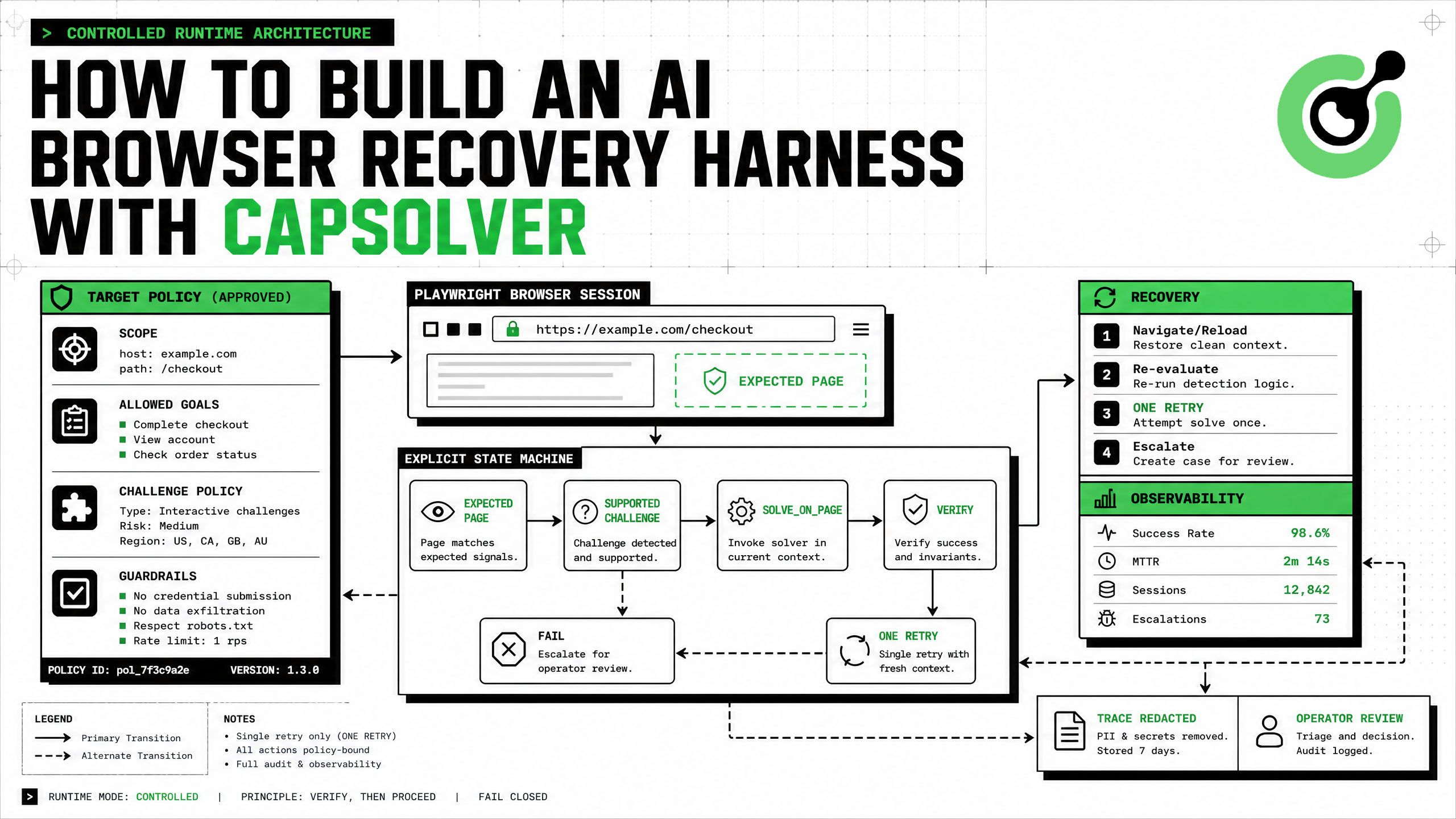
detect, get_captcha_info, or solve_on_page at deterministic recovery boundaries.An AI browser recovery harness is the runtime layer that keeps a browser task controlled when page state changes unexpectedly. The model can decide what business step comes next, but the harness should own the Playwright context, approved-host policy, navigation checkpoints, page classification, supported challenge recovery, retry limits, traces, screenshots, and teardown. CapSolver fits inside this layer as a deterministic recovery capability: capsolver-core can detect supported challenges, read parameters, solve them, and fill the result back into the same page. The harness then verifies that the expected application state returned before allowing the agent to continue. This guide builds the policy model, state machine, async context manager, recovery function, artifact recorder, OpenTelemetry spans, tests, and production controls for reliable authorized browser automation.
The harness is not the model and not the browser driver alone. It is the control plane between them.
Business goal from agent
          ↓
Browser recovery harness
  ├─ target policy
  ├─ Playwright context
  ├─ state classifier
  ├─ checkpoint store
  ├─ CapSolver recovery
  ├─ retry budget
  ├─ trace + artifacts
  └─ cleanup
          ↓
Approved page action or operator review
Playwright's fixture documentation emphasizes isolated page and browser-context fixtures, reusable setup and teardown, composability, and automatic debug attachments. Those properties translate directly into a production harness.
The CapSolver Core SDK documentation defines four useful browser stages: detect, get_captcha_info, solve, and solve_on_page.
The model may decide to open a known product page or read a public status. The harness decides whether the requested host is allowed, whether the current page is expected, whether recovery is supported, and whether the retry budget remains.
| Decision | Owner | Reason |
|---|---|---|
| Next business step | Agent or workflow | Requires task context |
| Host and path permission | Harness policy | Must be deterministic |
| Page-state classification | Harness classifier | Must use trusted DOM/network evidence |
| Challenge recovery call | Harness | Requires secrets and browser object |
| Token/cookie handling | Harness | Sensitive runtime data |
| Continue vs review | Harness state machine | Enforces bounded recovery |
| Final submission | Human or dedicated service | High-impact action |
The CapSolver AI Agents guide explains the same division of labor: the model handles reasoning, while CapSolver's layers perform the supported challenge work.
Start with a narrow policy for approved hosts, paths, actions, and budgets.
from dataclasses import dataclass, field
from urllib.parse import urlparse

@dataclass(frozen=True)
class TargetPolicy:
    allowed_hosts: set[str]
    allowed_path_prefixes: tuple[str, ...]
    max_navigations: int = 20
    max_recovery_attempts: int = 1
    capture_screenshots: bool = True
    capture_html: bool = False
    allow_form_submission: bool = False

    def validate_url(self, url: str) -> None:
        parsed = urlparse(url)
        if parsed.scheme != "https":
            raise PermissionError("Only HTTPS targets are permitted")
        if parsed.hostname not in self.allowed_hosts:
            raise PermissionError("Host is outside the approved policy")
        if not parsed.path.startswith(self.allowed_path_prefixes):
            raise PermissionError("Path is outside the approved policy")
Use tenant-specific policies. Do not maintain one global allowlist for unrelated customers or projects.
The CapSolver AI and automation FAQ provides integration context, while the CapSolver web-scraping FAQ covers responsible public-data workflows.
A recovery harness should use explicit states rather than an unbounded “try again” loop.
from enum import Enum

class BrowserState(str, Enum):
    EXPECTED_PAGE = "expected_page"
    SUPPORTED_CHALLENGE = "supported_challenge"
    UNKNOWN_PAGE = "unknown_page"
    RECOVERING = "recovering"
    RECOVERED = "recovered"
    REVIEW_REQUIRED = "review_required"
    FAILED = "failed"
Permitted transitions can be represented as data:
ALLOWED_TRANSITIONS = {
    BrowserState.EXPECTED_PAGE: {
        BrowserState.EXPECTED_PAGE,
        BrowserState.SUPPORTED_CHALLENGE,
        BrowserState.UNKNOWN_PAGE,
    },
    BrowserState.SUPPORTED_CHALLENGE: {
        BrowserState.RECOVERING,
        BrowserState.REVIEW_REQUIRED,
    },
    BrowserState.RECOVERING: {
        BrowserState.RECOVERED,
        BrowserState.REVIEW_REQUIRED,
        BrowserState.FAILED,
    },
    BrowserState.RECOVERED: {
        BrowserState.EXPECTED_PAGE,
        BrowserState.REVIEW_REQUIRED,
    },
}
Validate every transition. This makes loops visible and testable.
A checkpoint records safe metadata needed to determine whether the workflow resumed correctly.
from dataclasses import dataclass
from datetime import datetime, timezone

@dataclass
class BrowserCheckpoint:
    url: str
    title: str
    expected_selector: str | None
    navigation_index: int
    recovery_attempts: int
    observed_at: str

async def checkpoint(page, expected_selector, nav_index, attempts):
    return BrowserCheckpoint(
        url=page.url,
        title=await page.title(),
        expected_selector=expected_selector,
        navigation_index=nav_index,
        recovery_attempts=attempts,
        observed_at=datetime.now(timezone.utc).isoformat(),
    )
Do not store storage state, cookies, passwords, tokens, or full form values in the checkpoint.
Use trusted DOM evidence, title, URL, and expected selectors. Never ask the model to infer page state from a screenshot alone.
async def classify_page(page, expected_selector: str) -> BrowserState:
    if await page.locator(expected_selector).count():
        return BrowserState.EXPECTED_PAGE

    title = (await page.title()).strip().lower()
    html = (await page.content()).lower()

    challenge_markers = (
        "just a moment...",
        "challenge-platform",
        "cf-chl-",
    )
    if any(marker in title or marker in html for marker in challenge_markers):
        return BrowserState.SUPPORTED_CHALLENGE

    return BrowserState.UNKNOWN_PAGE
Use target-specific markers and controlled fixtures. A marker set is a routing heuristic, not an access entitlement.
The CapSolver CAPTCHA-solving FAQ explains supported challenge workflows, and the CapSolver errors FAQ helps classify failures.
The official Core SDK recommends using its async context manager so HTTP connections are reused and released correctly.
import os
from capsolver_core import create_capsolver


def create_recovery_client():
    return create_capsolver(
        api_key=os.environ["CAPSOLVER_API_KEY"],
        default_timeout=120,
        polling_interval=5,
        request_timeout_ms=30000,
        source="ai-browser-recovery-harness",
        version="1.0.0",
    )
Do not create a new client for every DOM check. Keep one client for the harness lifecycle and close it during teardown.
Use detect and get_captcha_info for diagnostics, then solve_on_page for the all-in-one browser flow.
from capsolver_core import SolveOnPageOptions

async def recover_supported_challenge(
    cap,
    page,
    policy: TargetPolicy,
    recovery_attempts: int,
) -> dict:
    policy.validate_url(page.url)

    if recovery_attempts >= policy.max_recovery_attempts:
        return {
            "success": False,
            "state": BrowserState.REVIEW_REQUIRED,
            "reason": "recovery budget exhausted",
        }

    detected = await cap.detect(page)
    if not detected:
        return {
            "success": False,
            "state": BrowserState.REVIEW_REQUIRED,
            "reason": "no supported challenge detected",
        }

    infos = await cap.get_captcha_info(page)
    results = await cap.solve_on_page(
        page,
        options=SolveOnPageOptions(
            autofill=True,
            throw_on_error=False,
            timeout=120,
            polling_interval=5,
        ),
    )

    errors = [item.error for item in results if item.error]
    filled = bool(results) and all(item.filled for item in results)

    return {
        "success": filled and not errors,
        "state": (
            BrowserState.RECOVERED
            if filled and not errors
            else BrowserState.REVIEW_REQUIRED
        ),
        "detected_count": len(detected),
        "info_count": len(infos),
        "result_count": len(results),
        "errors": errors,
    }
Keep the original page object. The point of solve_on_page is to detect, solve, and fill back within the existing browser session.
A successful tool response does not prove that the expected application page returned.
async def verify_recovery(
    page,
    expected_selector: str,
    timeout_ms: int = 15000,
) -> bool:
    try:
        await page.locator(expected_selector).wait_for(
            state="visible",
            timeout=timeout_ms,
        )
        return True
    except Exception:
        return False
After recovery, classify the page again. If the challenge remains or the expected selector is absent, stop and request review.
async def recover_and_verify(cap, page, policy, expected_selector, attempts):
    result = await recover_supported_challenge(
        cap=cap,
        page=page,
        policy=policy,
        recovery_attempts=attempts,
    )
    if not result["success"]:
        return result

    if not await verify_recovery(page, expected_selector):
        return {
            "success": False,
            "state": BrowserState.REVIEW_REQUIRED,
            "reason": "expected page did not return after recovery",
        }

    return {
        "success": True,
        "state": BrowserState.EXPECTED_PAGE,
        "reason": "page recovered and verified",
}Use an async context manager to guarantee cleanup.
from contextlib import asynccontextmanager
from playwright.async_api import async_playwright

@dataclass
class BrowserHarness:
    policy: TargetPolicy
    playwright: object
    browser: object
    context: object
    page: object
    capsolver: object
    navigation_count: int = 0
    recovery_attempts: int = 0

@asynccontextmanager
async def browser_recovery_harness(policy: TargetPolicy):
    async with async_playwright() as playwright:
        browser = await playwright.chromium.launch(headless=True)
        context = await browser.new_context()
        page = await context.new_page()

        async with create_recovery_client() as cap:
            harness = BrowserHarness(
                policy=policy,
                playwright=playwright,
                browser=browser,
                context=context,
                page=page,
                capsolver=cap,
            )
            try:
                yield harness
            finally:
                await context.close()
                await browser.close()
The model or workflow receives controlled methods, not raw unrestricted browser access.
async def safe_navigate(
    harness: BrowserHarness,
    url: str,
    expected_selector: str,
) -> dict:
    harness.policy.validate_url(url)

    if harness.navigation_count >= harness.policy.max_navigations:
        return {
            "success": False,
            "state": BrowserState.REVIEW_REQUIRED,
            "reason": "navigation budget exhausted",
        }

    harness.navigation_count += 1
    await harness.page.goto(url, wait_until="domcontentloaded")

    state = await classify_page(harness.page, expected_selector)
    if state == BrowserState.EXPECTED_PAGE:
        return {"success": True, "state": state}

    if state == BrowserState.SUPPORTED_CHALLENGE:
        result = await recover_and_verify(
            cap=harness.capsolver,
            page=harness.page,
            policy=harness.policy,
            expected_selector=expected_selector,
            attempts=harness.recovery_attempts,
        )
        harness.recovery_attempts += 1
        return result

    return {
        "success": False,
        "state": BrowserState.REVIEW_REQUIRED,
        "reason": "unknown page state",
    }
The agent can request safe_navigate, but the harness owns the policy and recovery path.
OpenTelemetry's GenAI observability guidance describes traces for model and tool operations. It also notes that full prompt and tool content can contain sensitive data. Default to metadata-only spans.
from opentelemetry import trace

tracer = trace.get_tracer("capsolver.browser_harness")

async def traced_safe_navigate(harness, url, expected_selector):
    with tracer.start_as_current_span("browser.safe_navigate") as span:
        span.set_attribute("browser.target_host", url.split("/")[2])
        span.set_attribute("browser.navigation_index", harness.navigation_count + 1)
        span.set_attribute("browser.recovery_attempts", harness.recovery_attempts)

        result = await safe_navigate(harness, url, expected_selector)

        span.set_attribute("browser.outcome", str(result.get("state")))
        span.set_attribute("browser.success", bool(result.get("success")))
        return result
Do not attach tokens, cookies, API keys, proxy credentials, storage state, prompt content, or full page HTML to spans.
Screenshots and HTML can contain personal or confidential data. Capture them only when policy allows, redact where possible, and store short-lived references.
from pathlib import Path
import secrets

async def capture_failure_artifacts(harness, directory: Path) -> dict:
    artifact_id = secrets.token_hex(12)
    screenshot = directory / f"{artifact_id}.png"

    await harness.page.screenshot(
        path=str(screenshot),
        full_page=False,
    )

    return {
        "artifact_id": artifact_id,
        "screenshot_path": str(screenshot),
        "url": harness.page.url,
        "title": await harness.page.title(),
    }
Use retention limits and access controls. Avoid capturing full-page screenshots when only the top-level state is needed.
The CapSolver browser automation blog contains related implementation patterns, and the CapSolver Chrome extension guide can help teams inspect supported widget parameters during development.
Use isolated browser contexts and controlled pages. Playwright fixtures provide reusable setup and teardown.
import pytest

@pytest.mark.asyncio
async def test_unknown_host_is_rejected():
    policy = TargetPolicy(
        allowed_hosts={"staging.example.com"},
        allowed_path_prefixes=("/qa/",),
    )

    with pytest.raises(PermissionError):
        policy.validate_url("https://other.example.net/qa/test")

@pytest.mark.asyncio
async def test_recovery_budget_is_bounded(fake_cap, fake_page):
    policy = TargetPolicy(
        allowed_hosts={"staging.example.com"},
        allowed_path_prefixes=("/qa/",),
        max_recovery_attempts=1,
    )

    result = await recover_supported_challenge(
        cap=fake_cap,
        page=fake_page,
        policy=policy,
        recovery_attempts=1,
    )

    assert result["state"] == BrowserState.REVIEW_REQUIRED
    assert result["reason"] == "recovery budget exhausted"
Create fixtures for no challenge, supported challenge, unknown interstitial, successful fill-back, solve failure, post-recovery challenge loop, and missing expected selector.
| Metric | Purpose |
|---|---|
| Expected-page rate | Measures successful normal navigation |
| Challenge encounter rate | Shows source friction by approved host |
| Recovery success rate | Measures supported recovery outcomes |
| Challenge-loop rate | Detects repeated interstitial state |
| Unknown-page rate | Finds layout, auth, or policy changes |
| P95 recovery latency | Tracks user-visible delay |
| Operator-review rate | Measures unresolved workflow volume |
| Artifact capture rate | Detects excessive failure logging |
Break metrics down by target policy, route, browser version, challenge type, and harness version. Never label a challenge recovery failure as a business-task failure without preserving both dimensions.
Bonus Code: Use code WEBS at CapSolver Dashboard to get an extra 5% bonus on every recharge.
| Approach | Browser ownership | Recovery control | Best use |
|---|---|---|---|
| Direct agent browser access | Agent runtime | Prompt-dependent | Low-risk prototypes only |
| Framework-specific action | Agent framework | Tool wrapper | Fast integration |
| Dedicated recovery harness | Independent control layer | Deterministic state machine | Production reliability and governance |
| Human-only recovery | Operator | Manual | Unsupported or high-risk workflows |
A dedicated harness requires more engineering, but it creates one policy and observability layer that can serve multiple agent frameworks.
The CapSolver products page lists supported solution categories, while the CapSolver AI blog covers agent-framework examples that can call a harness action.
Use the browser recovery harness only on systems you own, test, or have explicit authorization to automate. A successful challenge solution does not grant permission to access private content, ignore authentication boundaries, exceed rate limits, or perform transactions. Keep the harness scoped, read-only by default, and auditable. Route uncertainty to a person instead of expanding permissions dynamically.
An AI browser recovery harness turns challenge handling into a controlled runtime capability. It owns the browser context, validates targets, classifies page state, invokes CapSolver Core at a deterministic boundary, verifies the expected page, records redacted telemetry, and stops after a bounded attempt. Agent frameworks can use the harness without gaining direct access to secrets or unrestricted browser control.
Start with CapSolver, implement the state machine against an approved staging application, and add isolated fixtures and reliability gates before production.
No. It is an independent runtime and policy layer that an agent framework can call. The harness owns browser state, recovery, checkpoints, telemetry, and cleanup.
solve_on_page?solve_on_page combines detection, parameter extraction, solving, and DOM fill-back on the same Playwright page, which makes it suitable for a controlled browser recovery boundary.
Prefer narrow harness actions such as safe_navigate and read_public_page. Raw page access makes it harder to enforce target, navigation, and recovery policies.
Use one attempt by default. Repeated challenges or unknown page state should route to operator review instead of creating an uncontrolled loop.
Store metadata such as target host, harness version, state transitions, latency, normalized errors, and artifact references. Do not store solution tokens, cookies, API keys, proxy credentials, storage state, or private page content.
Ethan Collins
AI Agent Workflow Engineer
Building clearer handoffs between AI agents and tools.
ABOUT THE AUTHOR
Estimate CAPTCHA solving costs in Browser Use by separating agent runs, challenge types, billable solves, retries, and verified outcomes from browser costs.

Set up CapSolver MCP in Claude Code, check the available CAPTCHA tools, and choose token or page solving for a supported, authorized browser task.