🎉NEWCapSolver for AI agents-MCP, agent tools, and SDK integrations

Lucas Mitchell
Automation Engineer
Published Sep 01, 2026
Updated Sep 01, 2026 · min read
CloakBrowser is a custom Chromium distribution and a set of language wrappers designed for browser automation. It keeps the Playwright or Puppeteer programming model while changing browser-level signals that automation environments can expose.
That positioning separates CloakBrowser from a conventional browser profile manager and from a hosted browser API. You install the wrapper, let it obtain the compatible binary, and run browser sessions on your own machine, container, or server. CloakBrowser also advertises a managed Cloud option on request, but its core product is downloadable software that you operate.
The official CloakBrowser repository is the most useful starting point because it contains the Python and JavaScript APIs, Docker examples, release notes, troubleshooting guidance, and binary licensing details. Developers new to the underlying interface can also review CapSolver's Playwright glossary.
CloakBrowser combines a thin language wrapper with a customized Chromium binary. The wrapper launches that binary with compatible options and returns a standard Playwright Browser or browser context.
The vendor currently describes 73 source-level patches across areas such as canvas, WebGL, audio, fonts, GPU reporting, screen properties, WebRTC, network timing, hardware reporting, automation signals, and CDP input behavior. This differs from a library that changes only JavaScript-visible values after a page loads.
The architecture has two practical effects. First, an existing Playwright team does not need to adopt a proprietary page-control API. Second, the browser binary becomes an operational dependency: platform compatibility, version pinning, downloads, license access, and updates must be managed alongside application code.
As of September 1, 2026, the CloakBrowser website listed Chromium v151 for its current plans. That version will change, so production teams should check the active binary with the documented cloakbrowser info command instead of assuming a version from an article.
CloakBrowser's Python launcher returns a Playwright browser, and its JavaScript package supports Playwright and Puppeteer launch paths. Core operations such as new_page(), new_context(), navigation, locators, evaluation, and closing the browser therefore follow familiar APIs.
Compatibility reduces migration cost, but it does not eliminate testing. Browser-specific flags, extensions, persistent profiles, downloads, media components, and CI dependencies can behave differently across operating systems and releases.
The current product surface supports Python, JavaScript, and .NET. Python installs through pip install cloakbrowser, while JavaScript uses the cloakbrowser npm package. The project also documents synchronous and asynchronous Python launch functions.
This language coverage is useful for teams with several automation services, although feature parity should be checked for the exact wrapper and release channel being deployed.
CloakBrowser accepts HTTP and SOCKS5 proxies and exposes options for locale, timezone, viewport, user agent, platform-related values, and GeoIP-assisted alignment. Persistent-context APIs keep cookies and browser storage across sessions when the workflow requires a stable profile.
These controls do not replace sound session design. Proxy location, browser locale, timezone, cookies, and application state should agree with one another. CapSolver's explanation of browser fingerprinting in web security provides useful context for why isolated settings should not be evaluated independently.
The humanize=True option changes mouse, keyboard, and scrolling behavior, with presets for different movement styles. This can make interaction timing less mechanically uniform, but it is not a guarantee that every site will accept every session. CloakBrowser's own FAQ acknowledges that detection changes and that no browser works on every site every time.
CloakBrowser publishes Docker examples for running scripts and a cloakserve mode that exposes Chrome DevTools Protocol connections. This makes the browser usable behind another automation service or inside container infrastructure.
Remote access adds familiar platform responsibilities: bind the service to an appropriate interface, secure network access, isolate workloads, handle process cleanup, and monitor browser capacity. The vendor's examples bind CDP locally by default, which is a sensible baseline.
The wrapper verifies binary downloads against signed checksums, and the repository documents additional GPG and Sigstore verification procedures. Stable and preview release channels are available, and browser versions can be pinned when a new build causes a regression.
Version pinning is valuable for incident response, but it should be temporary. Older browser builds may lose compatibility with modern sites or accumulate security risk, so teams need a controlled update and regression-testing process.
CloakBrowser prices paid plans by concurrent sessions, with the same current browser build and language support across the displayed tiers. The official pricing page showed the following promotional monthly prices on September 1, 2026:
| Plan | Displayed promotional price | Active sessions | Support |
|---|---|---|---|
| Free | $0 | 1 | Self-service entry point |
| Solo | $19/month | 5 | Hands-on support |
| Team | $49/month | 20 | Hands-on support |
| Business | $289/month | 200 | Priority support |
| Scale | $989/month | 2,000 | Priority support |
The page also displayed higher crossed-out reference prices, so buyers should treat the promotional amounts as time-sensitive rather than permanent list prices. Cloud access, prepaid browser-hour pilots, deployments above 2,000 sessions, and Enterprise arrangements require direct discussion with CloakHQ.
Pricing is only one part of total cost. A self-hosted deployment still needs compute, proxy capacity, storage for persistent profiles, monitoring, update testing, and incident response. Compare cost per successful workflow rather than price per browser slot.
CloakBrowser is not governed by one uniform open-source license. The repository wrappers are MIT-licensed, but the compiled browser is covered by CloakHQ's separate binary license.
The current binary license allows personal, commercial, and internal business use subject to its terms. It restricts redistribution, resale, sublicensing, repackaging, reverse engineering, and modification of the distributed binary. It also says an additional OEM/SaaS license is required when the binary is bundled into, or provides browser functionality for, a third-party product or hosted service.
This distinction matters for product teams. Using CloakBrowser internally to produce a business output is different from giving customers control over browser sessions. Organizations planning customer-facing browser infrastructure should review the license and obtain written guidance from CloakHQ before committing to the architecture.
CloakBrowser has five clear strengths for developers evaluating an automation browser.
These strengths are most valuable when a team already understands Playwright operations. CapSolver's guide to browser automation for developers covers the surrounding engineering concerns beyond choosing a browser binary.
CloakBrowser's main limitations come from scope, operational ownership, and licensing rather than its page-control API.
Running locally or in containers keeps control in your environment, but your team owns capacity planning, isolation, crashes, downloads, browser updates, proxy behavior, metrics, and cleanup. Teams that want a fully managed browser fleet may prefer a hosted browser service or CloakBrowser Cloud.
Browser behavior and site checks change. The vendor explicitly states that source-level patches can still be detected and that a site may require configuration or a new build. A production workflow needs target-specific monitoring and a fallback plan.
The difference between the MIT wrappers and the proprietary binary can surprise teams that discover CloakBrowser through GitHub. Redistribution and customer-facing browser services may require a separate agreement even when application code is open source.
CloakBrowser does not automatically provide proxies, business workflow orchestration, target-specific data models, or CAPTCHA solutions. Those components must be selected and operated separately. This narrower scope is good for modular systems, but it is less convenient for buyers seeking one managed platform.
The best alternative depends on which responsibility you want a tool to own.
CloakBrowser is strongest when Playwright compatibility and self-hosted execution are high-priority requirements. It is weaker when the primary need is a no-code interface, multi-engine testing, or a completely managed platform.
CloakBrowser is a good candidate for developers running authorized scraping, QA, monitoring, research, or browser-agent workflows who already use Playwright or Puppeteer. It also fits teams that need proxy-aware persistent sessions and want browser data to remain in their own environment.
CloakBrowser is a less natural fit for teams without browser operations expertise, organizations that require a permissively redistributable binary, or products that expose browser control to customers without an OEM/SaaS agreement.
Before selecting it, run a bounded proof of concept against your actual workflow. Test page behavior, extension needs, downloads, media, persistent state, proxy alignment, memory use, crash recovery, version updates, and the final business outcome. Vendor detection-test claims should not replace target-specific acceptance criteria.
CloakBrowser is worth evaluating when replacing an existing Playwright browser launcher is substantially easier than adopting a new automation platform. The wrapper compatibility is real, the deployment options are broad, and concurrency pricing is straightforward to model.
The decision becomes less attractive when your team wants fully managed operations or needs redistribution rights. Licensing and infrastructure costs should be reviewed alongside the technical proof of concept, not after the integration is complete.
For authorized workflows that also encounter supported CAPTCHA checkpoints, CapSolver can be added as a separate task-solving component rather than changing CloakBrowser's browser role.
Redeem Your CapSolver Bonus Code
Boost your automation budget instantly!
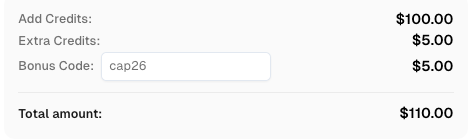
Use bonus code CAP26 when topping up your CapSolver account to get an extra 5% bonus on every recharge — with no limits.
Redeem it now in your CapSolver Dashboard
CloakBrowser and CapSolver solve different parts of a browser automation stack. CloakBrowser manages the browser environment; CapSolver returns results for supported CAPTCHA tasks in authorized workflows.
The separate CloakBrowser CAPTCHA Solver integration guide contains the Python setup, reCAPTCHA v2 token flow, image-recognition example, troubleshooting steps, and end-to-end Playwright submission logic. Keeping those implementation details in the integration tutorial allows this review to remain focused on whether CloakBrowser itself fits your browser architecture.
Q: What is CloakBrowser used for?
CloakBrowser is used to run Playwright or Puppeteer browser automation through a customized Chromium binary on local, container, server, or managed infrastructure.
Q: Is CloakBrowser open source?
CloakBrowser's wrapper code is MIT-licensed, but its compiled Chromium binary has a separate proprietary license with version, redistribution, and OEM/SaaS conditions.
Q: Is CloakBrowser free?
CloakBrowser offers a free entry point with one concurrent session, while paid plans increase concurrency and provide access and support under the current subscription terms. Pricing and version availability can change.
Q: Does CloakBrowser work with Playwright?
Yes. CloakBrowser's official Python and JavaScript documentation exposes Playwright-compatible launchers and returns standard Playwright browser objects or contexts.
Q: Does CloakBrowser solve CAPTCHAs?
No. CloakBrowser manages browser execution and related environment signals; a separate CAPTCHA-solving service is required when an authorized workflow encounters a supported challenge.
Q: Can CloakBrowser be embedded in a SaaS product?
Not under the standard binary terms when customers receive browser functionality or control. CloakHQ's current license says those uses require a separate OEM/SaaS agreement.
Q: What is the main CloakBrowser tradeoff?
The main tradeoff is control versus operational responsibility: self-hosting keeps browser sessions in your environment, but your team must manage infrastructure, updates, reliability, and licensing fit.
Lucas Mitchell
Automation Engineer
Helping browser automation recover and continue.
ABOUT THE AUTHOR
Estimate CAPTCHA solving costs in Browser Use by separating agent runs, challenge types, billable solves, retries, and verified outcomes from browser costs.

Set up CapSolver MCP in Claude Code, check the available CAPTCHA tools, and choose token or page solving for a supported, authorized browser task.