🎉NEWCapSolver for AI agents-MCP, agent tools, and SDK integrations

Adélia Cruz
MCP Integration Engineer
Published Jun 25, 2026
Updated Jun 24, 2026 · min read
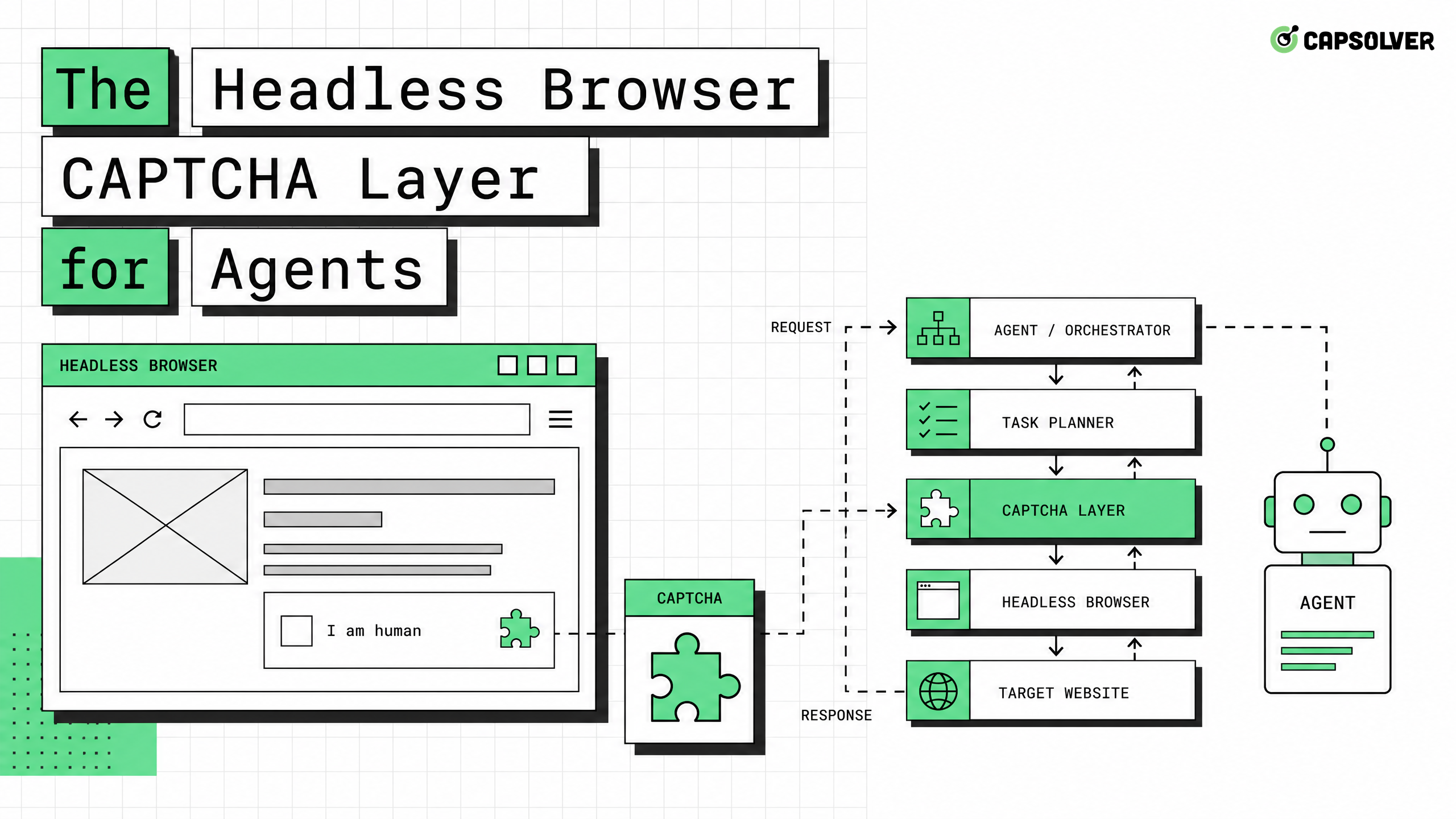
AI agents are increasingly vital for automating complex web tasks, from data scraping to intelligent process automation. However, their interaction with the web is often hindered by sophisticated bot detection mechanisms, primarily CAPTCHAs. Overcoming these challenges is crucial for the continuous operation of autonomous agents. This article delves into the critical role of the headless browser CAPTCHA layer, a specialized component designed to enable AI agents to navigate the web effectively by solving CAPTCHAs programmatically. By integrating advanced CAPTCHA-solving capabilities, agents can maintain their operational flow, ensuring uninterrupted access to necessary web resources. For developers and businesses deploying AI agents, understanding and implementing a robust CAPTCHA layer is not merely an advantage but a necessity for achieving reliable and scalable web automation. CapSolver offers a powerful solution to these challenges, providing an agent-ready CAPTCHA solving infrastructure.
Headless browsers are web browsers without a graphical user interface, making them ideal for automated control by programs. They execute web pages in a real browser environment, allowing AI agents to perform actions like clicking buttons, filling forms, and extracting data as a human user would, but at scale and without visual overhead. This capability is fundamental for web scraping, automated testing, and various forms of robotic process automation (RPA). However, the very nature of headless browsing, while efficient, often triggers bot detection systems, leading to CAPTCHA challenges that halt automation processes. The ability of AI agents to effectively use headless browsers hinges on their capacity to handle these interruptions gracefully.
AI agents are evolving rapidly, moving beyond simple scripts to perform complex, goal-oriented tasks. These agents often require extensive interaction with dynamic web content, necessitating tools that can mimic human browsing behavior. Headless browsers provide this essential interaction layer, allowing agents to render JavaScript, manage cookies, and handle AJAX requests, which are common in modern web applications. Without a robust headless browser setup, AI agents would be severely limited in their ability to engage with the internet's vast resources. For more on how AI agents interact with the web, consider exploring the web automation layer for AI agents explained.
CAPTCHAs (Completely Automated Public Turing test to tell Computers and Humans Apart) are designed to prevent automated programs from accessing web services. They come in various forms, including image recognition, text distortion, and interactive puzzles like reCAPTCHA v2/v3 and Cloudflare Turnstile. For AI agents, encountering a CAPTCHA means a direct interruption to their workflow, requiring a mechanism to solve it before proceeding. Traditional methods of resolving CAPTCHAs often involve manual intervention or simple rule-based systems, which are ineffective against modern, adaptive CAPTCHA technologies. The challenge lies in developing a CAPTCHA layer that can reliably and efficiently solve these tests without human input.
Different CAPTCHA types present unique hurdles. Image-based CAPTCHAs require advanced computer vision, while reCAPTCHA v3 operates silently in the background, assessing user behavior to determine bot likelihood. Cloudflare Turnstile, similarly, uses non-intrusive challenges. The impact on AI agents is significant: a failed CAPTCHA attempt can lead to IP blocking, rate limiting, or even permanent bans, jeopardizing the entire automation process. Therefore, a comprehensive CAPTCHA solving API is indispensable for maintaining agent functionality and resilience. You can learn more about choosing a CAPTCHA solver for agent infrastructure.
Redeem Your CapSolver Bonus Code
Boost your automation budget instantly!
Use bonus code CAP26 when topping up your CapSolver account to get an extra 5% bonus on every recharge — with no limits.
Redeem it now in your CapSolver Dashboard
The headless browser CAPTCHA layer is an architectural component that integrates CAPTCHA-solving services directly into the agent's automation stack. This layer intercepts CAPTCHA challenges, sends them to a specialized solver, and then injects the solution back into the headless browser session, allowing the agent to continue its task. This integration requires careful design to ensure minimal latency and high success rates. Key considerations include choosing a reliable CAPTCHA solving API, implementing robust error handling, and optimizing the interaction between the headless browser and the solver. Effective implementation of this layer is crucial for scalable CAPTCHA solving for production agents.
Integrating a CAPTCHA layer involves several strategies. One common approach is to use a proxy that routes CAPTCHA requests to a solving service. Another involves direct API integration within the agent's code, where the agent detects a CAPTCHA, calls the API, and then submits the token. Best practices include using a service that supports various CAPTCHA types, implementing retries with exponential backoff, and monitoring success rates. The goal is to create a smooth experience where CAPTCHAs are handled as an intrinsic part of the web interaction, rather than an external obstacle. For more details on this, refer to the article on adding CAPTCHA handling middleware to your agent.
CapSolver provides a comprehensive and efficient solution for integrating a CAPTCHA layer into headless browser automation. Its API supports a wide range of CAPTCHA types, including reCAPTCHA, and Cloudflare Turnstile, making it a versatile choice for diverse web environments. By integrating CapSolver, AI agents can overcome bot detection mechanisms with high accuracy and speed, significantly improving their operational efficiency and reliability. The service is designed for scalability, allowing agents to handle a large volume of CAPTCHA challenges without compromising performance. This makes CapSolver an ideal partner for any organization looking to enhance their web automation capabilities.
CapSolver offers several advantages for AI agents. Its advanced solving algorithms ensure high success rates, minimizing interruptions to automation workflows. The API is easy to integrate, providing developers with clear documentation and support. Furthermore, CapSolver's infrastructure is built for performance, offering fast response times crucial for time-sensitive tasks. By offloading the complex task of CAPTCHA solving to a specialized service, developers can focus on core agent logic, knowing that their automation processes are protected against bot detection. For a deeper dive into how CapSolver helps, check out the best CAPTCHA API for AI agents in 2026.
The landscape of bot detection and web automation is constantly evolving. Research from institutions like the University of California, Berkeley, often highlights the arms race between bot developers and bot protection systems, emphasizing the need for adaptive solutions. Industry reports, such as those from Akamai Technologies, frequently detail the increasing sophistication of bot attacks and the countermeasures employed by websites. These external sources underscore the importance of robust CAPTCHA-solving layers for maintaining legitimate automation. For instance, a study published by Imperva reveals the growing percentage of bad bot traffic on the internet, reinforcing the necessity of effective bot protection. Additionally, the official Google reCAPTCHA documentation provides insights into how behavioral analysis is used to distinguish humans from bots, which is critical for understanding how to design resilient agents. The OWASP Automated Threat Handbook also offers valuable guidance on mitigating automated threats, including those posed by headless browsers.
The headless browser CAPTCHA layer is an indispensable component for AI agents operating in today's complex web environment. It enables agents to overcome bot detection mechanisms and CAPTCHA challenges, ensuring uninterrupted and efficient web automation. By carefully selecting and integrating a reliable CAPTCHA-solving service, developers can significantly enhance the resilience and performance of their AI agents. As web defenses continue to evolve, the importance of a sophisticated CAPTCHA layer will only grow. Empower your AI agents with the ability to navigate the web reliably and efficiently. Explore CapSolver's advanced CAPTCHA-solving solutions today and elevate your web automation capabilities.
What is a headless browser?
A headless browser is a web browser without a graphical user interface, used for automated control by programs to interact with web pages as a human would, but without visual rendering.
Why do AI agents need a CAPTCHA layer?
AI agents need a CAPTCHA layer to automatically solve CAPTCHA challenges encountered during web automation, preventing interruptions and ensuring continuous operation against bot detection systems.
How does CapSolver help with headless browser automation?
CapSolver provides an API that integrates with headless browsers to automatically solve various CAPTCHA types, allowing AI agents to resolve bot detection challenges and perform web tasks efficiently.
What types of CAPTCHAs can CapSolver solve?
CapSolver supports a wide range of CAPTCHA types, including reCAPTCHA v2/v3, Cloudflare Turnstile, and many others, offering a versatile solution for different web environments.
Is it legal to use CAPTCHA-solving services for automation?
The legality of using CAPTCHA-solving services depends on the terms of service of the websites being accessed and local regulations. It is crucial to ensure compliance and use such services responsibly and ethically, respecting website policies and data privacy.
Adélia Cruz
MCP Integration Engineer
Making CapSolver tools accessible through MCP.
ABOUT THE AUTHOR
Fix CAPTCHA handling that works locally but fails in a cloud AI agent. Compare browser setup, dependencies, credentials, network access, and page state.

Estimate CAPTCHA solving costs in Browser Use by separating agent runs, challenge types, billable solves, retries, and verified outcomes from browser costs.