🎉NEWCapSolver for AI agents-MCP, agent tools, and SDK integrations

Ethan Collins
AI Agent Workflow Engineer
Published Aug 11, 2026
Updated Aug 10, 2026 · min read
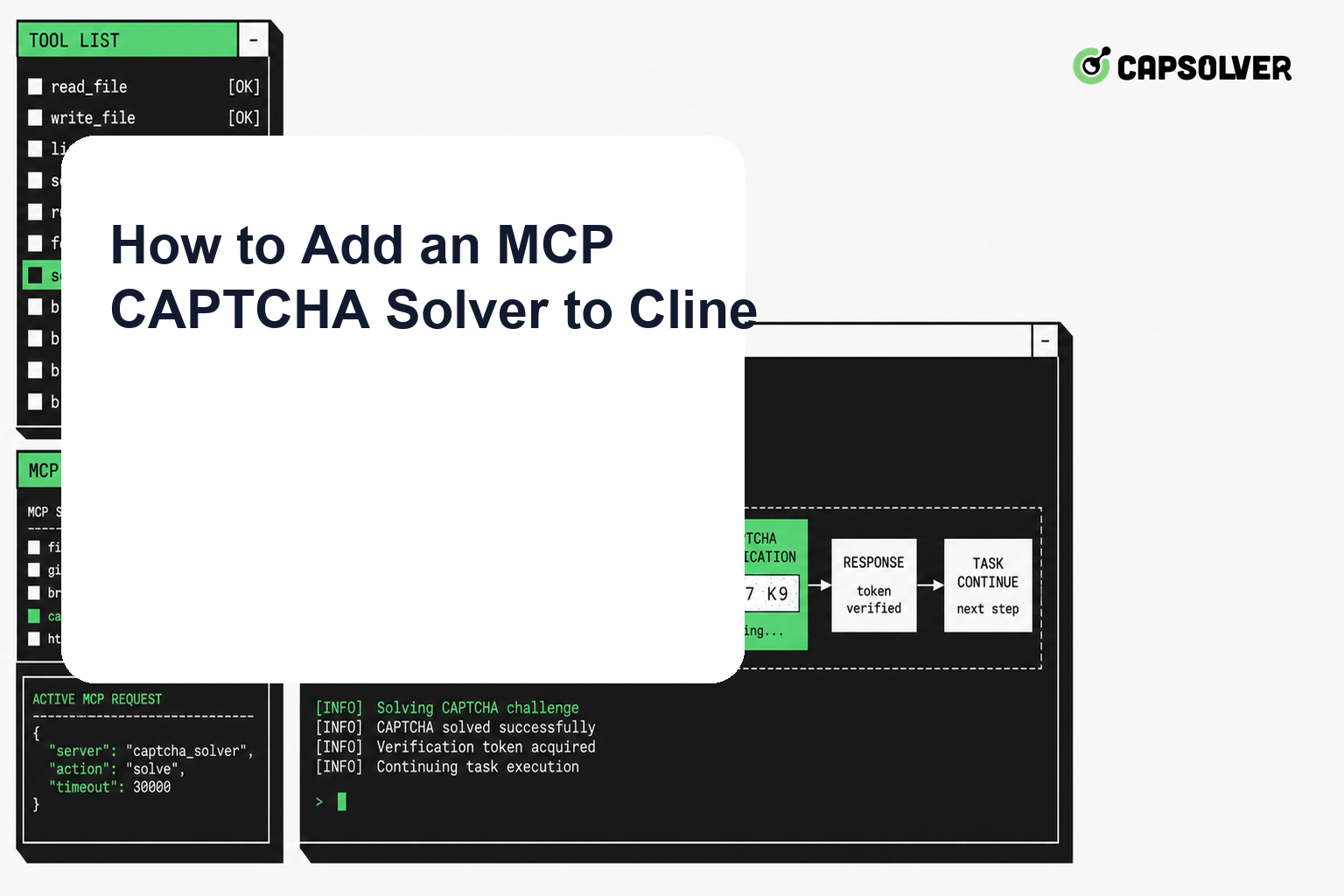
A Cline MCP CAPTCHA solver gives a coding agent a controlled way to recover an authorized browser workflow from a supported verification challenge. CapSolver exposes the solving capability, Cline selects the relevant MCP tool, and trusted application code keeps authority over credentials, browser state, host scope, and completion checks. That division prevents a CAPTCHA tool from becoming a general browsing permission. This tutorial connects the documented capsolver-mcp server, verifies its tool registry, and tests a bounded staging workflow. The approach applies to lawful QA, RPA, and user-directed automation. It does not grant permission to reach private, restricted, sensitive, or unauthorized data, and it should stop instead of retrying when the task leaves its approved scope.
Cline acts as the MCP client and launches or connects to the CapSolver server. The server publishes tool schemas; Cline can inspect those schemas and decide when a tool matches the current task. The official MCP Service guide lists the supported tool surface, including solve_captcha, detect_captchas, get_balance, and get_supported_captchas.
The CapSolver agent overview positions the service as a recovery layer in an existing browser stack. It does not replace Cline, the browser, or your application acceptance logic.
Write the boundary before installing anything. A useful task contract contains:
{
  "approved_host": "staging.example.org",
  "purpose": "authorized-login-regression",
  "max_challenge_attempts": 1,
  "expected_result": "account-page-visible",
  "on_scope_change": "REVIEW"
}
This file is application policy, not a CapSolver API payload. It keeps Cline from expanding the task when a redirect, repeated widget, or unknown page appears. The Model Context Protocol architecture explains why tool servers and model clients remain separate trust boundaries. The Cline MCP server configuration should be checked for the current client syntax, and Playwright web assertions provide a practical way to define the final browser outcome.
Install the CapSolver MCP package in a dedicated Python environment:
python -m venv .venv
source .venv/bin/activate
pip install git+https://github.com/capsolver-ai/capsolver-mcp.git
Keep the API key in the environment:
export CAPSOLVER_API_KEY="YOUR_API_KEY"Add a CapSolver server entry through Cline's MCP settings. Confirm the current executable name after installation instead of assuming a global binary:
{
  "mcpServers": {
    "capsolver": {
      "command": "capsolver-mcp",
      "env": {
        "CAPSOLVER_API_KEY": "${CAPSOLVER_API_KEY}"
      }
    }
  }
}
Restart or reload Cline's MCP servers. Ask Cline to list available CapSolver tools. The names must match the official server guide before a live browser test proceeds.
Redeem Your CapSolver Bonus Code
Boost your automation budget instantly!
Use bonus code CAP26 when topping up your CapSolver account to get an extra 5% bonus on every recharge — with no limits.
Redeem it now in your CapSolver Dashboard
Call get_supported_captchas first. Then call get_balance to confirm authentication. These read-only checks establish that the Cline MCP CAPTCHA solver is reachable before a target workflow is involved.
For the first live run, use a staging page you control. Let Cline detect the supported challenge, call the solver once, return control to the browser, and assert the expected application state. A token or successful tool response is intermediate evidence only. The acceptance test must be something the application can observe, such as a known element becoming visible or a test-only route completing.
Use the Core SDK API map if application code needs direct detect, get_captcha_info, solve, or solve_on_page control. Use Agent Tools when you need framework tool schemas outside MCP.
Missing tools usually indicate a server startup or configuration problem. Authentication errors point to environment propagation or an invalid key. A solved challenge followed by an unchanged page points to browser-state or acceptance logic. Do not convert those failures into unlimited attempts. Record the tool name, challenge type, host, request identifier when available, and terminal result, then move to review.
A Cline MCP CAPTCHA solver should remain a small, reviewable capability inside a larger authorized task. Verify the registry, protect the key, use a staging handshake, and stop on repeated or ambiguous states. When those controls are in place, CapSolver can provide the CAPTCHA recovery step while Cline and your test harness keep control of the workflow.
Q: Does Cline need direct access to the CapSolver API key?
Cline's MCP server process needs the key, but the model prompt and project files should not contain it.
Q: Which CapSolver MCP tool should be tested first?
Test get_supported_captchas first because it verifies discovery without interacting with a target page.
Q: Can Cline retry a challenge automatically?
Cline should use a bounded attempt budget and stop when the same challenge repeats or task scope changes.
Q: How do you confirm the workflow succeeded?
Confirm the original browser task reached its expected application state rather than treating a tool response as final success.
Ethan Collins
AI Agent Workflow Engineer
Building clearer handoffs between AI agents and tools.
ABOUT THE AUTHOR
Estimate CAPTCHA solving costs in Browser Use by separating agent runs, challenge types, billable solves, retries, and verified outcomes from browser costs.

Set up CapSolver MCP in Claude Code, check the available CAPTCHA tools, and choose token or page solving for a supported, authorized browser task.