🎉NEWCapSolver for AI agents-MCP, agent tools, and SDK integrations

Lucas Mitchell
Automation Engineer
Published Jan 28, 2025
Updated Jan 09, 2026 · min read
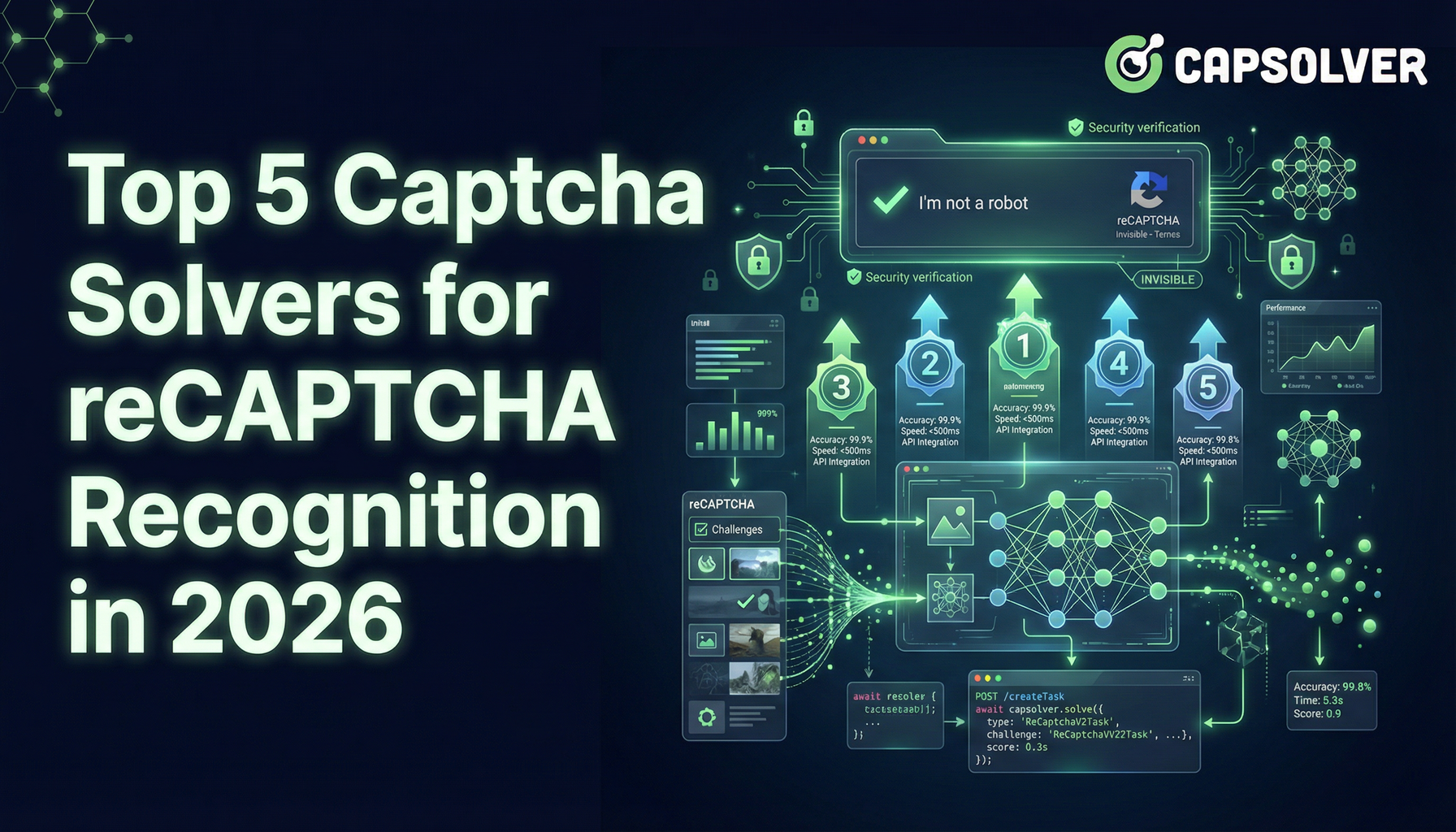
Let’s face it: CAPTCHAs are the digital equivalent of a locked door when you’re trying to get work done. Whether you’re scraping data for market research, testing a new app, or just tired of clicking traffic lights, these “Are you human?” tests have gotten crazy sophisticated by 2026. But here’s the good news—CAPTCHA solvers are evolving too. Let’s cut through the noise and explore the top 5 tools that’ll save your sanity (and your deadlines).
CAPTCHA stands for "Completely Automated Public Turing test to tell Computers and Humans Apart." These tests are designed to prevent automated bots from accessing or abusing online services by presenting challenges that are easy for humans but difficult for machines to solve. Common types include distorted text recognition, image selection tasks, and behavioral analysis.
CAPTCHAs have evolved significantly over the years, taking on a variety of forms to challenge bots and protect online platforms. Today, CAPTCHAs come in various formats, each designed to address specific security needs. Some of the most common types include:
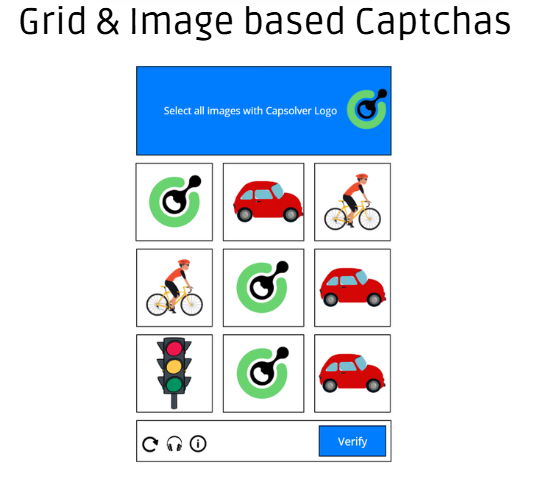
Image-Based CAPTCHAs: These CAPTCHAs ask users to identify objects or patterns within images, such as selecting all squares containing a specific item (e.g., traffic lights, crosswalks, or cars). Their reliance on visual recognition makes them challenging for automated bots to solve.
Grid Method CAPTCHAs: Often seen in combination with image CAPTCHAs, this type presents users with a grid of images and requires them to select tiles that meet a specific condition. For example, users may be prompted to pick all tiles showing a bridge or a storefront.
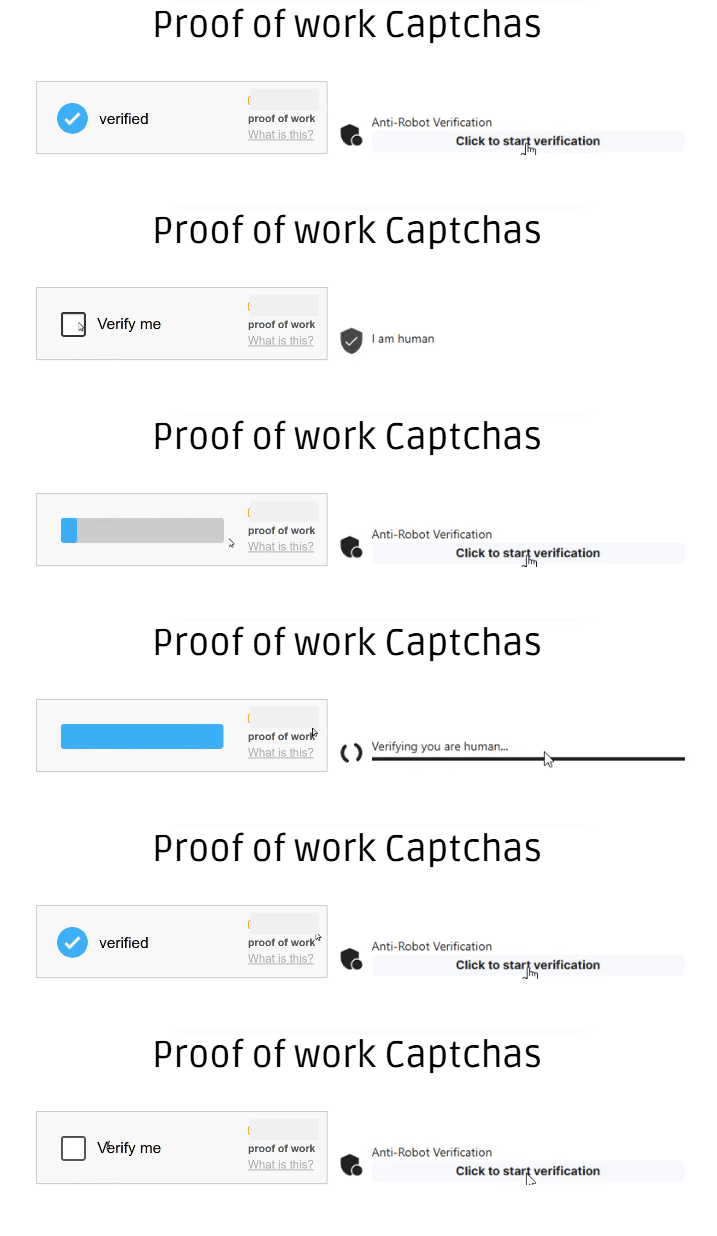
Proof-of-Work CAPTCHAs: These CAPTCHAs focus on computational power rather than user interaction. They require bots to solve complex mathematical puzzles, which consume resources and discourage automated abuse. These are becoming more popular in blockchain and decentralized platforms.
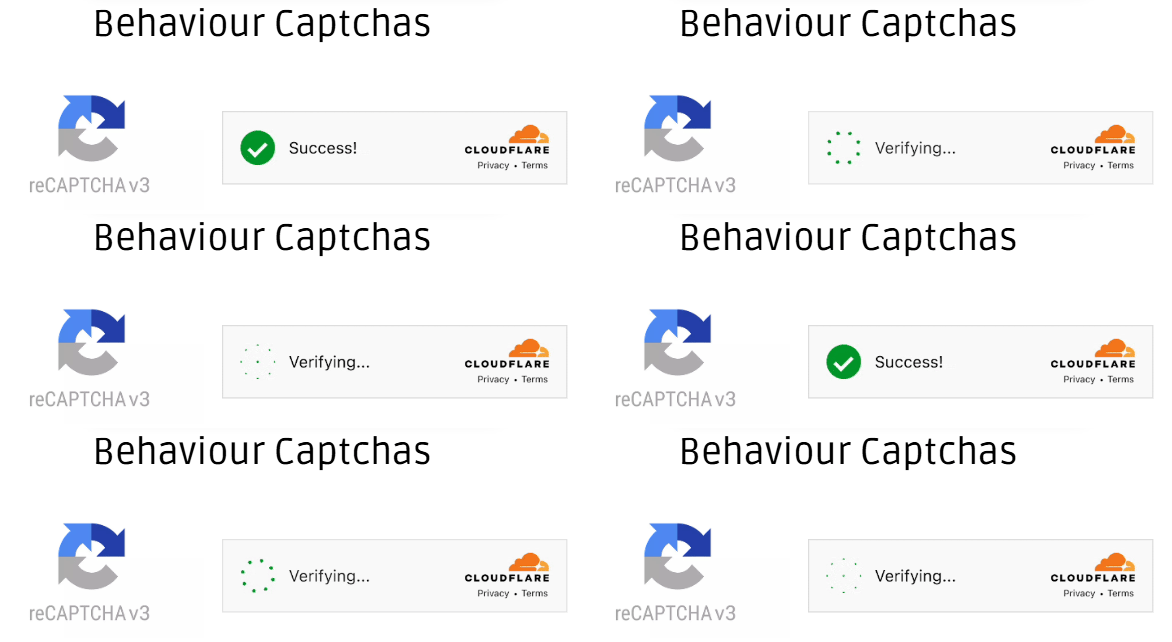
Behaviour CAPTCHAs: Simplified CAPTCHAs, such as Google’s reCAPTCHA v3, analyze a user’s behavior to determine if they are human. Users often just need to click a single checkbox (“I’m not a robot”), with the system verifying them based on behavioral data and background checks.
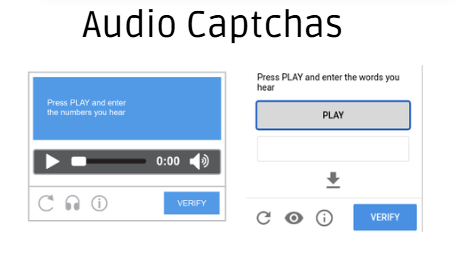
Audio CAPTCHAs: Designed for accessibility, these CAPTCHAs present users with a distorted audio clip that they must transcribe. This type ensures visually impaired users can still complete the verification process.
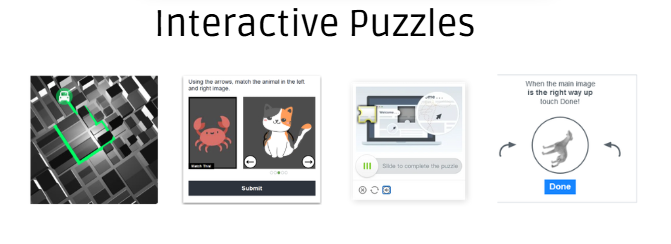
Interactive Puzzles: These are more engaging CAPTCHAs that may involve dragging and dropping items, solving simple puzzles, or rotating images to the correct orientation. They aim to provide a better user experience while maintaining security.
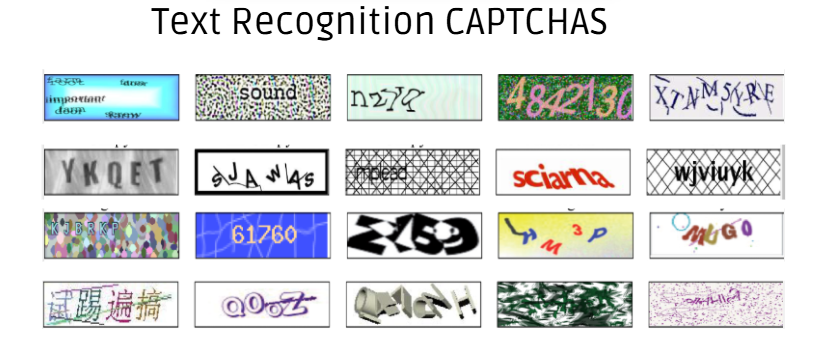
Text Recognition CAPTCHAs: These classic CAPTCHAs require users to type in distorted or obscured text displayed in an image. While less common today, they were the original CAPTCHA format and are still used on some platforms.
These diverse types of CAPTCHAs aim to balance user accessibility with robust security. However, as CAPTCHAs become more sophisticated, so too do CAPTCHA solvers like CapSolver, which employ cutting-edge AI and machine learning to navigate these challenges effectively. Whether it’s decoding a complex image-based CAPTCHA, solving proof-of-work challenges, or responding to one-click verifications, modern solvers provide fast, reliable, and cost-effective solutions for all CAPTCHA formats.
So the question is...
You know the drill: “Select all squares with bicycles”… only to fail and restart. CAPTCHAs exist to block bots, but they often feel like they’re blocking us. For businesses, this is more than a nuisance—it’s a roadblock.
While CAPTCHAs play a vital role in maintaining internet security, they can hinder legitimate activities such as:
But, how captchas solvers works?
Modern CAPTCHAs come in endless flavors—image grids, audio clips, even behavior tracking. Solvers counter these with two main strategies:
Human Solvers: Real people solve CAPTCHAs manually. Pros? High accuracy. Cons? Slow and pricey for large-scale projects.
AI-Powered Tools: Machine learning models crack CAPTCHAs in seconds. Think of it like teaching a robot to recognize blurry text or hidden stop signs. Fast and scalable, but some struggle with trickier puzzles.

In 2025, several CAPTCHA solvers have distinguished themselves in terms of efficiency, speed, and accuracy. Below is a comparison of the top five services:
CapSolver
9kw
9kw offers a community-driven approach to CAPTCHA solving, allowing users to earn credits by solving CAPTCHAs, which can then be used to have their own CAPTCHAs solved.
BestCaptchaSolver
ImageTyperz
AZcaptcha
As AI gets smarter, so do CAPTCHAs. But tools like CapSolver prove that automation doesn’t have to hit a wall. Whether you’re building the next big app or just tired of verifying your humanity, investing in a good solver isn’t just smart—it’s essential in 2026.
Ready to ditch CAPTCHA headaches? Give Capsolver a spin—your future self will thank you
CAPTCHAs are designed to distinguish between human users and automated bots to prevent abuse such as spam, credential stuffing, scraping, and denial-of-service attacks.
As bots and automation tools improve, CAPTCHA providers continuously upgrade their systems using AI, behavioral tracking, and fingerprinting techniques to stay ahead in the security arms race.
For large-scale or time-sensitive tasks, AI solvers are generally superior due to speed and scalability. Human solvers may still perform better on rare or highly complex CAPTCHA types but are slower and less predictable.
Only some advanced solvers can. reCAPTCHA v3 and Enterprise rely heavily on behavioral scoring rather than visible challenges, requiring sophisticated AI models and browser signal simulation.
Legality depends on jurisdiction and the target website’s terms of service. CAPTCHA solvers are commonly used for automation testing, data collection, and research, but users should ensure compliance with applicable laws and site policies.
Image-based reCAPTCHAs require advanced visual recognition models trained on large datasets. Solvers without specialized AI models often struggle or rely solely on human labor.
Key factors include CAPTCHA type support, solving speed, accuracy, pricing, API stability, and whether AI-based recognition is available for modern CAPTCHA systems.
Lucas Mitchell
Automation Engineer
Helping browser automation recover and continue.
ABOUT THE AUTHOR
Understand reCAPTCHA v3 score range (0.0 to 1.0), its meaning, and how to improve your score. Learn how to handle low scores and optimize user experience.

Facing "reCAPTCHA Invalid Site Key" or "invalid reCAPTCHA token" errors? Discover common causes, step-by-step fixes, and troubleshooting tips to resolve reCAPTCHA verification failed issues. Learn how to fix reCAPTCHA verification failed please try again.