🎉NEWCapSolver for AI agents-MCP, agent tools, and SDK integrations

Ethan Collins
AI Agent Workflow Engineer
Published Aug 20, 2026
Updated Aug 20, 2026 · min read
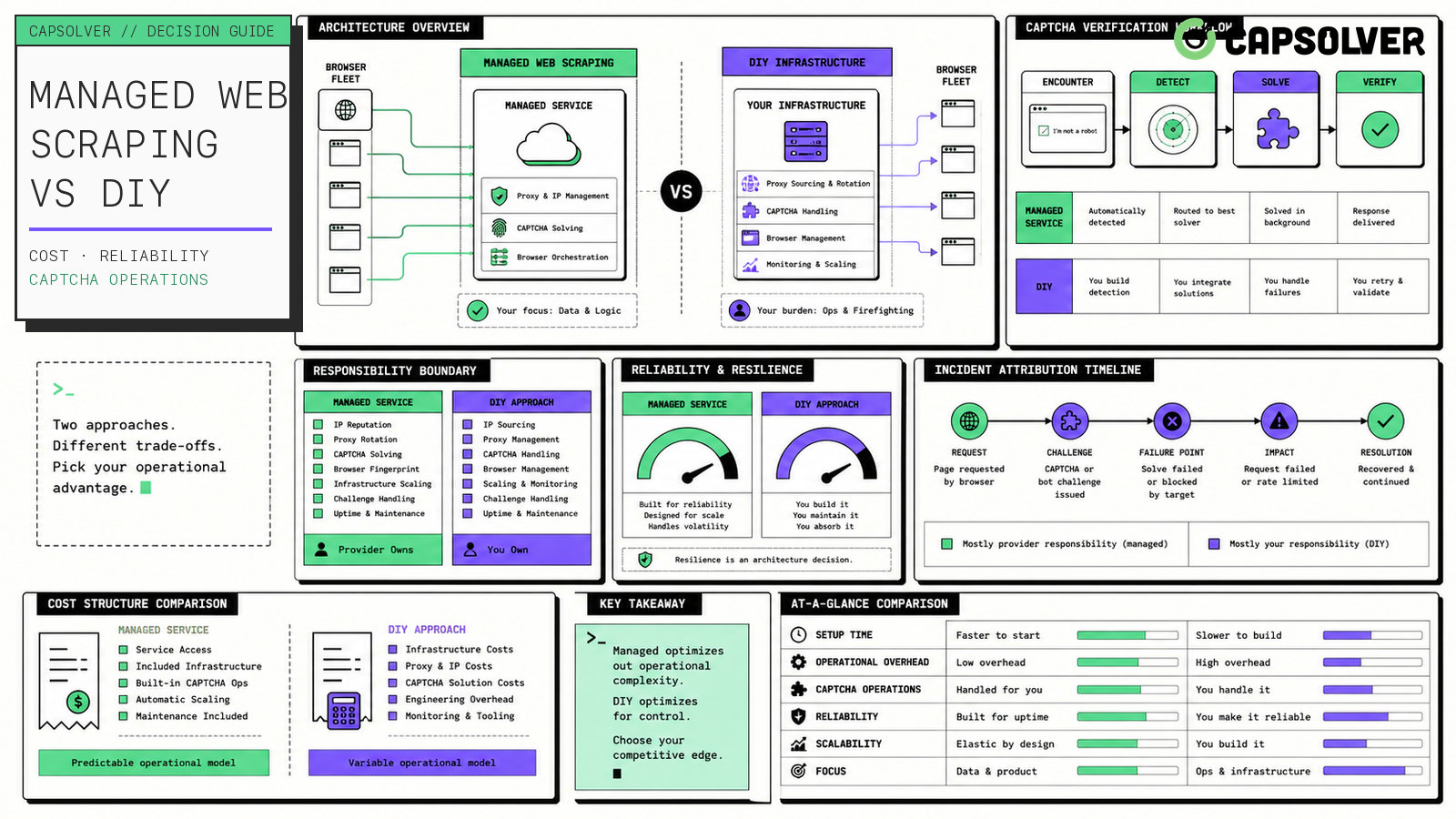
The managed web scraping vs DIY decision is not a contest between a subscription and a few scripts. It is a decision about who owns production reliability, failure diagnosis, browser sessions, CAPTCHA operations, data acceptance, and lawful access controls. Managed delivery can reduce infrastructure work, while DIY can preserve control over unusual workflows. Neither option removes the need for authorization, monitoring, or clear stop conditions. CapSolver fits into either model as a bounded CAPTCHA capability: a managed provider may integrate it, or an internal platform team may call it within an approved workflow. The right choice depends on evidence from your targets and service requirements, not unsupported ROI claims or universal benchmarks.
Managed web scraping vs DIY describes two ends of an ownership spectrum. The technical components may look similar, but responsibility moves between teams.
DIY means your organization designs and runs the extraction pipeline. It owns target configuration, request scheduling, parsers, browser automation, proxy policy, CAPTCHA integration, storage, monitoring, data validation, incident response, and changes caused by target-site updates. A DIY team may still buy proxies or a CAPTCHA API. “DIY” does not mean every component must be invented internally; it means the organization remains the system operator and integrator.
Managed web scraping means a provider accepts responsibility for an agreed portion of the pipeline. That may range from returning rendered HTML through an API to delivering validated records on a schedule. The short web scraping and CAPTCHA service overview explains why teams often abstract proxies, JavaScript rendering, and verification challenges. A real managed contract, however, must say exactly where that abstraction ends.
Many production systems are hybrid. An internal team may own source authorization, schedules, schema, and data quality while using a hosted browser fleet, proxy network, or CAPTCHA service. Another team may use a managed data provider for standard targets and keep specialized sources in-house.
This middle ground matters because build vs buy scraping is rarely binary. A team can outsource operations that are expensive to maintain without giving up its acceptance criteria or policy controls. The key is to document each boundary so that a failed run has one clear owner.
A credible managed web scraping vs DIY comparison uses a cost ledger built from your own workload. Published salary estimates, success rates, and request prices change by region, target, volume, and contract. Treat outside figures as hypotheses, not as your business case.
Scraping infrastructure cost starts before the first successful record and continues after launch. A DIY ledger should include:
Do not count every failed request as the same cost. A transient network error, a parser regression, an expired session, a repeated CAPTCHA, and a target-policy stop need different responses. Combining them into one “failure rate” hides the work that drives cost.
A managed fee is only one line item. Add integration engineering, contract review, schema mapping, provider monitoring, escalation time, overage rules, data egress, reruns, and internal acceptance testing. If the provider returns raw pages rather than validated records, your team still owns parsing and data quality.
The calculation can remain simple:
DIY total cost = platform work + run cost + incident work + validation work + compliance work
Managed total cost = provider charges + integration work + oversight + validation work + exception handling
Use observed hours and invoices for each term. Run the calculation separately for a stable static target, a JavaScript-heavy target, and a session-sensitive target. One blended average can conceal the target that consumes most operating time.
Reliability in managed web scraping vs DIY should be measured at the business boundary. An HTTP 200 response can contain a challenge page, login screen, empty shell, consent interstitial, or changed layout. A CAPTCHA provider can return a result while the target workflow still rejects it. A parser can complete while silently dropping required fields.
Define success as accepted data delivered within the required freshness window. Useful indicators include:
Retries should respect protocol evidence. The HTTP Retry-After semantics define how a server can tell a client when to make a follow-up request. A reliable system records this evidence and waits when appropriate. It does not turn every non-success response into immediate parallel retries.
The infrastructure scaling checklist is useful for capacity planning, but capacity is not permission. More workers, browsers, or proxies should never override an authorization boundary or a target stop signal.
CAPTCHA operations deserve their own owner and telemetry. Treating a challenge as a generic fetch failure makes managed web scraping vs DIY look cheaper and simpler than it is.
A controlled workflow separates these states:
CapSolver’s official CAPTCHA task-type model distinguishes recognition tasks from token-oriented tasks and documents their different result flows. That distinction should remain visible in your operational model. A managed provider should disclose how it classifies challenges; a DIY team should preserve the same classification in logs and metrics.
Challenge recovery is often session-sensitive. Browser state, cookies, storage, user agent, proxy identity, target URL, and timing can all belong to one execution context. Playwright’s BrowserContext isolation model shows that cookies, local storage, and session storage belong to isolated contexts. Replacing a context midway through a challenge can turn a valid solve into an application-level failure.
The proxy and CAPTCHA relationship also needs clear ownership. A proxy change is not a universal recovery action. CapSolver’s current proxy parameter guidance explains that some task scenarios use a client proxy and that task documentation determines the required form. The operator must keep the documented network and browser context coherent.
Stop conditions protect both reliability and responsible use. A run should stop when:
The practical web scraping CAPTCHA handling workflow can inform implementation, but the attempt budget and authorization gate still belong to the system operator.
Redeem Your CapSolver Bonus Code
Boost your automation budget instantly!
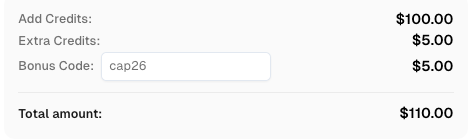
Use bonus code CAP26 when topping up your CapSolver account to get an extra 5% bonus on every recharge — with no limits.
Redeem it now in your CapSolver Dashboard
The best managed web scraping vs DIY comparison is a responsibility map, not a marketing checklist.
| Capability | DIY owner | Managed owner | Customer responsibility that remains |
|---|---|---|---|
| Source authorization | Customer | Customer | Approve sources, accounts, actions, and data scope |
| Parser and target maintenance | Internal engineering | Provider within contract | Define expected fields and approve changes |
| Browser fleet | Internal platform team | Provider if included | Set concurrency, geography, and policy requirements |
| Proxy and session policy | Internal platform team | Provider if included | Approve network policy and prohibited targets |
| CAPTCHA operations | Internal integration team or specialist API | Provider if explicitly included | Define authorization, attempt budgets, and acceptance evidence |
| Failure attribution | Internal operations | Provider for its boundary | Maintain end-to-end correlation and escalation rules |
| Data validation | Customer | Provider only if contracted | Define schema, completeness, freshness, and semantic checks |
| Incident response | Internal on-call | Provider for contracted service | Coordinate downstream impact and final recovery decision |
| Compliance and platform policy | Customer | Provider supports evidence | Retain accountability and legal review |
A contract that says “managed” but does not identify these owners is incomplete. Ask which failures are provider incidents, which are target exceptions, which are customer configuration errors, and what evidence accompanies each category.
Failure attribution is where many scraping programs lose time. The browser team sees a challenge. The proxy team sees a healthy endpoint. The parser team sees empty HTML. The provider reports a completed request. Without a shared event model, every incident begins with reconstruction.
The OWASP application logging guidance recommends recording enough event attributes for monitoring and analysis while excluding or protecting tokens, session identifiers, credentials, and sensitive personal data. For scraping operations, one correlation record can include:
The following YAML is an internal control example, not a CapSolver API request:
workflow: public-catalog-monitor
authorization:
  allowed_domains:
    - example.com
  allowed_actions:
    - read_public_product_pages
session_policy:
  preserve_browser_context: true
  preserve_proxy_identity_during_challenge: true
captcha_operations:
  max_solve_attempts: 1
  max_application_retries: 1
  require_post_solve_content_check: true
stop_when:
  - authorization_scope_changes
  - unsupported_challenge
  - repeated_challenge_after_verification
  - private_or_sensitive_data_boundary
evidence:
  record:
    - run_id
    - target_id
    - challenge_class
    - attempt_count
    - final_state
  never_record:
    - raw_solution_token
    - cookies
    - credentials
The input is the approved workflow and target policy. The output is a small set of auditable states. The stopping rules prevent an automation loop from converting uncertainty into repeated traffic.
DIY can be the better managed web scraping vs DIY choice when extraction logic is a core product capability, targets require unusual workflow control, or internal governance prohibits third-party processing. It also makes sense for a small, well-defined prototype where the team is explicitly testing data value rather than promising production reliability.
Choose DIY only after assigning real owners for browser fleet maintenance, CAPTCHA operations, incident response, data validation, and compliance. Control is valuable when the organization can operate what it controls.
Evidence that supports DIY includes stable targets, low operational variance, an existing platform team, mature observability, tested recovery states, and a clear ability to pause work when policies or target behavior change.
Managed delivery can be the better choice when the business values validated data more than infrastructure control, needs many targets with recurring maintenance, or cannot staff browser and extraction operations. It is also useful when requirements are stable enough to express as a contract: sources, fields, schedule, freshness, quality thresholds, escalation paths, and prohibited actions.
Do not accept “we handle everything” as sufficient evidence. Ask for the provider’s failure taxonomy, retry policy, CAPTCHA responsibility, session model, incident process, data-retention rules, change-management process, and boundaries for unsupported targets. Confirm which metrics are measured at request level and which are measured at accepted-record level.
A hybrid model can preserve the business’s most important controls while delegating specialized operations. The customer can own authorization, workflow state, schema, and final data acceptance. A provider can run browsers or target adapters. CapSolver can provide a bounded CAPTCHA capability within the approved execution path.
This arrangement is especially useful when a team wants to keep source policy and domain logic close to the product but does not want to build every layer of CAPTCHA or browser infrastructure. The fully managed service concept is therefore only one option; the more precise question is which operational responsibility should move outside the organization.
Use the same process for every managed web scraping vs DIY review:
This process avoids a false universal answer. The decision can change as targets, policies, volumes, and internal capabilities change.
Managed web scraping vs DIY does not change the need for lawful, reasonable, responsible, and user-authorized automation. A provider contract does not grant permission to access private, restricted, sensitive, or unauthorized data. Your organization must still evaluate applicable law, terms, platform policies, account permissions, rate expectations, and data-protection duties.
The Robots Exclusion Protocol explicitly states that crawler rules are not a form of access authorization. Treat robots.txt as one machine-readable signal, not as the complete permission model. If authorization is unclear, stop and obtain review before continuing.
Responsible operation also means minimizing collection, protecting credentials, limiting retention, and preventing repeated attempts after a clear stop signal. These controls should be testable in DIY code and written into managed-service requirements.
The managed web scraping vs DIY choice should follow workload evidence and an explicit responsibility map. DIY offers control but makes your team accountable for browsers, proxies, CAPTCHA operations, validation, and incidents. Managed delivery can shift much of that work, yet authorization, acceptance criteria, oversight, and final accountability remain with the customer. A hybrid model is often the most precise answer when specialized operations can be delegated behind firm policy and stop controls. If CAPTCHA challenges are part of your approved workflow, evaluate CapSolver as a bounded component whose inputs, attempts, session context, outputs, and verification states remain observable.
No. Cost depends on target complexity, volume, maintenance frequency, internal staffing, validation requirements, provider pricing, and incident workload. Compare both options with observed costs from a representative pilot rather than universal ROI figures.
No. A provider can support controls and evidence, but the customer still owns source authorization, data scope, acceptable use, vendor oversight, and legal review. Technical capability or a commercial contract does not grant access to restricted data.
Application-level acceptance is more useful than provider completion alone. Measure whether the expected authorized workflow resumed, the correct content appeared, the data passed validation, and the challenge did not immediately repeat.
Yes. DIY commonly means the organization owns integration and operations while purchasing proxies, browser capacity, monitoring, or CAPTCHA capabilities. Document the boundary and keep end-to-end failure attribution inside the operating model.
Stop when authorization is absent, a private or sensitive boundary appears, the challenge is unsupported, session continuity is lost, retry budgets are exhausted, a target requests a delay, or post-recovery verification fails. Route the evidence to review instead of continuing automatically.
Ethan Collins
AI Agent Workflow Engineer
Building clearer handoffs between AI agents and tools.
ABOUT THE AUTHOR
Learn scalable Rust web scraping architecture with reqwest, scraper, async scraping, headless browser scraping, proxy rotation, and compliant CAPTCHA handling.

Learn the best techniques to scrape job listings without getting blocked. Master Indeed scraping, Google Jobs API, and web scraping API with CapSolver.