
🎉NEWCapSolver for AI agents-MCP, agent tools, and SDK integrations

Ethan Collins
AI Agent Workflow Engineer
Published Jul 29, 2026
Updated Jul 29, 2026 · min read
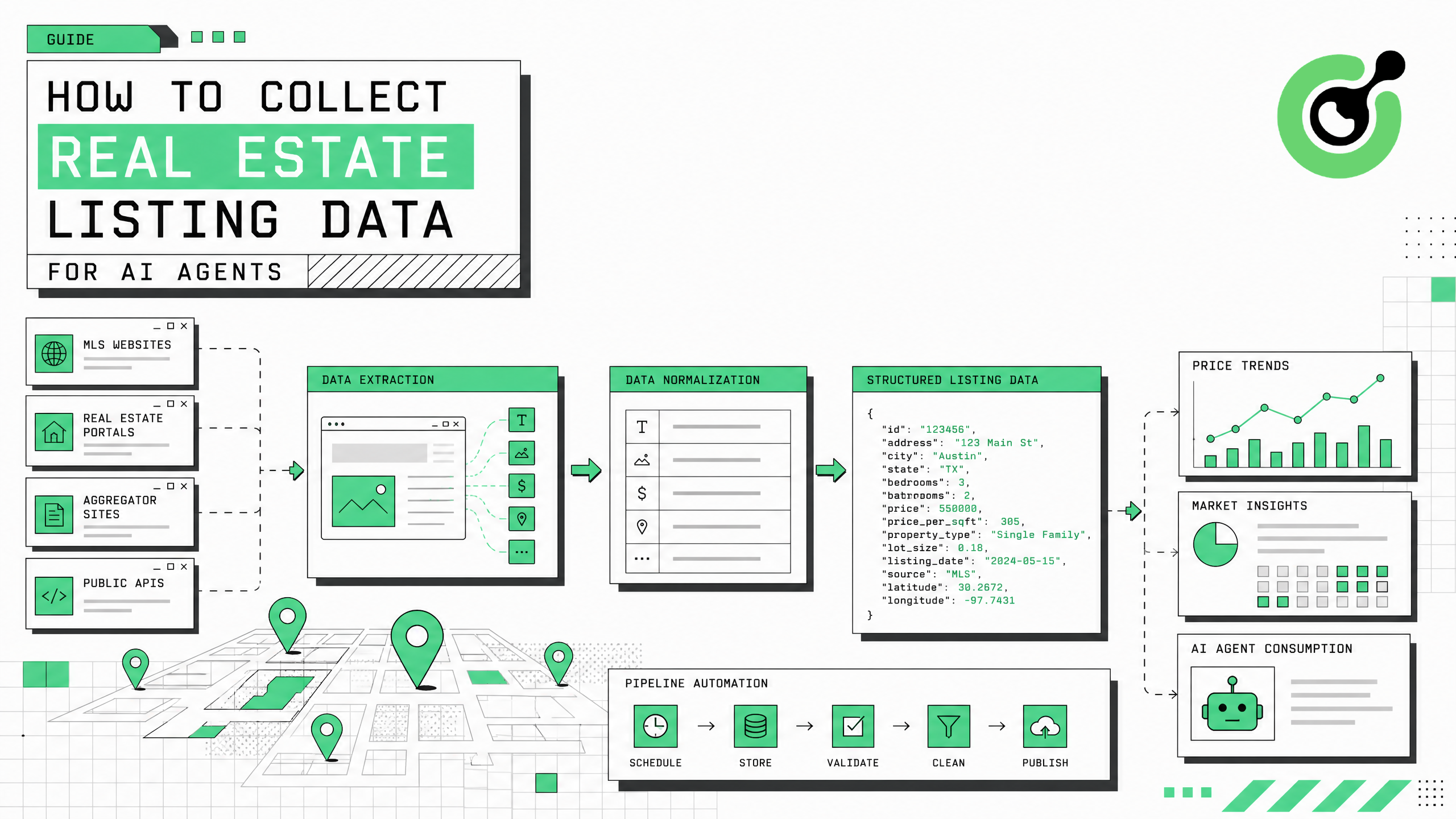
AI-powered real estate platforms need continuous access to property listing data — prices, availability, features, and market trends — from MLS systems, real estate portals, and aggregator sites. These platforms deploy CAPTCHA protection that blocks automated data collection, preventing AI agents from maintaining accurate, up-to-date property databases. This guide shows how to build a real estate listing data pipeline for AI agents using CapSolver to handle verification challenges on Zillow, Realtor.com, Redfin, and similar platforms.
Real estate platforms contain some of the most commercially valuable data on the internet. Property prices, listing histories, days on market, and neighborhood trends drive billions of dollars in investment decisions. These platforms protect their data aggressively — deploying multiple layers of bot detection including CAPTCHAs, rate limiting, and behavioral analysis.
AI real estate agents that provide property valuations, market analysis, or investment recommendations need fresh listing data. When these agents attempt to collect property information at scale — checking hundreds of listings across multiple markets — they trigger verification challenges that halt data collection. NAR research data shows that property prices can change daily in active markets, making continuous monitoring essential for accurate AI-powered recommendations.
Common CAPTCHA deployments include reCAPTCHA v2 on search result pages, Cloudflare Turnstile on modern real estate platforms, and custom challenges on MLS access portals. Without automated solving, AI agents cannot maintain the data freshness required for reliable property analysis.
pip install git+https://github.com/capsolver-ai/capsolver-core.git
pip install aiohttp beautifulsoup4 pandasexport CAPSOLVER_API_KEY="your-capsolver-api-key"Additional requirements:
REAL_ESTATE_PLATFORMS = {
    "zillow": {
        "name": "Zillow",
        "captcha_type": "ReCaptchaV2TaskProxyLess",
        "trigger": "after_50_listing_views",
        "data_fields": ["price", "beds", "baths", "sqft", "lot_size", "year_built", "zestimate"]
    },
    "realtor_com": {
        "name": "Realtor.com",
        "captcha_type": "AntiTurnstileTaskProxyLess",
        "trigger": "rate_limit_80_per_hour",
        "data_fields": ["price", "beds", "baths", "sqft", "listing_date", "agent"]
    },
    "redfin": {
        "name": "Redfin",
        "captcha_type": "ReCaptchaV3TaskProxyLess",
        "trigger": "behavioral_score",
        "data_fields": ["price", "beds", "baths", "sqft", "redfin_estimate", "hot_home"]
    }
}
Use the CapSolver browser extension to identify CAPTCHA parameters on each platform.
import asyncio
from capsolver_core import create_capsolver, CaptchaType, CaptchaInfo

class RealEstateCollector:
    """Collect real estate listing data with CAPTCHA handling."""

    def __init__(self, api_key: str, proxies: list):
        self.cap = create_capsolver(api_key=api_key)
        self.proxies = proxies
        self.proxy_idx = 0

    async def collect_listings(self, market: str, platform: str, max_pages: int = 10) -> list:
        """Collect property listings for a market with CAPTCHA handling."""
        listings = []

        for page in range(max_pages):
            proxy = self.proxies[self.proxy_idx % len(self.proxies)]
            self.proxy_idx += 1

            html = await self._fetch_page(platform, market, page, proxy)

            # Handle CAPTCHA if triggered
            if self._is_captcha(html):
                token = await self._solve(platform)
                html = await self._retry_with_token(platform, market, page, proxy, token)

            page_listings = self._parse_listings(html)
            listings.extend(page_listings)

            if not page_listings:
                break

            await asyncio.sleep(5)  # Rate limiting

        return listings

    async def _solve(self, platform_key: str) -> str:
        """Solve CAPTCHA for a real estate platform."""
        platform = REAL_ESTATE_PLATFORMS[platform_key]
        type_map = {
            "ReCaptchaV2TaskProxyLess": CaptchaType.RECAPTCHA_V2,
            "ReCaptchaV3TaskProxyLess": CaptchaType.RECAPTCHA_V3,
            "AntiTurnstileTaskProxyLess": CaptchaType.CLOUDFLARE
        }

        info = CaptchaInfo(
            type=type_map[platform["captcha_type"]],
            website_url=f"https://www.{platform_key.replace('_', '')}.com",
            website_key=platform.get("site_key", "")
        )
        solution = await self.cap.solve(info)
        return solution.token

    async def close(self):
await self.cap.aclose()class RealEstateMonitor:
"""Monitor real estate markets for listing changes."""
def __init__(self, collector: RealEstateCollector):
self.collector = collector
self.listing_history = {}
async def monitor_market(self, market: str, platforms: list) -> dict:
"""Monitor a market across platforms and detect changes."""
changes = {"new_listings": [], "price_changes": [], "removed": []}
for platform in platforms:
current = await self.collector.collect_listings(market, platform)
for listing in current:
listing_id = listing.get("id")
if listing_id in self.listing_history:
prev = self.listing_history[listing_id]
if listing["price"] != prev["price"]:
changes["price_changes"].append({
"id": listing_id,
"address": listing["address"],
"old_price": prev["price"],
"new_price": listing["price"]
})
else:
changes["new_listings"].append(listing)
self.listing_history[listing_id] = listing
return changes| Monitoring Scope | Daily Listings Checked | Monthly CAPTCHAs | Monthly Cost |
|---|---|---|---|
| 1 market, 1 platform | ~500 | ~150 | $0.30-0.45 |
| 5 markets, 2 platforms | ~5,000 | ~1,500 | $3-4.50 |
| 20 markets, 3 platforms | ~30,000 | ~9,000 | $18-27 |
Claim Your Bonus Code: Use code WEBS at CapSolver Dashboard to get an extra 5% bonus on every recharge. Perfect for PropTech teams building AI-powered property analysis.
The CapSolver web scraping guide covers additional infrastructure patterns. For Cloudflare-protected sites, the Turnstile documentation provides specific implementation details. The CapSolver FAQ addresses common questions about web data collection.
Building a real estate listing data pipeline for AI agents requires profiling platform CAPTCHA systems, implementing async solving with CapSolver, and setting up market monitoring with change detection. The combination of residential proxies and automated CAPTCHA solving enables reliable data collection across major real estate platforms at manageable cost.
This approach works for platforms using standard CAPTCHA systems: Zillow, Realtor.com, Redfin, Trulia, Homes.com, and most regional MLS portals. Each requires specific CAPTCHA parameter identification.
For active markets, daily updates capture most price changes and new listings. For investment analysis, twice-weekly is often sufficient. Hot markets during peak season may benefit from twice-daily monitoring.
At 5 markets with 2 platforms each, approximately 1,500 CAPTCHAs per month at $2-3 per 1,000 solves equals $3-4.50 monthly for CAPTCHA solving. Add proxy costs for total infrastructure under $30/month.
Yes. Historical listing data, comparable sales, and market trends enable AI agents to generate property valuations. The key is maintaining sufficient data history (6-12 months) and covering enough comparable properties in each market.
MLS systems have strict access controls. Focus on publicly displayed listing data from consumer-facing portals rather than attempting direct MLS access. Public portal data provides sufficient information for most AI agent use cases including market analysis and property recommendations.
Ethan Collins
AI Agent Workflow Engineer
Building clearer handoffs between AI agents and tools.
ABOUT THE AUTHOR
Learn scalable Rust web scraping architecture with reqwest, scraper, async scraping, headless browser scraping, proxy rotation, and compliant CAPTCHA handling.

Learn the best techniques to scrape job listings without getting blocked. Master Indeed scraping, Google Jobs API, and web scraping API with CapSolver.