
🎉NEWCapSolver for AI agents-MCP, agent tools, and SDK integrations

Ethan Collins
AI Agent Workflow Engineer
Published Jul 29, 2026
Updated Jul 29, 2026 · min read
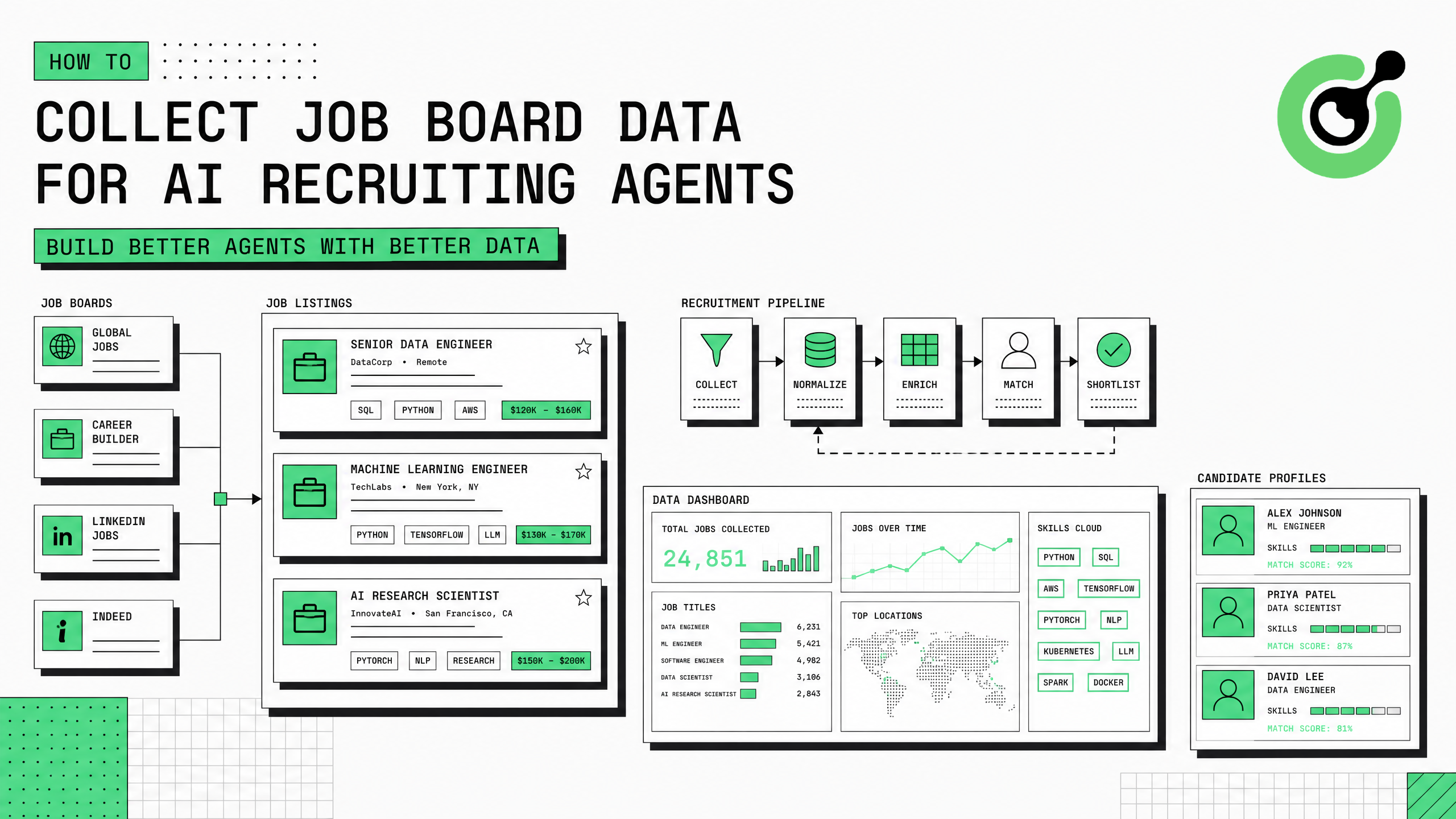
AI recruiting agents need structured job listing data — titles, requirements, compensation, company details — from major job boards to match candidates, analyze market trends, and automate sourcing workflows. Job boards like Indeed, LinkedIn, and Glassdoor deploy CAPTCHA protection that blocks automated collection after a few dozen requests. This guide shows how to build a job board data pipeline for AI recruiting agents using CapSolver to maintain continuous access to employment platforms.
AI recruiting agents perform tasks that require large-scale job board access: scanning thousands of listings to match candidate skills, monitoring compensation trends across industries, tracking which companies are hiring for specific roles, and identifying emerging skill requirements. Each of these tasks generates request volumes that trigger bot detection on employment platforms.
Job boards invest heavily in bot protection because their data is commercially valuable. Listing data, salary information, and company reviews drive subscription revenue. Bureau of Labor Statistics data shows that the US job market processes over 6 million hires monthly — the data underlying these transactions is worth billions to recruiting technology companies.
When an AI recruiting agent encounters a CAPTCHA on Indeed's search results, LinkedIn's job listings, or Glassdoor's company pages, it cannot continue collecting the data needed for candidate matching and market analysis. CapSolver provides the verification-clearing layer that keeps recruitment data pipelines running continuously.
pip install git+https://github.com/capsolver-ai/capsolver-core.git
pip install aiohttp beautifulsoup4 pandasexport CAPSOLVER_API_KEY="your-capsolver-api-key"Additional requirements:
JOB_BOARDS = {
    "indeed": {
        "name": "Indeed",
        "captcha_type": "ReCaptchaV2TaskProxyLess",
        "trigger": "after_30_searches",
        "data_fields": ["title", "company", "location", "salary", "description", "posted_date"]
    },
    "linkedin_jobs": {
        "name": "LinkedIn Jobs",
        "captcha_type": "AntiTurnstileTaskProxyLess",
        "trigger": "rate_limit_and_behavioral",
        "data_fields": ["title", "company", "location", "level", "employment_type", "applicants"]
    },
    "glassdoor": {
        "name": "Glassdoor",
        "captcha_type": "ReCaptchaV2TaskProxyLess",
        "trigger": "after_40_page_views",
        "data_fields": ["title", "company", "salary_range", "rating", "reviews", "benefits"]
    },
    "ziprecruiter": {
        "name": "ZipRecruiter",
        "captcha_type": "AntiTurnstileTaskProxyLess",
        "trigger": "rate_limit_60_per_hour",
        "data_fields": ["title", "company", "salary", "location", "skills", "posted_date"]
    }
}
Use the CapSolver browser extension to identify CAPTCHA parameters on each job board.
import asyncio
from capsolver_core import create_capsolver, CaptchaType, CaptchaInfo

class JobBoardCollector:
    """Collect job listing data with CAPTCHA handling."""

    def __init__(self, api_key: str, proxies: list):
        self.cap = create_capsolver(api_key=api_key)
        self.proxies = proxies
        self.proxy_idx = 0
        self.stats = {"listings_collected": 0, "captchas_solved": 0}

    async def search_jobs(self, query: str, location: str, platform: str = "indeed") -> list:
        """Search job listings with CAPTCHA handling."""
        proxy = self.proxies[self.proxy_idx % len(self.proxies)]
        self.proxy_idx += 1

        html = await self._fetch_search(platform, query, location, proxy)

        if self._is_captcha(html):
            token = await self._solve(platform)
            html = await self._retry(platform, query, location, proxy, token)
            self.stats["captchas_solved"] += 1

        listings = self._parse_listings(html)
        self.stats["listings_collected"] += len(listings)
        return listings

    async def _solve(self, platform_key: str) -> str:
        """Solve CAPTCHA for a job board."""
        platform = JOB_BOARDS[platform_key]
        type_map = {
            "ReCaptchaV2TaskProxyLess": CaptchaType.RECAPTCHA_V2,
            "AntiTurnstileTaskProxyLess": CaptchaType.CLOUDFLARE
        }
        info = CaptchaInfo(
            type=type_map[platform["captcha_type"]],
            website_url=f"https://www.{platform_key.replace('_', '')}.com",
            website_key=platform.get("site_key", "")
        )
        solution = await self.cap.solve(info)
        return solution.token

    async def collect_salary_data(self, role: str, location: str) -> dict:
        """Collect salary data for a specific role and location."""
        results = {}
        for platform in ["indeed", "glassdoor", "ziprecruiter"]:
            listings = await self.search_jobs(f"{role} salary", location, platform)
            salaries = [l.get("salary") for l in listings if l.get("salary")]
            if salaries:
                results[platform] = {
                    "min": min(salaries),
                    "max": max(salaries),
                    "median": sorted(salaries)[len(salaries)//2],
                    "sample_size": len(salaries)
                }
            await asyncio.sleep(5)
        return results

    async def close(self):
        await self.cap.aclose()
The CapSolver API documentation covers optimizing solve times for high-frequency data collection.
class RecruitingIntelligence:
    """AI recruiting agent data layer."""

    def __init__(self, collector: JobBoardCollector):
        self.collector = collector

    async def market_analysis(self, role: str, locations: list) -> dict:
        """Analyze job market for a specific role across locations."""
        analysis = {}
        for location in locations:
            listings = await self.collector.search_jobs(role, location)
            analysis[location] = {
                "total_openings": len(listings),
                "companies_hiring": list(set(l.get("company") for l in listings if l.get("company"))),
                "common_skills": self._extract_skills(listings),
                "salary_range": self._salary_range(listings)
            }
            await asyncio.sleep(5)
        return analysis

    async def track_hiring_trends(self, companies: list, period_days: int = 30) -> dict:
        """Track hiring activity for specific companies."""
        trends = {}
        for company in companies:
            listings = await self.collector.search_jobs(company, "remote")
            trends[company] = {
                "active_listings": len(listings),
                "roles": [l.get("title") for l in listings[:10]],
                "locations": list(set(l.get("location") for l in listings if l.get("location")))
            }
            await asyncio.sleep(5)
        return trends

    def _extract_skills(self, listings: list) -> list:
        """Extract common skills from job descriptions."""
        # Simplified skill extraction
        all_skills = []
        for listing in listings:
            desc = listing.get("description", "").lower()
            common_skills = ["python", "javascript", "sql", "aws", "react", "machine learning", "docker", "kubernetes"]
            for skill in common_skills:
                if skill in desc:
                    all_skills.append(skill)
        from collections import Counter
return [s for s, _ in Counter(all_skills).most_common(10)]| Monitoring Scope | Daily Searches | Monthly CAPTCHAs | Monthly Cost |
|---|---|---|---|
| 10 roles, 3 locations | ~90 | ~270 | $0.54-0.81 |
| 50 roles, 5 locations | ~750 | ~2,250 | $4.50-6.75 |
| 200 roles, 10 locations | ~6,000 | ~18,000 | $36-54 |
Optimization strategies:
Claim Your Bonus Code: Use code WEBS at CapSolver Dashboard to get an extra 5% bonus on every recharge. Ideal for HR tech teams building AI recruiting agents.
The CapSolver FAQ on responsible use provides additional guidance. The CapSolver web scraping documentation covers infrastructure patterns for high-volume collection. For Cloudflare-protected job boards, the Turnstile documentation provides specific implementation details.
Building a job board data pipeline for AI recruiting agents requires profiling platform CAPTCHA systems, implementing async solving with CapSolver, and building intelligence features on top of the collected data. The combination of residential proxies, session management, and automated CAPTCHA solving enables reliable data collection across major employment platforms.
This approach works for platforms using standard CAPTCHA systems: Indeed, LinkedIn Jobs, Glassdoor, ZipRecruiter, Monster, CareerBuilder, and most regional job boards. Each requires specific CAPTCHA parameter identification.
For active recruiting, daily collection captures new postings within 24 hours. For market analysis and trend tracking, 2-3 times per week is sufficient. High-demand roles (engineering, AI/ML) benefit from twice-daily monitoring.
At 50 roles with 5 locations checked daily, approximately 2,250 CAPTCHAs per month at $2-3 per 1,000 solves equals $4.50-6.75 monthly. Add proxy costs for total infrastructure under $40/month.
Yes. Structured job listing data (requirements, skills, experience levels) combined with candidate profiles enables AI matching. The key is extracting structured skill requirements from job descriptions and comparing them against candidate qualifications.
LinkedIn uses multiple protection layers beyond standard CAPTCHAs. Maintain realistic session behavior, use residential proxies, and limit request frequency to 20-30 per hour. Focus on publicly accessible job listings rather than profile data, and comply with LinkedIn's terms of service for automated access.
Ethan Collins
AI Agent Workflow Engineer
Building clearer handoffs between AI agents and tools.
ABOUT THE AUTHOR
Learn scalable Rust web scraping architecture with reqwest, scraper, async scraping, headless browser scraping, proxy rotation, and compliant CAPTCHA handling.

Learn the best techniques to scrape job listings without getting blocked. Master Indeed scraping, Google Jobs API, and web scraping API with CapSolver.