🎉NEWCapSolver for AI agents-MCP, agent tools, and SDK integrations

Lucas Mitchell
Automation Engineer
Published Sep 08, 2026
Updated Sep 08, 2026 · min read
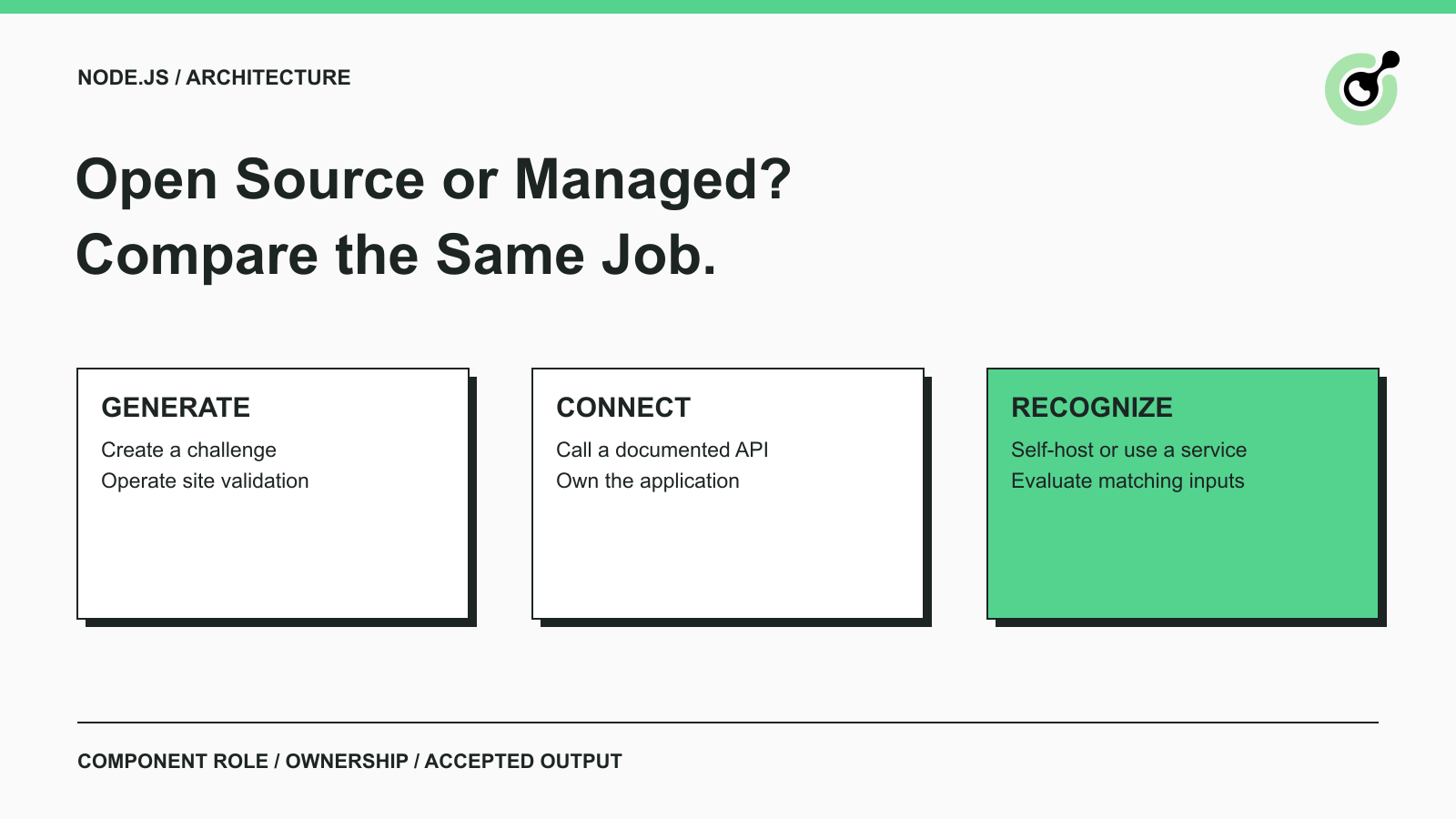
A package search for “Node.js CAPTCHA API” can return code that creates a puzzle, code that sends a request to a remote service, or code that recognizes an image. Choosing among those results without identifying the direction of the workflow produces a misleading comparison. A team protecting its own form and a team testing an authorized browser workflow need different components.
This guide separates those components before comparing ownership and operating cost. CapSolver belongs in the managed solving part of that discussion. The decision is whether your team should operate the recognition capability or call a documented service for a permitted task, while keeping the application integration under your control. It is not a claim that a generator library and a solving API are interchangeable.
An open-source CAPTCHA package may generate challenges, provide a client interface or perform recognition; its license alone does not identify its role.
The first-party svg-captcha repository describes a Node.js generator that returns SVG data and an answer string. That is useful for understanding a generation interface. It is not documentation for solving a third-party challenge, and generating an image does not establish the security of an entire verification system.
A client library is another category. The client can expose request helpers while a remote service performs the work. Reading the client source may explain serialization and error handling without making the remote recognition engine available for self-hosting.
A self-hosted recognition system requires its own supported input formats, inference runtime, evaluation dataset and maintenance process. Do not label an arbitrary OCR package a complete CAPTCHA service without testing the actual challenge families it is expected to handle.
Compare alternatives that produce the same application-level output from the same permitted inputs.
| Component | Main job | What you still need to operate | Suitable comparison |
|---|---|---|---|
| Generator library | Create a challenge for your own application | Validation, expiry, accessibility and abuse controls | Another challenge-generation approach |
| API client | Send documented requests and interpret responses | Secrets, runtime, limits and consuming workflow | Another client for the same service or contract |
| Self-hosted recognition | Process supported inputs on infrastructure you operate | Runtime, capacity, evaluation and model maintenance | Managed recognition for matching inputs |
| Managed solving API | Process documented task types remotely | Integration, task tracking and application verification | Another service or a tested self-hosted implementation |
The matrix is a component map, not a vendor ranking. An architecture can contain more than one row. A Node.js application may use an open-source client for a managed service and a separate generator in its own staging environment.
Write an acceptance statement that names the task and the evidence. For image-to-text work, a returned string may be the immediate result, but the application may also need an exact format or a downstream acceptance check. For a browser challenge, the final page state matters. A task completion response is not evidence that the application accepted a protected action.
Use a labeled sample that represents the authorized workflow. Keep challenge families, input quality and acceptance rules visible in the report. A single blended rate can conceal a weak result in the one category your application actually needs.
Redeem Your CapSolver Bonus Code
Boost your automation budget instantly!
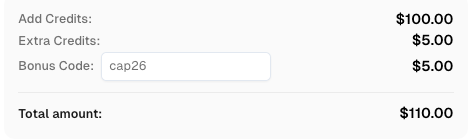
Use bonus code CAP26 when topping up your CapSolver account to get an extra 5% bonus on every recharge — with no limits.
Redeem it now in your CapSolver Dashboard
Managed task handling moves recognition behind an API while leaving request ownership and result consumption in your application.
CapSolver documents task submission through createTask and asynchronous result retrieval through getTaskResult. Follow the task-specific guide when constructing inputs; do not reuse a payload merely because two challenges both appear in a browser. This article compares architecture and does not claim a live solving benchmark.
A network timeout can leave the caller unsure whether a submission reached the service. Retrying a task-creation request may create additional work if the first request succeeded. Read the provider's actual retry and correlation contract before adding automatic retries; do not invent an idempotency field.
Node.js documents cancellation primitives in its global API reference. A client deadline bounds how long the application waits, but it does not prove that remote work stopped. Store a returned task identifier before handing control to another worker, and separately record an uncertain submission when no definitive response arrives.
For a supported task, put credentials in the server-side runtime and return only the fields the caller needs. A package being open source does not make it appropriate to expose provider secrets to browser code or an agent prompt.
The cost model should include operating work and accepted outputs for both alternatives.
For self-hosting, estimate inference compute, spare capacity, engineering maintenance, evaluation labeling and incident handling. For a managed service, include billable requests, integration maintenance, application retries and review work. If the comparison excludes engineering time on one side, label that exclusion instead of presenting the result as total cost.
Consider a hypothetical team spending $200 each month on service usage and four engineering hours on integration. A self-hosted option with $80 of compute but twelve engineering hours is not automatically cheaper. Apply the same internal hourly cost to both, then compare the accepted workload and the scope of maintenance included. These figures illustrate the method; they are not CapSolver prices or measured operating costs.
The accepted-result cost guide explains why request counts and completed application tasks need separate denominators. Use current pricing and your own trial data when calculating an actual budget.
If the project is a challenge-generation system for your own site, include accessibility and completion friction in the decision. The W3C's CAPTCHA accessibility analysis describes barriers that a technical generation demo does not resolve. Recognition cost is the wrong primary metric for that separate product decision.
Choose a managed solving service when its documented task coverage and operational contract fit your authorized workload, and choose self-hosting when your team can demonstrate the required recognition quality and sustain the full runtime.
Before committing, require a written result from a limited trial: inputs tested, accepted outputs, error categories, workload limits, operating costs and unresolved cases. Retain the same test set when changing a dependency or provider. Use the CAPTCHA solving FAQ to clarify CapSolver's product scope, then verify the implementation details in the relevant task documentation.
CapSolver can be evaluated as the managed recognition component while your team owns the Node.js application, its permissions and its acceptance checks. Make the decision at that boundary. A small integration with explicit ownership is easier to evaluate than a “free versus paid” comparison that mixes unrelated components.
Q: Is an open-source Node.js CAPTCHA library always a solver?
No. It may generate puzzles or provide a client for a remote service. Check the documented inputs, outputs and execution location before comparing it with a solving API.
Q: Can an open-source client use a managed service?
Yes. The client license and the remote service's operating model are separate concerns. Review both the client dependency and the service contract.
Q: Does a successful API result prove my browser task finished?
No. The application must check the expected page or business outcome after consuming the result. Keep that verification separate from the API response.
Q: What is the fairest first comparison?
Use one authorized workload, one acceptance definition and the same accounting period. Compare total operating effort and accepted outputs, and disclose any untested challenge types.
Lucas Mitchell
Automation Engineer
Helping browser automation recover and continue.
ABOUT THE AUTHOR
Fix ERROR_IP_BANNED by stopping repeated bad CAPTCHA API requests, finding the first error, checking related codes, and resuming with a controlled test.

Compare CAPTCHA image recognition and token solving, understand their inputs and outputs, and choose the right API workflow for your authorized automation.