🎉NEWCapSolver for AI agents-MCP, agent tools, and SDK integrations

Ethan Collins
AI Agent Workflow Engineer
Published Jul 29, 2026
Updated Jul 29, 2026 · min read
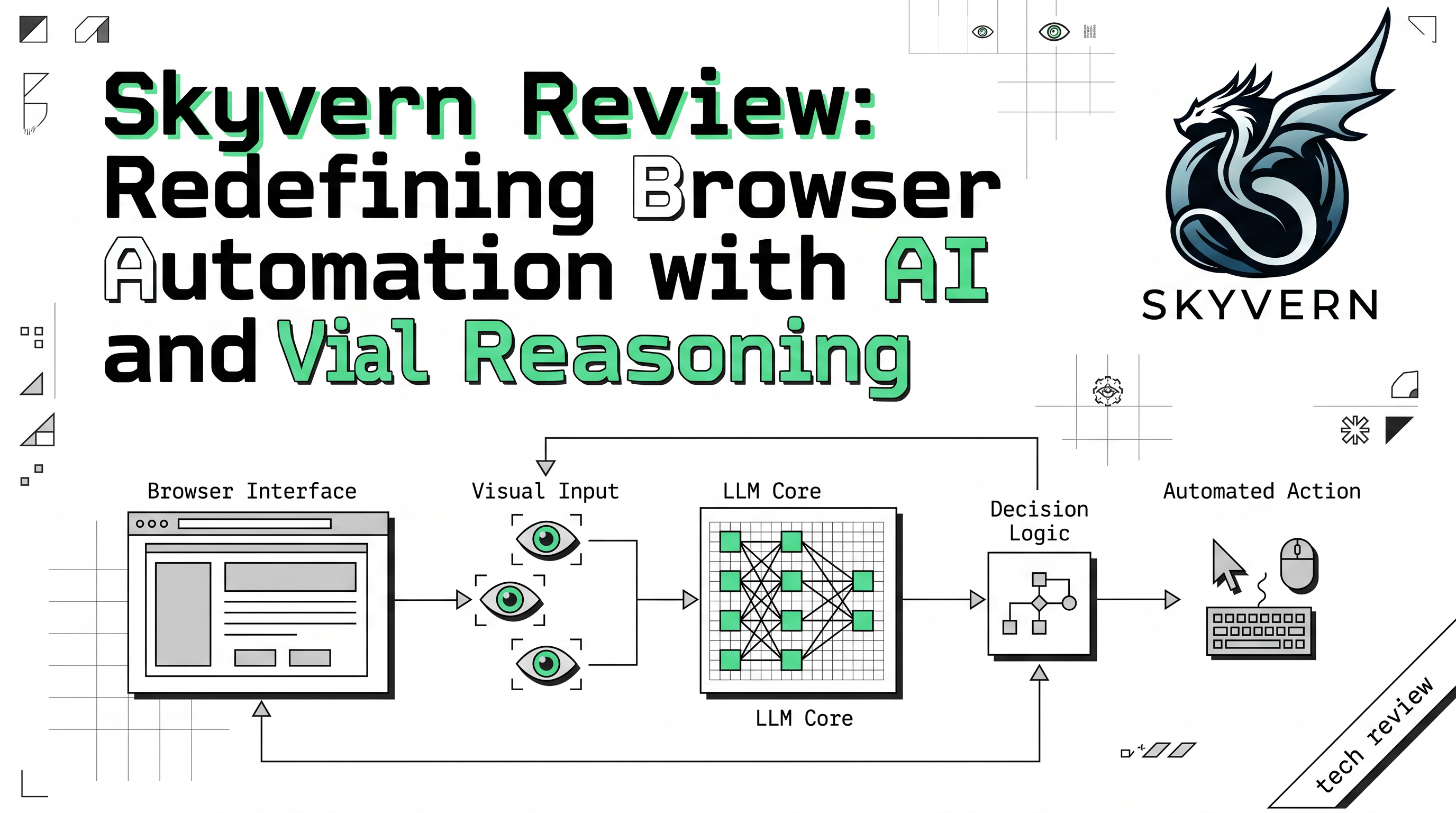
Skyvern revolutionizes browser automation by using AI (LLMs and Computer Vision) instead of fragile CSS/XPath selectors, making workflows resilient to UI changes. Its Planner-Agent-Validator architecture and Code Caching ensure both adaptability and speed. Skyvern natively handles complex challenges like CAPTCHAs and 2FA, offers explainable AI, and is self-hostable. For robust automation, especially against advanced CAPTCHAs, integrating with specialized services like CapSolver can provide seamless and highly effective solutions.
The landscape of web automation has undergone a seismic shift over the last decade. From the early days of fragile Selenium scripts to the modern, robust Playwright framework, developers have long sought a way to interact with the web that doesn't require constant maintenance. However, even the most advanced traditional tools remain tethered to the Document Object Model (DOM), making them inherently vulnerable to the slightest change in a website's frontend. Enter Skyvern, an AI-powered browser automation platform that promises to break this cycle by replacing brittle CSS selectors and XPath scripts with visual reasoning and Large Language Models (LLMs). This review explores whether Skyvern truly represents the future of the "Agentic Web" or if it is simply another layer of complexity in an already crowded field.
To understand Skyvern's value proposition, one must first recognize the limitations of its predecessors. Traditional automation tools operate at the code level, identifying elements through their underlying HTML structure. While this is fast and deterministic, it lacks the semantic understanding that a human brings to the browser. When a website undergoes a redesign—even a minor one like changing a button's ID or moving a login field—traditional scripts fail. This has created a massive "maintenance tax" for enterprises, where engineering teams spend more time fixing broken scrapers than building new features.
Skyvern, a Y Combinator-backed (S23) open-source project, approaches this problem from a different angle. Instead of looking at the code, it looks at the page. By leveraging Computer Vision and LLMs, Skyvern interprets the visual layout of a website just as a human would. A "Login" button is recognized by its text, its position, and its visual context, regardless of whether its underlying HTML tag is a <button>, an <a>, or a <div>. This shift from selector-based to vision-based automation is the core of Skyvern's "no-maintenance" promise.
The intelligence behind Skyvern is not a single prompt-and-response loop. With the release of Skyvern 2.0, the platform introduced a sophisticated Planner-Agent-Validator architecture designed to minimize hallucinations and handle complex, multi-step workflows. This tiered approach ensures that the AI doesn't just "guess" its way through a website but follows a structured logical path.
| Component | Function | Role in Workflow |
|---|---|---|
| Planner | Strategic Reasoning | Breaks down a high-level natural language goal into a series of logical sub-tasks. |
| Task Agent | Execution | Navigates the browser, interacts with elements, and executes the sub-tasks defined by the Planner. |
| Validator | Quality Assurance | Verifies that each step was successful and that the final goal has been achieved before concluding the run. |
One of the most impressive technical feats in Skyvern is its Code Caching mechanism. On the initial run of a new workflow, Skyvern uses the full power of its LLM and vision stack to navigate the site. Once successful, it records the sequence of actions and generates a native Playwright script. On subsequent runs, Skyvern replays this script directly, bypassing the expensive and slower LLM calls. If the website changes and the script fails, Skyvern automatically falls back to the live agent, re-reasons through the new layout, and updates the cache. This "self-healing" capability effectively combines the speed of traditional automation with the adaptability of AI.
Skyvern is built for real-world business processes, which often involve more than just clicking buttons. It handles the "dirty work" of web automation that typically stops other tools in their tracks.
One of the primary blockers for browser automation is security. Skyvern integrates native support for solving various CAPTCHA types, ensuring that workflows aren't interrupted by "are you a human?" checks. Furthermore, it handles Two-Factor Authentication (2FA) by integrating with credential managers like Bitwarden or 1Password, allowing it to retrieve and enter TOTP codes in real-time. This makes it viable for automating high-security portals like banking, insurance, and government sites.
A common criticism of AI agents is their "black box" nature. Skyvern addresses this through Explainable AI features. Every action the agent takes is documented with a summary of what was done and why. Users can inspect the reasoning process, view screenshots of every step, and even take manual control of a session if the agent gets stuck. This level of observability is critical for enterprise compliance and debugging.
For data extraction tasks that require localized access, Skyvern supports integration with residential and datacenter proxy networks. It allows for precise targeting down to the country, state, or even zip-code level. This is particularly useful for price monitoring, ad verification, and lead generation where content may vary based on the user's location.
When evaluating Skyvern, it is helpful to compare it against the broader ecosystem of automation tools. While tools like Playwright and Selenium remain the gold standard for speed, Skyvern occupies a unique niche for adaptability.
| Feature | Skyvern | Playwright / Selenium | RPA (e.g., UiPath) | Other AI Agents |
|---|---|---|---|---|
| Primary Selector | Visual & LLM Reasoning | CSS / XPath / DOM | Visual / Desktop API | Pure LLM Prompts |
| Maintenance | Low (Self-healing) | High (Breaks on UI change) | Medium | High (Hallucinations) |
| Learning Curve | Low (Natural Language) | High (Coding required) | Medium (Low-code) | Low (Chat-based) |
| Speed | Medium (Fast with cache) | Very High | Medium | Low |
| Auth Support | Native 2FA & Login | Manual Implementation | Plugin-based | Limited |
Compared to pure-prompt agents like AutoGPT, Skyvern is significantly more grounded. By using a Playwright-compatible SDK, it tethers its reasoning to actual browser actions, preventing the "infinite loops" and hallucinations that plague many autonomous agents. It doesn't just think about the web; it interacts with it through a hardened, deterministic execution layer.
Skyvern's versatility allows it to be applied across a wide range of industries where manual browser work is a bottleneck.
A major factor in Skyvern's rapid adoption is its commitment to open source. With over 22,600 GitHub stars, the project has a vibrant community of contributors. Being open source (under the AGPL-3.0 license) allows enterprises to self-host the platform on their own infrastructure. This is a non-negotiable requirement for many organizations dealing with sensitive data, as it ensures that credentials and private information never leave their controlled environment.
Furthermore, Skyvern's backing by Y Combinator provides it with the institutional support needed to scale and compete with established RPA giants. The project's technical reports, such as its performance on the WebVoyager benchmark, demonstrate its commitment to transparency and rigorous evaluation.
In the world of AI agents, accuracy is the only metric that matters. Skyvern has consistently demonstrated state-of-the-art (SOTA) performance on various web navigation benchmarks. According to its own evaluations on WebBench, Skyvern achieves a high accuracy rate in "WRITE" tasks—actions that involve changing the state of a page, such as form submissions or clicks.
| Benchmark | Metric | Skyvern Performance |
|---|---|---|
| WebBench | Accuracy (Overall) | 64.4% |
| WebVoyager | Task Completion Rate | 85.8% (v2.0) |
| Internal Write Tasks | Success Rate | High Reliability on Form Fills |
While 64.4% may seem low compared to human performance, it is exceptionally high for an autonomous agent and represents a significant leap over previous generations of web-browsing AI. When combined with the "Validator" layer and human-in-the-loop fallback, the effective reliability for business processes can approach 99%.
Despite its impressive capabilities, Skyvern is not a "magic bullet." There are several factors that organizations should consider before full-scale deployment:
While Skyvern offers native capabilities for handling CAPTCHAs, the reality of web automation often presents evolving and increasingly sophisticated bot detection mechanisms. CAPTCHAs remain a significant barrier, designed specifically to differentiate human users from automated scripts. For mission-critical workflows, relying solely on built-in solutions might not always suffice against the most advanced challenges.
This is where specialized CAPTCHA solving services become invaluable. Platforms like CapSolver excel at providing robust and reliable CAPTCHA resolution for a wide array of types, including reCAPTCHA, hCaptcha, and ImageToText challenges. The power of Skyvern can be significantly amplified by integrating with such dedicated services.
CapSolver offers a seamless integration experience, allowing Skyvern to delegate the complex task of CAPTCHA solving to a highly optimized external service. This ensures that your automation workflows remain uninterrupted, even when encountering difficult CAPTCHAs. The integration is straightforward, as demonstrated in our dedicated guide: Skyvern and CapSolver Integration Guide. By combining Skyvern's intelligent browser interaction with CapSolver's specialized CAPTCHA-solving prowess, you achieve a truly resilient and efficient automation solution.
Skyvern represents a significant milestone in the journey toward fully autonomous web agents. By bridging the gap between high-level AI reasoning and low-level browser execution, it has created a tool that is both powerful and practical. For companies struggling with the maintenance of traditional scrapers or looking to automate portals that lack APIs, Skyvern offers a compelling path forward.
As LLMs continue to become faster, cheaper, and more capable, the "maintenance tax" of the web will likely continue to decrease. Skyvern is at the forefront of this movement, turning the browser from a manual interface into a programmable environment. Whether you are a developer looking for a better way to build scrapers or a business leader seeking to streamline back-office operations, Skyvern is a platform that demands your attention.
Q1: What makes Skyvern different from traditional automation tools like Playwright?
A1: Skyvern uses AI (LLMs and Computer Vision) to interpret web pages visually, making it resilient to UI changes, unlike traditional tools that rely on brittle CSS/XPath selectors.
Q2: Can Skyvern handle complex login flows with 2FA?
A2: Yes, Skyvern natively supports Two-Factor Authentication (2FA) and integrates with credential managers to handle secure login processes.
Q3: Is Skyvern suitable for high-volume, real-time automation?
A3: While Skyvern's Code Caching improves speed, the AI-driven reasoning introduces some latency. It's generally better suited for background batch processes and complex workflows where adaptability is key, rather than ultra-low-latency real-time applications.
Q4: Is Skyvern open source and can it be self-hosted?
A4: Yes, Skyvern is an open-source project (AGPL-3.0 license) and can be self-hosted using Docker, which is crucial for enterprises with strict data residency and security requirements.
Q5: How does Skyvern handle CAPTCHAs?
A5: Skyvern has native CAPTCHA solving capabilities. For more advanced or persistent challenges, it can be seamlessly integrated with specialized services like CapSolver to ensure uninterrupted workflows.
Ethan Collins
AI Agent Workflow Engineer
Building clearer handoffs between AI agents and tools.
ABOUT THE AUTHOR
Choose the CapSolver Python Core SDK or direct HTTP API by task support, page access, response handling, and the responsibilities your application owns.
Build search intent drift monitoring with Search Console data, controlled SERP observations, intent labels, confidence gates, evidence, and safe automation.