🎉NEWCapSolver for AI agents-MCP, agent tools, and SDK integrations

Lucas Mitchell
Automation Engineer
Published Jun 25, 2026
Updated Jun 24, 2026 · min read
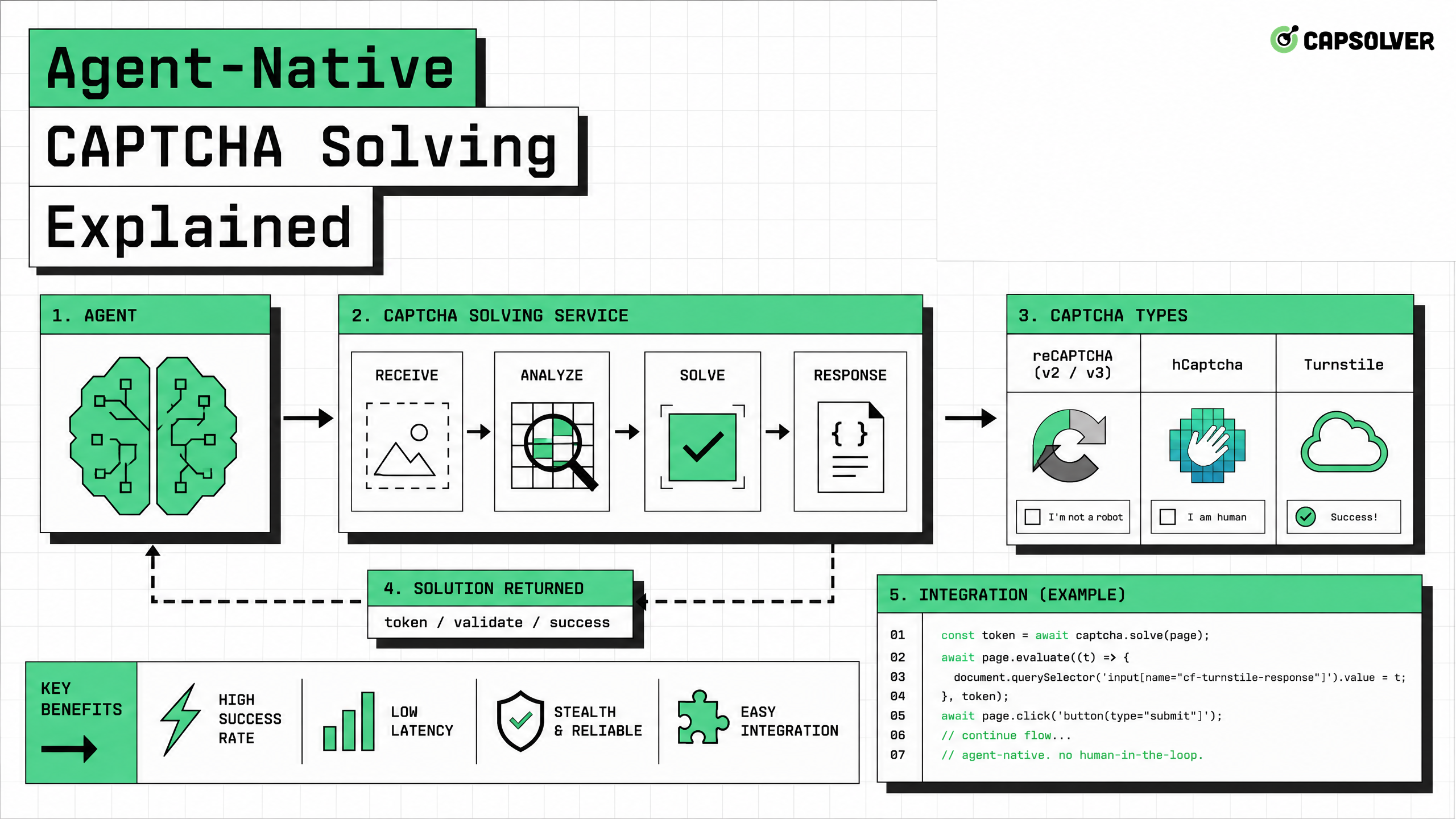
Agent-native CAPTCHA solving represents a critical advancement in the field of AI automation, enabling artificial intelligence agents to navigate and overcome CAPTCHA challenges with unprecedented efficiency and reliability. This approach moves beyond traditional, often brittle, methods of CAPTCHA resolution, integrating the solving mechanism directly into the agent's operational framework. The result is a more robust and adaptive solution for automated tasks that encounter bot protection. For businesses and developers deploying AI agents for web scraping, data collection, or process automation, the ability to reliably handle CAPTCHAs is no longer a luxury but a necessity. CapSolver provides a leading platform for these advanced, agent-native solutions, ensuring that AI agents can maintain their workflow without interruption. This article will delve into the intricacies of agent-native CAPTCHA solving, exploring its core principles, technological advantages, and practical applications for modern AI-driven operations.
Agent-native CAPTCHA solving fundamentally differs from traditional manual or semi-automated approaches by integrating the solution directly into the AI agent's operational logic. Instead of relying on human intervention or simple API calls that might be easily detected, agent-native systems use advanced machine learning models and contextual understanding to interpret and respond to CAPTCHA challenges. This involves real-time analysis of the CAPTCHA type, such as reCAPTCHA v2/v3, Cloudflare Turnstile, or image-based puzzles, and then programmatically generating the correct response. The agent's ability to interact with the web environment, mimic human-like behavior, and process visual or audio cues is crucial. This direct integration minimizes delays and reduces the footprint of automated activity, making it harder for bot detection systems to identify and block the agent. The core idea is to make the CAPTCHA resolution an intrinsic part of the agent's decision-making process, rather than an external, bolted-on service.
AI agents interact with CAPTCHAs through a combination of browser automation, computer vision, and specialized solving algorithms. When an agent encounters a CAPTCHA, it first identifies the challenge type. For visual CAPTCHAs, computer vision techniques are employed to analyze images, identify objects, or decipher distorted text. For interactive CAPTCHAs like reCAPTCHA, the agent might simulate mouse movements, clicks, and even solve simple puzzles. The key is to perform these actions in a way that appears natural and avoids triggering bot detection heuristics. This often involves dynamic adjustment of interaction speed, randomized click patterns, and the use of legitimate browser fingerprints. The data collected from the CAPTCHA—whether it's an image grid, audio snippet, or text input—is then fed into a solving module, which returns the solution to the agent for submission. This iterative process ensures that the agent can adapt to variations in CAPTCHA designs and difficulty levels.
The adoption of agent-native CAPTCHA solving brings significant advantages for any operation relying on AI automation. Firstly, it dramatically improves reliability and uptime for automated workflows. Traditional methods often lead to frequent interruptions, requiring manual intervention or causing task failures when CAPTCHAs are encountered. Agent-native solutions, by contrast, are designed to handle these challenges autonomously, ensuring continuous operation. Secondly, there's a substantial increase in efficiency and speed. The real-time, integrated nature of these solvers means that CAPTCHAs are resolved almost instantaneously, preventing bottlenecks in data collection or process execution. This is particularly vital for time-sensitive tasks like market research or real-time data aggregation. Thirdly, agent-native approaches offer enhanced stealth and reduced detection risk. By blending CAPTCHA resolution into the agent's natural behavior, the likelihood of being flagged as a bot is significantly lowered. This is crucial for maintaining access to target websites and avoiding IP bans or other protective measures. Finally, these solutions are often more scalable and cost-effective in the long run, as they reduce the need for human oversight and can be deployed across a large fleet of agents without proportional increases in operational complexity.
Despite the numerous benefits, implementing agent-native CAPTCHA solving is not without its challenges. The primary hurdle is the ever-evolving nature of CAPTCHA technology. CAPTCHA providers constantly update their algorithms and introduce new challenge types to counteract automated solving efforts. This necessitates continuous development and adaptation of agent-native solutions to remain effective. Another significant challenge is maintaining ethical boundaries and compliance. While agent-native CAPTCHA solving can facilitate legitimate automation, it also has the potential for misuse. Users must ensure their activities comply with terms of service and legal regulations, avoiding unauthorized access or malicious intent. The computational resources required for sophisticated AI-driven CAPTCHA analysis can also be substantial, especially for large-scale deployments. Furthermore, the complexity of integration into existing AI agent frameworks can be a barrier for some organizations, requiring specialized expertise. Balancing the need for effective automation with responsible and ethical practices remains a key consideration for developers and businesses utilizing these advanced solving techniques.
Given the dynamic and complex nature of CAPTCHA challenges, specialized CAPTCHA solving services like CapSolver play a pivotal role in enabling effective agent-native solutions. These services provide robust APIs that AI agents can integrate with, offloading the heavy lifting of CAPTCHA analysis and resolution. By using a vast infrastructure and continuously updated algorithms, these platforms can handle a wide array of CAPTCHA types, often with high success rates and low latency. This allows AI developers to focus on their core automation tasks without needing to build and maintain their own complex CAPTCHA-solving mechanisms. For instance, understanding the nuances of different CAPTCHA types and how to effectively integrate a solver is crucial for any AI agent infrastructure [^1]. The choice of a CAPTCHA solver for agent infrastructure in 2026 is a critical decision that impacts the overall efficiency and resilience of AI agents [^2]. These services are designed to provide a scalable CAPTCHA solving solution for production agents, ensuring that automation workflows remain uninterrupted even under heavy load [^3].
Redeem Your CapSolver Bonus Code
Boost your automation budget instantly!
Use bonus code CAP26 when topping up your CapSolver account to get an extra 5% bonus on every recharge — with no limits.
Redeem it now in your CapSolver Dashboard
To better understand the advantages of agent-native CAPTCHA solving, it's helpful to compare it with traditional methods. Traditional approaches often involve manual solving, simple proxy rotations, or basic script-based workarounds that are easily detected. Agent-native solutions, conversely, are built for resilience and direct integration.
| Feature | Agent-Native CAPTCHA Solving | Traditional CAPTCHA Solving |
|---|---|---|
| Integration | Deeply integrated into AI agent's workflow | External, often manual, or loosely coupled |
| Reliability | High, designed for continuous operation | Low, prone to frequent interruptions |
| Detection Risk | Low, mimics human behavior, uses advanced techniques | High, easily flagged by bot detection systems |
| Scalability | Highly scalable, API-driven solutions | Limited, often requires human oversight or complex scripts |
| Efficiency | Real-time, minimal latency | Delays due to manual intervention or failed attempts |
| Cost-Effectiveness | Lower long-term operational costs, higher initial setup | Higher long-term operational costs due to failures/manual work |
| Adaptability | Adapts to new CAPTCHA types with continuous updates | Requires constant manual updates or script modifications |
This comparison highlights why agent-native solutions are becoming the preferred choice for serious AI automation tasks, especially when dealing with advanced bot protection infrastructure for AI agents [^4]. The ability to add CAPTCHA handling middleware to your agent is also a key component of a robust system [^5].
Agent-native CAPTCHA solving represents a significant leap forward in empowering AI agents to operate effectively in a web environment increasingly protected by sophisticated bot detection mechanisms. By integrating CAPTCHA resolution directly into the agent's workflow, businesses can achieve higher reliability, efficiency, and stealth in their automated operations. While challenges such as the evolving nature of CAPTCHAs and ethical considerations remain, specialized services like CapSolver offer powerful, adaptive solutions that mitigate these hurdles. Embracing agent-native approaches is essential for any organization looking to maximize the potential of their AI agents for tasks like web scraping, data collection, and process automation. Ready to enhance your AI agent's capabilities and ensure uninterrupted automation? Explore CapSolver's advanced CAPTCHA solving solutions today and empower your agents to navigate the web reliably. Visit CapSolver to learn more.
What is agent-native CAPTCHA solving?
Agent-native CAPTCHA solving refers to the integration of CAPTCHA resolution mechanisms directly into the operational framework of an AI agent, allowing it to autonomously identify and solve CAPTCHAs without external human intervention.
How does it differ from traditional CAPTCHA resolution methods?
Unlike traditional methods that often rely on manual solving or simple scripts easily detected by bot protection, agent-native solutions use advanced AI, computer vision, and behavioral mimicry to handle CAPTCHAs reliably as part of the agent's natural workflow, offering higher reliability and lower detection risk.
Why is agent-native CAPTCHA solving important for AI agents?
It's crucial for maintaining the continuous operation and efficiency of AI agents in tasks like web scraping, data collection, and process automation, especially when encountering websites protected by CAPTCHAs. It ensures agents can complete their tasks without interruptions.
What types of CAPTCHAs can agent-native solutions handle?
Agent-native solutions, especially when powered by specialized services, can handle a wide range of CAPTCHA types, including reCAPTCHA v2/v3, image-based puzzles, and other interactive challenges, by adapting their solving strategies.
Are there ethical considerations when using agent-native CAPTCHA solvers?
Yes, it's important to use agent-native CAPTCHA solvers responsibly and ethically, ensuring compliance with website terms of service and legal regulations. The focus should be on legitimate automation tasks, avoiding unauthorized access or malicious activities.
Lucas Mitchell
Automation Engineer
Helping browser automation recover and continue.
ABOUT THE AUTHOR
Fix CAPTCHA handling that works locally but fails in a cloud AI agent. Compare browser setup, dependencies, credentials, network access, and page state.

Estimate CAPTCHA solving costs in Browser Use by separating agent runs, challenge types, billable solves, retries, and verified outcomes from browser costs.