Price Monitoring with CAPTCHA: Prevent False Price Alerts

Nikolai Smirnov
Software Development Lead
TL;DR
- A CAPTCHA interruption means the current price observation is unavailable, not that the product costs zero.
- Compare prices only when product variant, seller, condition, currency, and price basis match.
- Keep the last accepted price with its original timestamp while recording the current collection gap separately.
- Validate the destination page after challenge handling before accepting any extracted offer.
- Generate alerts from accepted observations and an explicit threshold, with duplicate notification controls.
A price tracker can send a convincing but incorrect alert when a collection failure becomes a numeric value. The previous observation says 100 dollars. The next page shows a verification challenge, the parser returns an empty value, and a default conversion turns that value into zero. The resulting price-drop calculation is mathematically valid and operationally wrong.
Product monitoring CAPTCHA services address the challenge step, while your monitoring application decides whether it has observed a comparable offer. CapSolver can support documented challenges in authorized collection workflows. It cannot establish that an extracted number describes the right product, seller, or purchase conditions. This article focuses on that acceptance boundary and includes a local comparison example for preventing false price alerts before they reach a customer or pricing team.
Treat a challenge page as a missing observation
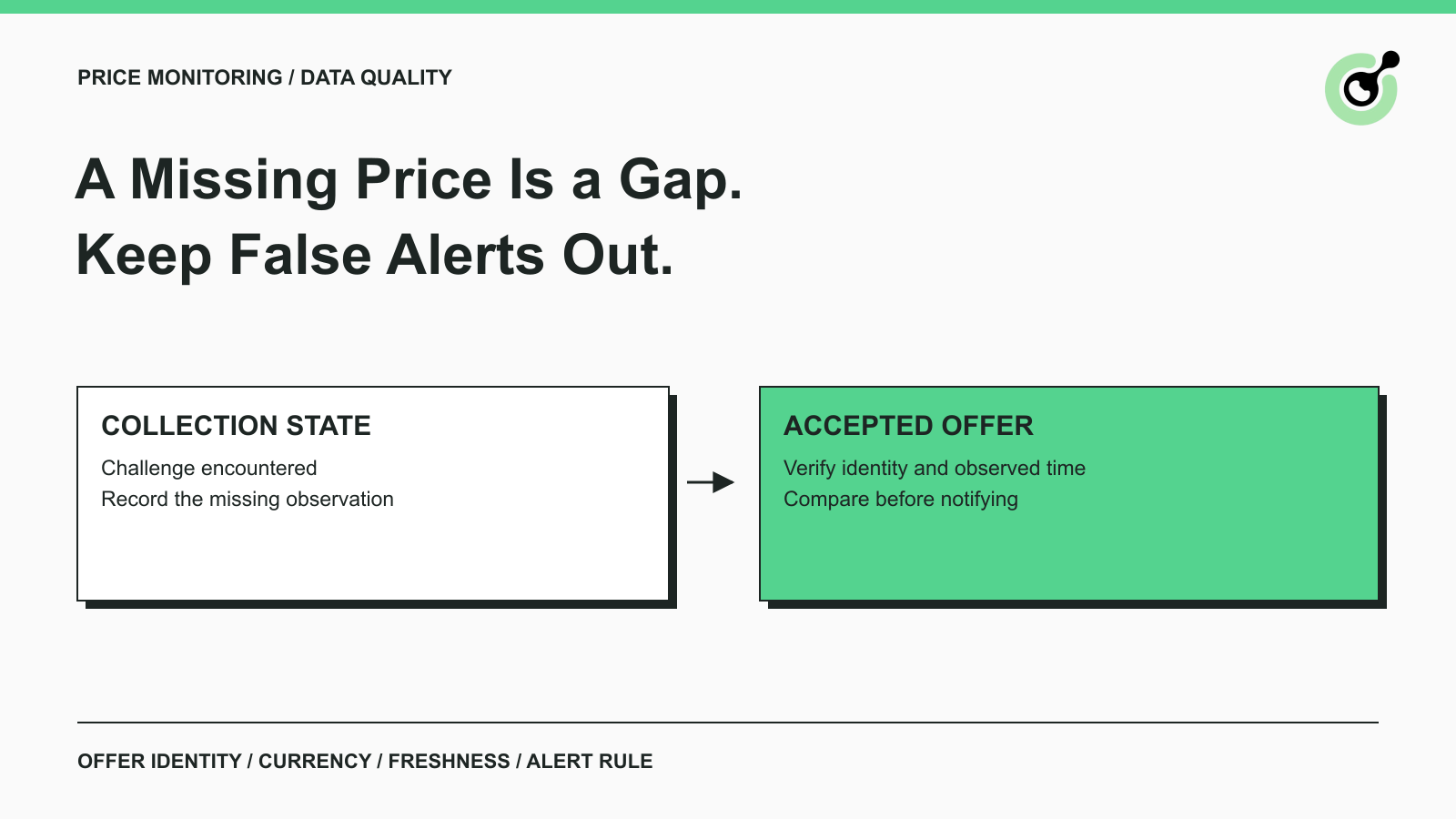
A challenge page should produce a collection state that is distinct from a price record. The collector has evidence that the current observation did not complete; it has no evidence that the product became free, unavailable for purchase, or unchanged in price.
Preserve the previous accepted value and its original observation time. Alongside it, record that the current collection attempt encountered a challenge. A dashboard can then show both the last known price and the gap in fresh coverage. Replacing the old timestamp with the retry time would falsely imply that the old price was observed again.
Distinguish challenge handling from offer extraction in the workflow. A documented task can finish, but the destination may still show an error, a login page, a different region, or a product-selection screen. The collector should inspect the resulting application state before invoking the price parser.
The AI web scraping glossary describes the broader collection process. For price monitoring, the useful output is an observation with a verifiable offer identity, not merely a page response or text containing a currency symbol.
Define what counts as the same offer
Comparable offers must refer to the same purchasing proposition. A product name alone is often insufficient because variant, seller, condition, package quantity, and payment basis can all affect the amount displayed.
Start with a stable product identifier and the selected variant. Add the seller and item condition when the source distinguishes them. Record currency and whether the amount is an item price, a total including delivery, or another explicitly defined basis. Keep a subscription installment separate from a one-time purchase price.
The Schema.org Offer vocabulary includes properties such as price, currency, availability, seller, and item condition. Those concepts help define a record, but their presence in markup does not prove that the record matches the visible selection or is current.
Google's product structured-data guidance also distinguishes product and offer information. Use structured data as one source of evidence. If the page presents multiple offers or a price range, do not silently substitute the lowest number for the specific offer your monitor tracks.
Write the price basis into the monitor configuration. A team tracking item-only prices can reasonably exclude shipping, provided the comparison and alert make that scope clear. A landed-cost monitor needs delivery and relevant context. Switching between these definitions mid-series creates false changes even when every extracted number is accurate.
Accept observations before calculating changes
An observation should pass identity, value, and time checks before it reaches the alert calculation. Keep rejected observations in a separate diagnostic path so they cannot accidentally replace the accepted baseline.
Check that required identity fields are present and equal to the monitor's expected identity. Confirm that the price parser handled the source's decimal and thousands separators correctly. Reject non-finite values and unexplained negative prices. A zero value requires explicit evidence that a zero-price offer is within the intended scope; it should never be the fallback for missing text.
Timestamp the actual observation in a consistent time representation. Separately record ingestion time and processing time when useful. A delayed worker should not make an old observation appear new by attaching its current execution time to the price.
Choose a freshness window appropriate to the business decision. There is no universal window for every product category. A slow-changing reference catalog and a time-sensitive promotion have different requirements. Record the chosen window so another operator can explain why an otherwise valid price was excluded.
Use a small comparator with explicit outcomes
A comparator can return a reasoned decision instead of a bare percentage. The following Python example consumes already-normalized records and uses synthetic values. It runs locally without network access, a browser, or a CAPTCHA service. It does not demonstrate a live collection integration.
Python's Decimal arithmetic supports decimal calculations without introducing binary floating-point representation artifacts. The example constructs decimal values from strings and requires the upstream parser to have normalized locale-specific prices first.
python
from decimal import Decimal, InvalidOperation

IDENTITY = ("product", "variant", "seller", "condition", "currency", "basis")

def compare(previous, current, *, now, max_age, threshold):
    if current.get("state") != "accepted":
        return "gap"
    if previous.get("state") != "accepted":
        return "baseline_required"
    if any(not previous.get(k) or previous[k] != current.get(k)
           for k in IDENTITY):
        return "not_comparable"
    if not (previous["observed_at"] < current["observed_at"] <= now):
        return "invalid_time_order"
    if now - current["observed_at"] > max_age:
        return "stale"
    try:
        old = Decimal(previous["price"])
        new = Decimal(current["price"])
    except (InvalidOperation, ValueError, TypeError):
        return "invalid_price"
    if not old.is_finite() or not new.is_finite() or old <= 0 or new <= 0:
        return "review_price"
    drop = (old - new) / old
    return "alert" if drop >= threshold else "no_alert"

base = dict(state="accepted", product="demo-1", variant="blue-medium",
            seller="demo-seller", condition="new", currency="USD",
            basis="item-only", price="100.00", observed_at=1000)
latest = dict(base, price="89.00", observed_at=1100)
options = dict(now=1120, max_age=120, threshold=Decimal("0.10"))
cases = [
    (latest, "alert"),
    (dict(latest, price="95.00"), "no_alert"),
    (dict(latest, state="challenge", price=None), "gap"),
    (dict(latest, currency="EUR"), "not_comparable"),
    (dict(latest, variant="red-large"), "not_comparable"),
    (dict(latest, price="0"), "review_price"),
    (dict(latest, price="NaN"), "review_price"),
    (dict(latest, price="unknown"), "invalid_price"),
    (dict(latest, observed_at=1000), "invalid_time_order"),
    (dict(latest, observed_at=1200), "invalid_time_order"),
]
for record, expected in cases:
    assert compare(base, record, **options) == expected
assert compare(base, latest, **dict(options, now=1400)) == "stale"
assert compare(dict(base, state="missing"), latest, **options) == "baseline_required"
print("12 synthetic comparison checks passed")
In this example, the synthetic change from 100 to 89 qualifies against a 10 percent threshold. A challenge state produces a gap, while a different currency or variant produces a non-comparable result. Those outcomes must remain different in the user interface and in operational metrics.
The example intentionally sends zero-priced observations for review and compares against the previous accepted observation even if that baseline is old. A production monitor should explicitly choose whether it needs a recent baseline or a scheduled-interval comparison. It should also validate the complete input schema, identifiers, timestamp types, and configuration before calling the comparator.
Redeem Your CapSolver Bonus Code
Boost your automation budget instantly!
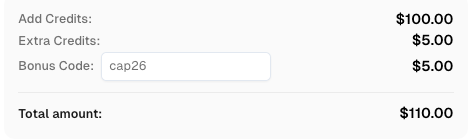
Use bonus code CAP26 when topping up your CapSolver account to get an extra 5% bonus on every recharge — with no limits.
Redeem it now in your CapSolver Dashboard
Keep CAPTCHA handling inside the collection attempt
CAPTCHA handling should preserve the identity and deadline of the observation that needs it. The retry belongs to that collection attempt, not to a new price series or a newly selected product.
For supported tasks, follow the CapSolver task creation documentation and the corresponding task-specific requirements. An asynchronous result is retrieved through the documented result interface. Keep any returned task reference associated with the active collection attempt.
After the approved challenge step, recheck the product selection and price basis. A page can return to its default variant after navigation or a refreshed session. Compare the observed identifiers with the monitor configuration before accepting the number.
If the result arrives after the observation deadline, record the delayed result and apply the monitor's freshness policy. Do not repeatedly extend the deadline until the collection looks successful. That makes the coverage report impossible to interpret.
The ecommerce CAPTCHA handling guide covers the broader collection topic. Keep the price acceptance rule independent of the chosen challenge integration so a change in collection tooling cannot silently change what counts as a valid offer.
Prevent duplicate alerts when workers retry
Alert delivery needs its own duplicate-control mechanism because retrying a notification is different from observing another price. A worker can compute the same valid price change twice after a restart without discovering a new market event.
Create an alert identity from the monitor, accepted baseline observation, current observation, and rule version. Persist the decision before dispatching the notification, then track its delivery state. Use the notification channel's documented deduplication facilities where available; do not assume that every message API provides them.
If delivery becomes uncertain, preserve that uncertainty for the dispatcher rather than recomputing the price event with a new identity. This keeps the collection system from multiplying alerts while trying to repair a messaging problem.
A later accepted observation may legitimately create a new event. Decide whether the user wants every qualifying change, only the first threshold crossing, or a reminder after a specified policy interval. These are product choices. Store the selected rule and explain it in the alert settings.
Show price evidence and missing coverage together
A trustworthy monitoring report presents accepted prices alongside the gaps that limit interpretation. Keep challenge encounters, parser failures, identity mismatches, stale observations, and delivery failures as separate categories.
An alert should include the product variant, seller where relevant, currency, price basis, old and new observation times, and the source reference. The reviewer can then distinguish a current comparison from a delayed notification about an earlier change.
Use only data and destinations the monitoring workflow is authorized to access. Avoid collecting account-specific checkout details when public offer information is sufficient. If the requested price requires a private account or personalized terms, define that authorization and handling separately before adding it to the monitor.
Make accepted offers the source of alerts
False price alerts are prevented by preserving meaning across the workflow: a collection gap stays a gap, an offer keeps its identity, and an accepted observation retains its actual time. The comparator and notification system should operate on those explicit records.
Use CapSolver for supported challenge handling within authorized product monitoring, then validate the resulting offer before changing the baseline. This keeps a successful challenge response from being mistaken for a verified price change.
FAQ
Q: Should a CAPTCHA failure set the latest price to zero?
No. Record a missing current observation and retain the last accepted price with its original timestamp. Zero is a price value that needs its own evidence, not a missing-data default.
Q: Can I compare prices in different currencies?
Only through an explicitly defined currency-conversion workflow with an appropriate rate source and time basis. The local example rejects different currencies because direct comparison would mix unlike values.
Q: Is JSON-LD enough to confirm a product price?
Structured data is useful evidence, but it still needs to match the monitored product, selected variant, seller, price basis, and current page state. Reject or review contradictions instead of choosing a convenient number.
Q: Does the Python example scrape a website or solve a CAPTCHA?
No. The example tests a local comparison rule using synthetic normalized records. A collector, authorized challenge integration, persistent storage, and notification dispatcher remain separate application components.
More
Web ScrapingApr 22, 2026
Rust Web Scraping Architecture for Scalable Data Extraction
Learn scalable Rust web scraping architecture with reqwest, scraper, async scraping, headless browser scraping, proxy rotation, and compliant CAPTCHA handling.

Web ScrapingApr 17, 2026
How to Scrape Job Listings Without Getting Blocked
Learn the best techniques to scrape job listings without getting blocked. Master Indeed scraping, Google Jobs API, and web scraping API with CapSolver.