🎉NEWCapSolver for AI agents-MCP, agent tools, and SDK integrations

Ethan Collins
AI Agent Workflow Engineer
Published Aug 14, 2026
Updated Aug 14, 2026 · min read
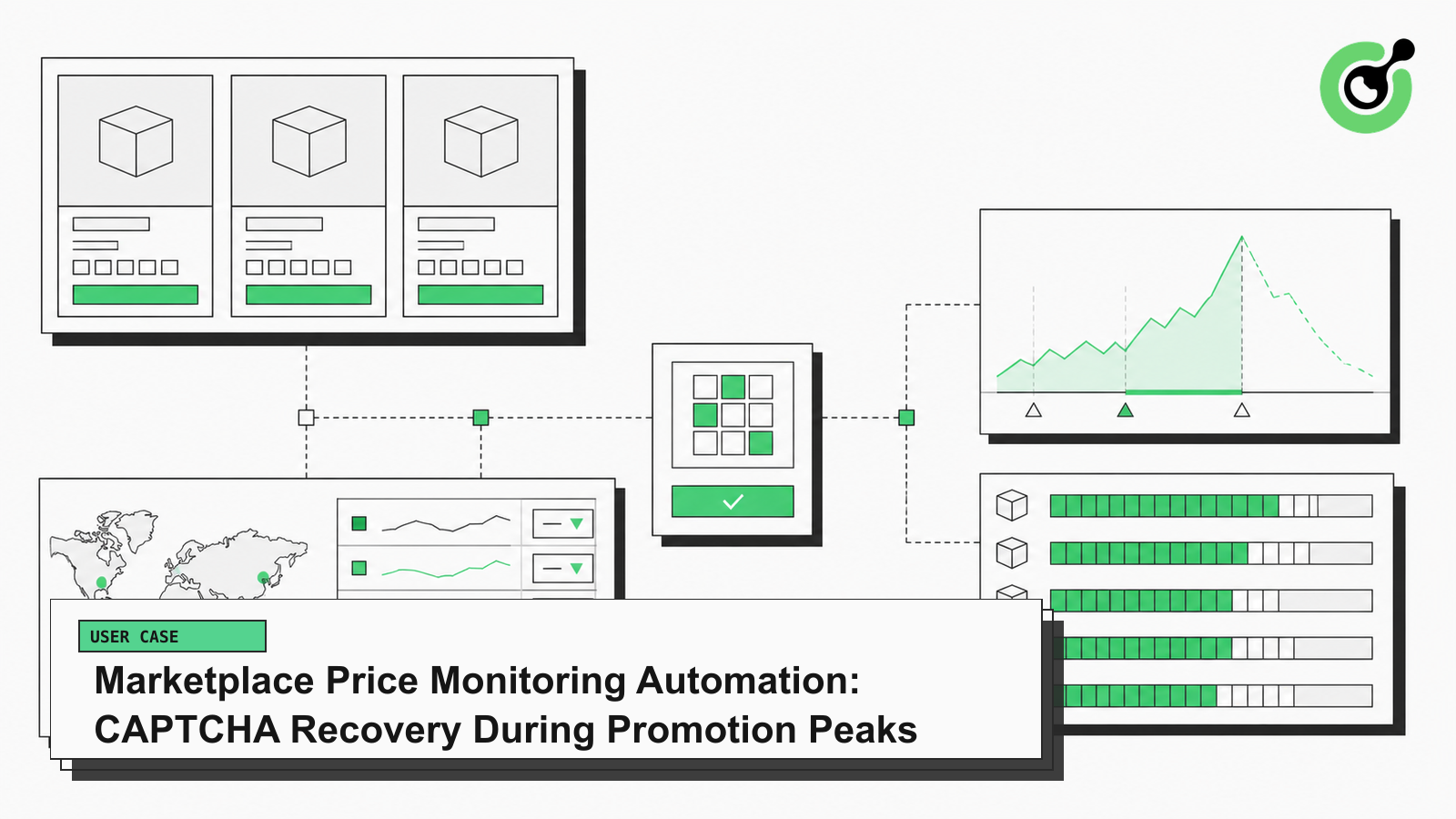
Marketplace price monitoring automation becomes hardest when a promotion window changes prices, inventory, shipping promises, and regional availability at the same time. CapSolver can serve as a bounded CAPTCHA recovery step when an authorized monitor reaches reCAPTCHA or Cloudflare Turnstile, but it does not replace product identity, change validation, or traffic governance. This guide designs a brand-neutral cross-border retail workflow for high-traffic promotion peaks. It separates observation from interpretation, protects a stable product key across regions, and stops when a challenge repeats or the page changes. Use marketplace price monitoring automation only for lawful, reasonable, responsible, user-authorized collection of public or otherwise permitted product data. Respect terms, rate limits, data rights, and regional obligations.
The CapSolver-specific implementation in this workflow is grounded in reCAPTCHA v2 tasks, reCAPTCHA v3 tasks, Cloudflare Turnstile tasks. Select the task guide that matches the challenge detected in the authorized page. Do not mix task fields between CAPTCHA families, and do not invent callbacks or response properties. The application owns input validation, retries, result use, and the final business assertion.
The input is a previous and current normalized observation. The output is a quality state, not an automatic pricing decision. The function stops on missing timezone, currency drift, product or region mismatch, and nonpositive prices. CAPTCHA recovery happens before parsing and must return to the same authorized observation context.
from dataclasses import dataclass
from decimal import Decimal
from datetime import datetime, timezone

@dataclass(frozen=True)
class Observation:
    product_key: str
    region: str
    currency: str
    displayed_price: Decimal
    reference_price: Decimal | None
    stock_state: str
    captured_at: datetime

def accept_observation(previous, current):
    if current.captured_at.tzinfo is None:
        return "REVIEW_MISSING_TIMEZONE"
    if current.currency != previous.currency:
        return "REVIEW_CURRENCY_CHANGE"
    if current.product_key != previous.product_key or current.region != previous.region:
        return "REVIEW_IDENTITY_CHANGE"
    if current.displayed_price <= 0:
        return "REVIEW_INVALID_PRICE"
return "ACCEPT_CANDIDATE_CHANGE"marketplace price monitoring automation needs a clear business scope for this stage. The record should cover approved product set, target regions, currency, promotion interval, inventory fields, and reporting cadence. These fields belong to one observation or checkpoint so later systems can explain exactly what changed. The practical rule is to write the question before collection; the conservative boundary is to exclude private account and checkout data. A pipeline that omits this boundary may produce a technically successful request with an unusable or misleading business result.
Start with approved product set, then connect it to target regions, currency, promotion interval. Store values in typed fields rather than a free-form message. Include capture time, correlation ID, and the policy decision that permitted the operation. If a field is unavailable, preserve an explicit unknown state. Do not replace missing evidence with a default that looks like a real observation.
The surrounding workflow should compare the current packet with the immediately preceding valid packet. A difference in target regions may be expected, while a difference in currency can invalidate the entire job. The decision engine should therefore emit ACCEPT, RETRY_ONCE, REVIEW, or STOP with a reason. Operational telemetry can follow HTTP Semantics while keeping credentials, cookies, raw solution values, and unnecessary page content out of logs.
The stop rule is operational, not decorative. When the workflow must exclude private account and checkout data, it should cancel pending child work, preserve a redacted evidence summary, and release its queue lock. The next run begins from a fresh authorized state rather than inheriting stale browser or task context. This behavior makes marketplace price monitoring automation auditable under load and prevents a small ambiguity from becoming repeated traffic.
The ecommerce price-monitoring CAPTCHA workflow provides adjacent context for this decision. Use that material to understand the failure family, then keep this article's narrower contract: write the question before collection. The output of the stage is a machine-readable state plus enough evidence for an operator to reproduce the decision. The output is not permission to expand scope, ignore a rate signal, or access data outside the approved purpose.
marketplace price monitoring automation needs a clear entity key for this stage. The record should cover merchant-neutral product ID, variant, pack size, region, language, and fulfillment mode. These fields belong to one observation or checkpoint so later systems can explain exactly what changed. The practical rule is to join observations on durable fields; the conservative boundary is to send ambiguous matches to review. A pipeline that omits this boundary may produce a technically successful request with an unusable or misleading business result.
Start with merchant-neutral product ID, then connect it to variant, pack size, region. Store values in typed fields rather than a free-form message. Include capture time, correlation ID, and the policy decision that permitted the operation. If a field is unavailable, preserve an explicit unknown state. Do not replace missing evidence with a default that looks like a real observation.
The surrounding workflow should compare the current packet with the immediately preceding valid packet. A difference in variant may be expected, while a difference in pack size can invalidate the entire job. The decision engine should therefore emit ACCEPT, RETRY_ONCE, REVIEW, or STOP with a reason. Evidence retention should reflect W3C Trace Context while keeping credentials, cookies, raw solution values, and unnecessary page content out of logs.
The stop rule is operational, not decorative. When the workflow must send ambiguous matches to review, it should cancel pending child work, preserve a redacted evidence summary, and release its queue lock. The next run begins from a fresh authorized state rather than inheriting stale browser or task context. This behavior makes marketplace price monitoring automation auditable under load and prevents a small ambiguity from becoming repeated traffic.
The price intelligence under CAPTCHA pressure provides adjacent context for this decision. Use that material to understand the failure family, then keep this article's narrower contract: join observations on durable fields. The output of the stage is a machine-readable state plus enough evidence for an operator to reproduce the decision. The output is not permission to expand scope, ignore a rate signal, or access data outside the approved purpose.
marketplace price monitoring automation needs a clear observation schema for this stage. The record should cover displayed price, reference price, unit price, promotion condition, stock state, shipping promise, and timestamp. These fields belong to one observation or checkpoint so later systems can explain exactly what changed. The practical rule is to store raw evidence hash with normalized values; the conservative boundary is to do not treat a missing field as zero. A pipeline that omits this boundary may produce a technically successful request with an unusable or misleading business result.
Start with displayed price, then connect it to reference price, unit price, promotion condition. Store values in typed fields rather than a free-form message. Include capture time, correlation ID, and the policy decision that permitted the operation. If a field is unavailable, preserve an explicit unknown state. Do not replace missing evidence with a default that looks like a real observation.
The surrounding workflow should compare the current packet with the immediately preceding valid packet. A difference in reference price may be expected, while a difference in unit price can invalidate the entire job. The decision engine should therefore emit ACCEPT, RETRY_ONCE, REVIEW, or STOP with a reason. Timeout and trace design can use OWASP Logging Guidance while keeping credentials, cookies, raw solution values, and unnecessary page content out of logs.
The stop rule is operational, not decorative. When the workflow must do not treat a missing field as zero, it should cancel pending child work, preserve a redacted evidence summary, and release its queue lock. The next run begins from a fresh authorized state rather than inheriting stale browser or task context. This behavior makes marketplace price monitoring automation auditable under load and prevents a small ambiguity from becoming repeated traffic.
The price-monitoring agent recovery provides adjacent context for this decision. Use that material to understand the failure family, then keep this article's narrower contract: store raw evidence hash with normalized values. The output of the stage is a machine-readable state plus enough evidence for an operator to reproduce the decision. The output is not permission to expand scope, ignore a rate signal, or access data outside the approved purpose.
marketplace price monitoring automation needs a clear adaptive cadence for this stage. The record should cover baseline interval, launch window, inventory volatility, challenge rate, HTTP status, and queue age. These fields belong to one observation or checkpoint so later systems can explain exactly what changed. The practical rule is to increase freshness without unbounded traffic; the conservative boundary is to reduce concurrency when risk signals rise. A pipeline that omits this boundary may produce a technically successful request with an unusable or misleading business result.
Start with baseline interval, then connect it to launch window, inventory volatility, challenge rate. Store values in typed fields rather than a free-form message. Include capture time, correlation ID, and the policy decision that permitted the operation. If a field is unavailable, preserve an explicit unknown state. Do not replace missing evidence with a default that looks like a real observation.
The surrounding workflow should compare the current packet with the immediately preceding valid packet. A difference in launch window may be expected, while a difference in inventory volatility can invalidate the entire job. The decision engine should therefore emit ACCEPT, RETRY_ONCE, REVIEW, or STOP with a reason. Implementation boundaries are consistent with HTTP Semantics while keeping credentials, cookies, raw solution values, and unnecessary page content out of logs.
The stop rule is operational, not decorative. When the workflow must reduce concurrency when risk signals rise, it should cancel pending child work, preserve a redacted evidence summary, and release its queue lock. The next run begins from a fresh authorized state rather than inheriting stale browser or task context. This behavior makes marketplace price monitoring automation auditable under load and prevents a small ambiguity from becoming repeated traffic.
The ecommerce product data collection provides adjacent context for this decision. Use that material to understand the failure family, then keep this article's narrower contract: increase freshness without unbounded traffic. The output of the stage is a machine-readable state plus enough evidence for an operator to reproduce the decision. The output is not permission to expand scope, ignore a rate signal, or access data outside the approved purpose.
marketplace price monitoring automation needs a clear recovery boundary for this stage. The record should cover challenge type, page URL, public site key, browser session, product key, and attempt count. These fields belong to one observation or checkpoint so later systems can explain exactly what changed. The practical rule is to run one context-bound recovery; the conservative boundary is to stop on a second challenge or route change. A pipeline that omits this boundary may produce a technically successful request with an unusable or misleading business result.
Start with challenge type, then connect it to page URL, public site key, browser session. Store values in typed fields rather than a free-form message. Include capture time, correlation ID, and the policy decision that permitted the operation. If a field is unavailable, preserve an explicit unknown state. Do not replace missing evidence with a default that looks like a real observation.
The surrounding workflow should compare the current packet with the immediately preceding valid packet. A difference in page URL may be expected, while a difference in public site key can invalidate the entire job. The decision engine should therefore emit ACCEPT, RETRY_ONCE, REVIEW, or STOP with a reason. Operational telemetry can follow W3C Trace Context while keeping credentials, cookies, raw solution values, and unnecessary page content out of logs.
The stop rule is operational, not decorative. When the workflow must stop on a second challenge or route change, it should cancel pending child work, preserve a redacted evidence summary, and release its queue lock. The next run begins from a fresh authorized state rather than inheriting stale browser or task context. This behavior makes marketplace price monitoring automation auditable under load and prevents a small ambiguity from becoming repeated traffic.
The price intelligence definition provides adjacent context for this decision. Use that material to understand the failure family, then keep this article's narrower contract: run one context-bound recovery. The output of the stage is a machine-readable state plus enough evidence for an operator to reproduce the decision. The output is not permission to expand scope, ignore a rate signal, or access data outside the approved purpose.
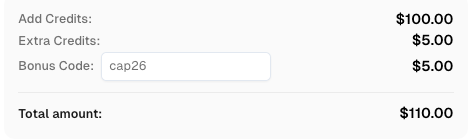
Redeem Your CapSolver Bonus Code
Boost your automation budget instantly!
Use bonus code CAP26 when topping up your CapSolver account to get an extra 5% bonus on every recharge — with no limits.
Redeem it now in your CapSolver Dashboard
marketplace price monitoring automation needs a clear quality rules for this stage. The record should cover currency, tax display, coupon condition, membership condition, unit basis, and reference-price semantics. These fields belong to one observation or checkpoint so later systems can explain exactly what changed. The practical rule is to separate observed facts from derived labels; the conservative boundary is to require review for impossible deltas. A pipeline that omits this boundary may produce a technically successful request with an unusable or misleading business result.
Start with currency, then connect it to tax display, coupon condition, membership condition. Store values in typed fields rather than a free-form message. Include capture time, correlation ID, and the policy decision that permitted the operation. If a field is unavailable, preserve an explicit unknown state. Do not replace missing evidence with a default that looks like a real observation.
The surrounding workflow should compare the current packet with the immediately preceding valid packet. A difference in tax display may be expected, while a difference in coupon condition can invalidate the entire job. The decision engine should therefore emit ACCEPT, RETRY_ONCE, REVIEW, or STOP with a reason. Evidence retention should reflect OWASP Logging Guidance while keeping credentials, cookies, raw solution values, and unnecessary page content out of logs.
The stop rule is operational, not decorative. When the workflow must require review for impossible deltas, it should cancel pending child work, preserve a redacted evidence summary, and release its queue lock. The next run begins from a fresh authorized state rather than inheriting stale browser or task context. This behavior makes marketplace price monitoring automation auditable under load and prevents a small ambiguity from becoming repeated traffic.
The price monitoring value provides adjacent context for this decision. Use that material to understand the failure family, then keep this article's narrower contract: separate observed facts from derived labels. The output of the stage is a machine-readable state plus enough evidence for an operator to reproduce the decision. The output is not permission to expand scope, ignore a rate signal, or access data outside the approved purpose.
marketplace price monitoring automation needs a clear availability states for this stage. The record should cover in stock, limited, back order, unavailable, unknown, region restricted, and stale. These fields belong to one observation or checkpoint so later systems can explain exactly what changed. The practical rule is to confirm changes across bounded samples; the conservative boundary is to preserve unknown instead of guessing. A pipeline that omits this boundary may produce a technically successful request with an unusable or misleading business result.
Start with in stock, then connect it to limited, back order, unavailable. Store values in typed fields rather than a free-form message. Include capture time, correlation ID, and the policy decision that permitted the operation. If a field is unavailable, preserve an explicit unknown state. Do not replace missing evidence with a default that looks like a real observation.
The surrounding workflow should compare the current packet with the immediately preceding valid packet. A difference in limited may be expected, while a difference in back order can invalidate the entire job. The decision engine should therefore emit ACCEPT, RETRY_ONCE, REVIEW, or STOP with a reason. Timeout and trace design can use HTTP Semantics while keeping credentials, cookies, raw solution values, and unnecessary page content out of logs.
The stop rule is operational, not decorative. When the workflow must preserve unknown instead of guessing, it should cancel pending child work, preserve a redacted evidence summary, and release its queue lock. The next run begins from a fresh authorized state rather than inheriting stale browser or task context. This behavior makes marketplace price monitoring automation auditable under load and prevents a small ambiguity from becoming repeated traffic.
The ecommerce price-monitoring CAPTCHA workflow provides adjacent context for this decision. Use that material to understand the failure family, then keep this article's narrower contract: confirm changes across bounded samples. The output of the stage is a machine-readable state plus enough evidence for an operator to reproduce the decision. The output is not permission to expand scope, ignore a rate signal, or access data outside the approved purpose.
marketplace price monitoring automation needs a clear traffic governance for this stage. The record should cover per-host concurrency, jittered schedule, cache, circuit breaker, retry budget, and operator pause. These fields belong to one observation or checkpoint so later systems can explain exactly what changed. The practical rule is to protect both the source and pipeline; the conservative boundary is to do not react to commercial urgency with unsafe volume. A pipeline that omits this boundary may produce a technically successful request with an unusable or misleading business result.
Start with per-host concurrency, then connect it to jittered schedule, cache, circuit breaker. Store values in typed fields rather than a free-form message. Include capture time, correlation ID, and the policy decision that permitted the operation. If a field is unavailable, preserve an explicit unknown state. Do not replace missing evidence with a default that looks like a real observation.
The surrounding workflow should compare the current packet with the immediately preceding valid packet. A difference in jittered schedule may be expected, while a difference in cache can invalidate the entire job. The decision engine should therefore emit ACCEPT, RETRY_ONCE, REVIEW, or STOP with a reason. Implementation boundaries are consistent with W3C Trace Context while keeping credentials, cookies, raw solution values, and unnecessary page content out of logs.
The stop rule is operational, not decorative. When the workflow must do not react to commercial urgency with unsafe volume, it should cancel pending child work, preserve a redacted evidence summary, and release its queue lock. The next run begins from a fresh authorized state rather than inheriting stale browser or task context. This behavior makes marketplace price monitoring automation auditable under load and prevents a small ambiguity from becoming repeated traffic.
The price intelligence under CAPTCHA pressure provides adjacent context for this decision. Use that material to understand the failure family, then keep this article's narrower contract: protect both the source and pipeline. The output of the stage is a machine-readable state plus enough evidence for an operator to reproduce the decision. The output is not permission to expand scope, ignore a rate signal, or access data outside the approved purpose.
marketplace price monitoring automation needs a clear operational metrics for this stage. The record should cover freshness, identity match rate, field completeness, CAPTCHA rate, recovery outcome, and application assertion. These fields belong to one observation or checkpoint so later systems can explain exactly what changed. The practical rule is to report denominators and terminal states; the conservative boundary is to keep solving success separate from data success. A pipeline that omits this boundary may produce a technically successful request with an unusable or misleading business result.
Start with freshness, then connect it to identity match rate, field completeness, CAPTCHA rate. Store values in typed fields rather than a free-form message. Include capture time, correlation ID, and the policy decision that permitted the operation. If a field is unavailable, preserve an explicit unknown state. Do not replace missing evidence with a default that looks like a real observation.
The surrounding workflow should compare the current packet with the immediately preceding valid packet. A difference in identity match rate may be expected, while a difference in field completeness can invalidate the entire job. The decision engine should therefore emit ACCEPT, RETRY_ONCE, REVIEW, or STOP with a reason. Operational telemetry can follow OWASP Logging Guidance while keeping credentials, cookies, raw solution values, and unnecessary page content out of logs.
The stop rule is operational, not decorative. When the workflow must keep solving success separate from data success, it should cancel pending child work, preserve a redacted evidence summary, and release its queue lock. The next run begins from a fresh authorized state rather than inheriting stale browser or task context. This behavior makes marketplace price monitoring automation auditable under load and prevents a small ambiguity from becoming repeated traffic.
The price-monitoring agent recovery provides adjacent context for this decision. Use that material to understand the failure family, then keep this article's narrower contract: report denominators and terminal states. The output of the stage is a machine-readable state plus enough evidence for an operator to reproduce the decision. The output is not permission to expand scope, ignore a rate signal, or access data outside the approved purpose.
marketplace price monitoring automation needs a clear responsible operation for this stage. The record should cover authorization, terms, jurisdiction, localization, retention, access control, and deletion schedule. These fields belong to one observation or checkpoint so later systems can explain exactly what changed. The practical rule is to minimize stored evidence; the conservative boundary is to exclude credentials, personal data, and restricted content. A pipeline that omits this boundary may produce a technically successful request with an unusable or misleading business result.
Start with authorization, then connect it to terms, jurisdiction, localization. Store values in typed fields rather than a free-form message. Include capture time, correlation ID, and the policy decision that permitted the operation. If a field is unavailable, preserve an explicit unknown state. Do not replace missing evidence with a default that looks like a real observation.
The surrounding workflow should compare the current packet with the immediately preceding valid packet. A difference in terms may be expected, while a difference in jurisdiction can invalidate the entire job. The decision engine should therefore emit ACCEPT, RETRY_ONCE, REVIEW, or STOP with a reason. Evidence retention should reflect HTTP Semantics while keeping credentials, cookies, raw solution values, and unnecessary page content out of logs.
The stop rule is operational, not decorative. When the workflow must exclude credentials, personal data, and restricted content, it should cancel pending child work, preserve a redacted evidence summary, and release its queue lock. The next run begins from a fresh authorized state rather than inheriting stale browser or task context. This behavior makes marketplace price monitoring automation auditable under load and prevents a small ambiguity from becoming repeated traffic.
The ecommerce product data collection provides adjacent context for this decision. Use that material to understand the failure family, then keep this article's narrower contract: minimize stored evidence. The output of the stage is a machine-readable state plus enough evidence for an operator to reproduce the decision. The output is not permission to expand scope, ignore a rate signal, or access data outside the approved purpose.
marketplace price monitoring automation is reliable only when each stage has a defined input, typed output, evidence record, and terminal stop condition. The workflow should preserve authorization and context, use official CapSolver surfaces, keep retries bounded, and validate the original application or business state after every recovery. Teams operating lawful and permitted automation can evaluate CapSolver for the documented CAPTCHA layer while retaining deterministic policy and review controls in their own application.
Q: What is marketplace price monitoring automation?
Marketplace price monitoring automation is a controlled process that records normalized public or permitted product prices and availability by product, region, currency, and time.
Q: Why capture inventory with promotion price?
Inventory explains whether a displayed promotion is actually available and prevents a price record from losing its commercial context.
Q: How should CAPTCHA recovery work during a promotion peak?
Pause one authorized observation, preserve its browser and product context, recover once, and verify that the same product page is still active.
Q: Should the monitor increase traffic when products change quickly?
Only within approved limits. Use adaptive scheduling, caching, jitter, and circuit breakers instead of unbounded concurrency.
Q: Can this workflow collect private marketplace data?
No. Collect only public or otherwise permitted data and exclude private, restricted, sensitive, or unauthorized content.
Ethan Collins
AI Agent Workflow Engineer
Building clearer handoffs between AI agents and tools.
ABOUT THE AUTHOR
Learn scalable Rust web scraping architecture with reqwest, scraper, async scraping, headless browser scraping, proxy rotation, and compliant CAPTCHA handling.

Learn the best techniques to scrape job listings without getting blocked. Master Indeed scraping, Google Jobs API, and web scraping API with CapSolver.