🎉NEWCapSolver for AI agents-MCP, agent tools, and SDK integrations

Nikolai Smirnov
Software Development Lead
Published Oct 13, 2026
Updated Oct 13, 2026 · min read
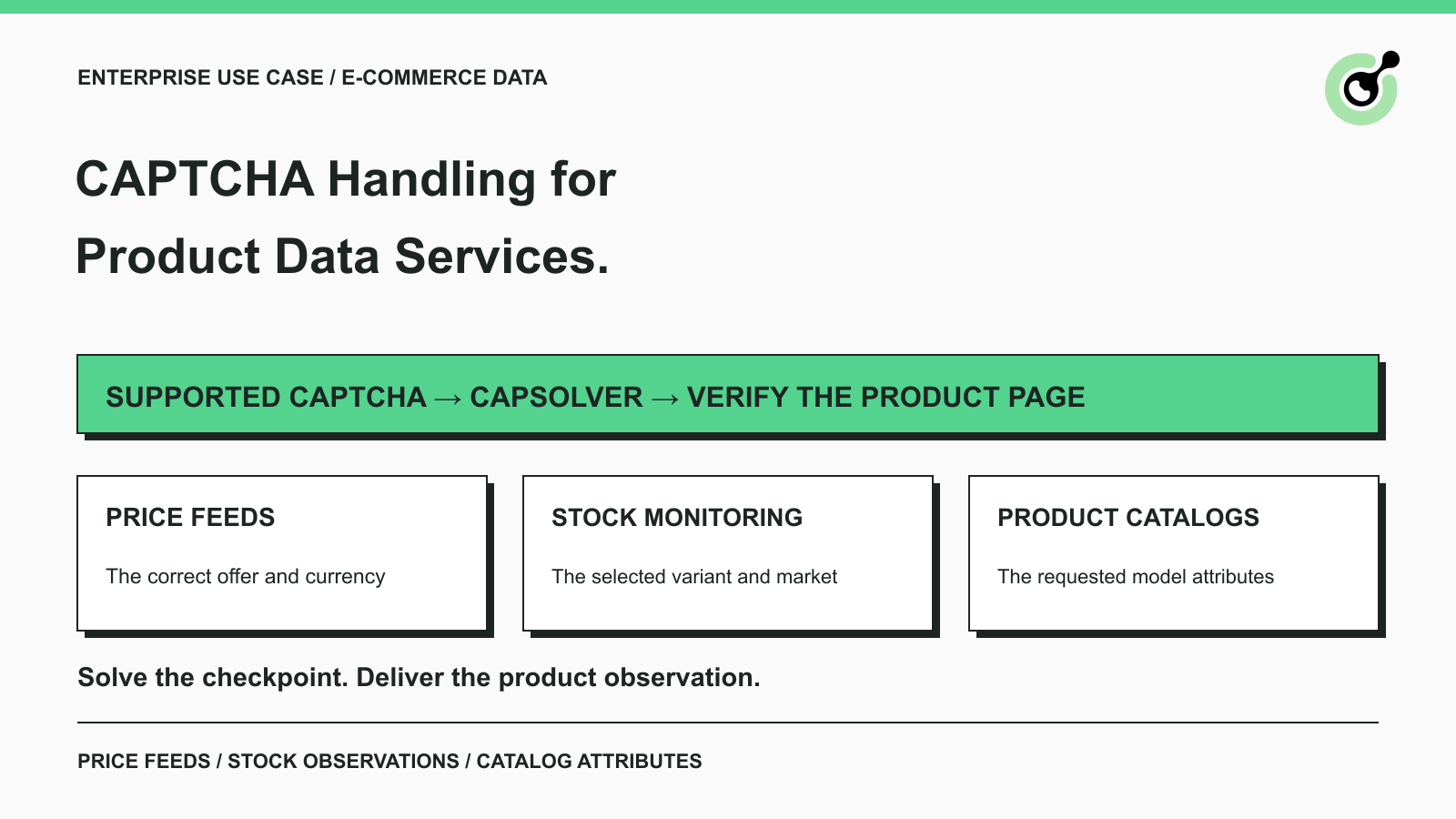
An e-commerce data provider sells usable product information: competitor prices for a retailer, stock observations for a brand, or standardized catalog attributes for a comparison platform. A CAPTCHA can interrupt one of the permitted source visits behind those deliveries. The immediate problem is getting that particular product observation through the supported verification step.
CapSolver can handle the matching CAPTCHA task so the collector can continue to the product data. The examples below are proposed enterprise workflows, not named customer deployments or performance claims. They apply to approved public-product sources and agreed data use; they do not involve customer accounts, checkout automation, or private order information.
CAPTCHA solving belongs between encountering a supported challenge and reading the product content needed for the customer's delivery.
The collector starts with an approved source and a specific product task. If the source returns the expected page, extraction can proceed. If a supported CAPTCHA appears, the collector pauses that observation, supplies the required challenge inputs to CapSolver, uses the returned result, and checks the product page again.
The three use cases have different definitions of a useful result:
| Service sold to the customer | Example customer | What must be available after solving |
|---|---|---|
| Product price feed | Retailer or pricing-intelligence platform | Correct product offer, price, currency, and observation time |
| Stock monitoring | Brand or distributor | Availability for the specified variant and market |
| Product catalog enrichment | Comparison platform or retail catalog team | Requested attributes for the correct product model |
A solver supplies a CAPTCHA result. Your service performs the data extraction, product matching, and customer delivery. Keeping those responsibilities clear makes it easier to diagnose the right problem when an observation is incomplete.
A price-feed provider uses CAPTCHA solving to continue a permitted product visit before extracting the offer its customer wants to compare.
Imagine a retailer that subscribes to a daily competitor-price feed for a selected group of products. The provider's job is to deliver comparable offers, including the correct seller, product variant, currency, and collection time. A CAPTCHA interruption leaves one observation unfinished; it does not mean the price changed.
Suppose a permitted source presents a text-image CAPTCHA before returning the requested product page. The collector captures the current image, encodes its bytes, and sends an ImageToTextTask. It uses the returned characters in the matching form and checks whether the intended offer is now visible.
If the observed challenge is reCAPTCHA instead, use the corresponding documented task and current page parameters. Do not keep sending image-recognition requests merely because the workflow was originally built for an image CAPTCHA.
After the supported solving step, confirm that the page still refers to the requested product and offer. A product can have several sellers or variants; reading a price from a different offer does not complete the original job.
Include enough offer context for the client to understand the number. A member-only price, unit price, or promotional condition should not silently become the general product price.
The Schema.org Offer vocabulary distinguishes fields such as price, currency, availability, and seller. Where a source exposes structured product information, those concepts can help organize the extracted result. They do not guarantee that the current page contains all required fields or that its markup is current.
An accepted observation should therefore connect the price to the actual product page and capture time. If the page is still a CAPTCHA screen, keep the observation unresolved. The provider can retain the last verified price as history, but should not present that earlier value as a fresh collection.
This use case is about continuing a specific price-collection task. It does not require the provider to change suppliers, rebuild its whole crawler, or let a language model infer the missing price.
A stock-monitoring provider uses CAPTCHA solving to reach the availability information for the exact product variant and market requested by its customer.
A brand may want to know whether its products are available across approved retail sources. A distributor may need a report of observed availability for selected items. The service delivers observations from those sources, not an assertion about a retailer's private inventory system.
In a hypothetical approved source workflow, the collector opens a product, selects the relevant size or configuration, and reaches a Turnstile checkpoint. The required observation concerns that selected variant, not the default product page.
Use the documented Turnstile task with the current page URL, sitekey, and any required context. The surrounding browser workflow must use the result through the intended page operation, then inspect the selected variant's availability.
Cloudflare's Turnstile validation documentation makes clear that server-side validation is part of the process. A returned token alone is not evidence that the retailer accepted the verification or displayed the intended stock information.
The collector should check the variant after the challenge step because a refresh or navigation may change what is selected. Where availability depends on a chosen region, retain that region with the observation. Avoid mixing results for different delivery areas into one stock status.
A challenge page is not an out-of-stock message. If the permitted attempt ends without a readable availability result, the customer report should identify that source observation as unavailable.
The ItemAvailability vocabulary includes distinct availability states. Preserve the meaning supplied by the source rather than collapsing every missing or unrecognized response into “out of stock.”
For the customer, the useful completion check is simple: the correct product variant, the requested market, the source's observed status, and a timestamp. If any of those are missing, the data provider should qualify the record instead of hiding the uncertainty behind a successful solver call.
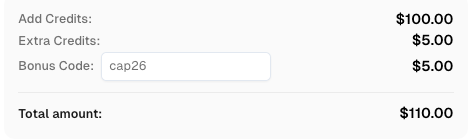
Redeem Your CapSolver Bonus Code
Boost your automation budget instantly!
Use bonus code CAP26 when topping up your CapSolver account to get an extra 5% bonus on every recharge — with no limits.
Redeem it now in your CapSolver Dashboard
A catalog-enrichment provider uses CAPTCHA solving to reach the source attributes needed to complete a product record.
A comparison platform might need dimensions, materials, compatibility, or pack size for a product. A retail catalog team may need to fill a missing specification from an approved manufacturer or distributor source. The provider's deliverable is a sourced attribute attached to the correct product model.
Suppose a permitted catalog search displays reCAPTCHA before returning a technical product page. The collector records the current page inputs and uses the matching reCAPTCHA v2 task. After applying the response through the application's supported flow, it opens the intended result and reads the requested fields.
Google's reCAPTCHA verification rules include token validity and single-use requirements. The collection job should therefore consume a result for its current operation rather than save it as a reusable catalog credential.
The solver does not infer the product's missing attributes. If the resulting page does not contain a requested specification, return it as unavailable or consult another approved source with clear attribution.
Check the model identifier, variation, unit, and source passage for the attribute. A manufacturer can sell related products with similar names but different specifications. CAPTCHA completion does not resolve that product-matching problem.
Keep a record of where the value came from and when it was obtained. This lets the customer distinguish a manufacturer specification from a reseller description and investigate conflicts later.
For an example, a pack size of six and a single-unit size answer different catalog questions. The provider should preserve the source's unit meaning rather than deliver a bare number that the customer may apply incorrectly.
This is an enterprise use for CAPTCHA solving because an interruption affects a contracted data deliverable. The practical goal remains narrow: reach the approved source, read the requested attribute, and return it with enough context to use.
Select a CapSolver task by inspecting the current challenge, rather than assuming a particular retailer always uses the same system.
For text images, submit image bytes through ImageToTextTask and consume the recognized text. For reCAPTCHA or Turnstile, follow the task's documented parameters and token handling. If a full-page challenge or unsupported protection appears, do not relabel it as a supported widget to keep the job moving.
CapSolver's task creation interface is the service entry point. Some task types return results directly; others require retrieving the created task's result. Keep the response handling specific to the selected task.
The existing e-commerce CAPTCHA guide provides broader background. For implementation, use current task documentation rather than copying an old retailer-to-CAPTCHA mapping or an unsupported success-rate claim.
Start with one approved product visit and verify it end to end before enabling the same handling for scheduled customer deliveries. Test the real source behavior instead of treating a generic demo result as proof of compatibility with every source.
A data provider should use CAPTCHA solving only where it supports a defined, permitted collection task and a verifiable customer result.
Agree on the product scope, source permissions, delivery schedule, and meaning of missing observations. If an official API or licensed feed already provides the data, use that route without adding a solving step.
When a challenge does interrupt the browser path, keep retries bounded and preserve the source's operating limits. A CAPTCHA result does not authorize additional collection or a change in data scope. Do not extend a public-product job into customer accounts, checkout, or private purchase history.
Record enough technical evidence to distinguish a solver error from a parsing error or a wrong product match. Avoid storing account keys and raw tokens in customer-facing reports. The customer usually needs the observation and its qualification, not the secret material used during collection.
Price feeds, stock monitoring, and catalog enrichment all depend on reaching the right product information. A supported CAPTCHA can be handled as a specific step within each of those deliveries.
CapSolver supplies the recognition or token result for the matching task. Continue the approved operation, confirm the product data, and deliver the observation your customer actually requested.
Q: Which e-commerce businesses would use this workflow?
Data providers serving retailers, brands, distributors, pricing platforms, and comparison services can evaluate it for permitted sources where supported CAPTCHAs actually interrupt collection.
Q: Should every product page be sent to a solver?
No. Use a solver only after identifying a supported CAPTCHA. Normal pages, approved APIs, and licensed feeds do not need an extra solving request.
Q: Can CAPTCHA solving determine whether a product is in stock?
No. Solving can help the collector reach the relevant page. The source's actual availability information, for the correct variant and market, determines the observation.
Q: Can we use the same task type for every retailer?
No. Inspect the observed challenge and follow the corresponding documented task. Challenge behavior can differ across pages and change over time.
Q: What should we deliver when the source remains blocked?
Return a clear collection gap or qualified partial delivery. Do not convert missing content into a zero price, out-of-stock result, or invented catalog attribute.
Nikolai Smirnov
Software Development Lead
Building dependable software for complex automation.
ABOUT THE AUTHOR
Learn scalable Rust web scraping architecture with reqwest, scraper, async scraping, headless browser scraping, proxy rotation, and compliant CAPTCHA handling.

Learn the best techniques to scrape job listings without getting blocked. Master Indeed scraping, Google Jobs API, and web scraping API with CapSolver.