🎉NEWCapSolver for AI agents-MCP, agent tools, and SDK integrations

Lucas Mitchell
Automation Engineer
Published Aug 25, 2026
Updated Aug 25, 2026 · min read
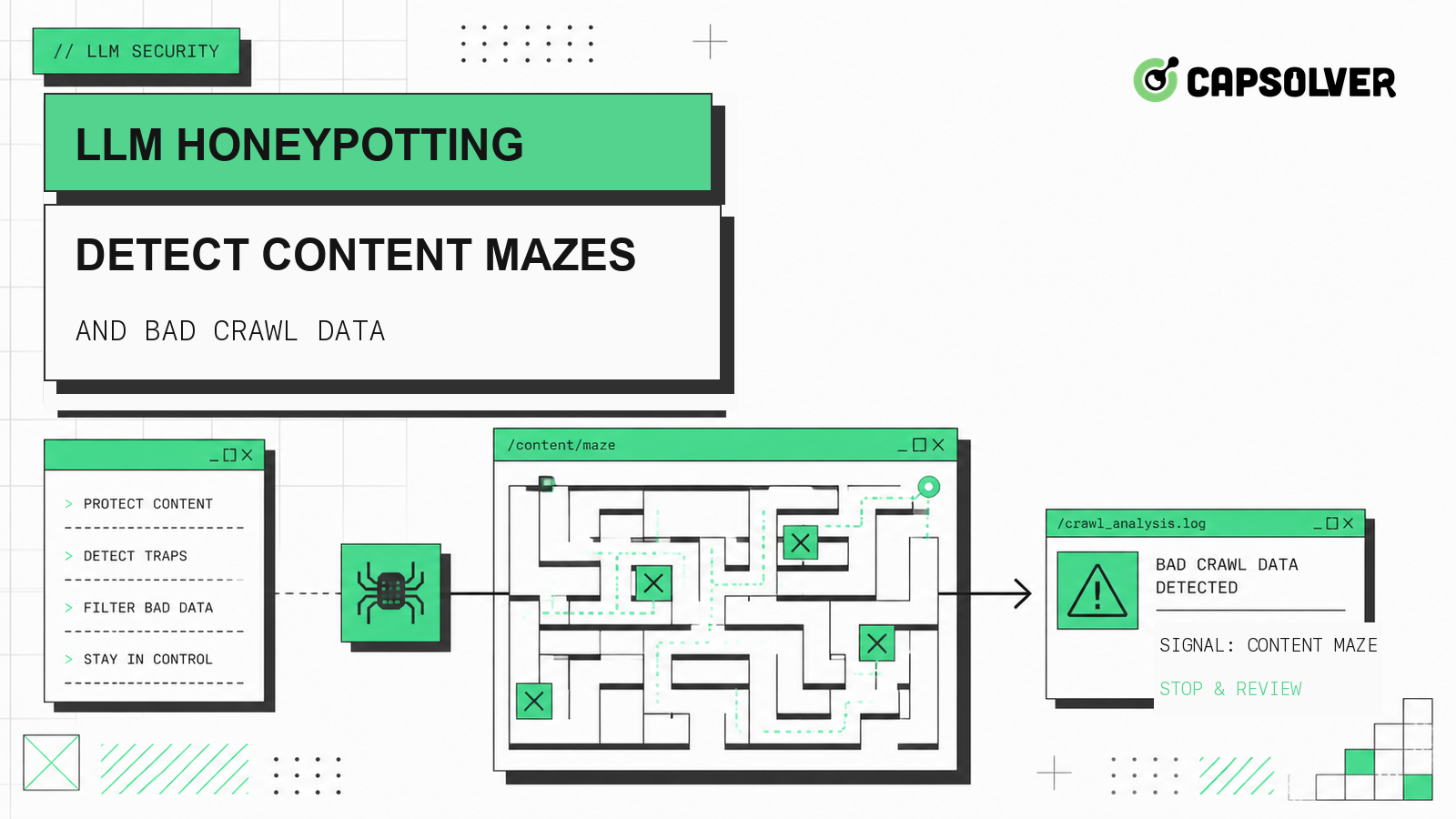
LLM honeypotting changes the meaning of a “successful” crawl. A page may load, parse, and expose links while contributing no trustworthy information. That creates a data-quality and safety problem for AI agents, RAG systems, browser automation, and web-data pipelines. The right response is not to find a route around a suspected trap. It is to detect abnormal crawl behavior, preserve evidence, quarantine uncertain content, and stop within a predefined budget. This guide turns those principles into a practical validation model and a runnable offline guard. In an independently authorized workflow, CapSolver may handle a supported CAPTCHA interruption, but it cannot establish page truth, access permission, or dataset quality.
LLM honeypotting is an emerging label for deceptive web content or navigation designed to consume crawler resources or contaminate collected data. It is related to the older honeypot technique, but the data-pipeline risk is different from a hidden form field. The crawler may receive fluent text, plausible page titles, normal markup, and more discoverable links. The failure appears downstream rather than at the network boundary.
Cloudflare publicly describes an AI Labyrinth for unauthorized crawlers that links detected bots into pre-generated AI pages. This is one documented implementation, not a universal specification. Other sites can create near-infinite URL spaces accidentally through calendars, faceted navigation, session parameters, or broken pagination. Therefore, LLM honeypotting detection should produce a risk decision, not an unsupported accusation about a website's intent.
A content maze expands the crawl graph. New URLs appear faster than useful terminal pages, paths become unusually deep, and similar content repeats under new addresses. The immediate cost is wasted requests, rendering, tokens, storage, and operator time.
AI crawler data poisoning is a record-quality failure. A page can contain fabricated entities, unsupported claims, contradictory dates, or generated filler that passes a schema check. The immediate risk is that the record enters retrieval, training, evaluation, or agent memory as if it were verified evidence.
The same site can exhibit both patterns, but they require different controls. Graph budgets stop unbounded discovery. Content validation and provenance prevent untrusted records from reaching production.
HTTP status answers whether a response was served, not whether the content is useful or true. LLM honeypotting exploits that gap. A crawler that treats every 200 response as an accepted document can report high throughput while the usable-data ratio falls.
For an AI agent, contaminated retrieval can produce false summaries or waste its tool budget. For RAG, repeated synthetic pages can dominate nearest-neighbor results. For a web-data pipeline, duplicated records inflate coverage metrics and make later cleanup more expensive. The data-quality definition is helpful here: usability depends on accuracy, completeness, consistency, and timeliness for the intended purpose, not merely on successful transport.
Keep two independent fields:
fetch_state: fetched, redirected, denied, challenged, timed out, or failed;evidence_state: accepted, quarantined, rejected, or pending human review.A fetched page can still be quarantined. A solved challenge can still yield an invalid page. A canonical page can still contain claims that require source verification. This separation prevents automation success metrics from masking bad input.
No single heuristic proves LLM honeypotting. Use layered evidence and treat ambiguous results conservatively.
| Layer | Evidence to record | Suspicious pattern | Safe response |
|---|---|---|---|
| Protocol | robots result, status, redirect chain, content type | disallowed route, unexpected status, repeated redirect | stop or quarantine; do not retry blindly |
| Identity | URL, canonical, sitemap membership, page title | many URLs claim the same canonical or lack stable identity | consolidate, quarantine, and review |
| Graph | depth, parent, outlink count, repeated path pattern | frontier expands rapidly without useful terminal pages | stop discovery at the configured budget |
| Content | fingerprint, similarity, unique-token ratio, named evidence | near-duplicate or fluent text with little verifiable information | exclude from downstream indexes pending review |
| Provenance | observed time, source, collector version, authorization record | content cannot be traced to an approved acquisition event | reject promotion to production |
The Robots Exclusion Protocol standard says a crawler that successfully downloads robots.txt must follow its parseable rules. Robots compliance belongs before page scoring. If the route is disallowed, the correct outcome is a terminal stop, not an attempt to collect enough content to decide whether the page looks suspicious.
Cache the robots decision with its retrieval time and applicable user agent. Handle unavailable or unreachable rules according to policy and the standard. When authorization or policy is unclear, fail closed and ask an owner.
Canonical metadata is evidence, not absolute truth. Google's canonicalization explanation describes canonical selection as grouping duplicate or very similar pages and selecting a representative URL. It also distinguishes redirects, canonical annotations, and sitemap inclusion as signals.
For crawl validation, compare the fetched URL, declared canonical, normalized URL, sitemap membership, and expected navigation path. Escalate when many deep URLs point to one canonical, when a page alternates canonical targets, or when discovered inventory grows far beyond the authorized seed set. Do not assume that every off-sitemap URL is malicious; many legitimate sites have incomplete sitemaps.
A bounded crawler should know its maximum depth, maximum pages per host, maximum new links per page, maximum redirects, and wall-clock deadline before it starts. Record the frontier size after every page. The most useful signal is acceleration: the queue grows while accepted unique content remains flat.
LLM honeypotting can create a long chain or a branching maze. Both are controlled by explicit budgets. When a hard budget triggers, preserve the parent path and last accepted page, then stop the host. Increasing the limit during the same run destroys the value of the control.
Hashing exact bytes catches identical pages but misses small variations. Shingles, MinHash, SimHash, or embedding similarity can identify near-duplicates at different cost and recall levels. The Google Research publication on near-duplicate detection for web crawling establishes this as a core large-scale crawling problem, not a signal unique to deliberate mazes.
Compare cleaned main text, not raw HTML containing timestamps, navigation, or rotating identifiers. Keep the chosen threshold versioned by source class. A documentation site, forum, and catalog naturally have different template repetition.
The safest example evaluates records already collected through an authorized process. It does not fetch URLs. Each JSON record includes URL identity, robots decision, status, depth, redirect count, sitemap membership, text, and outlink count.
#!/usr/bin/env python3
import argparse, json, re
from pathlib import Path
from urllib.parse import urldefrag

def tokens(text):
    return re.findall(r"[a-z0-9]+", text.lower())

def shingles(text, width=4):
    words = tokens(text)
    if len(words) < width:
        return {" ".join(words)} if words else set()
    return {" ".join(words[i:i + width]) for i in range(len(words) - width + 1)}

def jaccard(left, right):
    union = left | right
    return len(left & right) / len(union) if union else 1.0

def evaluate(records, max_depth=4, max_outlinks=40,
             min_unique_ratio=0.45, duplicate_threshold=0.75):
    accepted_fingerprints, results = [], []
    hard_stop = False
    for page in records:
        page_tokens = tokens(page.get("text", ""))
        fingerprint = shingles(page.get("text", ""))
        similarity = max(
            (jaccard(fingerprint, previous) for previous in accepted_fingerprints),
            default=0.0,
        )
        unique_ratio = len(set(page_tokens)) / len(page_tokens) if page_tokens else 0.0
        canonical = urldefrag(page.get("canonical", ""))[0]
        current = urldefrag(page["url"])[0]
        signals = []
        if not page.get("robots_allowed", False): signals.append("robots_disallowed")
        if page.get("status") != 200: signals.append("unexpected_status")
        if not canonical or canonical != current: signals.append("canonical_mismatch")
        if page.get("depth", 0) > max_depth: signals.append("depth_budget_exceeded")
        if page.get("outlinks", 0) > max_outlinks: signals.append("frontier_expansion")
        if not page.get("in_sitemap", False): signals.append("outside_known_inventory")
        if similarity >= duplicate_threshold: signals.append("near_duplicate")
        if unique_ratio < min_unique_ratio: signals.append("low_information_density")
        terminal = any(signal in signals for signal in
                       ("robots_disallowed", "depth_budget_exceeded", "frontier_expansion"))
        decision = "stop" if terminal else "quarantine" if signals else "accept"
        hard_stop = hard_stop or terminal
        if decision == "accept": accepted_fingerprints.append(fingerprint)
        results.append({"url": page["url"], "decision": decision,
                        "similarity": round(similarity, 3),
                        "unique_ratio": round(unique_ratio, 3), "signals": signals})
    return {"pipeline_decision": "stop_and_review" if hard_stop else "continue_bounded",
            "pages": results}

parser = argparse.ArgumentParser()
parser.add_argument("records", type=Path)
args = parser.parse_args()
records = json.loads(args.records.read_text(encoding="utf-8"))
print(json.dumps(evaluate(records), indent=2, sort_keys=True))
Run it against a synthetic or approved fixture:
python3 crawl_guard.py crawl-records.jsonIn the tested fixture, two known pages were accepted. A third page was outside known inventory, exceeded the configured depth, exposed more outlinks than the frontier budget, and was highly similar to an accepted page. The output was stop_and_review. No request was retried.
The numbers in the example are not universal internet standards. Set them from an approved source inventory and a representative baseline. A narrow documentation crawl might allow depth four; another legitimate site may require more. Measure known-good sessions, choose a conservative envelope, and review threshold changes separately from a live incident.
Low information density is also contextual. Repetition can be legitimate in legal notices, tables, catalogs, or localized templates. The guard should quarantine uncertain pages, not delete source evidence or label a publisher malicious.
Do not send raw crawl output directly to embeddings. Introduce a promotion boundary:
raw: immutable response, request metadata, robots decision, and acquisition authorization;parsed: extracted main text, canonical, language, entities, dates, and links;validated: schema, similarity, inventory, factual cross-check, and graph-budget results;approved: records allowed into retrieval, training, analytics, or persistent agent memory.The W3C PROV-O model provides a standard vocabulary for representing entities, activities, and agents involved in producing data. A team does not need a full semantic-web deployment to adopt the principle. Store source URL, observed time, content hash, collector version, parent URL, validation version, authorization reference, and reviewer decision with every promoted record.
This ledger makes scraper data quality auditable. If a source later proves unreliable, the team can identify derived chunks, embeddings, summaries, and agent memories for removal or reevaluation.
A CAPTCHA interruption is a fetch-state event. A content maze is an evidence-quality risk. Combining them into one “access failed” branch hides the different responsibilities.
For a lawful, reasonable, user-authorized workflow, first verify that the domain, data scope, request rate, and page are approved. If a supported CAPTCHA interrupts that approved task, use the current official task specification and a strict attempt budget. The controlled CAPTCHA handling sequence separates permission, challenge detection, task execution, and post-result validation.
After recovery, restart content validation from zero. Recheck URL identity, canonical, expected fields, text similarity, depth, and provenance. A successful challenge result does not prove that the page belongs in an AI dataset. If the next page triggers maze signals, stop and quarantine it.
Redeem Your CapSolver Bonus Code
Boost your automation budget instantly!
Use bonus code CAP26 when topping up your CapSolver account to get an extra 5% bonus on every recharge — with no limits.
Redeem it now in your CapSolver Dashboard
LLM honeypotting becomes expensive when a system has no terminal state. Define stops as code and policy, not operator intuition.
Quarantine should prevent indexing and downstream use while preserving the raw artifact for a human. The broader distinction between web crawling and selective data extraction matters here: discovery does not create an obligation to fetch every link.
LLM honeypotting detection must not become a pretext for continuing where a site has said no. Follow applicable terms, contracts, robots rules, privacy requirements, and organizational policy. Use only public data within an authorized purpose and a reasonable collection rate. Do not collect private, restricted, sensitive, or unauthorized information.
Do not use the signals in this guide to conceal crawler identity, imitate a protected client, change fingerprints, route around defensive pages, or discover alternate paths into denied content. The safe output of suspected maze detection is stop, quarantine, and review.
Teams operating their own sites can also use these metrics defensively. Unexpected URL expansion, conflicting canonicals, and duplicate page families can reveal accidental crawl traps that harm legitimate crawlers and users. The web-crawling lifecycle provides useful vocabulary for separating discovery, fetching, parsing, and storage controls.
LLM honeypotting is best treated as an evidence-quality and resource-control problem. A robust pipeline respects robots first, normalizes identity, limits graph growth, detects near-duplicates, quarantines low-confidence content, and attaches provenance before any record reaches RAG, training, analytics, or agent memory. It also acknowledges uncertainty: an odd page pattern may be accidental, so classification requires human review.
CAPTCHA recovery belongs only to a separately authorized fetch branch with bounded attempts and full post-result validation. When that narrow requirement exists, teams can evaluate CapSolver as a controlled component while retaining responsibility for permission, crawl budgets, truth checks, provenance, and stopping.
LLM honeypotting is an emerging term for deceptive content or navigation intended to waste AI-crawler resources or reduce the quality of collected data. It may involve generated page mazes, repetitive content, or plausible but unreliable records. It is not a single standardized protocol.
No. HTTP 200 confirms successful response handling, not factual quality, canonical identity, authorization, or usefulness. Validate the page against inventory, content expectations, provenance, and downstream purpose before accepting it.
Use predefined depth, frontier, page-count, redirect, and time budgets. Combine those controls with sitemap comparison, canonical checks, near-duplicate detection, and accepted-content yield. When a hard limit triggers, stop the host and preserve evidence for review.
Quarantine them first. Preserve the raw artifact, content hash, parent path, acquisition metadata, and triggered signals. A reviewer can then distinguish deliberate deception from legitimate templates, incomplete sitemaps, or accidental infinite URL spaces.
No. CAPTCHA handling can restore an authorized browser task when a supported challenge interrupts it. It cannot verify that the returned content is true, canonical, useful, or safe for a model. Run the complete content and provenance checks after any recovery.
Lucas Mitchell
Automation Engineer
Helping browser automation recover and continue.
ABOUT THE AUTHOR
Learn scalable Rust web scraping architecture with reqwest, scraper, async scraping, headless browser scraping, proxy rotation, and compliant CAPTCHA handling.
Learn the best techniques to scrape job listings without getting blocked. Master Indeed scraping, Google Jobs API, and web scraping API with CapSolver.