
🎉NEWCapSolver for AI agents-MCP, agent tools, and SDK integrations

Ethan Collins
AI Agent Workflow Engineer
Published Jul 31, 2026
Updated Jul 31, 2026 · min read
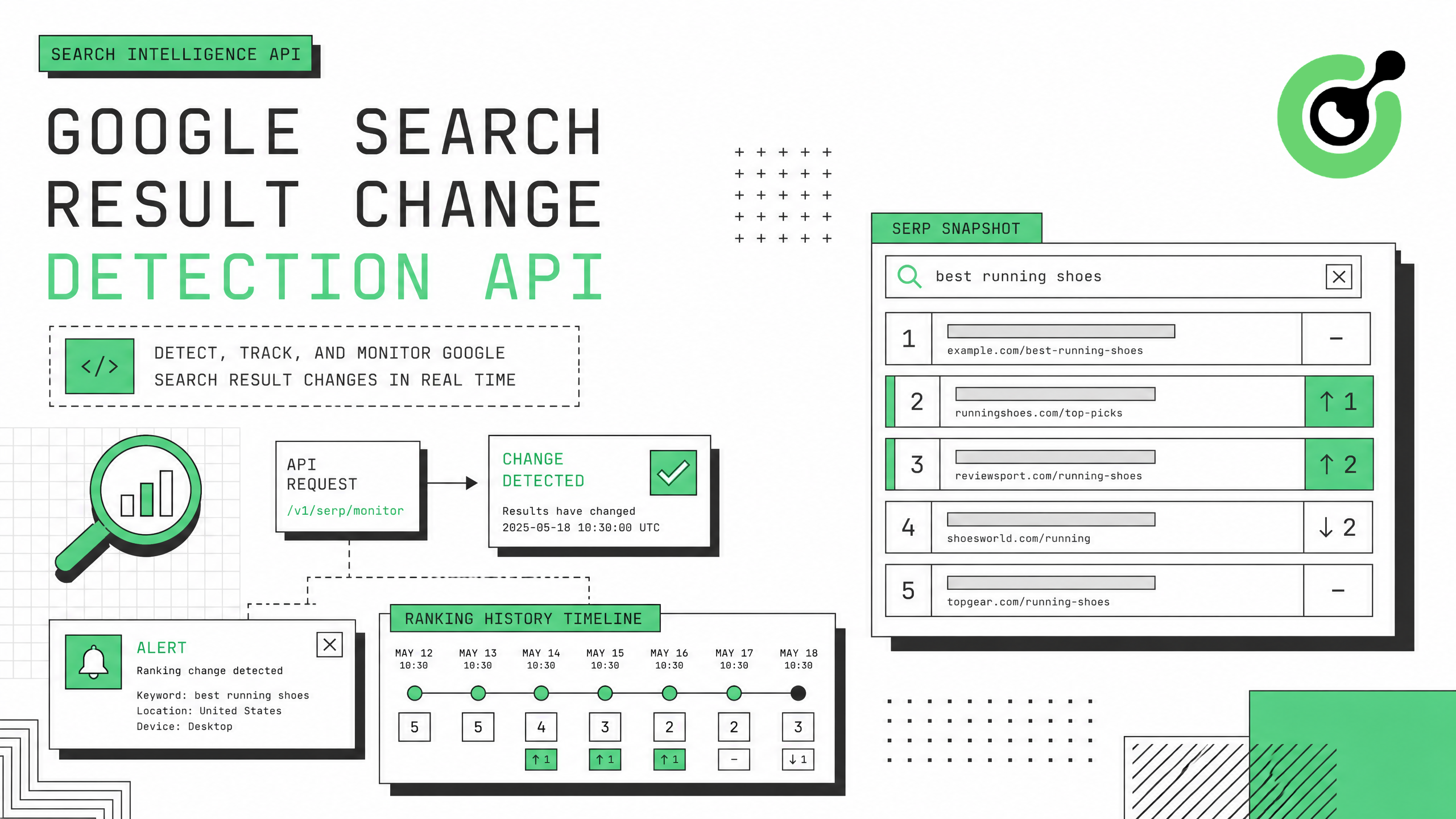
Google's search results change constantly — rankings shift, featured snippets rotate, new competitors appear, and AI Overviews update without notice. Detecting these changes in real time gives SEO teams a critical edge: respond to ranking drops within hours, capitalize on competitor losses immediately, and track the impact of content updates as they happen. This guide covers building an automated SERP change detection system using CapSolver to maintain continuous access to Google's search results.
Search engine rankings are not static. For competitive keywords, positions shift multiple times per week as Google re-evaluates content quality, freshness, and authority signals. A page ranking position 3 today may drop to position 8 tomorrow — or jump to position 1 — based on competitor actions, algorithm updates, or content freshness decay.
Without automated change detection, SEO teams discover ranking changes days or weeks late — often only when traffic reports show declines. By then, the competitive window for response has closed. Google's documentation on how search works confirms that the index is continuously updated, meaning rankings can change at any time.
The challenge for automated monitoring is Google's bot protection. After 50-100 automated search queries, Google presents reCAPTCHA challenges or blocks the IP. CapSolver provides the verification-clearing layer that enables continuous, reliable SERP monitoring at scale.
pip install git+https://github.com/capsolver-ai/capsolver-core.git
pip install aiohttp beautifulsoup4 pandas scheduleexport CAPSOLVER_API_KEY="your-capsolver-api-key"Additional requirements:
from dataclasses import dataclass, field
from typing import List, Optional
import time

@dataclass
class SERPSnapshot:
    keyword: str
    timestamp: float
    organic_results: List[dict]  # [{position, url, title}]
    featured_snippet: Optional[dict]
    ai_overview_present: bool
    paa_questions: List[str]

@dataclass
class SERPChange:
    keyword: str
    change_type: str  # ranking_gained, ranking_lost, snippet_gained, snippet_lost, new_competitor
    details: dict
    detected_at: float
    severity: str  # high, medium, low

class SERPChangeDetector:
    """Detect changes in Google search results over time."""

    def __init__(self):
        self.snapshots = {}  # keyword -> list of SERPSnapshot

    def detect_changes(self, keyword: str, current: SERPSnapshot) -> List[SERPChange]:
        """Compare current snapshot with previous and detect changes."""
        changes = []
        previous_list = self.snapshots.get(keyword, [])

        if not previous_list:
            self.snapshots[keyword] = [current]
            return []

        previous = previous_list[-1]

        # Detect ranking changes for tracked URLs
        prev_positions = {r["url"]: r["position"] for r in previous.organic_results}
        curr_positions = {r["url"]: r["position"] for r in current.organic_results}

        for url, curr_pos in curr_positions.items():
            prev_pos = prev_positions.get(url)
            if prev_pos is None:
                changes.append(SERPChange(
                    keyword=keyword, change_type="new_competitor",
                    details={"url": url, "position": curr_pos},
                    detected_at=time.time(), severity="medium"
                ))
            elif curr_pos < prev_pos and (prev_pos - curr_pos) >= 3:
                changes.append(SERPChange(
                    keyword=keyword, change_type="ranking_gained",
                    details={"url": url, "old": prev_pos, "new": curr_pos},
                    detected_at=time.time(), severity="high"
                ))
            elif curr_pos > prev_pos and (curr_pos - prev_pos) >= 3:
                changes.append(SERPChange(
                    keyword=keyword, change_type="ranking_lost",
                    details={"url": url, "old": prev_pos, "new": curr_pos},
                    detected_at=time.time(), severity="high"
                ))

        # Detect featured snippet changes
        if current.featured_snippet and not previous.featured_snippet:
            changes.append(SERPChange(
                keyword=keyword, change_type="snippet_gained",
                details=current.featured_snippet,
                detected_at=time.time(), severity="high"
            ))
        elif previous.featured_snippet and not current.featured_snippet:
            changes.append(SERPChange(
                keyword=keyword, change_type="snippet_lost",
                details=previous.featured_snippet,
                detected_at=time.time(), severity="high"
            ))

        # Store current snapshot
        self.snapshots[keyword].append(current)
        self.snapshots[keyword] = self.snapshots[keyword][-30:]  # Keep 30 days

return changesimport asyncio
from capsolver_core import create_capsolver, CaptchaType, CaptchaInfo
class SERPCollector:
"""Collect SERP data with automated CAPTCHA handling."""
def __init__(self, api_key: str, proxies: list):
self.cap = create_capsolver(api_key=api_key)
self.proxies = proxies
self.proxy_idx = 0
async def collect_serp(self, keyword: str, location: str = "us") -> SERPSnapshot:
"""Collect a complete SERP snapshot for a keyword."""
proxy = self.proxies[self.proxy_idx % len(self.proxies)]
self.proxy_idx += 1
html = await self._search(keyword, location, proxy)
if self._is_captcha(html):
info = CaptchaInfo(
type=CaptchaType.RECAPTCHA_V2,
website_url="https://www.google.com",
website_key="6LfwuyUTAAAAAOAmoS0fdqijC2PbbdH4kjq62Y1b"
)
solution = await self.cap.solve(info)
html = await self._retry(keyword, location, proxy)
return self._parse_serp(html, keyword)
async def monitor_keywords(self, keywords: list, detector: SERPChangeDetector) -> List[SERPChange]:
"""Monitor a batch of keywords and detect changes."""
all_changes = []
for keyword in keywords:
snapshot = await self.collect_serp(keyword)
changes = detector.detect_changes(keyword, snapshot)
all_changes.extend(changes)
await asyncio.sleep(7)
return all_changes
async def close(self):
await self.cap.aclose()class SERPAlertSystem:
"""Generate alerts for significant SERP changes."""
def __init__(self, tracked_domains: list):
self.tracked_domains = tracked_domains
def filter_relevant_changes(self, changes: List[SERPChange]) -> List[SERPChange]:
"""Filter changes relevant to tracked domains."""
relevant = []
for change in changes:
url = change.details.get("url", "")
if any(domain in url for domain in self.tracked_domains):
relevant.append(change)
elif change.change_type == "new_competitor" and change.severity == "high":
relevant.append(change)
return relevant
def generate_alert_message(self, changes: List[SERPChange]) -> str:
"""Generate human-readable alert message."""
if not changes:
return "No significant SERP changes detected."
lines = [f"🔔 {len(changes)} SERP change(s) detected:\n"]
for c in changes:
if c.change_type == "ranking_gained":
lines.append(f" 📈 [{c.keyword}] {c.details['url']} moved from #{c.details['old']} to #{c.details['new']}")
elif c.change_type == "ranking_lost":
lines.append(f" 📉 [{c.keyword}] {c.details['url']} dropped from #{c.details['old']} to #{c.details['new']}")
elif c.change_type == "snippet_gained":
lines.append(f" ⭐ [{c.keyword}] Featured snippet gained")
elif c.change_type == "new_competitor":
lines.append(f" 🆕 [{c.keyword}] New competitor at #{c.details['position']}: {c.details['url']}")
return "\n".join(lines)| Keywords Monitored | Check Frequency | Monthly CAPTCHAs | Monthly Cost |
|---|---|---|---|
| 50 keywords | 2x daily | ~900 | $1.80-2.70 |
| 200 keywords | daily | ~1,800 | $3.60-5.40 |
| 500 keywords | daily | ~4,500 | $9-13.50 |
| 1,000 keywords | 3x weekly | ~5,400 | $10.80-16.20 |
Claim Your Bonus Code: Use code WEBS at CapSolver Dashboard to get an extra 5% bonus on every recharge.
The CapSolver reCAPTCHA documentation covers Google's specific implementation. The CapSolver web scraping guide provides infrastructure patterns for high-volume monitoring. For additional SERP data collection patterns, the CapSolver automation blog covers related workflows.
Automated Google search result change detection requires continuous SERP data collection with CAPTCHA handling, snapshot comparison logic, and an alert system for significant changes. CapSolver provides the verification-clearing infrastructure that enables reliable monitoring at scale, solving Google's reCAPTCHA in 3-8 seconds so your change detection system always has fresh data. The result is real-time visibility into ranking shifts, competitor movements, and SERP feature changes — enabling rapid response that turns search volatility into competitive advantage.
The system detects: organic ranking gains/losses (3+ position changes), featured snippet gains/losses, new competitors entering top 10, AI Overview appearance/disappearance, People Also Ask changes, and local pack modifications.
For high-priority keywords (brand terms, top revenue drivers), check twice daily. For broader keyword sets, daily monitoring captures most changes. Weekly monitoring is sufficient for long-tail keywords with low competition.
Yes. When multiple keywords show simultaneous ranking changes (10+ keywords shifting in the same direction within 24 hours), it strongly indicates an algorithm update. The system can flag these patterns automatically.
With residential proxies and 7-10 second delays between queries, the encounter rate is typically 10-15%. Without proxies, it can reach 40-50%. The combination of quality proxies and CapSolver solving ensures near-100% data collection success.
Ethan Collins
AI Agent Workflow Engineer
Building clearer handoffs between AI agents and tools.
ABOUT THE AUTHOR
Learn scalable Rust web scraping architecture with reqwest, scraper, async scraping, headless browser scraping, proxy rotation, and compliant CAPTCHA handling.

Learn the best techniques to scrape job listings without getting blocked. Master Indeed scraping, Google Jobs API, and web scraping API with CapSolver.