🎉NEWCapSolver for AI agents-MCP, agent tools, and SDK integrations

Lola Ng
Key Account Manager
Published Sep 23, 2026
Updated Sep 23, 2026 · min read
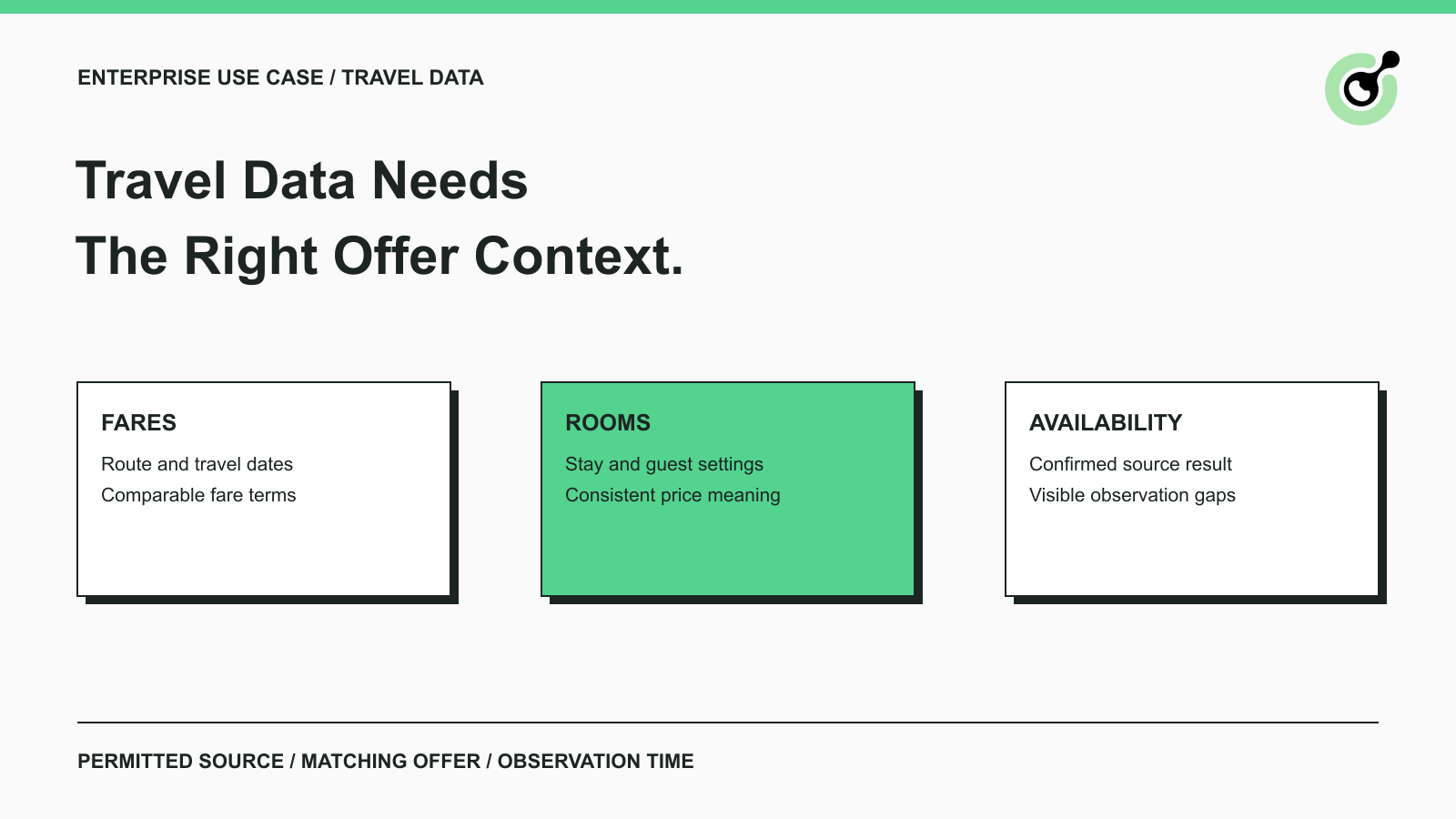
A travel data provider may supply fare feeds to a comparison product, hotel observations to a pricing-intelligence platform, or availability reports to a travel-management business. Each customer needs information about a defined travel product. A price without its dates or room conditions is difficult to compare, even when the number itself is correct.
CapSolver can support the CAPTCHA-handling step when an approved browser workflow encounters a supported challenge. The surrounding data service still owns product matching, collection permissions, freshness, and customer delivery. The following uses are illustrative B2B scenarios; they are not claims about named customers or measured commercial outcomes.
Choose an approved supplier interface before deciding whether CAPTCHA solving belongs in the collection path.
A licensed feed or official API may already provide the required data in a structured response. For example, Booking.com's accommodation API overview distinguishes property search from product-level availability and pricing. These documented interfaces are examples of travel-data structure, not evidence that those API calls require CAPTCHA handling.
Where your business is permitted to inspect a browser-based source, the collector may encounter a CAPTCHA. Identify that response explicitly before asking the travel parser to extract an offer.
A solver belongs in that supported verification step. It cannot create supplier permission, replace a commercial data agreement, or establish that two different offers are equivalent. Keep restricted accounts, personal itineraries, purchases, and inventory reservations outside the monitoring workflows described here.
The useful design starts with the customer's required observation and works backward: which source can provide it, which collection route is permitted, and what must be checked before delivery?
An airfare feed should preserve the itinerary and fare conditions that make one price comparable with another.
Consider a data provider serving a corporate travel analytics product. The customer monitors selected routes and travel dates to understand changes in available offers. If one approved browser query encounters a CAPTCHA, the provider must keep that query identifiable while handling the interruption.
After supported challenge handling, the collector needs to confirm the intended route, date, passenger assumptions, cabin, and currency. It should also retain any fare conditions included in the product contract, such as baggage information or flexibility. The exact fields depend on the source and the dataset being sold.
A returned page containing a cheaper number is not necessarily a better observation. It might represent another date, a different itinerary, or a different fare product. Acceptance should follow the query and product definition agreed with the customer.
If the response remains a challenge or fails validation, report an unavailable observation. Do not copy the last accepted fare into the new collection time and label it current.
A customer may choose to display historical data, but the timestamp must describe when the offer was observed. The API response time and the observation time should not be treated as the same field.
For this business use, a useful trial asks whether challenged queries return comparable fare observations within the customer's update window. The solver's output is only one stage in that evaluation.
A hotel pricing feed should compare the requested stay and room offer rather than match only a property name.
A pricing-intelligence company may monitor a defined property set for selected stay dates. Its customers need to know which room product and conditions produced each price. If a collection interruption affects one property, a missing value should remain a coverage gap until a valid observation is available.
Booking.com's accommodation pricing guide explains that pricing responses contain components and extra charges whose meaning depends on the endpoint. That reinforces a practical requirement for a provider: define what the delivered amount includes before comparing it across sources.
For a permitted browser observation, preserve the check-in and check-out dates, number of rooms, occupancy assumptions, currency, room or rate-plan identity, and relevant conditions visible in the source. A room-only rate and a rate with additional inclusions should not be merged merely because they belong to the same property.
A page may refresh or return to an earlier selection after verification. Recheck the intended stay and guest settings before accepting the displayed amount.
A challenge result does not establish that the original selection survived. The collector should obtain the price from the current, confirmed offer, rather than attach a newly displayed number to an older request label.
This is where CAPTCHA handling and data quality meet: the supported solver can help the approved browser step proceed, while the provider must determine whether the resulting observation still answers the customer's request.
Keep supplier-specific meanings intact. If your product normalizes taxes, fees, or stay totals, record the source values and the transformation rule. A successful solve cannot correct an inconsistent price definition.
An availability report should distinguish an explicit source result from a query that never reached a usable response.
Imagine a travel-management business checking an approved set of public offers for planning purposes. An incomplete browser response might contain no offers because the page is still verifying the request. That is different from a completed source response stating that nothing matches the selected dates and conditions.
Keep three practical outcomes separate:
| Observation outcome | What the customer can infer |
|---|---|
| Valid matching offer observed | The defined source showed that offer at the recorded time |
| Valid response with no matching offer | The completed query returned no match for its stated conditions |
| Query incomplete or challenged | Availability was not established by this attempt |
An observation is not a guarantee that the same offer will remain available for a later transaction. This article concerns data delivery, not booking or holding inventory.
A global success percentage can conceal a missing supplier or destination. Report coverage using the customer's relevant grouping, such as route, property set, supplier, or observation window.
If a customer depends on one selected property, a high overall completion rate across unrelated properties does not answer their question. Show the age and status of that property's last accepted observation.
Agree on how corrected observations enter a report. A later successful run may update the current dataset, but it should retain its actual collection time. Avoid rewriting the history of an earlier incomplete check as though the later observation had been available then.
Redeem Your CapSolver Bonus Code
Boost your automation budget instantly!
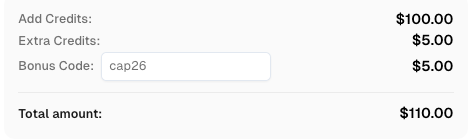
Use bonus code CAP26 when topping up your CapSolver account to get an extra 5% bonus on every recharge — with no limits.
Redeem it now in your CapSolver Dashboard
Keep the customer's product reference attached to the collection job from the initial request through final validation.
The Schema.org Offer definition treats an offer as more than a price: its properties can describe currency, availability, and other terms. For a travel data product, define the additional itinerary or stay fields your customers require and preserve them consistently.
A simple processing sequence is enough to explain ownership:
CapSolver's task creation interface documents how supported tasks are submitted. Use the appropriate task guide for the observed challenge, such as the reCAPTCHA v2 task documentation, and the result interface when the selected task completes asynchronously.
Do not send a pending task ID to the travel parser as though it were a completed page. Likewise, a ready solver result must be followed by a check of the intended browser response.
Keep jobs separate across customer datasets. A challenge result or browser page associated with one offer query should not be reused as evidence for another query merely because the supplier is the same.
Retain enough permitted evidence to explain an observation without collecting unnecessary travel or account information.
A useful record includes the customer job reference, source, requested product settings, collection time, accepted result, and a safe reason for an incomplete attempt. Where retention is allowed, keep the source reference needed to investigate an unexpected price or availability change.
Screenshots can help diagnose a parsing problem, but inspect what they contain. A page may show unrelated account details or personal travel information that does not belong in a public monitoring dataset.
When a customer asks why a value changed, distinguish changes in the source offer from changes in the collector. A new parser, a different occupancy setting, or an unresolved challenge should not be described as market movement.
The related travel-availability data guide discusses observation state and freshness. A B2B provider adds another responsibility: explaining those states through the customer's data contract and support process.
Start with one permitted source route and one defined customer deliverable before expanding the workload.
For an airfare feed, choose a representative route-and-date set. For hotel intelligence, choose a property-and-stay set with known comparison rules. For availability reporting, agree on which outcomes count as established availability and which remain unresolved.
Review accepted observations, context mismatches, completion before the update cutoff, and unexplained gaps. Include the expense of unsuccessful attempts and operator investigation when calculating cost per accepted observation.
Use current CapSolver task pricing together with actual usage if the pilot includes managed solving. No general solve-rate or cost-saving estimate can replace the trial's own results.
If the pilot uses only a supplier API and encounters no CAPTCHA, record that finding. Do not add a solving dependency merely because another collection route might need one. Conversely, an offline parser test does not demonstrate how a live browser behaves after verification.
Set a review owner for repeated challenges, source refusals, and changed page structures. These conditions may require suspending the affected source while the team investigates. More attempts are not evidence that the next observation will be valid.
A travel data provider succeeds when the customer receives an understandable observation of the intended offer.
That means retaining the itinerary or stay assumptions, interpreting amounts consistently, preserving the observation time, and identifying incomplete checks. CapSolver can handle a supported challenge within an approved collection step; the travel service owns the offer-level checks that make the resulting data useful.
Q: Do all travel data providers need a CAPTCHA solver?
No. An approved supplier API or licensed feed may provide the required data without a browser challenge. A solver is relevant only where a permitted collection route encounters a supported CAPTCHA.
Q: Does an empty response mean a flight or hotel is unavailable?
Not necessarily. Confirm that the query completed and produced a valid source response. A challenge page or incomplete load does not establish availability.
Q: What should be checked after a CAPTCHA is handled?
Check the current itinerary or stay selection, passenger or guest assumptions, currency, offer conditions, and observation time. Then verify that the parsed result matches the customer's requested product.
Q: Can these workflows book or reserve travel inventory?
The scenarios here are for observing and delivering permitted travel data. They do not include purchases, reservations, inventory holds, or access to private itineraries.
Q: What is the most useful pilot outcome?
The most useful outcome is a validated observation delivered under the customer's agreed conditions. Review coverage, freshness, mismatches, and full operating cost alongside the solver's task outcome.
Lola Ng
Key Account Manager
Connecting customer needs with practical automation solutions.
ABOUT THE AUTHOR
Learn scalable Rust web scraping architecture with reqwest, scraper, async scraping, headless browser scraping, proxy rotation, and compliant CAPTCHA handling.

Learn the best techniques to scrape job listings without getting blocked. Master Indeed scraping, Google Jobs API, and web scraping API with CapSolver.