🎉NEWCapSolver for AI agents-MCP, agent tools, and SDK integrations

Ethan Collins
AI Agent Workflow Engineer
Published Aug 11, 2026
Updated Aug 11, 2026 · min read
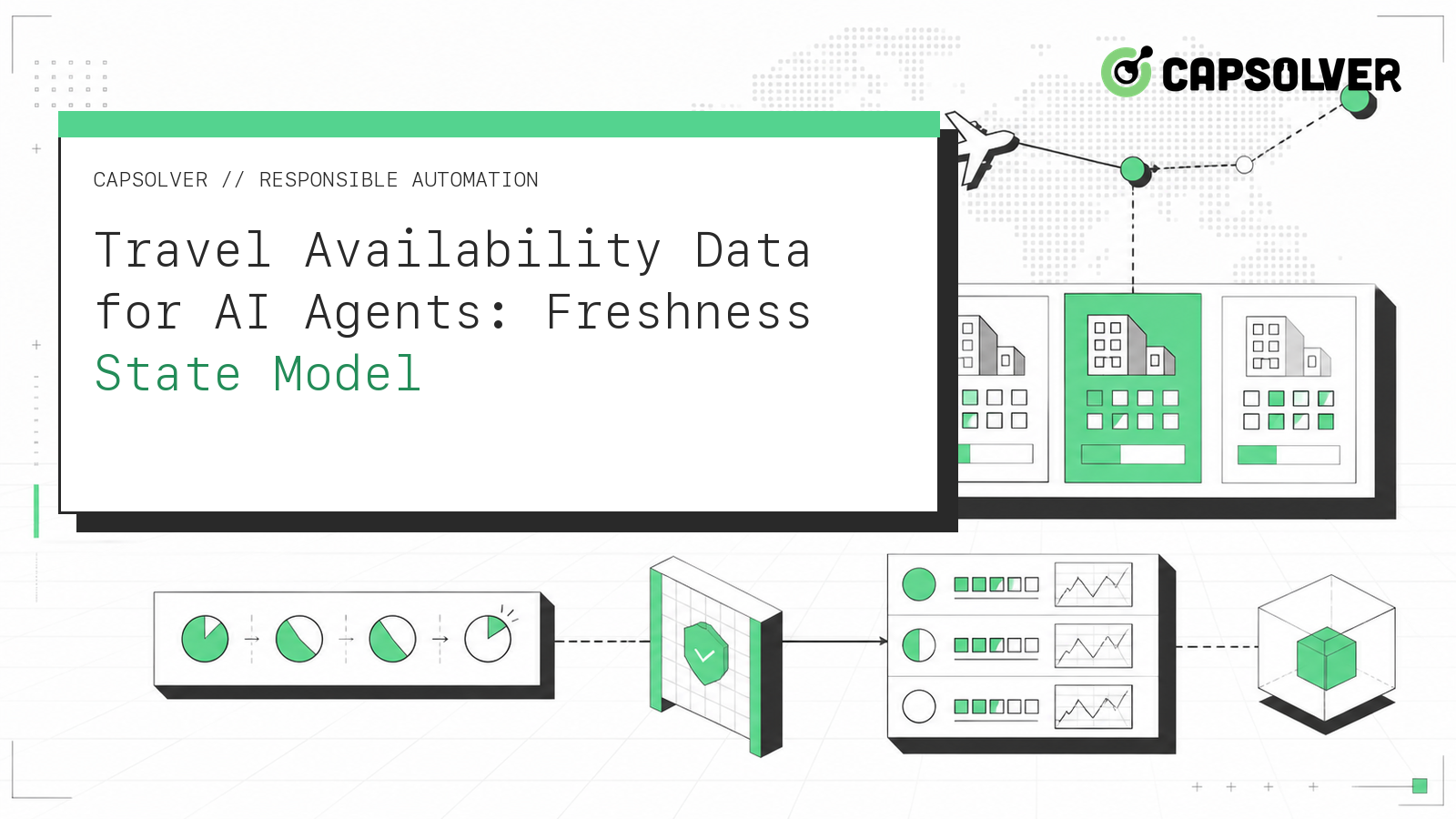
travel availability data for ai agents needs a freshness state model because travel offers can change between discovery and decision. CapSolver can support a permitted public-search workflow when a verification checkpoint interrupts an authorized session, but it does not grant booking authority or access rights. A useful pipeline records the complete search scope, visible offer, restrictions, currency, observation time, source evidence, and expiry signal. It never promises inventory from an old snapshot. The design below classifies offers as FRESH, AGING, REVALIDATE, or EXPIRED, caps collection and recovery attempts, and requires the user to approve any material price or itinerary change. Private traveler data, restricted accounts, payment details, and unauthorized sources remain outside the collection agent.
The travel availability data for ai agents record is not just a price. For flights, retain origin, destination, dates, passenger mix, cabin, segments, currency, displayed total, restrictions, and source. For hotels, retain property, dates, occupancy, room type, cancellation terms, taxes, and source.
{
  "search_scope": {
    "origin": "SHA",
    "destination": "SIN",
    "departure_date": "2026-09-15",
    "adults": 1,
    "cabin": "economy"
  },
  "observed_total": {"amount": 4200, "currency": "CNY"},
  "observed_at": "2026-08-11T02:30:00Z",
  "state": "FRESH",
  "source_url": "https://public.example.org/offer/123"
}
The input is an authorized search scope. The output is a timestamped offer observation. The stop condition is any missing date, traveler scope, currency, restrictions, source evidence, or clear public context. The Schema.org Offer vocabulary provides a useful neutral model for price, availability, and validity concepts without defining a booking contract.
The agent should never infer freshness from the presence of a price. A local reducer can classify the observation before it enters the planning context.
from datetime import datetime, timezone

def freshness_state(observed_at, now=None):
    now = now or datetime.now(timezone.utc)
    age = (now - observed_at).total_seconds()
    if age <= 120:
        return "FRESH"
    if age <= 600:
        return "AGING"
    if age <= 1800:
        return "REVALIDATE"
    return "EXPIRED"

stamp = datetime.fromisoformat("2026-08-11T02:30:00+00:00")
print(freshness_state(stamp))
The input is a timezone-aware observation timestamp. The output is one freshness state. The stop condition for autonomous recommendation is REVALIDATE or EXPIRED; the exact time windows are local policy inputs and should reflect the supplier and use case.
Discovery and booking are different operations. travel availability data for ai agents may collect and compare authorized public offers, but a user must approve the itinerary and price before a consequential action. Revalidation should use the original route, dates, traveler scope, and room or cabin attributes.
If price, currency, route, airport, date, cabin, room type, cancellation terms, or supplier changes, present the difference. Do not let the agent select a nearby alternative without consent. A lower price is not equivalent when restrictions or timing have changed.
Use opaque search IDs rather than traveler names. Booking credentials and payment information belong in a separate user-controlled system. The NIST Privacy Framework supports data minimization and purpose limitation for this boundary.
Cap routes, dates, pages, and suppliers per run. Stop on authentication prompts, 401, 403, 429, changed terms, repeated verification, or source-layout drift. The HTTP semantics standard provides the transport vocabulary. Preserve observation records rather than overwriting them so the pipeline can explain why an offer changed.
The W3C provenance vocabulary helps connect normalized offers, source snapshots, and later revalidation events. An AI agent should receive both the current record and its provenance chain.
Because this is travel availability data for ai agents, a recovery boundary must follow the official CapSolver AI-agent overview, introduction and quick start, core SDK contract, agent tools contract, and MCP service contract.
{
  "service": "capsolver-mcp",
  "allowed_tools": [
    "solve_captcha",
    "detect_captchas",
    "get_balance",
    "get_supported_captchas"
  ],
  "same_browser_context_required": true,
  "max_recovery_attempts": 1,
  "on_repeat": "REVIEW"
}
The input is the discovered official tool registry and an approved browser context. The output is a restricted recovery surface. Stop on any missing tool, changed supplier host, stale context, repeated challenge, or ambiguous permission. Code integrations may use only documented capsolver-core, create_capsolver, detect, get_captcha_info, solve, solve_on_page, capsolver-agent, get_all_tools, and create_executor.
Redeem Your CapSolver Bonus Code
Boost your automation budget instantly!
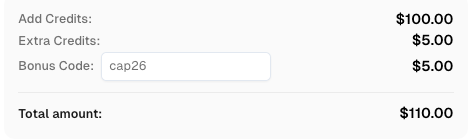
Use bonus code CAP26 when topping up your CapSolver account to get an extra 5% bonus on every recharge — with no limits.
Redeem it now in your CapSolver Dashboard
The travel availability data for ai agents response should show option identity, total price and currency, restrictions, observation time, freshness state, source, and material changes since the previous snapshot. It should also state what will be revalidated before any user-approved action.
Use NO_LONGER_OBSERVED, SCOPE_CHANGED, PRICE_CHANGED, RESTRICTIONS_CHANGED, and SOURCE_UNAVAILABLE reason codes. Do not turn absence into a claim that inventory sold out; the source may simply be unavailable. The NIST AI Risk Management Framework supports assigning review ownership to these uncertain states.
Test a currency change, nearby-airport substitution, overnight date shift, cabin downgrade, room-type change, cancellation-policy change, stale observation, and second verification checkpoint. Each should stop or request explicit user approval. Also test one unchanged fresh offer and one changed offer that produces a readable diff.
This prevents travel availability data for ai agents from optimizing a headline price while losing the constraints that made the option useful.
Reliable travel availability data for ai agents treats availability as expiring evidence. Keep search scope, price, restrictions, source, timestamp, and freshness state together; revalidate at the user decision boundary; and stop on material changes or uncertain access. For a permitted, one-attempt recovery layer inside that design, teams can evaluate CapSolver.
It should include the complete search scope, visible offer, currency, restrictions, source evidence, observation time, and freshness state.
No. An aging offer needs a warning, and a stale offer must be revalidated before it informs a user decision.
No. Material changes require a clear diff and explicit user approval.
Stop on authentication boundaries, 401, 403, 429, changed scope, repeated verification, missing provenance, or configured ceilings.
No. This travel availability data for ai agents pipeline supports lawful, reasonable, responsible comparison of authorized public offers; booking and payment remain user-controlled.
Ethan Collins
AI Agent Workflow Engineer
Building clearer handoffs between AI agents and tools.
ABOUT THE AUTHOR
Learn scalable Rust web scraping architecture with reqwest, scraper, async scraping, headless browser scraping, proxy rotation, and compliant CAPTCHA handling.

Learn the best techniques to scrape job listings without getting blocked. Master Indeed scraping, Google Jobs API, and web scraping API with CapSolver.