🎉NEWCapSolver for AI agents-MCP, agent tools, and SDK integrations

Sora Fujimoto
AI Solutions Architect
Published Jun 16, 2026
Updated Jun 16, 2026 · min read
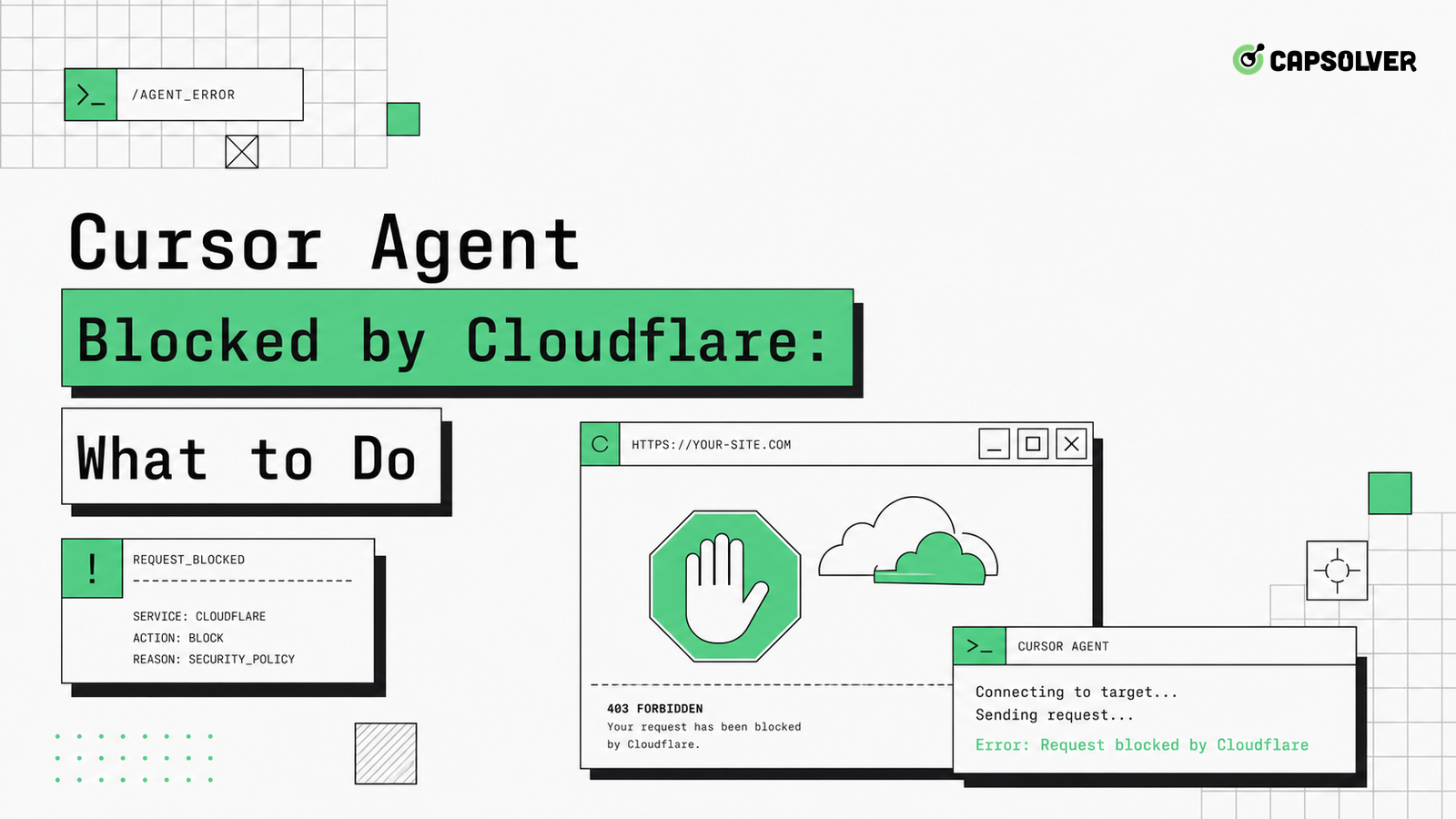
A Cursor agent blocked by Cloudflare is usually not failing because one page is hard to click. It is failing because a browser session, network route, Turnstile event, or planner decision no longer matches what the protected site expects. CapSolver can help approved automation teams handle Cloudflare and Turnstile challenges, but the repair should begin with trace evidence. Capture the first protected navigation, the challenge trigger, the widget parameters, the HTTP status, the storage state, and the next action chosen by Cursor. That record turns a vague block into a controlled engineering fix.
The first question is where Cloudflare entered the workflow. A Cursor agent blocked by Cloudflare may see a challenge on the initial page, after a login redirect, after a POST request, or after a burst of asset requests caused by repeated planner reloads. Those cases are different. A challenge on first navigation points to traffic validation or route reputation. A challenge after login points to cookie or account continuity. A challenge after repeated retries points to planner pressure. Treat the first protected navigation as the root of the incident, not the final screenshot.
Record the navigation as a chain. Include requested URL, referrer, browser context ID, proxy route if used, user-agent family, response status, challenge page title, and redirect target. MDN's explanation of HTTP 403 Forbidden is a useful baseline because a 403 response is an access decision, not a generic browser error. When a Cursor agent blocked by Cloudflare receives 403, the planner should not keep probing the same route. It should stop, classify, or ask for review.
Cloudflare can also respond with rate-control behavior. If the browser or agent produces a burst of failed navigations, the next response may be a 429 or a challenge page that is functionally rate related. RFC 9110 defines Retry-After response timing as server guidance for when a client should wait. Cursor should convert that signal into a domain cooldown. A fixed retry loop is not a fix; it is more evidence against the session.
Turnstile diagnostics should focus on runtime parameters, not copied constants. A protected page can create a widget after hydration, after route selection, or inside an iframe that only appears when the session reaches a specific step. The Cloudflare description of Turnstile client-side rendering shows why render mode, site key, action, and callback behavior matter. Use that official document sparingly as implementation context, then rely on your own trace to show what the page actually did.
A Cursor agent blocked by Cloudflare should log the widget render timestamp, site key, action value when present, cData value when present, callback name, iframe URL, token receipt time, and the request that consumes the result. CapSolver's Turnstile parameter discovery is relevant here because the agent needs the same runtime values the page expects. If the agent collects an old site key from source but the hydrated route uses a different action, the backend may reject the result even when a token exists.
Keep token evidence separate from clearance evidence. A Turnstile token may support a form or request, while Cloudflare clearance state can be stored in cookies and validated on later navigation. CapSolver's Cloudflare Turnstile concept helps name those parts, but the practical rule is simple: log token, cookie, and target request as three fields. When a token is present and the next page still challenges, inspect storage scope and route continuity before assuming the token failed.
Cursor often works through tools that return page text, screenshots, or DOM snippets. That is not enough when Cloudflare appears. The browser tool should return a structured state such as cloudflare_challenge, turnstile_widget, rate_limited, forbidden, or clearance_lost. A Cursor agent blocked by Cloudflare needs a state the planner can reason about. Without it, the model may interpret the challenge page as an ordinary page and continue clicking, refreshing, and searching.
The state should include a recommended action. turnstile_widget can mean hand off to an approved solver path. rate_limited can mean wait according to policy. forbidden can mean stop and request access review. clearance_lost can mean restart the browser context only if the domain policy allows it. CapSolver's Cloudflare challenge workflow should sit behind this explicit state transition, not behind every failed selector.
The state machine also protects the target site. OWASP's automated threat taxonomy describes why repeated scripted actions can be treated as risk. A responsible Cursor workflow should avoid unbounded retries, credential stuffing patterns, private data access, and attempts to continue after an explicit refusal. Technical remediation does not grant permission to enter a system.
Redeem Your CapSolver Bonus Code
Boost your automation budget instantly!
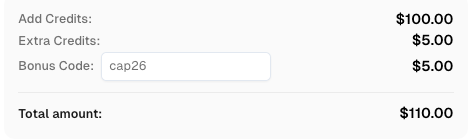
Use bonus code CAP26 when topping up your CapSolver account to get an extra 5% bonus on every recharge — with no limits.
Redeem it now in your CapSolver Dashboard
Solver output is only one part of the browser journey. A Cursor agent blocked by Cloudflare can complete a challenge and still fail when the browser opens a new context, loses cookies, changes proxy routes, blocks storage, or follows a redirect in a way that drops the clearance cookie. MDN's discussion of HTTP cookie scope is the right reference when a clearance state appears and then disappears. Domain, path, SameSite, expiry, and secure attributes all affect what the next request sends.
Persist the browser context through the whole protected path. Do not solve in one context and submit in another. Do not rotate user agent, locale, timezone, viewport, or network route between the widget and the target request. Do not clear storage while trying to recover from a challenge. If the run must restart, mark the previous session as closed and begin a new attempt after the domain cooldown allows it.
The same idea applies to Cursor planning. If the model decides to open the same URL in a fresh tab after a challenge, it may throw away the state that just mattered. The browser tool should expose session identifiers and storage snapshots so the planner can preserve them. A Cursor agent blocked by Cloudflare is often a memory problem as much as a CAPTCHA problem.
Recovery policy should be deterministic. For 403, stop unless an owner-approved path says the route is expected and challenge handling is permitted. For 429, obey the server or domain cooldown, reduce concurrent navigations, and restart with one low-cost request. For a challenge page with no HTTP clue, count it as a challenge event and apply the domain's challenge budget. A Cursor agent blocked by Cloudflare should never decide that more attempts are automatically better.
Use Cloudflare rate limiting as practical vocabulary for 1015-style pressure. In Cursor workflows, pressure may come from the planner opening search results, reloading after extraction failures, or retrying a form without classifying the response. Put budgets on protected navigations, form submissions, and challenge events. Budget by domain and task, not only by tool call.
Write the policy as data. A domain entry should name the allowed purpose, owner, account, maximum challenge attempts, cooldown rule, solver eligibility, and stop conditions. This gives Cursor a rule to follow instead of relying on a prompt sentence. It also gives reviewers a way to audit why a challenge was handled or why the agent stopped.
The repair is complete only when a trace can prove it. Run one controlled task through the protected path and save request logs, console events, screenshots, storage snapshots, challenge states, planner decisions, and final outcome. CapSolver's Cloudflare Playwright workflow is useful if your Cursor tool is backed by Playwright, because traces can show if the widget appears, if the token callback fires, and if the next request carries the right cookies.
Compare a successful manual run with the Cursor run under the same account and domain policy. If the manual run gets clearance and Cursor does not, inspect storage, route, JavaScript errors, and retry cadence. If both runs fail, the issue may be authorization, credentials, or target policy. If Cursor succeeds only after many retries, the fix is incomplete because the workflow still creates pressure.
Finally, add a regression guard. The browser tool should refuse to continue when it sees the same challenge state twice without progress. It should surface 403 and 429 as terminal or cooldown states. It should preserve a short incident record containing URL, status, widget parameters, cookie state, and planner action. That record is what prevents the next Cursor agent blocked by Cloudflare incident from becoming a guessing session.
A Cursor agent blocked by Cloudflare needs a trace-first repair: identify the first protected navigation, collect runtime Turnstile parameters, preserve browser continuity, turn 403 and 429 into policy decisions, and stop when authorization is not clear. Approved challenge handling can be part of the workflow, but it should be attached to a controlled state machine rather than a retry loop. For teams building permitted AI-agent automation with Cloudflare and Turnstile checkpoints, CapSolver can support the challenge-handling layer while your planner keeps the session responsible.
The first page may already trigger traffic validation because of route reputation, browser environment mismatch, missing cookies, or a protected path that expects JavaScript and storage. Start by logging the first response status, challenge title, widget parameters, and browser context.
No. Cursor should classify the state first. A challenge may require an approved solver handoff, a cooldown, a human review, or a stop decision. Automatic reloads can increase request pressure and make later attempts less reliable.
Collect widget render time, site key, action, cData, callback name, token receipt time, clearance cookies, target request status, and the planner action chosen after validation. Those fields show whether the problem is token handling, storage, or planning.
Only for owned, contracted, QA, or otherwise authorized workflows. If a site refuses access, exposes private data, or disallows automated use, the agent should stop rather than continuing with technical remediation.
Sora Fujimoto
AI Solutions Architect
Connecting agents, browsers, and APIs into one workflow.
ABOUT THE AUTHOR
Evaluate a Turnstile solver API by its documented inputs, token response, validation boundary, and controlled test cases before adding it to your workflow.

Diagnose Cloudflare Challenge flows with AntiCloudflareTask, stable proxy and user agent identity, fresh HTML, clearance handling, validation, and safe errors.