
🎉NEWCapSolver for AI agents-MCP, agent tools, and SDK integrations

Emma Foster
Machine Learning Engineer
Published Nov 04, 2026
Updated Nov 04, 2026 · min read
A Turnstile-related failure can consume more than the price of a solving task. A browser worker may remain active while waiting, a retry may repeat the same broken handoff, and an engineer may spend hours finding why a returned token never reached the application. A useful budget includes each of those costs without counting the same expense twice.
For teams using CapSolver in authorized browser automation, the practical question is how much it costs to keep a specific challenged workflow working. This guide gives you a small cost model, a worked hypothetical example, and a way to decide which failure deserves attention first. It does not assume every browser job encounters Turnstile or that a solver fixes every Cloudflare error.
A Turnstile troubleshooting budget should include the expenses attributable to investigating and handling Turnstile interruptions in a defined workload.
Start by separating the website's protection service from the automation team's solving service. Cloudflare's Turnstile plans include a free plan and an Enterprise option. That pricing describes the website owner's use of Turnstile. It does not pay for a separate solver, your browser infrastructure, or your team's investigation time.
The Cloudflare Turnstile glossary introduces the verification mechanism. For budgeting, identify whether the observed issue is a Turnstile widget, a full-page Cloudflare challenge, or an unrelated network or application error. Combining those cases produces a cost figure that is hard to explain or improve.
Use these cost categories for one reporting period:
| Cost category | Input to collect | Boundary to keep clear |
|---|---|---|
| Solver usage | Actual billed units and the applicable rate | Submitted requests and billed units may differ |
| Browser runtime | Billable or allocated time attributable to waiting, retries, and diagnostics | Exclude normal task runtime already charged elsewhere |
| Engineering | Investigation hours multiplied by your internal cost rate | Separate recurring support from one-time setup |
| Other direct expenses | Relevant logging, test infrastructure, or contracted support charges | Include only attributable costs, without duplicating bundled fees |
For a hosted browser with a bundled solving feature, check what its invoice already includes before adding a separate solver line. For a self-hosted worker, CPU time and memory are not necessarily billed by the browser-minute; use an allocation method that matches your infrastructure bill.
Estimate solver usage from observed challenged workflows and their attempts, rather than multiplying every page visit by a CAPTCHA price.
Choose a representative group of permitted jobs, such as an owned application test suite or an approved data workflow. Record how many jobs actually reach Turnstile, how many solver tasks they create, and how many eventually complete their intended action. Keep production observations separate from test traffic.
The official Turnstile task reference describes task creation and result retrieval for AntiTurnstileTaskProxyLess. Retrieving an existing task's result is different from creating another task. Your accounting should preserve that distinction, even when a wrapper hides several HTTP requests behind one function call.
For a usage rate quoted per thousand billable units, the estimate is:
Solver cost = billable units / 1,000 × price per 1,000 units.
Use the applicable account quote or current billing record for the price and unit definition. Confirm any package terms, included allowance, or adjustments before applying the formula. Do not assume that every rejected request is charged, that every failed workflow is refunded, or that one successful browser job always corresponds to one billed unit.
To forecast volume, start with your observed billing units per challenged workflow. Multiply that ratio by the expected number of comparable challenged workflows. This keeps the estimate tied to your own implementation rather than a generic CAPTCHA success-rate claim.
The total cost is the sum of attributable solver usage, browser runtime, engineering, and other direct expenses for the same period.
Consider a fictional month with 10,000 challenged workflows. Their logs contain 12,000 solving attempts, and their billing statement independently confirms 12,000 billable units. Suppose the quoted rate is $2 per 1,000 units, attributable browser usage costs $40, and the team spends three engineering hours at an internal rate of $60 per hour. These numbers are invented for arithmetic, not CapSolver prices or performance measurements.
The calculation is:
If 9,000 of those challenged workflows reach their defined application outcome, total cost per completed challenged workflow is $244 / 9,000, or approximately $0.0271. Solver-only cost per completion is $24 / 9,000, or approximately $0.00267. Label both figures so a reader does not mistake one for the other.
Count a workflow once even if it required multiple attempts. Keep unsuccessful and unresolved jobs in the workload report; removing them would hide expenses that produced no confirmed result. When there are no confirmed completions, report cost per completion as unavailable and show the total expenditure separately.
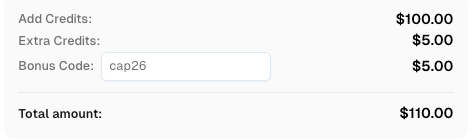
Redeem Your CapSolver Bonus Code
Boost your automation budget instantly!
Use bonus code CAP26 when topping up your CapSolver account to get an extra 5% bonus on every recharge — with no limits.
Redeem it now in your CapSolver Dashboard
Investigate the expense that changed alongside the first observable failure in the workflow.
If solver submissions increase while challenged-job volume remains stable, inspect retries and duplicate task creation. If solver spending stays flat but browser costs rise, inspect how long workers remain allocated after the result arrives or after a job has already failed. If infrastructure costs are stable but support hours grow, group incidents by failure cause before changing providers or adding more retries.
Cloudflare's server-side validation guidance states that Turnstile tokens are valid for 300 seconds and can be validated only once. Delayed handoff or repeated validation can therefore leave the application unable to use a returned token. A faster or repeated solving request will not, by itself, repair the application step that mishandles the result.
Only inspect Siteverify logs when you operate the application or have permission to access them. Otherwise, use the browser outcome you can observe and record backend validation as unavailable. An HTTP success response or a disappearing widget is not sufficient evidence that the requested operation finished.
The Turnstile solver API evaluation checklist provides a starting point for evaluating the integration. Connect technical findings to the expenses they produce; this budget should not replace technical diagnosis.
In the fictional example, halving the solver unit price would save $12 at unchanged billed volume. Removing two recurring engineering hours would save $120 at the assumed internal rate. Neither saving is guaranteed; the comparison shows why the largest cost category deserves attention.
Keep one-time implementation work separate. If a change takes four hours at the same $60 internal rate, its estimated implementation cost is $240. If a pilot supports a recurring saving of $120 per month with equivalent completion quality, simple payback is two months. Recalculate when workload, prices, or support effort change, and include the maintenance work the fix introduces.
Set retry and diagnostic limits before a failure causes a large increase in attempts.
A practical policy defines the maximum attempts per challenged workflow, the overall elapsed-time limit, and the conditions that justify another attempt. Incorrect parameters require correction. A job whose browser context has disappeared should not consume another result. Use documented API error categories to distinguish those cases before retrying.
Record a spend alert separately from a hard stop. An alert asks an operator to investigate; it does not prove that in-flight work has stopped or that the provider will reverse charges. Leave room in the budget for work already dispatched, and reconcile with actual billing after the observation period closes.
For routine application tests on systems you own, Cloudflare's official testing keys provide controlled pass and fail behavior. Use them for application branches that do not require a real solving service. They do not demonstrate production solver quality or end-to-end acceptance with real challenge tokens.
Keep a separate, bounded integration trial for the real solver handoff. Retain task identifiers, timing, safe error categories, and final outcome assertions. Avoid retaining API keys, raw tokens, cookies, or unnecessary page contents as cost evidence.
A useful monthly budget connects actual expenses to a consistent group of challenged workflows and confirmed results.
Keep three numbers visible: total attributable cost, solver-only cost, and completed challenged workflows. Add a short explanation of the largest change since the previous period. This makes a rise caused by more legitimate workload distinguishable from a rise caused by duplicate attempts or longer investigations.
For CapSolver, begin with the documented Turnstile task flow and your account's applicable billing terms. Verify the handoff in an authorized workflow, then scale the estimate using observed billing and completion data.
Q: Is Cloudflare Turnstile free to use?
Cloudflare offers a free Turnstile plan, subject to its documented features and limits. A separate CAPTCHA solver, browser hosting, and engineering work are different cost items.
Q: How much does Turnstile troubleshooting cost at scale?
There is no universal total. Add attributable solver charges, browser runtime, engineering time, and other direct expenses for a defined workload. The $244 example is hypothetical and is not a service quote.
Q: Should I multiply all page visits by a solver price?
No. Measure which workflows actually encounter Turnstile and how that activity maps to your provider's billable units. Keep test traffic, retries, and unrelated failures distinguishable.
Q: Does a returned token mean I paid for a successful workflow?
A returned token establishes a solver result. Your application must still reach its intended outcome, and billing follows the applicable service terms. Track those facts separately.
Q: Can test keys replace a real solver trial?
Test keys can validate controlled application branches on systems you own, but they do not validate real solving performance. Use a separate authorized integration trial when you need evidence about the actual solver handoff.
Emma Foster
Machine Learning Engineer
Where machine learning meets practical AI tooling.
ABOUT THE AUTHOR
Fix the AntiCloudflareTask dynamic DNS proxy error. Learn why a 10-minute sticky session can use different exit IPs and how to verify both request paths.

Diagnose Turnstile invisible mode problems by checking script loading, execution, token delivery, and validation before adding a solver to automation.