🎉NEWCapSolver for AI agents-MCP, agent tools, and SDK integrations

Nikolai Smirnov
Software Development Lead
Published Aug 31, 2026
Updated Aug 31, 2026 · min read
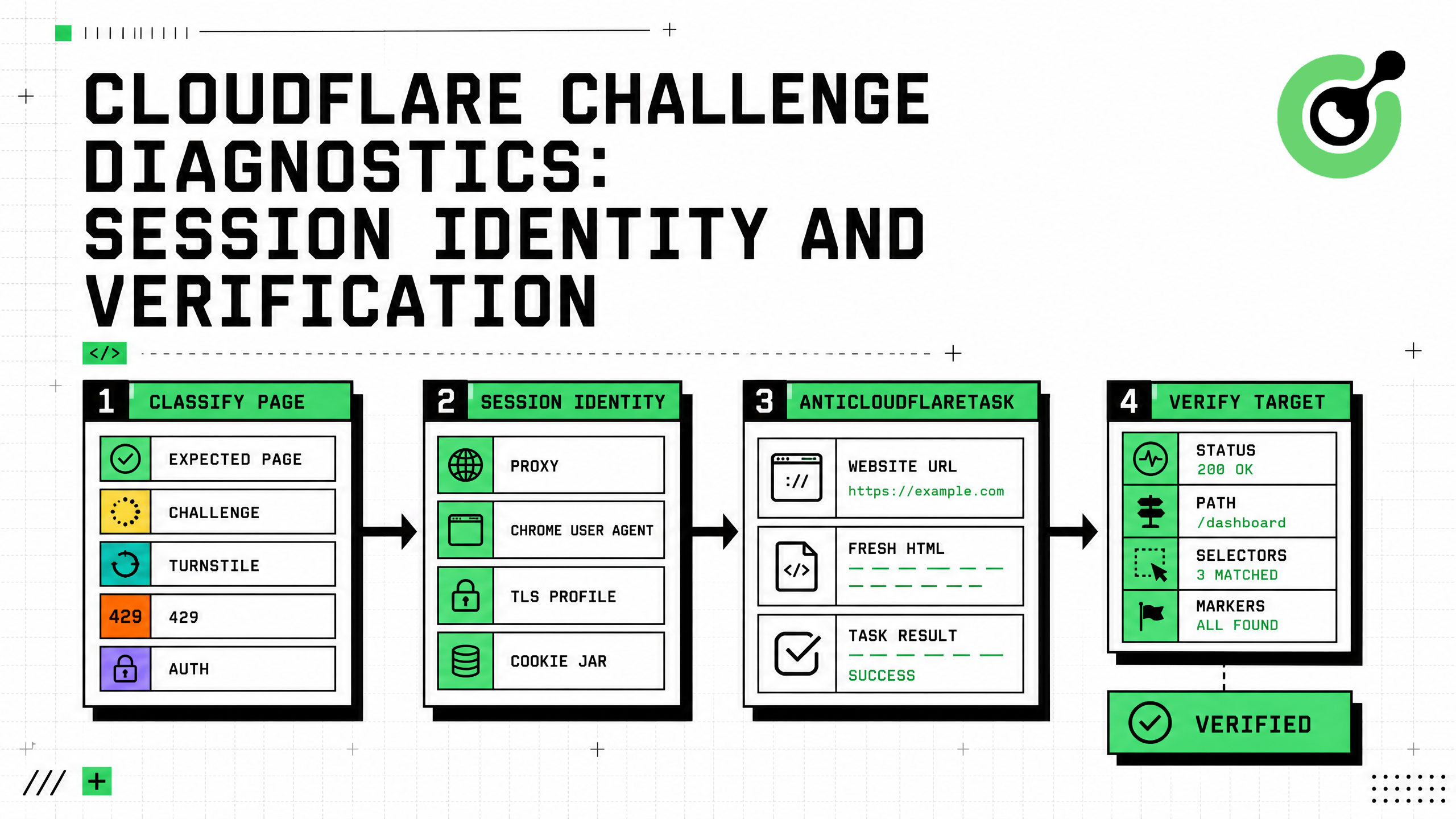
AntiCloudflareTask with the exact target URL and a static or sticky proxy; keep the supported Chrome user agent consistent.cf_clearance, cookies, tokens, proxy credentials, and raw HTML as short-lived secrets that must not enter logs or analytics.Cloudflare Challenge diagnostics should begin with state classification and session identity, not repeated task creation. A protected page can show an interstitial challenge, Turnstile widget, HTTP 429 response, hard block, authentication screen, origin error, or an ordinary application page. Each state needs a different action. For a supported Challenge page, CapSolver documents AntiCloudflareTask with the exact target URL, a static or sticky proxy, and a consistent Chrome user agent; some sites also need fresh challenge HTML from that same session. The returned clearance data must then be applied to the same request identity and validated against the expected target page. This guide presents a generic implementation without tying the design to an industry, use case, or agent framework.
Cloudflare describes Challenges as security mechanisms that evaluate browser and client-side signals and may request minimal user interaction. That broad category should not be confused with every blocked or incomplete response.
A diagnostic workflow should answer four questions in order:
The CapSolver Cloudflare blog contains related product and implementation material, while the CapSolver CAPTCHA-solving FAQ explains the general task lifecycle.
| State | Typical evidence | Correct next action |
|---|---|---|
| Expected page | Known title, route, semantic selector, or response schema | Parse or continue |
| Cloudflare Challenge page | “Just a moment…”, challenge script, Cloudflare markers | Validate scope and consider AntiCloudflareTask |
| Turnstile widget | Turnstile script, site key, widget container | Use the documented Turnstile task path |
| Rate limit | HTTP 429, Retry-After, quota response |
Wait and reduce request rate |
| Authentication required | Login form, 401, session-expired state | Authenticate through the approved flow |
| Hard block | Persistent 403 without supported challenge evidence | Stop and review access policy or network identity |
| Origin or network error | 5xx, DNS, TLS, timeout | Fix infrastructure; do not create a challenge task |
| Unknown page | Layout or semantics do not match known states | Store redacted diagnostics and request review |
A challenge service should never be used as a universal response to every 403 or empty page.
from dataclasses import dataclass

@dataclass(frozen=True)
class HttpObservation:
    url: str
    status_code: int
    title: str
    html: str
    headers: dict[str, str]


def classify_observation(obs: HttpObservation) -> str:
    title = obs.title.lower()
    html = obs.html.lower()

    if obs.status_code == 429:
        return "RATE_LIMIT"

    if obs.status_code >= 500:
        return "ORIGIN_OR_NETWORK_ERROR"

    if "challenges.cloudflare.com/turnstile" in html:
        return "TURNSTILE_WIDGET"

    challenge_markers = (
        "just a moment" in title
        or "challenge-platform" in html
        or "cf-chl-" in html
    )
    if challenge_markers:
        return "CLOUDFLARE_CHALLENGE"

    if 'type="password"' in html or obs.status_code == 401:
        return "AUTH_REQUIRED"

    if obs.status_code == 200 and 'data-page="expected"' in html:
        return "EXPECTED_PAGE"

    if obs.status_code == 403:
        return "HARD_BLOCK"

    return "UNKNOWN_PAGE"
Use target-specific success markers. A generic HTTP 200 is not sufficient because challenge, error, and consent pages may also return 200.
The CapSolver errors FAQ is useful for keeping provider errors separate from page-state errors.
Cloudflare clearance is associated with the visitor and device context. Cloudflare's clearance documentation states that cf_clearance is tied to a specific visitor and device and can be reassessed as session behavior changes.
Represent the request identity explicitly:
from dataclasses import dataclass

@dataclass(frozen=True)
class SessionIdentity:
    session_id: str
    proxy_profile: str
    chrome_user_agent: str
    tls_profile: str
    cookie_jar_id: str
    target_host: str
The tuple should remain stable from initial observation through task execution and target-page verification.
from dataclasses import dataclass
from urllib.parse import urlparse

@dataclass(frozen=True)
class TargetPolicy:
    target_id: str
    hostname: str
    allowed_path_prefixes: tuple[str, ...]
    purpose: str
    proxy_profile: str
    max_attempts: int = 1

TARGETS = {
    "docs_demo": TargetPolicy(
        target_id="docs_demo",
        hostname="approved.example.com",
        allowed_path_prefixes=("/public/", "/test/"),
        purpose="authorized integration validation",
        proxy_profile="approved_static_us",
    )
}


def resolve_target(target_id: str, url: str) -> TargetPolicy:
    policy = TARGETS.get(target_id)
    if policy is None:
        raise PermissionError("Unknown target")

    parsed = urlparse(url)
    if parsed.scheme != "https":
        raise PermissionError("HTTPS is required")
    if parsed.hostname != policy.hostname:
        raise PermissionError("Host is outside the approved scope")
    if not any(parsed.path.startswith(p) for p in policy.allowed_path_prefixes):
        raise PermissionError("Path is outside the approved scope")
    return policy
Do not let an untrusted caller supply an arbitrary URL, proxy, or purpose.
AntiCloudflareTask ContractCapSolver's Cloudflare Challenge documentation defines AntiCloudflareTask.
| Field | Required | Diagnostic rule |
|---|---|---|
type |
Yes | Must be AntiCloudflareTask |
websiteURL |
Yes | Exact approved target page |
proxy |
Yes | Static or sticky proxy used for the session |
userAgent |
Conditional | Same supported Chrome user agent used by the client |
html |
Conditional | Fresh challenge HTML from the same session |
The documentation also calls for a TLS-capable request library and recommends maintaining the proxy session for at least three minutes.
The CapSolver products page helps distinguish supported Cloudflare and Turnstile task categories.
import os
import capsolver

capsolver.api_key = os.environ["CAPSOLVER_API_KEY"]

PROXY_VAULT = {
    "approved_static_us": os.environ["APPROVED_STATIC_PROXY"],
}


def build_task(
    policy: TargetPolicy,
    identity: SessionIdentity,
    target_url: str,
    fresh_html: str | None,
) -> dict:
    if identity.proxy_profile != policy.proxy_profile:
        raise ValueError("Session proxy does not match target policy")
    if identity.target_host != policy.hostname:
        raise ValueError("Session host does not match target policy")

    task = {
        "type": "AntiCloudflareTask",
        "websiteURL": target_url,
        "proxy": PROXY_VAULT[identity.proxy_profile],
        "userAgent": identity.chrome_user_agent,
    }
    if fresh_html:
        task["html"] = fresh_html
    return task
The task builder reads network credentials from a protected vault. It does not return them to a caller or write them to a trace.
When HTML is needed, capture it immediately after the classifier identifies the challenge.
from datetime import datetime, timezone

@dataclass(frozen=True)
class ChallengeDocument:
    session_id: str
    target_url: str
    body: str
    status_code: int
    captured_at: str

async def capture_challenge_document(client, identity, target_url):
    response = await client.get(
        target_url,
        session_id=identity.session_id,
        proxy_profile=identity.proxy_profile,
        user_agent=identity.chrome_user_agent,
        tls_profile=identity.tls_profile,
        cookie_jar_id=identity.cookie_jar_id,
    )
    observation = HttpObservation(
        url=str(response.url),
        status_code=response.status_code,
        title=extract_title(response.text),
        html=response.text,
        headers=dict(response.headers),
    )
    if classify_observation(observation) != "CLOUDFLARE_CHALLENGE":
        raise ValueError("The response is not a recognized Challenge page")

    return ChallengeDocument(
        session_id=identity.session_id,
        target_url=target_url,
        body=response.text,
        status_code=response.status_code,
        captured_at=datetime.now(timezone.utc).isoformat(),
    )
Do not reuse HTML captured by another proxy, user agent, session, or target URL.
def solve_approved_challenge(
    target_id: str,
    target_url: str,
    identity: SessionIdentity,
    document: ChallengeDocument,
) -> dict:
    policy = resolve_target(target_id, target_url)

    if document.session_id != identity.session_id:
        raise ValueError("Document and session do not match")
    if document.target_url != target_url:
        raise ValueError("Document and target URL do not match")

    task = build_task(
        policy=policy,
        identity=identity,
        target_url=target_url,
        fresh_html=document.body,
    )
    solution = capsolver.solve(task)

    cookies = solution.get("cookies") or {}
    clearance = cookies.get("cf_clearance") or solution.get("token")
    returned_user_agent = solution.get("userAgent") or identity.chrome_user_agent

    if not clearance:
        raise RuntimeError("Task result did not contain clearance data")

    return {
        "cookies": cookies,
        "user_agent": returned_user_agent,
    }
Do not print solution. Extract only the runtime fields needed for the next request.
async def apply_clearance(client, identity: SessionIdentity, result: dict):
    for name, value in result["cookies"].items():
        await client.set_cookie(
            cookie_jar_id=identity.cookie_jar_id,
            domain=identity.target_host,
            name=name,
            value=value,
            secure=True,
        )

    await client.set_user_agent(
        session_id=identity.session_id,
        user_agent=result["user_agent"],
    )
Use the exact host and cookie scope required by the approved target. Do not copy the cookie to unrelated domains or another machine.
@dataclass(frozen=True)
class VerificationRule:
    expected_status: int
    required_selectors: tuple[str, ...]
    forbidden_markers: tuple[str, ...]
    expected_path_prefix: str

async def verify_target_page(
    client,
    identity: SessionIdentity,
    target_url: str,
    rule: VerificationRule,
) -> dict:
    response = await client.get(
        target_url,
        session_id=identity.session_id,
        proxy_profile=identity.proxy_profile,
        user_agent=identity.chrome_user_agent,
        tls_profile=identity.tls_profile,
        cookie_jar_id=identity.cookie_jar_id,
    )

    parsed = urlparse(str(response.url))
    body = response.text.lower()

    status_ok = response.status_code == rule.expected_status
    path_ok = parsed.path.startswith(rule.expected_path_prefix)
    markers_ok = not any(marker.lower() in body for marker in rule.forbidden_markers)
    selectors_ok = all(selector_in_html(response.text, selector) for selector in rule.required_selectors)

    return {
        "verified": status_ok and path_ok and markers_ok and selectors_ok,
        "status_ok": status_ok,
        "path_ok": path_ok,
        "markers_ok": markers_ok,
        "selectors_ok": selectors_ok,
    }
A CapSolver task result is not enough. The application should continue only after this verification returns verified=True.
from enum import Enum

class FlowState(str, Enum):
    OBSERVED = "OBSERVED"
    CLASSIFIED = "CLASSIFIED"
    TASK_CREATED = "TASK_CREATED"
    RESULT_READY = "RESULT_READY"
    PAGE_VERIFIED = "PAGE_VERIFIED"
    STOPPED = "STOPPED"

ALLOWED = {
    FlowState.OBSERVED: {FlowState.CLASSIFIED, FlowState.STOPPED},
    FlowState.CLASSIFIED: {FlowState.TASK_CREATED, FlowState.STOPPED},
    FlowState.TASK_CREATED: {FlowState.RESULT_READY, FlowState.STOPPED},
    FlowState.RESULT_READY: {FlowState.PAGE_VERIFIED, FlowState.STOPPED},
    FlowState.PAGE_VERIFIED: {FlowState.STOPPED},
}


def transition(current: FlowState, next_state: FlowState) -> FlowState:
    if next_state not in ALLOWED[current]:
        raise ValueError(f"Invalid transition: {current} -> {next_state}")
    return next_state
Permit one task attempt per observed page state. If verification fails, stop and request review rather than looping.
CapSolver's error-code documentation distinguishes input, limit, timeout, proxy, account, support, and temporary-service errors.
| Error class | Example | Action |
|---|---|---|
| Invalid input | ERROR_INVALID_TASK_DATA |
Fix trusted task construction |
| Rate limit | ERROR_RATE_LIMIT |
Wait according to policy |
| Timeout | ERROR_TASK_TIMEOUT |
Record timing and stop or review |
| Unsupported task | ERROR_TASK_NOT_SUPPORTED |
Reclassify the challenge type |
| Unsolvable | ERROR_CAPTCHA_UNSOLVABLE |
Stop and review the page state |
| Proxy blocked | ERROR_PROXY_BANNED |
Review approved network identity |
| Account/key | ERROR_KEY_DENIED_ACCESS, ERROR_ZERO_BALANCE |
Fix account configuration |
| Temporary service | ERROR_SERVICE_UNAVALIABLE |
Back off and check provider status |
Do not apply the same retry rule to every error.
ERROR_ACTIONS = {
    "ERROR_INVALID_TASK_DATA": "FIX_INPUT",
    "ERROR_RATE_LIMIT": "WAIT",
    "ERROR_TASK_TIMEOUT": "REVIEW",
    "ERROR_TASK_NOT_SUPPORTED": "RECLASSIFY",
    "ERROR_CAPTCHA_UNSOLVABLE": "REVIEW",
    "ERROR_PROXY_BANNED": "REVIEW_NETWORK",
    "ERROR_KEY_DENIED_ACCESS": "FIX_ACCOUNT",
    "ERROR_ZERO_BALANCE": "FIX_ACCOUNT",
    "ERROR_SERVICE_UNAVALIABLE": "BACKOFF",
}


def normalize_error(error_code: str | None) -> dict:
    code = error_code or "UNKNOWN_ERROR"
    return {
        "category": code,
        "action": ERROR_ACTIONS.get(code, "OPERATOR_REVIEW"),
        "retry_allowed": ERROR_ACTIONS.get(code) in {"WAIT", "BACKOFF"},
    }
A retry should be permitted only by a trusted policy and only after the triggering condition has changed or the waiting period has elapsed.
Treat the following as secrets:
cf_clearance and other cookies;SAFE_EVENT_FIELDS = {
"event",
"target_id",
"state",
"error_category",
"attempt_count",
"duration_ms",
"verified",
"observed_at",
}
def redact_event(event: dict) -> dict:
return {
key: event[key]
for key in SAFE_EVENT_FIELDS
if key in event
}Store a hash or internal reference to sensitive evidence rather than placing the evidence itself in general logs.
The CapSolver FAQ provides additional operational guidance, and the CapSolver status page helps distinguish application failures from provider availability.
from datetime import datetime, timezone
from time import monotonic


def diagnostic_event(
    target_id: str,
    state: str,
    attempt_count: int,
    verified: bool,
    started_at: float,
    error_category: str | None = None,
) -> dict:
    return redact_event({
        "event": "cloudflare_challenge_diagnostic",
        "target_id": target_id,
        "state": state,
        "attempt_count": attempt_count,
        "duration_ms": int((monotonic() - started_at) * 1000),
        "verified": verified,
        "error_category": error_category,
        "observed_at": datetime.now(timezone.utc).isoformat(),
    })
Track challenge rate, successful task rate, verified-page rate, error distribution, time to ready, and operator-review volume. Do not track secrets.
import pytest

@pytest.mark.parametrize(
    "status,title,html,expected",
    [
        (429, "Rate limited", "", "RATE_LIMIT"),
        (403, "Just a moment...", "cf-chl-test", "CLOUDFLARE_CHALLENGE"),
        (200, "Sign in", '<input type="password">', "AUTH_REQUIRED"),
        (500, "Server error", "", "ORIGIN_OR_NETWORK_ERROR"),
    ],
)
def test_classifier(status, title, html, expected):
    observation = HttpObservation(
        url="https://approved.example.com/test/",
        status_code=status,
        title=title,
        html=html,
        headers={},
    )
    assert classify_observation(observation) == expected
Also test identity mismatches:
def test_task_rejects_proxy_profile_mismatch():
    policy = TARGETS["docs_demo"]
    identity = SessionIdentity(
        session_id="session-1",
        proxy_profile="wrong_profile",
        chrome_user_agent="Mozilla/5.0 ... Chrome/141.0.0.0 ...",
        tls_profile="chrome141",
        cookie_jar_id="jar-1",
        target_host="approved.example.com",
    )

    with pytest.raises(ValueError):
        build_task(
            policy=policy,
            identity=identity,
            target_url="https://approved.example.com/test/",
            fresh_html="<html>Just a moment...</html>",
        )
Finally, test that redaction excludes cookies, HTML, keys, and proxy values.
Bonus Code: Use code WEBS at CapSolver Dashboard to get an extra 5% bonus on every recharge.
| Pattern | Identity consistency | Diagnostic clarity | Recommendation |
|---|---|---|---|
| Retry every 403 | Low | Low | Avoid |
| Create a task from caller-supplied fields | Variable | Low | Avoid |
| Classify, build from trusted identity, then verify | High | High | Preferred |
| Stop and request manual review | High | High | Required for unknown or sensitive states |
The preferred pattern makes each decision explicit and testable.
AntiCloudflareTask only for a recognized supported Challenge page.The CapSolver products page can help confirm supported challenge categories before implementation.
Use Cloudflare Challenge handling only on sites you own, test, or have explicit permission to access. Respect terms, rate limits, authentication boundaries, privacy obligations, and source policies. Challenge-processing capability does not grant access rights. Stop when the target is unknown, the page is sensitive, the identity is inconsistent, or verification fails. Keep consequential actions behind a separate policy and human approval step.
Cloudflare Challenge diagnostics should be a strict pipeline: authorize the target, classify the observed page, build AntiCloudflareTask from trusted session identity, keep the proxy and supported Chrome user agent consistent, apply short-lived clearance material to the same cookie jar, and verify the intended page. Errors should be categorized rather than retried blindly, and secrets should never enter logs or model context.
Start an approved implementation with CapSolver, validate it on a controlled test page, and add state, identity, verification, and redaction tests before production use.
Use the documented AntiCloudflareTask when the observed page matches a supported Cloudflare Challenge and the target is authorized.
Yes. CapSolver documents a static or sticky proxy for this task. Keep that network identity consistent through verification.
html field be included?Include fresh challenge HTML when the target requires it. Capture the HTML with the same sticky proxy, supported Chrome user agent, cookie jar, and target URL.
No. Apply the returned session material to the same request identity and verify that the expected target page loaded without challenge markers.
Stop, retain redacted diagnostics, and request operator review. Do not create an unbounded retry loop.
Nikolai Smirnov
Software Development Lead
Building dependable software for complex automation.
ABOUT THE AUTHOR
Fix the AntiCloudflareTask dynamic DNS proxy error. Learn why a 10-minute sticky session can use different exit IPs and how to verify both request paths.

Diagnose Turnstile invisible mode problems by checking script loading, execution, token delivery, and validation before adding a solver to automation.