🎉NEWCapSolver for AI agents-MCP, agent tools, and SDK integrations

Nikolai Smirnov
Software Development Lead
Published Aug 21, 2026
Updated Aug 21, 2026 · min read
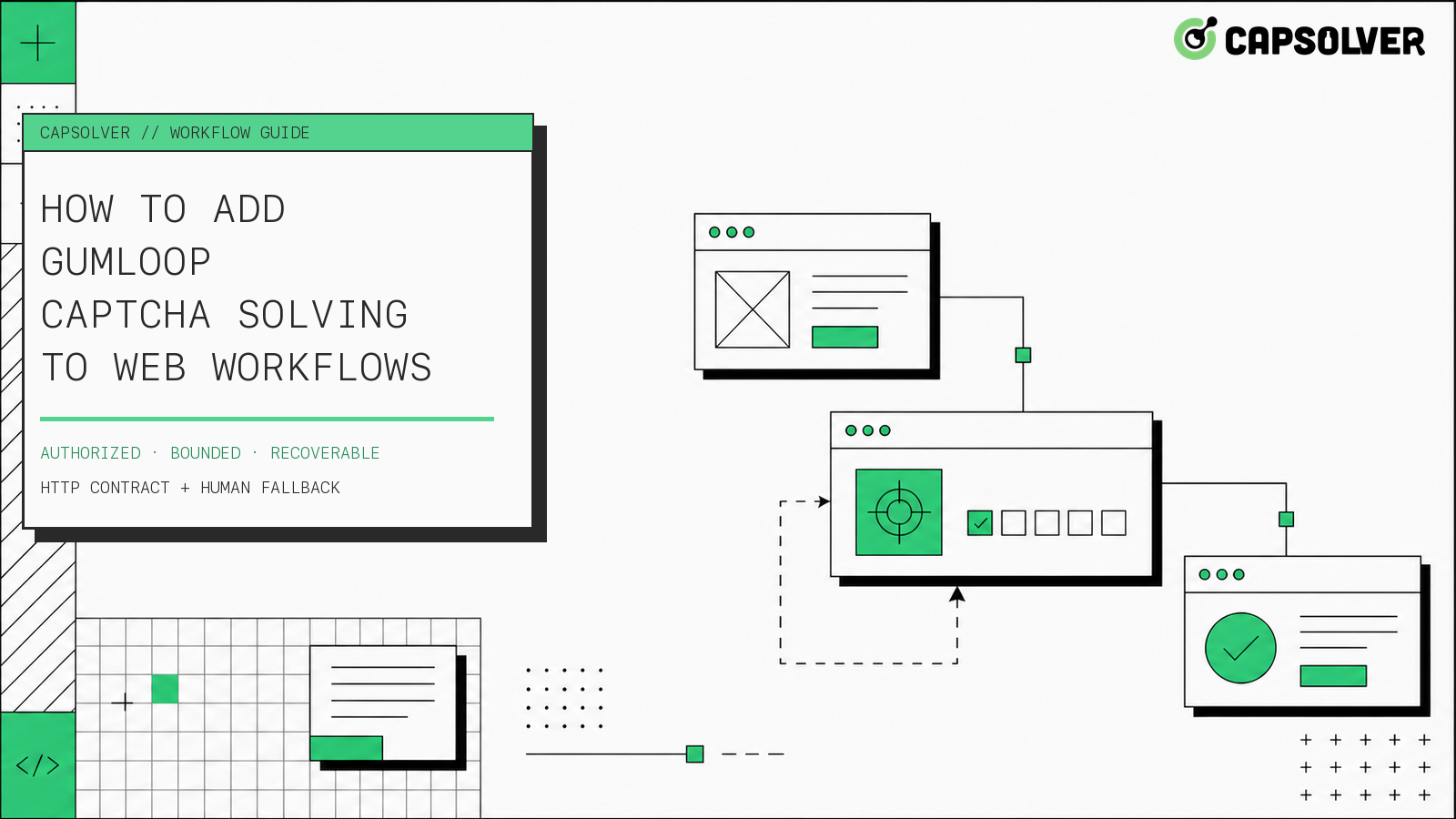
NO_CHALLENGE, RECOVERED, REVIEW, and STOP with deterministic rules, not an open-ended model decision.Gumloop CAPTCHA solving works best as a controlled recovery branch around an authorized browser task, not as an assumed native integration. Gumloop can orchestrate inputs, HTTP calls, routes, and error paths, while an external browser worker preserves the page session and applies a verified result. CapSolver can provide the documented CAPTCHA layer inside that worker. This separation matters because an API result alone does not prove that the original page advanced. The workflow must check the browser state, enforce a retry budget, and stop when authorization or session continuity is uncertain. The pattern below is for lawful, reasonable, responsible, user-authorized automation on systems and data you may access.
No official Gumloop–CapSolver native connector was verified during research for this guide. Gumloop CAPTCHA solving therefore needs an explicit prerequisite: your team must operate an HTTPS service that owns the authorized browser session and exposes a narrow recovery endpoint. This is not a Gumloop private API, a hidden node, or a claim that Gumloop officially integrates CapSolver.
The boundary follows capabilities documented for Gumloop. Its Call API node can send GET or POST requests to an HTTPS endpoint with headers and a request body. Its Input node contract can receive values from a user, webhook, or default. Those capabilities are enough to call a service your organization controls, but they do not create or preserve a browser session by themselves.
Prepare these components first:
If any component is missing, keep Gumloop CAPTCHA solving in design or test status. Do not substitute an unverified Gumloop node or place a production API key in ordinary workflow text.
A reliable Gumloop CAPTCHA solving design separates orchestration from browser execution. The Gumloop canvas should model the decision path; the browser worker should own challenge detection, CapSolver calls, result application, and page verification.
The workflow begins with a webhook or manual input containing an opaque run reference. Do not send cookies, passwords, raw HTML, or a browser-storage dump. A minimal event can look like this:
{
  "run_id": "run_01JX...",
  "session_ref": "browser_session_7f2a",
  "approved_host": "portal.example",
  "approved_action": "submit_owned_test_form",
  "observed_state": "CHALLENGE_DETECTED",
  "challenge_type": "recaptcha_v2",
  "attempt": 0
}
The input is a reference to an already approved execution. The output of this stage is either a valid recovery request or STOP. The workflow stops immediately if the host, action, or session reference is absent or outside policy.
Configure a Call API node to send a POST request to an organization-owned endpoint such as https://automation.example.net/v1/browser/recover. Use a managed credential for the service authorization header. The body should pass the bounded event fields, not the CapSolver API key.
{
  "run_id": "{{run_id}}",
  "session_ref": "{{session_ref}}",
  "approved_host": "{{approved_host}}",
  "approved_action": "{{approved_action}}",
  "challenge_type": "{{challenge_type}}",
  "attempt": "{{attempt}}",
  "max_attempts": 1
}
This JSON is a generic HTTP contract for your service. It is not a Gumloop export and not a CapSolver API request. Before implementation, confirm the exact variable interpolation and credential controls available in your Gumloop workspace.
The service should return a small response that Gumloop can route without seeing a raw solution value:
{
  "state": "RECOVERED",
  "run_id": "run_01JX...",
  "correlation_id": "recovery_91c8",
  "attempts_used": 1,
  "continuation_verified": true,
  "reason": "expected form step became visible"
}
Useful terminal responses are NO_CHALLENGE, RECOVERED, REVIEW, and STOP. A temporary service failure can return RETRYABLE_ERROR, but Gumloop should consume its one retry budget before calling again. Do not treat a missing state, unparseable body, or HTTP 200 with an unknown value as success.
Use the Gumloop Router's standard mode for exact state matching. Challenge recovery is a deterministic control problem, so it does not need model interpretation.
| State | Gumloop branch | Required action |
|---|---|---|
NO_CHALLENGE |
Continue | Resume only if the expected page state is already present |
RECOVERED |
Continue | Require continuation_verified=true |
RETRYABLE_ERROR |
Retry once | Increment the attempt counter, then stop if it repeats |
REVIEW |
Human queue | Preserve redacted evidence and end autonomous execution |
STOP |
Terminal | Close the run without another browser action |
| Unknown or empty | Terminal | Treat malformed output as STOP |
This table defines the output of Gumloop CAPTCHA solving, not the provider's internal task status. Provider state must be resolved inside the recovery service before a terminal response reaches the workflow.
Wrap the Call API node with Gumloop's Error Shield failure branch. Enable pass-through only for the non-secret input fields required to investigate a failed call. The error path should create a review record or send an alert; it should not automatically reconnect to the browser action.
Transport errors, provider errors, application rejection, and unsupported challenges require different evidence. Combining all four into one retry branch makes Gumloop CAPTCHA solving difficult to operate and can create repeated traffic after a terminal failure.
The recovery service is where official CapSolver fields belong. The createTask request accepts clientKey and a task object. The getTaskResult response uses errorId, status, and solution for asynchronous tasks. The official response states that a processing result can be queried again after three seconds.
The following Python example implements only the reCAPTCHA v2 adapter. It uses the documented ReCaptchaV2TaskProxyLess, websiteURL, and websiteKey fields from the reCAPTCHA v2 task definition. The browser-specific detection and application functions are placeholders owned by your worker; they are not Gumloop or CapSolver API methods.
import os
import time
import requests

CAPSOLVER_KEY = os.environ["CAPSOLVER_API_KEY"]
CREATE_TASK = "https://api.capsolver.com/createTask"
GET_RESULT = "https://api.capsolver.com/getTaskResult"
APPROVED_HOSTS = {"portal.example"}


def solve_recaptcha_v2(website_url: str, website_key: str) -> dict:
    created = requests.post(
        CREATE_TASK,
        json={
            "clientKey": CAPSOLVER_KEY,
            "task": {
                "type": "ReCaptchaV2TaskProxyLess",
                "websiteURL": website_url,
                "websiteKey": website_key,
            },
        },
        timeout=15,
    ).json()

    if created.get("errorId") or not created.get("taskId"):
        return {"state": "REVIEW", "reason": "task creation failed"}

    for _ in range(4):
        time.sleep(3)
        result = requests.post(
            GET_RESULT,
            json={"clientKey": CAPSOLVER_KEY, "taskId": created["taskId"]},
            timeout=15,
        ).json()

        if result.get("errorId"):
            return {"state": "REVIEW", "reason": "provider returned an error"}
        if result.get("status") == "ready":
            return {"state": "SOLUTION_READY", "solution": result["solution"]}
        if result.get("status") != "processing":
            return {"state": "REVIEW", "reason": "unexpected task status"}

    return {"state": "STOP", "reason": "poll budget exhausted"}


def recover_authorized_session(event: dict, browser_store) -> dict:
    if event.get("approved_host") not in APPROVED_HOSTS:
        return {"state": "STOP", "reason": "host outside approved scope"}
    if event.get("attempt", 0) >= event.get("max_attempts", 1):
        return {"state": "STOP", "reason": "attempt budget exhausted"}

    page = browser_store.get(event["session_ref"])
    if page is None:
        return {"state": "REVIEW", "reason": "browser session unavailable"}

    info = detect_supported_challenge(page)  # your verified browser adapter
    if info is None:
        return {"state": "NO_CHALLENGE"}
    if info["type"] != "recaptcha_v2":
        return {"state": "REVIEW", "reason": "adapter not configured"}

    solved = solve_recaptcha_v2(info["website_url"], info["website_key"])
    if solved["state"] != "SOLUTION_READY":
        return solved

    apply_solution_in_same_session(page, solved["solution"])
    if not verify_expected_transition(page, event["approved_action"]):
        return {"state": "REVIEW", "reason": "application did not advance"}

    return {"state": "RECOVERED", "continuation_verified": True}
The function input is an approved run event plus an opaque browser-session reference. Its output is a terminal state for Gumloop. It stops on an unapproved host, exhausted attempt budget, missing browser session, unsupported adapter, provider error, unexpected task status, poll-budget exhaustion, or failed application verification.
Do not reuse the v2 task object for other challenge types. Create separate adapters from the official reCAPTCHA v3 task guide and Cloudflare Turnstile task guide. Keep each adapter's required fields, returned solution, browser application logic, and validation assertion isolated.
Redeem Your CapSolver Bonus Code
Boost your automation budget instantly!
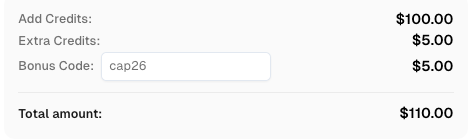
Use bonus code CAP26 when topping up your CapSolver account to get an extra 5% bonus on every recharge — with no limits.
Redeem it now in your CapSolver Dashboard
Session continuity is the decisive boundary in Gumloop CAPTCHA solving. A solution can be technically valid and still fail when it returns to a different page, cookie jar, user agent, proxy identity, route, or protected action.
The Gumloop workflow should pass an opaque session_ref; it should not rebuild browser state from copied fields. The recovery worker resolves that reference, confirms the current URL and challenge, applies the result in the same browser context, and checks a specific application assertion. Examples include a form step becoming visible, an owned QA route completing, or an expected public page element appearing.
Application verification must be stronger than “the HTTP call succeeded.” The adjacent n8n recovery diagnostic illustrates why workflow platforms need a separate post-recovery check. In Gumloop, model that check as part of the worker response and require continuation_verified=true before the success branch can run.
A good Gumloop CAPTCHA solving flow has two budgets: a provider poll budget inside the recovery service and a workflow retry budget in Gumloop. They solve different problems.
The provider poll budget controls how long the service waits for a task that is still processing. The workflow retry budget controls whether Gumloop can call the recovery service again after a temporary transport error. A sensible starting policy is one workflow recovery attempt and a small, timed provider polling loop. Tune those values only from observed authorized workloads.
Stop without retry when:
The workflow should record the stop reason, correlation ID, attempt count, and redacted target identifier. It should not store API keys, cookies, raw solution values, or unnecessary page content in routine logs.
Human fallback depends on which Gumloop surface you operate. For a standard workflow, route REVIEW to a notification, ticket, sheet, or other manual queue, then end the autonomous browser action. Do not claim that every workflow can pause indefinitely unless your own Gumloop plan and configuration prove it.
Gumloop separately documents human approval for agent tool calls. If the recovery action is exposed to a Gumloop agent as an approved tool, you can require approval before the tool call and let the agent resume after a decision. That is an agent-control option, not proof of a CapSolver connector and not a substitute for the recovery service's authorization checks.
An operator reviewing Gumloop CAPTCHA solving evidence should see:
Approval should permit one named action, not expand the run to a new host or data scope.
Validate Gumloop CAPTCHA solving with fixtures on a system you own or are authorized to test. The acceptance suite should cover both the Gumloop canvas and the browser worker.
NO_CHALLENGE event and confirm the workflow continues without calling the recovery endpoint.RECOVERED only after the application assertion passes.processing until the provider poll budget expires and confirm the service returns STOP.REVIEW.The final test evidence should answer four questions: Was the run authorized? Was the challenge adapter documented? Did the same browser session continue? Did the intended application state advance? A “yes” from the API call alone is not enough.
Gumloop CAPTCHA solving is reliable when Gumloop remains the orchestrator and an authorized browser service owns session-sensitive recovery. Use documented Input, Call API, Router, and Error Shield behavior; expose a small HTTP contract; keep retries bounded; verify the original page transition; and route uncertainty to review. Do not claim a native connector or copy browser state into the workflow. For approved web automation that needs documented reCAPTCHA v2/v3 or Cloudflare Turnstile handling behind these controls, evaluate CapSolver as the recovery component inside your service boundary.
No official native Gumloop–CapSolver connector was verified for this guide. The implementation uses Gumloop's documented HTTP and routing capabilities to call an organization-owned recovery service that integrates CapSolver.
The Call API node can send POST requests, but direct calls can expose provider credentials and still do not preserve or resume a browser session. A narrow server-side recovery service is the safer operational boundary because it stores the key, owns the session, applies the result, and returns only a verified state.
For this agent-oriented pattern, configure separate documented adapters for reCAPTCHA v2, reCAPTCHA v3 including Enterprise where applicable, and Cloudflare Turnstile. Do not reuse fields across task types or treat an unsupported type as a retryable error.
Start with one workflow recovery attempt. Keep provider polling inside the recovery service with its own time and query budget. Stop when the challenge repeats, session continuity is lost, the provider returns an error, or application verification fails.
Use human review when authorization is unclear, the browser session is missing, the challenge type is unsupported, the response is malformed, the attempt budget is exhausted, or the expected page transition does not occur. Review must not expand the approved host, action, or data scope.
Nikolai Smirnov
Software Development Lead
Building dependable software for complex automation.
ABOUT THE AUTHOR
Fix common Selenium CAPTCHA integration problems by checking test configuration, extensions, waits, iframe context, solver responses, and application results.
Choose the CapSolver Python Core SDK or direct HTTP API by task support, page access, response handling, and the responsibilities your application owns.