SERP Data Collection: A Production Readiness Checklist

Lucas Mitchell
Automation Engineer
TL;DR
- A SERP data collection production checklist should define the permitted source, query context, result types and release criteria before increasing volume.
- Organic position and position among all visible page elements are different measurements and need explicit field definitions.
- Validate an entire snapshot before replacing the last accepted version in a reporting store.
- Replaying the same snapshot should not create duplicate rows or erase valid data when the replacement fails validation.
- The Python example loads synthetic organic results into SQLite and rejects malformed batches; it does not collect live search results.
A search-results pipeline can produce a plausible chart while silently loading advertisements as organic results or replacing yesterday's data with an empty response. Successful collection is only the beginning of the job. The reporting system also needs a defined observation context and a decision about which responses are safe to publish.
This SERP data collection production checklist follows the path from a permitted source to an accepted snapshot. It gives each stage an input, output and failure boundary, then demonstrates the validation-to-storage transition with local Python. CapSolver has a role only when an authorized browser collection step encounters a supported CAPTCHA checkpoint. It does not provide the search dataset in this architecture or determine whether a returned row is an organic result.
What must be decided before collecting data?
The collection plan must identify a permitted source and a stable definition of the search context.
Start with the interface, licensed dataset or authorized workflow your team can use. Record the search engine or source, query, locale, device class, timestamp policy and requested depth. Assign an owner to changes in those fields. A new locale or device should not silently enter a time series built with different settings.
The Robots Exclusion Protocol describes crawler instructions and explicitly separates them from access authorization. Use the applicable source agreement and permission boundary when deciding what to collect. A publicly visible page or an allowed robots path is not a complete permission record for every use.
Record the observation key once
Use a stable cohort reference for the chosen query settings and a separate snapshot ID for a collection event. The fixture uses demo-cohort-run-1 as a synthetic snapshot identifier. A production adapter must generate and retain the actual context rather than accepting a caller-supplied label as proof of consistency.
Store source and parser versions with the snapshot envelope. Keep a reference to a permitted source response when retention allows it. Those fields let a reviewer distinguish changed search output from changed parsing logic.
How should a parser separate organic results from page layout?
The parser should map each source result to a documented result type before assigning an organic rank.
Google's search visual elements gallery describes different result presentations. A page is not a flat list of interchangeable links. Decide whether the dataset includes only organic text results or also images, videos, advertisements and other modules, then retain those categories separately.
For an organic-only series, define rank as the position within that selected sequence. If your source provides an absolute position across page elements, store that as another field. Do not rename it organic rank without a documented transformation. This distinction must be visible to the dashboard owner as well as the parser author.
Prefer an explicit unsupported state to a guessed mapping
When a source introduces a result type the adapter does not recognize, keep the original type and route the snapshot for review according to the contract. A guess that turns a paid result into rank one can create a false trend with no obvious transport error.
Maintain a small approved set of representative responses for parser tests. Include an ordinary organic list, a mixed-layout response, a missing-field response and an explicitly empty valid result. Use synthetic or properly retained source fixtures; do not place unrelated personal snippets in a public test repository.
Redeem Your CapSolver Bonus Code
Boost your automation budget instantly!
Use bonus code CAP26 when topping up your CapSolver account to get an extra 5% bonus on every recharge — with no limits.
Redeem it now in your CapSolver Dashboard
Which checks should control the release of a snapshot?
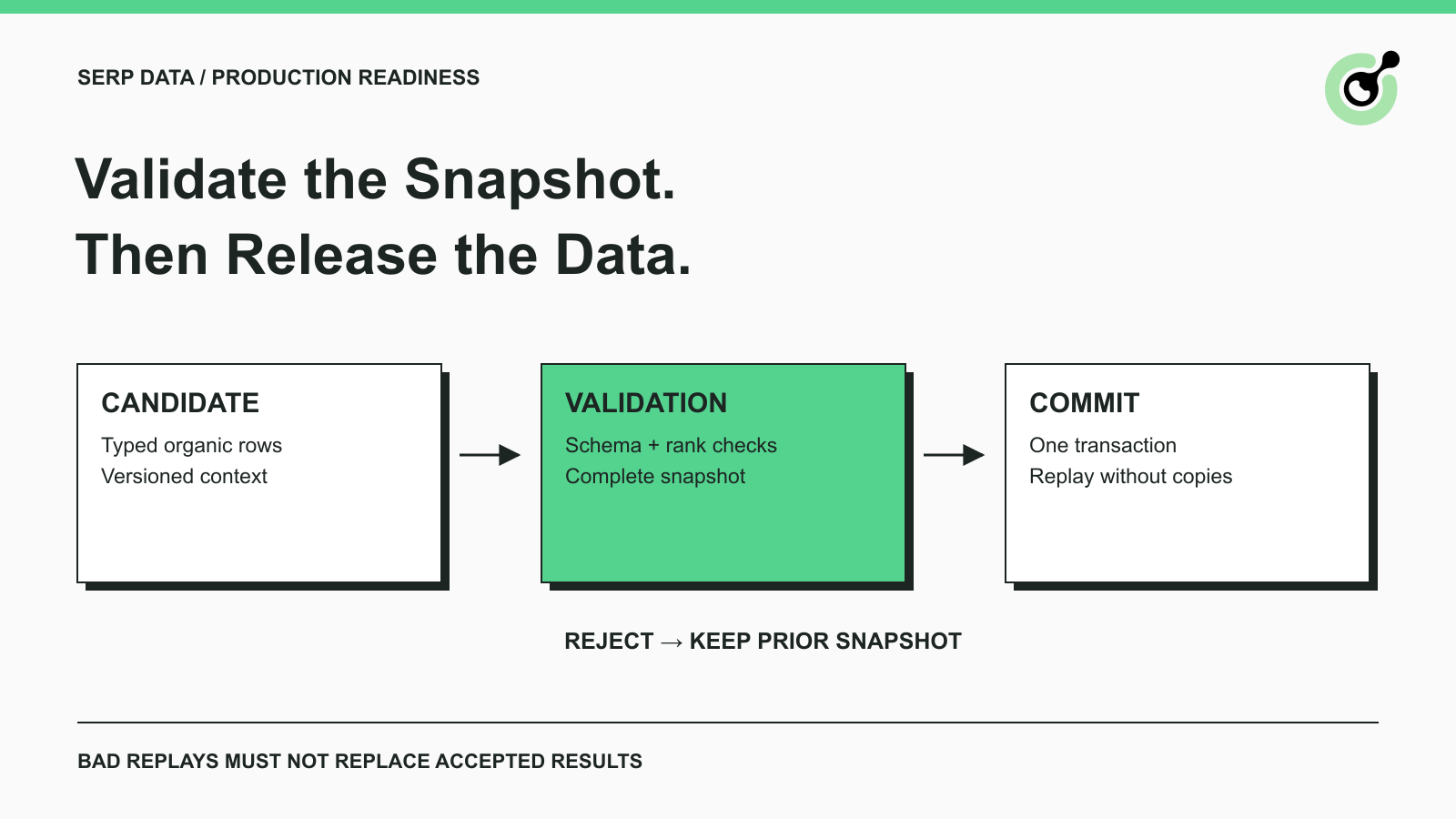
Snapshot release should depend on schema validity, consistent context and an explicit interpretation of empty or incomplete responses.
Use this checklist as a review contract, with thresholds chosen for the actual source rather than copied as universal SEO limits.
| Stage | Input and operation | Output | Stop or quarantine condition |
|---|---|---|---|
| Collection | Permitted source plus fixed query context | Response and source reference | Access refusal, rate limit or incomplete response |
| Parsing | Response plus versioned parser | Typed result rows | Unknown layout or unsupported result type |
| Validation | Rows plus snapshot contract | Accepted candidate snapshot | Duplicate rank, invalid URL or missing required field |
| Storage | Entire validated snapshot | Committed snapshot version | Database error or conflicting writer |
| Reporting | Committed snapshots of comparable cohorts | Report with freshness context | Stale data or incompatible observation settings |
A rate limit should remain a collection outcome; it must not become an empty organic list. A genuine empty result needs its own accepted representation. The compact code below deliberately rejects empty input so the adapter cannot confuse those two cases.
How can you prevent a bad replay from replacing good data?
Validate the complete candidate before changing the stored snapshot, then commit the replacement in one transaction.
Save the following as serp_gate.py and run it with Python 3.11 or later. It uses the standard library and an in-memory SQLite database. The rows are synthetic and contain only example-domain URLs. No search provider, browser or CAPTCHA service is called.
python
import json, sqlite3
from urllib.parse import urlsplit

def load_snapshot(db, snapshot, rows):
    if not isinstance(snapshot, str) or not snapshot:
        raise ValueError('snapshot ID required')
    if not rows:
        raise ValueError('empty response needs explicit review')
    ranks = []
    for row in rows:
        url = urlsplit(row['url'])
        if row['kind'] != 'organic' or type(row['rank']) is not int or row['rank'] < 1:
            raise ValueError('invalid organic result')
        if url.scheme not in {'http', 'https'} or not url.hostname:
            raise ValueError('invalid result URL')
        if url.username or url.password or not row['title'].strip():
            raise ValueError('unsafe URL or missing title')
        ranks.append(row['rank'])
    if len(set(ranks)) != len(ranks):
        raise ValueError('duplicate organic rank')
    # Replace one complete validated snapshot in one database transaction.
    with db:
        db.execute('DELETE FROM results WHERE snapshot=?', (snapshot,))
        db.executemany('INSERT INTO results VALUES (?,?,?,?)',
            [(snapshot, r['rank'], r['url'], r['title']) for r in rows])

db = sqlite3.connect(':memory:')
db.execute('''CREATE TABLE results (
    snapshot TEXT, rank INTEGER, url TEXT, title TEXT,
    PRIMARY KEY (snapshot, rank))''')
rows = [dict(kind='organic', rank=1, url='https://example.com/a', title='Demo A'),
        dict(kind='organic', rank=2, url='https://example.com/b', title='Demo B')]
load_snapshot(db, 'demo-cohort-run-1', rows)
load_snapshot(db, 'demo-cohort-run-1', rows)
assert db.execute('SELECT COUNT(*) FROM results').fetchone()[0] == 2
rejected = 0
for bad in [[], rows + [rows[0]], [dict(rows[0], kind='ad')],
            [dict(rows[0], rank=True)], [dict(rows[0], url='javascript:alert(1)')]]:
    try:
        load_snapshot(db, 'demo-cohort-run-1', bad)
    except ValueError:
        rejected += 1
    else:
        raise AssertionError('invalid batch accepted')
    assert db.execute('SELECT COUNT(*) FROM results').fetchone()[0] == 2
print(json.dumps({'stored_rows':2, 'rejected_batches':rejected, 'replay_duplicates':0}))
db.close()
The executed example keeps two stored rows after replay and rejects five invalid candidate batches. The original rows remain after each rejection. The zero duplicate count applies to replaying the same snapshot ID in this fixture; it does not establish deduplication across independently assigned IDs.
SQLite's transaction documentation explains the database boundary used for the replacement. The local test uses one writer. Production systems still need a policy for concurrent writers, stale versions and two workers that assign different IDs to the same collection event.
Expand the contract before using a real source
The fixture validates a small normalized schema. It does not verify the source's location, timestamp, language, requested depth or parser provenance; those fields belong in the production snapshot envelope. It also does not guarantee that a syntactically valid URL points to the expected business or page.
Add source-specific checks and keep a rejected candidate outside the reporting table. Record a reason and a source reference in a restricted quarantine store, with a retention policy appropriate to the data. An operator should be able to restore the last accepted snapshot without rerunning an external collection.
Where should CAPTCHA handling sit in the pipeline?
CAPTCHA handling should sit inside a permitted collection step and return a collection outcome to the pipeline controller.
Use the CapSolver MCP documentation to check the supported interface when a browser workflow needs that capability. After a result is consumed, verify that the intended source response was obtained before passing anything to the parser. A successful handling step does not establish the completeness or accuracy of the resulting dataset.
The local rank observation guide addresses a related but different reporting question: how to preserve missing observations across a geographic grid. This checklist focuses on the release boundary between a candidate response and a stored SERP snapshot.
Use the AI and automation FAQ to clarify product scope. Keep account secrets, browser state and challenge tokens out of the normalized result table.
How should the team approve production rollout?
The team should approve rollout only after the source adapter and reporting owner can explain both accepted and quarantined snapshots.
Run a limited canary workload with fixed context. Check that replay does not inflate row counts, invalid replacements leave the prior snapshot available, and a parser change creates a reviewable version boundary. Define a pause condition for unexpected schema failures and an owner who can inspect the retained evidence. Capacity increases should follow those checks instead of hiding failures in a larger volume of successful rows.
Use CapSolver where a documented verification step is required, then make the data contract decide what reaches the report. That separation gives collection engineers and analysts a shared answer to a practical question: which observation was accepted, and why was it accepted?
FAQ
Q: Is organic rank the same as absolute page position?
Not necessarily. Organic rank counts within the defined organic sequence, while absolute position may include other page elements. Preserve the source definition and label both fields clearly.
Q: Should an empty response replace the last successful snapshot?
Only when the adapter has established that it represents a valid empty result under the contract. A failed or incomplete response should remain a separate collection outcome.
Q: Does the example collect live Google results?
No. It validates and stores synthetic organic rows. A production system still needs a permitted source and a tested adapter for that source's format.
Q: What does replay safety mean in this example?
Loading the same accepted snapshot ID again leaves one set of rows, while a rejected replacement leaves the prior data intact. Cross-job identity and concurrent writers require additional controls.
More
Web ScrapingApr 22, 2026
Rust Web Scraping Architecture for Scalable Data Extraction
Learn scalable Rust web scraping architecture with reqwest, scraper, async scraping, headless browser scraping, proxy rotation, and compliant CAPTCHA handling.
Web ScrapingApr 17, 2026
How to Scrape Job Listings Without Getting Blocked
Learn the best techniques to scrape job listings without getting blocked. Master Indeed scraping, Google Jobs API, and web scraping API with CapSolver.